Home Improvement Project Planner
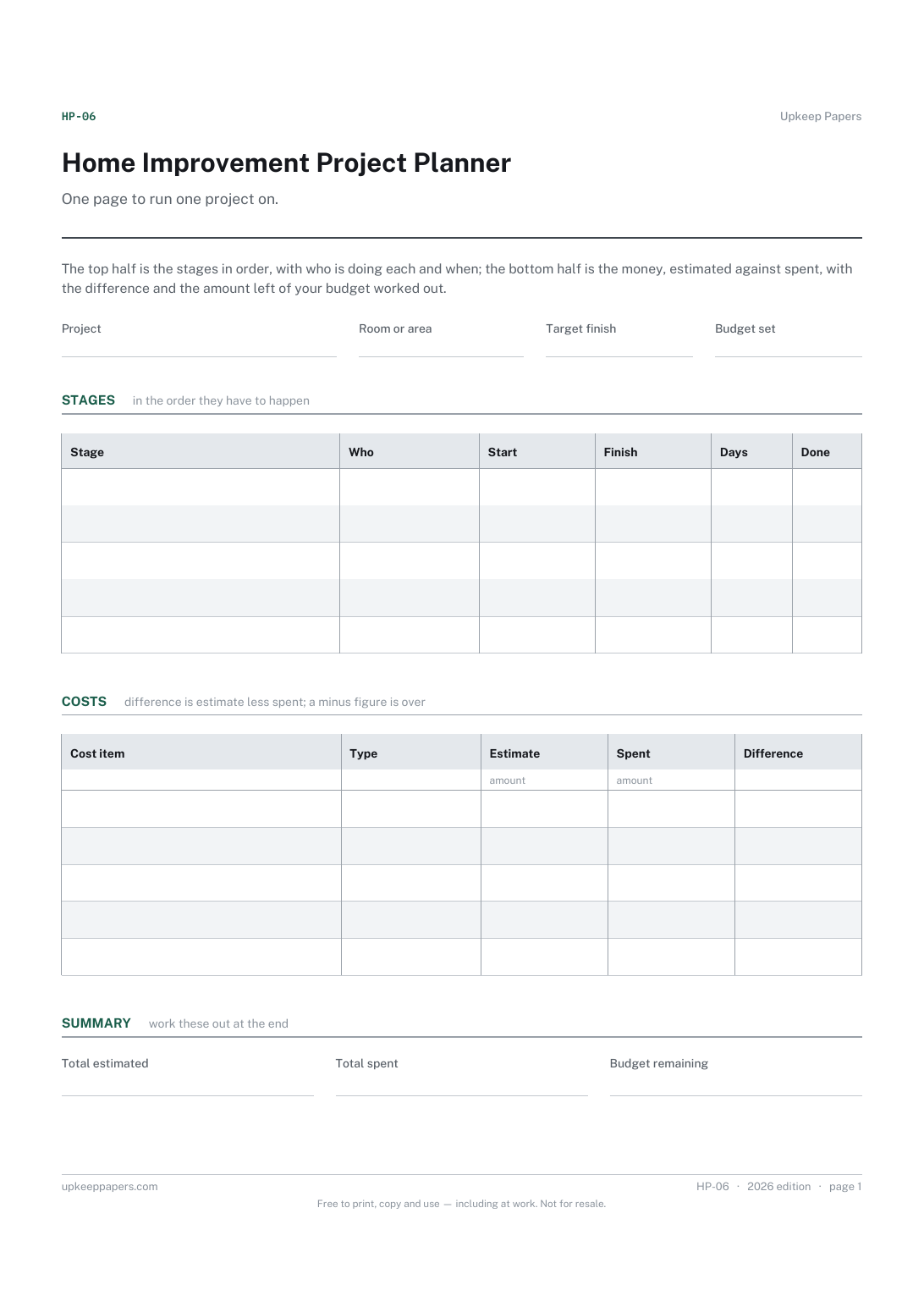
The stages of the job in order, with start and finish dates and how long each took.
HP-06 Planner PDF Excel Online
Everything here is free. Making it takes time and money. Everything here is free.
 Buy us a coffee
Renovation and DIY Projects · RD-1074 · Planner
Free ageing-in-place planner: difficulties noticed room by room, the adaptation for each, priority, cost, funding and your share. Excel, PDF and browser.
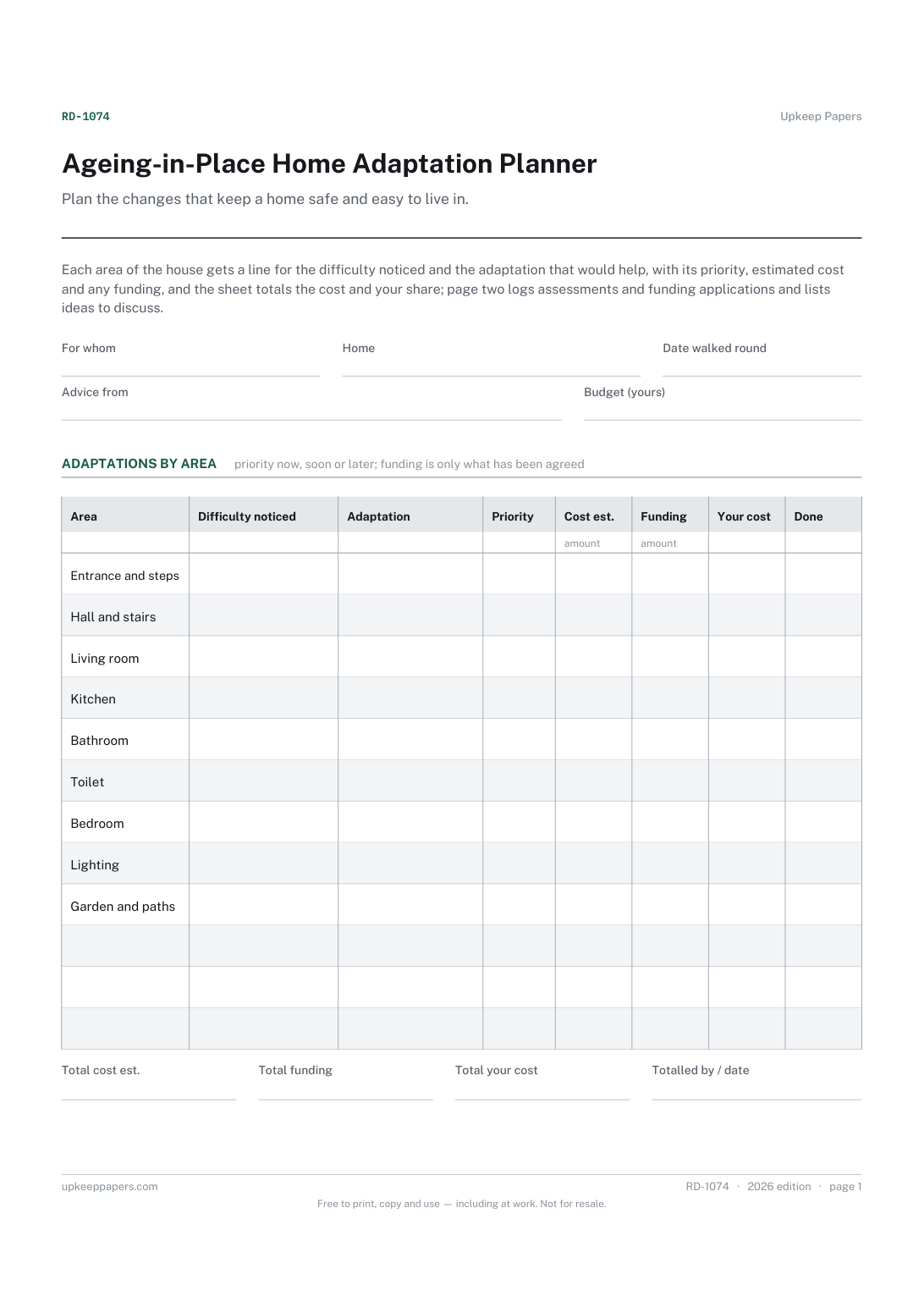
2 pages. The A4 and US Letter files are laid out identically, so neither is shrunk to fit.
Print it and write on it
Fillable PDF type and save
Spreadsheet formulas included
The fillable versions have real form fields — open them in any PDF reader, type into them and save. Printing help.
The same sheet, on screen. Totals and figures are worked out as you type, rows can be added or removed, and you can print it or download the completed version as a PDF. Everything stays in your browser — your entries are kept in this browser's own storage on this device, nothing is uploaded, and there is no account.
Plan the changes that keep a home safe and easy to live in. Each area of the house gets a line for the difficulty noticed and the adaptation that would help, with its priority, estimated cost and any funding, and the sheet totals the cost and your share; page two logs assessments and funding applications and lists ideas to discuss.
Older people planning to stay in their own home, family members helping a parent, and anyone adapting a home after an illness, an injury or a change in mobility.
The printable is laid out inside a box that fits both A4 and US Letter, so the two files are identical and neither one is scaled. The fillable PDF has real form fields. The workbook uses plain formulas only — SUM, IF, COUNTIF and the like — so it opens in Excel, LibreOffice and Google Sheets without anything breaking, and every calculated cell is grey so you can see which figures it worked out.
Download the A4 or US Letter file to match the paper in your printer, open it in a PDF reader and print at 100% — not "fit to page", which shrinks the writing space. Both files leave a 14 mm margin, which clears the unprintable edge on home printers. To print the online version with your entries in it, use the Print this sheet button, which prints only the sheet and none of the page around it. More on printing.
An occupational therapist can assess what would help, and in many places that assessment is arranged through the local council or health service. Write who advised at the top so later decisions can refer back to it.
In some places grants or other help exist, often after an assessment, and who qualifies differs. Check with your local council, health service or a housing advice body where you live, and enter only amounts actually agreed.
Now, soon and later are your own judgement, made with the person who lives there and anyone advising them. Write the reason in the difficulty column so the order still makes sense when you look back.
Every home and every person is different, so the table starts with the places to look rather than answers. The ideas on page two are prompts; copy into the table only the ones that fit.
The stages of the job in order, with start and finish dates and how long each took.
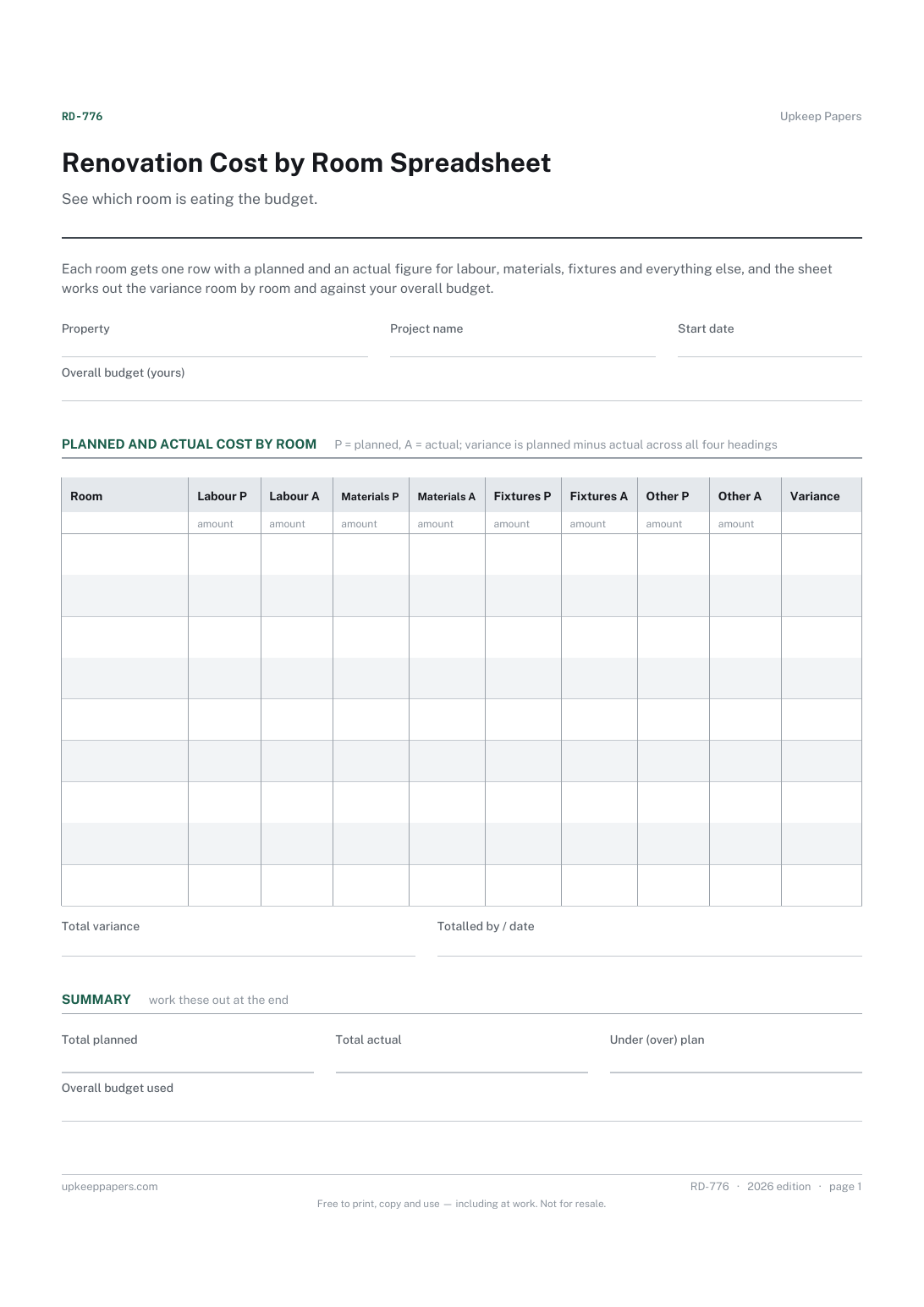
A planned figure for every room, split into labour, materials, fixtures and other.
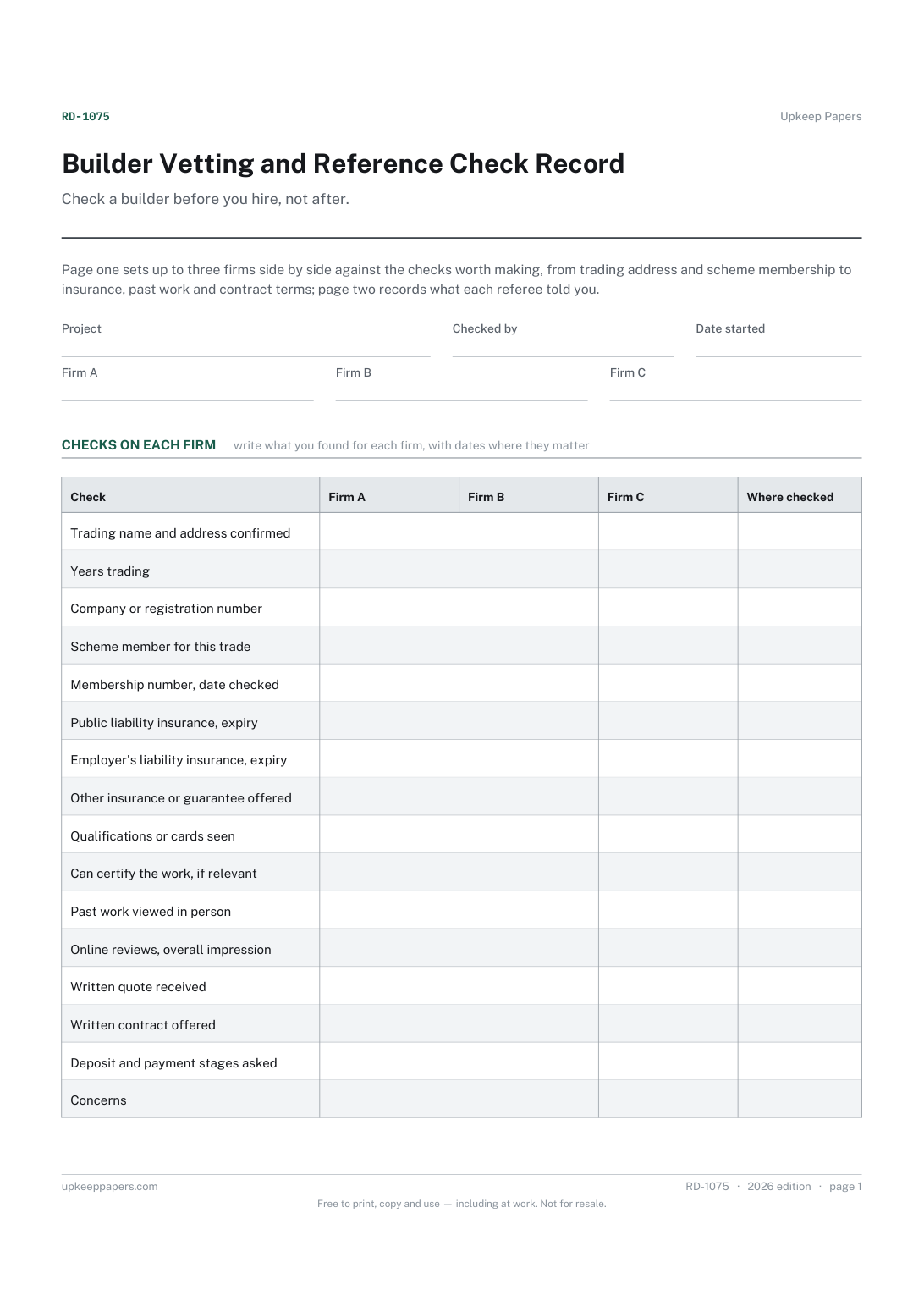
The checks made on each firm, and where and when you made them.
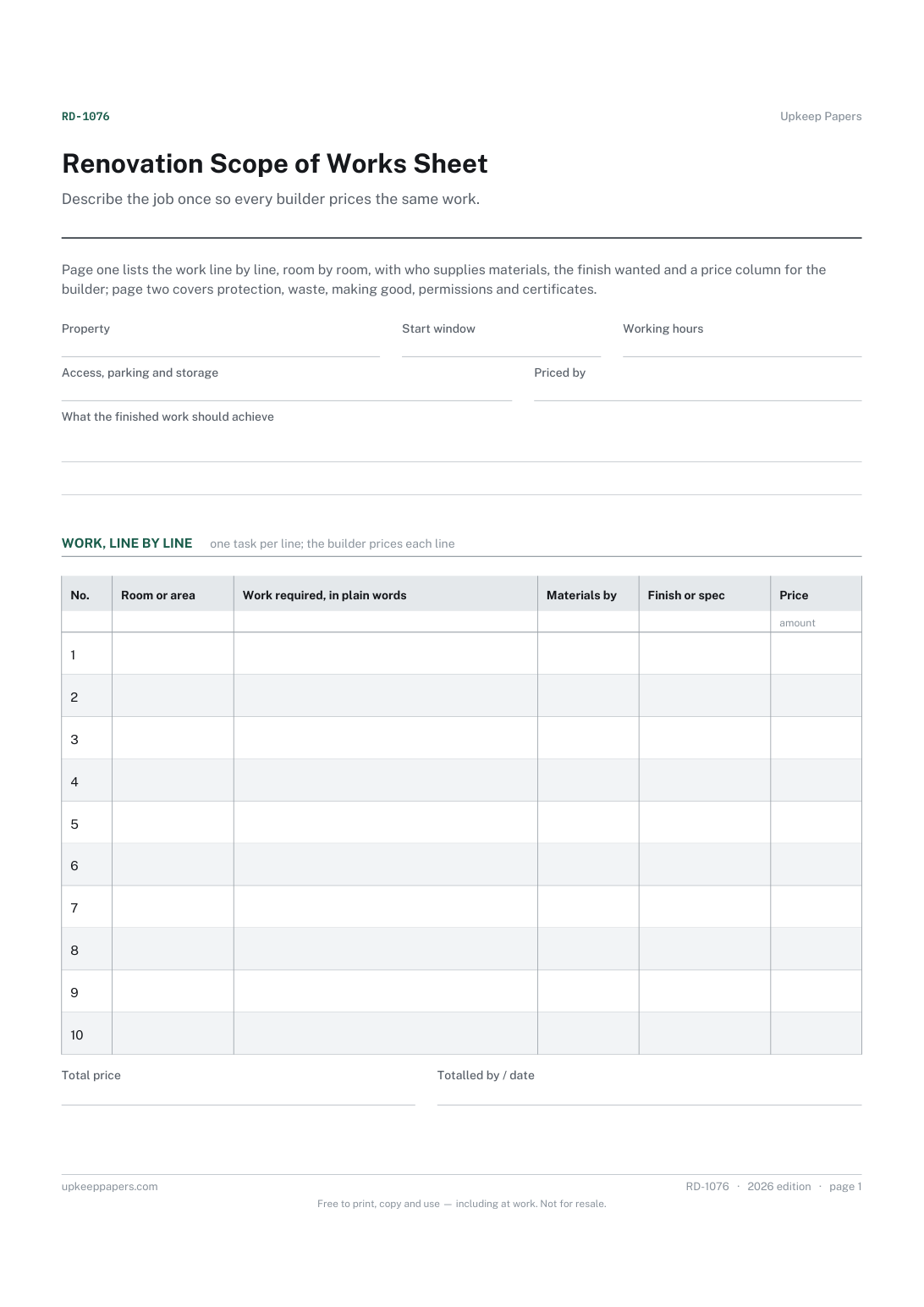
Every piece of work, numbered, so quotes and questions can refer to it.
Printable sheets, workbooks and tools on the same subject.
A room-by-room build budget holding quoted against actual, with the variance on every line and a contingency you set yourself.

Every sheet, binder, game and puzzle on Upkeep Papers is free to download, with no email and no account. Making them is not free: each one takes days of research, design and checking, and the site costs money to run. If something here saved you time, you can buy us a coffee. It is entirely optional: nothing is locked, and nothing changes if you don’t.
Buy us a coffee Opens PayPal in a new tab. Any amount, and nothing changes if you would rather not.