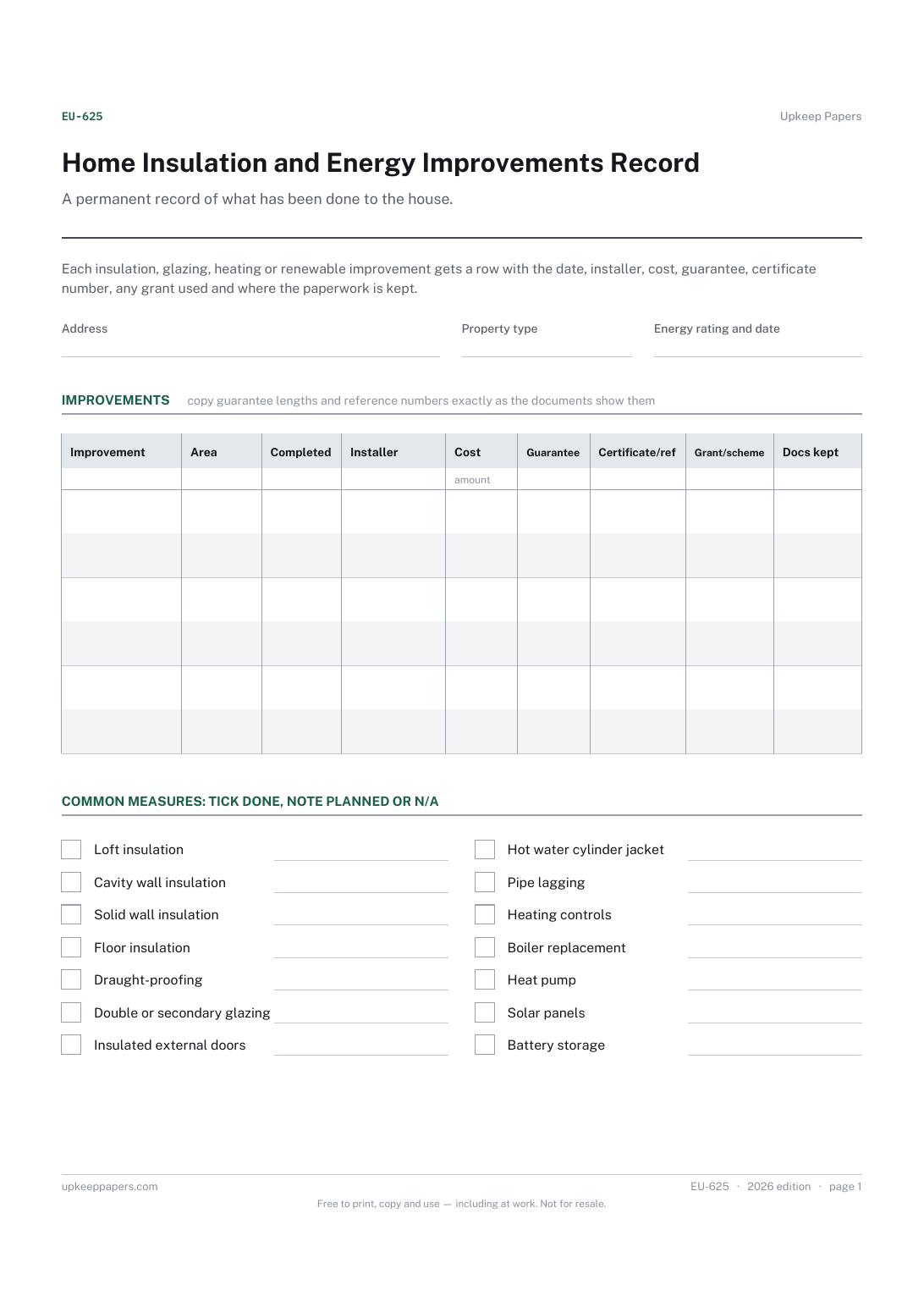
Home Insulation and Energy Improvements Record
What was done, where in the house and when.
EU-625 Record PDF Online
Everything here is free. Making it takes time and money. Everything here is free.
 Buy us a coffee
Renovation and DIY Projects · RD-1083 · Form
Free loft insulation calculator: net loft area, rolls or packs for each layer from the coverage on the packet, depth reached and cost. Excel, PDF and browser.
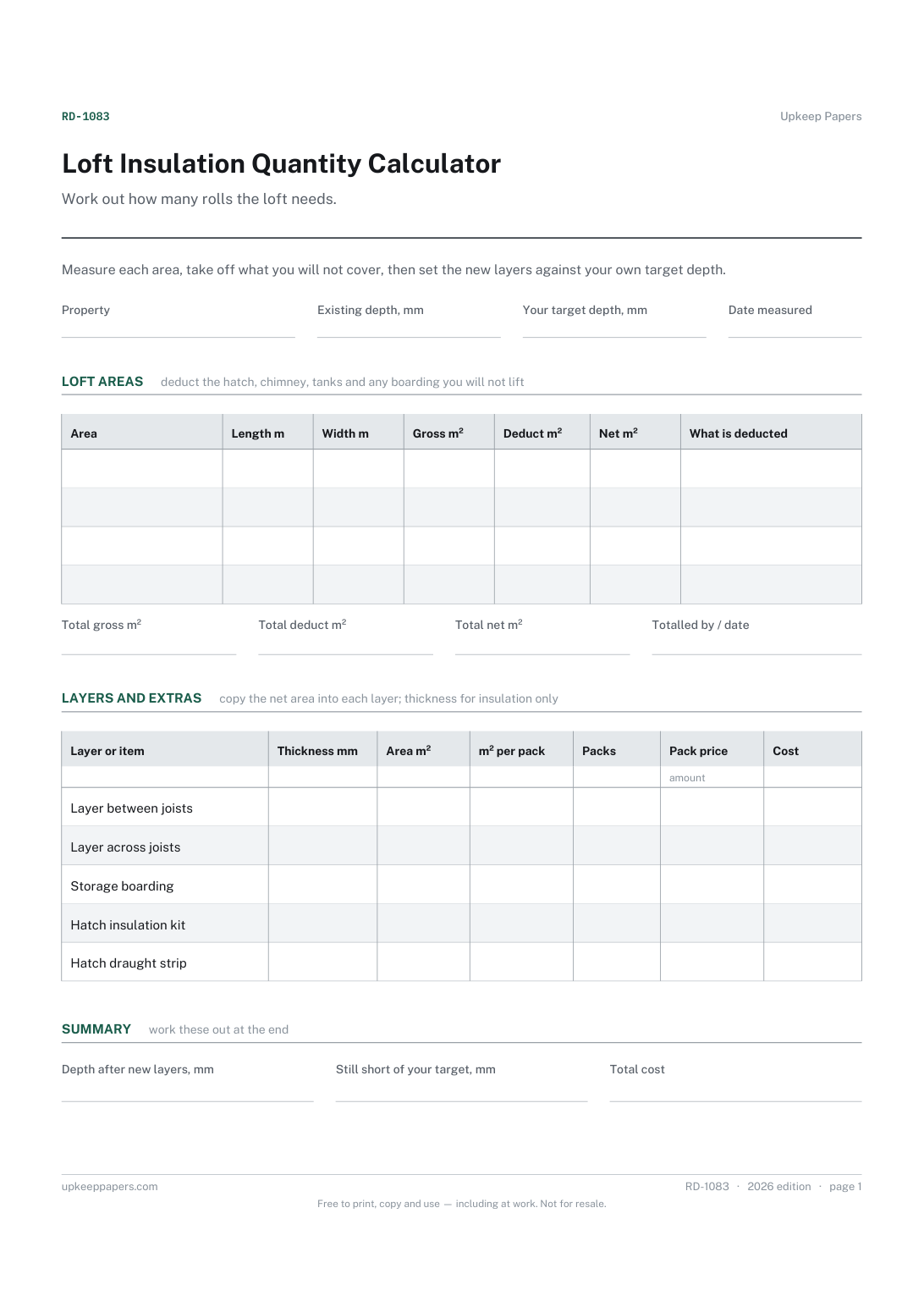
One page. The A4 and US Letter files are laid out identically, so neither is shrunk to fit.
Print it and write on it
Fillable PDF type and save
Spreadsheet formulas included
The fillable versions have real form fields — open them in any PDF reader, type into them and save. Printing help.
The same sheet, on screen. Totals and figures are worked out as you type, rows can be added or removed, and you can print it or download the completed version as a PDF. Everything stays in your browser — your entries are kept in this browser's own storage on this device, nothing is uploaded, and there is no account.
Work out how many rolls the loft needs. Measure each area, take off what you will not cover, then set the new layers against your own target depth.
Homeowners topping up or laying loft insulation themselves, and anyone checking an installer's quantity or a grant scheme's quote against their own measurements.
The printable is laid out inside a box that fits both A4 and US Letter, so the two files are identical and neither one is scaled. The fillable PDF has real form fields. The workbook uses plain formulas only — SUM, IF, COUNTIF and the like — so it opens in Excel, LibreOffice and Google Sheets without anything breaking, and every calculated cell is grey so you can see which figures it worked out.
Download the A4 or US Letter file to match the paper in your printer, open it in a PDF reader and print at 100% — not "fit to page", which shrinks the writing space. Both files leave a 14 mm margin, which clears the unprintable edge on home printers. To print the online version with your entries in it, use the Print this sheet button, which prints only the sheet and none of the page around it. More on printing.
The sheet does not say. The right depth depends on the material, where you live and any rules or grant conditions that apply, so enter your own target from official guidance, your installer or the scheme you are using.
Push a ruler down through the insulation to the ceiling below in a few places and use a typical reading. Write the lowest reading in the notes if the depth varies a lot across the loft.
Each layer covers the same floor, so each needs its own rolls. Laying one layer between the joists and another across them means two rows with the same area but different thicknesses and coverage.
The thickness of each insulation layer, from the packet. Leave it blank for boarding, hatch kits and draught strip, so the depth reached adds up insulation only.
What was done, where in the house and when.
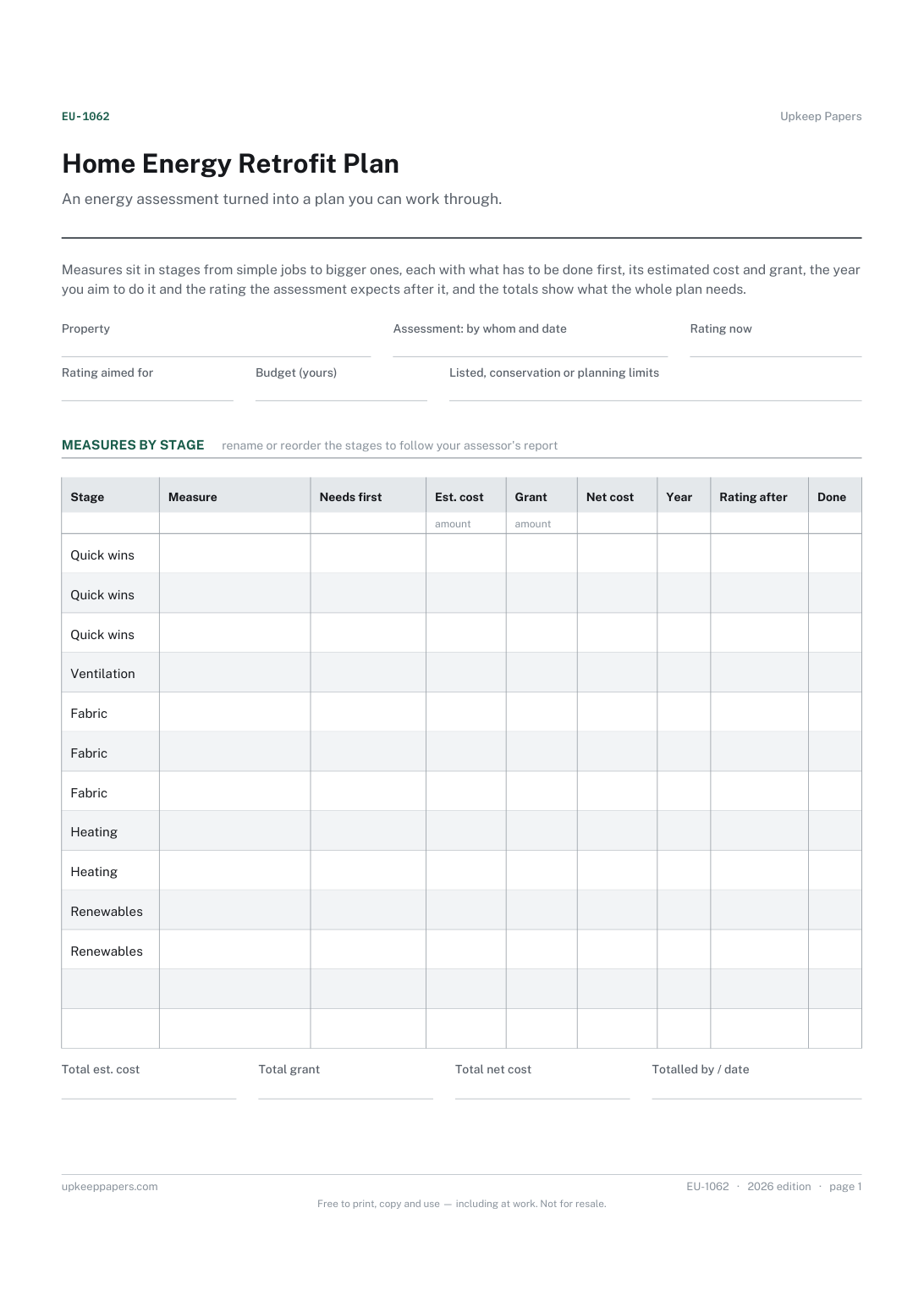
Every measure from the assessment, grouped in stages.
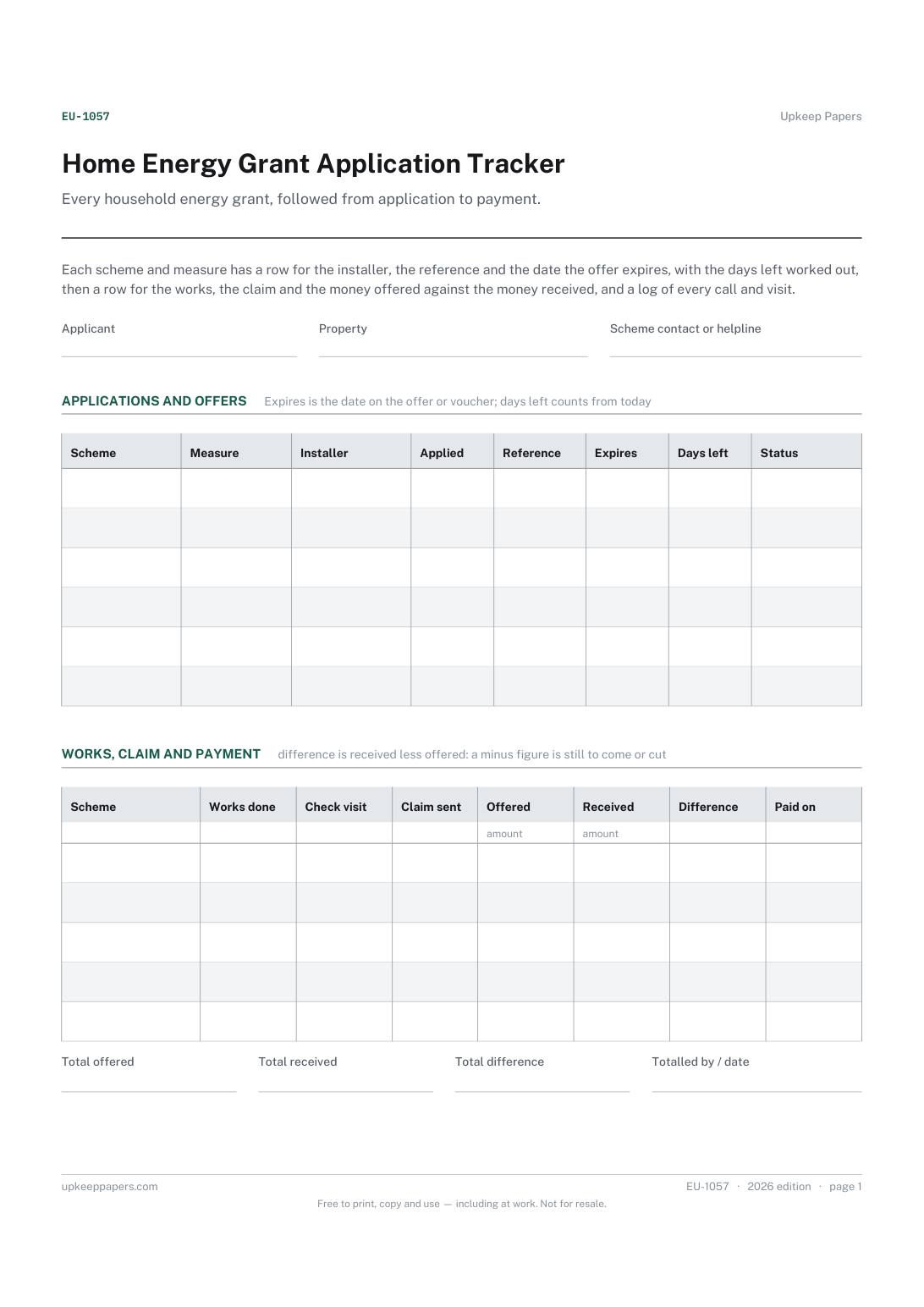
Each scheme, the measure it covers and the installer doing the work.
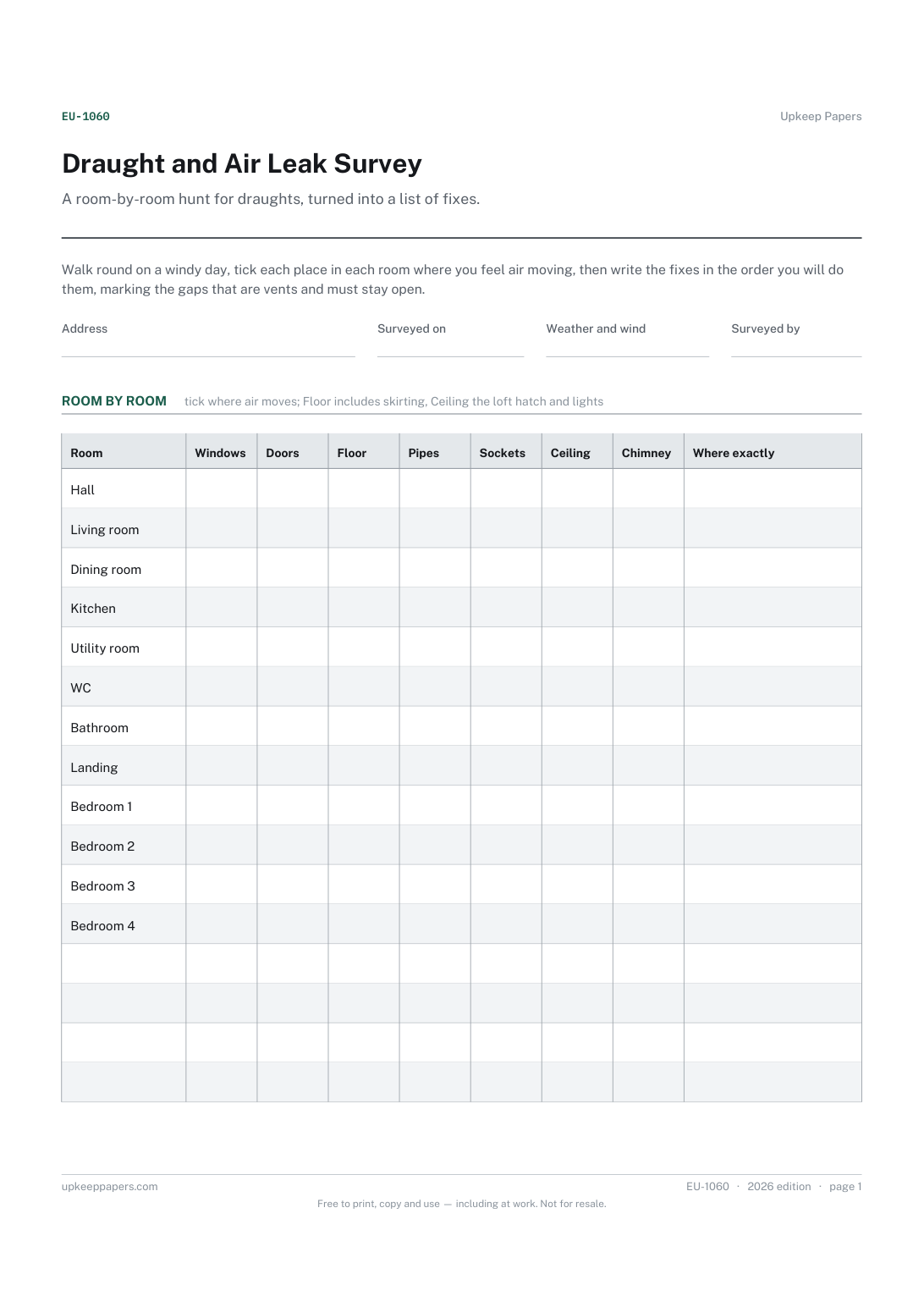
Every room checked at windows, doors, floors, pipes, sockets and ceilings.
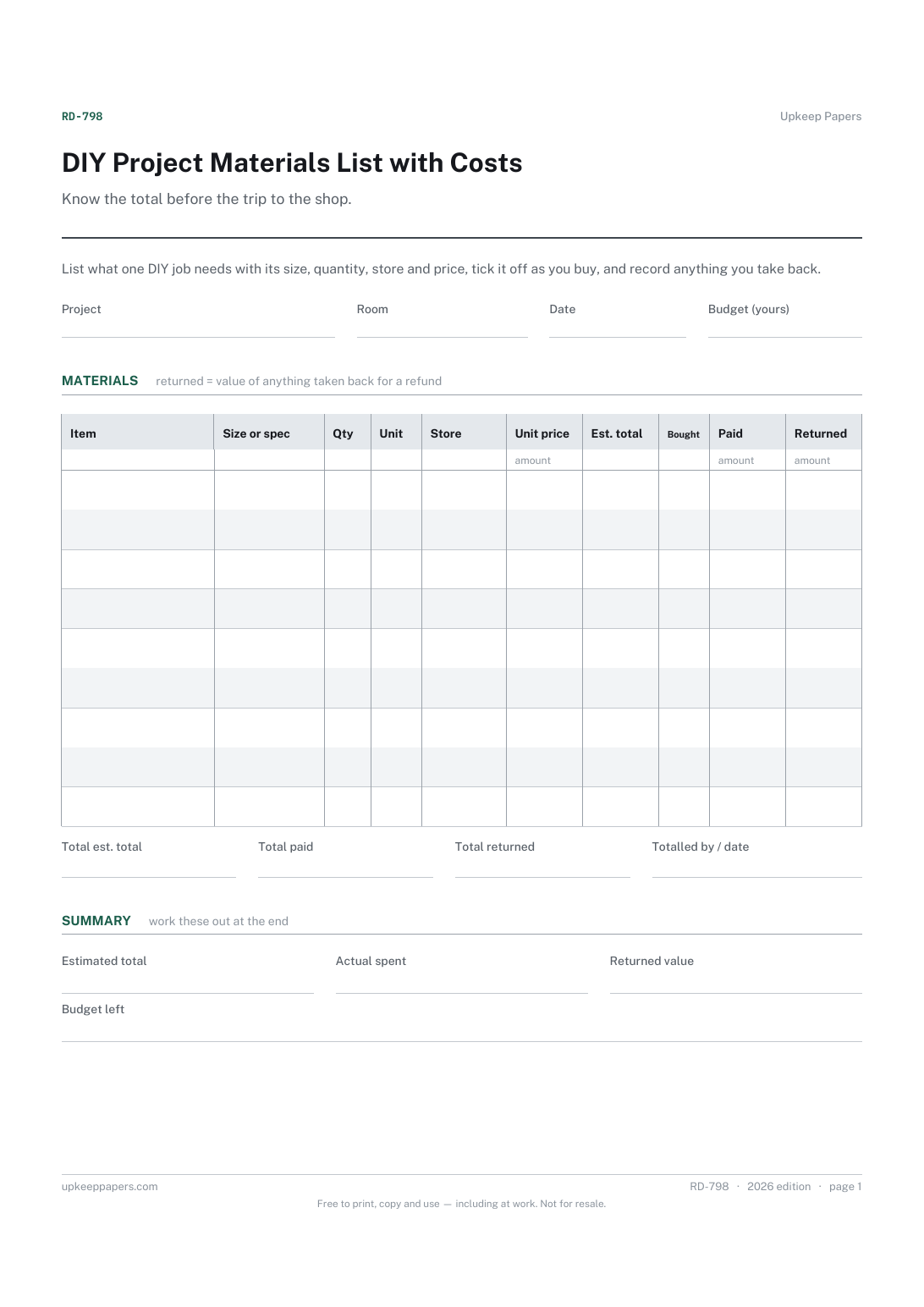
Every item the job needs, with its size or specification.

Every sheet, binder, game and puzzle on Upkeep Papers is free to download, with no email and no account. Making them is not free: each one takes days of research, design and checking, and the site costs money to run. If something here saved you time, you can buy us a coffee. It is entirely optional: nothing is locked, and nothing changes if you don’t.
Buy us a coffee Opens PayPal in a new tab. Any amount, and nothing changes if you would rather not.