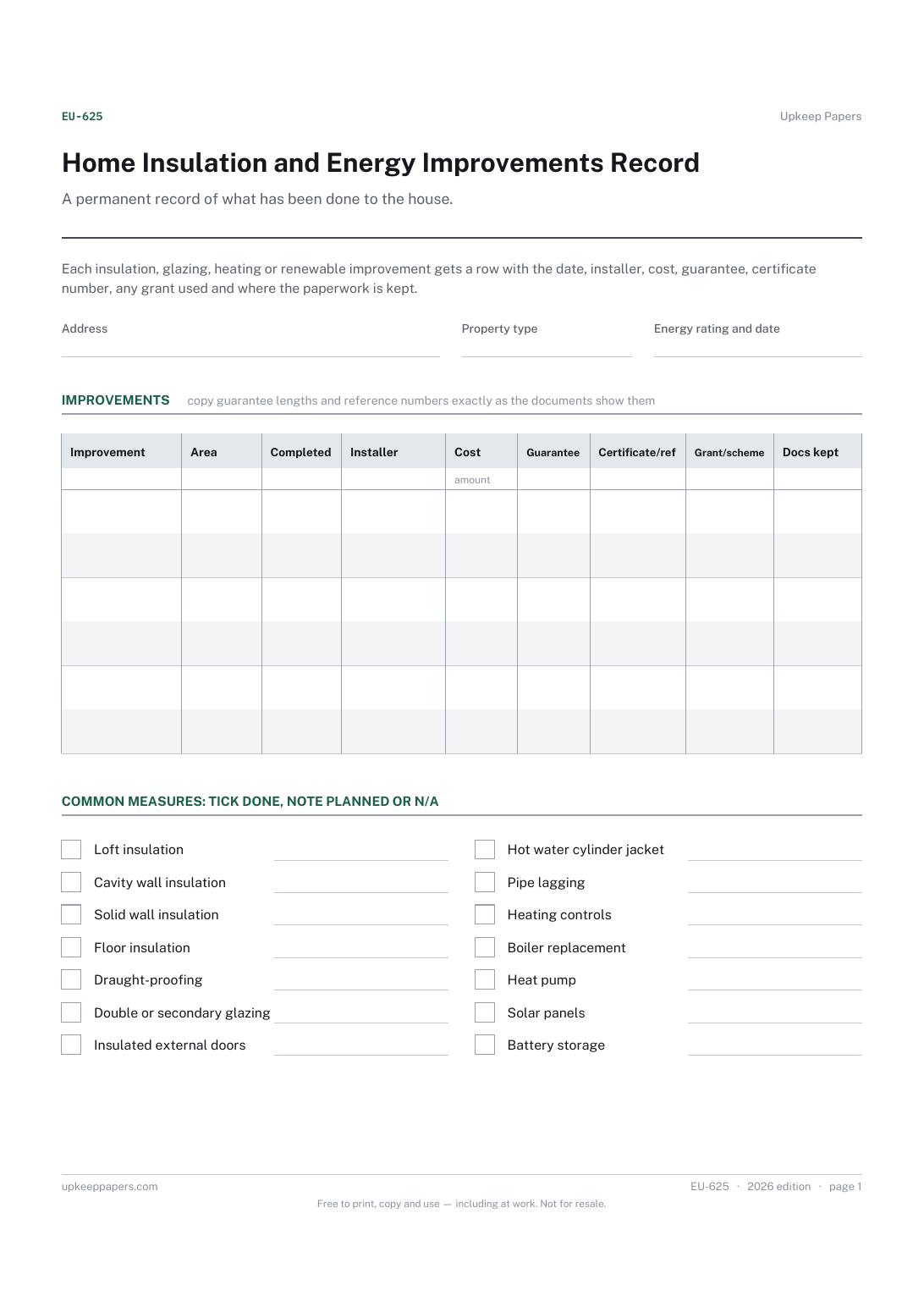
Home Insulation and Energy Improvements Record
What was done, where in the house and when.
EU-625 Record PDF Online
Everything here is free. Making it takes time and money. Everything here is free.
 Buy us a coffee
Energy and Utilities · EU-1062 · Planner
Home energy retrofit plan: measures in stages with what must come first, cost, grant, net cost, target year and rating after. Excel, PDF and browser.
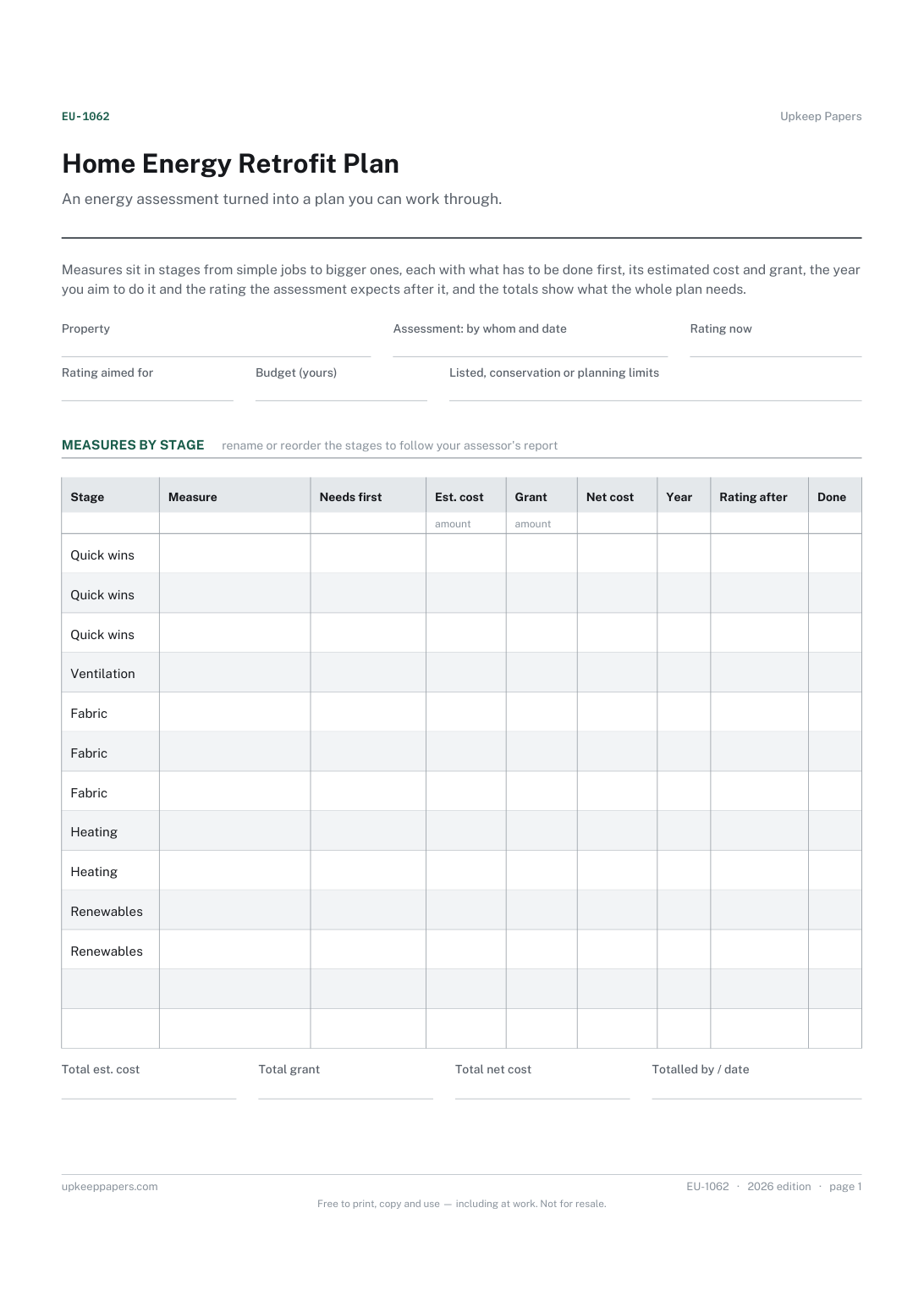
2 pages. The A4 and US Letter files are laid out identically, so neither is shrunk to fit.
Print it and write on it
Fillable PDF type and save
Spreadsheet formulas included
The fillable versions have real form fields — open them in any PDF reader, type into them and save. Printing help.
The same sheet, on screen. Totals and figures are worked out as you type, rows can be added or removed, and you can print it or download the completed version as a PDF. Everything stays in your browser — your entries are kept in this browser's own storage on this device, nothing is uploaded, and there is no account.
An energy assessment turned into a plan you can work through. Measures sit in stages from simple jobs to bigger ones, each with what has to be done first, its estimated cost and grant, the year you aim to do it and the rating the assessment expects after it, and the totals show what the whole plan needs.
Homeowners who have had an energy assessment or survey and want to improve the house in a sensible order over several years, rather than one job at a time as money allows.
The printable is laid out inside a box that fits both A4 and US Letter, so the two files are identical and neither one is scaled. The fillable PDF has real form fields. The workbook uses plain formulas only — SUM, IF, COUNTIF and the like — so it opens in Excel, LibreOffice and Google Sheets without anything breaking, and every calculated cell is grey so you can see which figures it worked out.
Download the A4 or US Letter file to match the paper in your printer, open it in a PDF reader and print at 100% — not "fit to page", which shrinks the writing space. Both files leave a 14 mm margin, which clears the unprintable edge on home printers. To print the online version with your entries in it, use the Print this sheet button, which prints only the sheet and none of the page around it. More on printing.
The order is yours and your assessor's. Many plans start with low-cost jobs and fix problems such as damp before insulating or sealing, but the sheet sets no sequence beyond the stage headings, which you can change.
Because sealing and insulating a house changes how air moves through it. Recording the ventilation work, or the decision that none is needed, keeps it from being forgotten when the fabric work starts.
From your assessment report and the quotes you collect. The sheet supplies no costs, grants, savings or ratings of its own; every figure is one you have been given.
This plan looks forward, at what you intend to do and what it will cost. The home insulation and energy improvements record is the permanent list of what has been done, with certificates and guarantees.
What was done, where in the house and when.
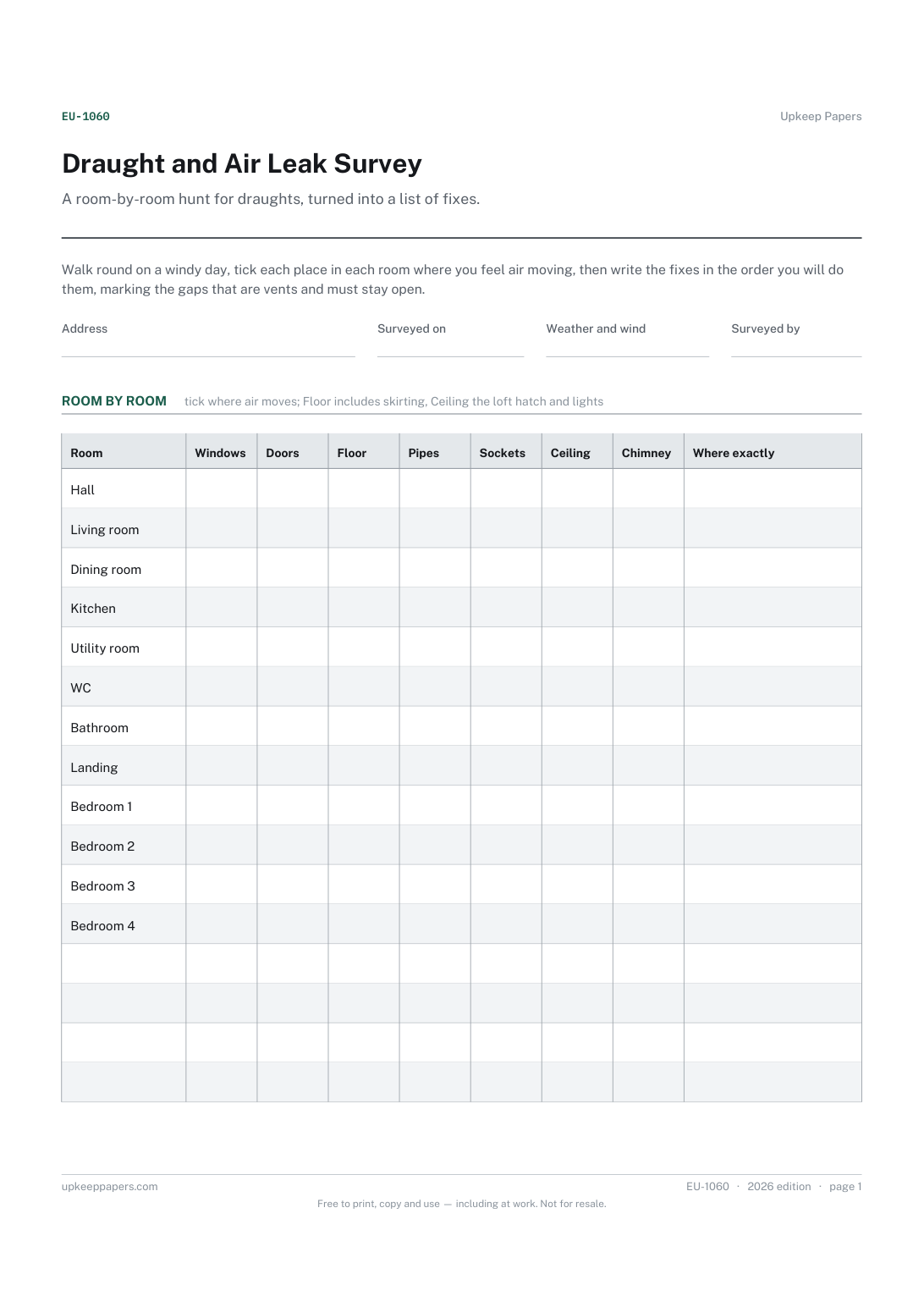
Every room checked at windows, doors, floors, pipes, sockets and ceilings.
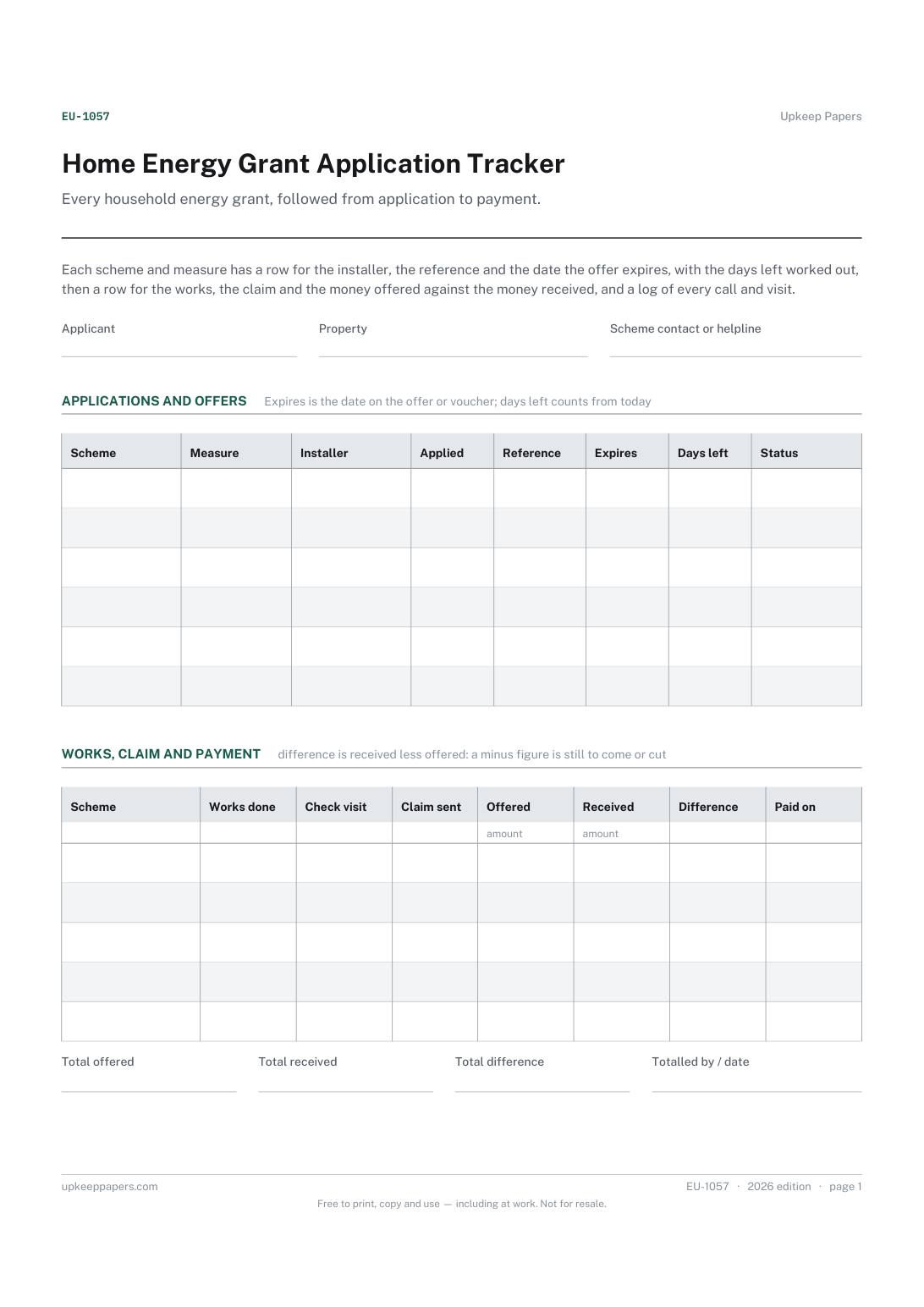
Each scheme, the measure it covers and the installer doing the work.
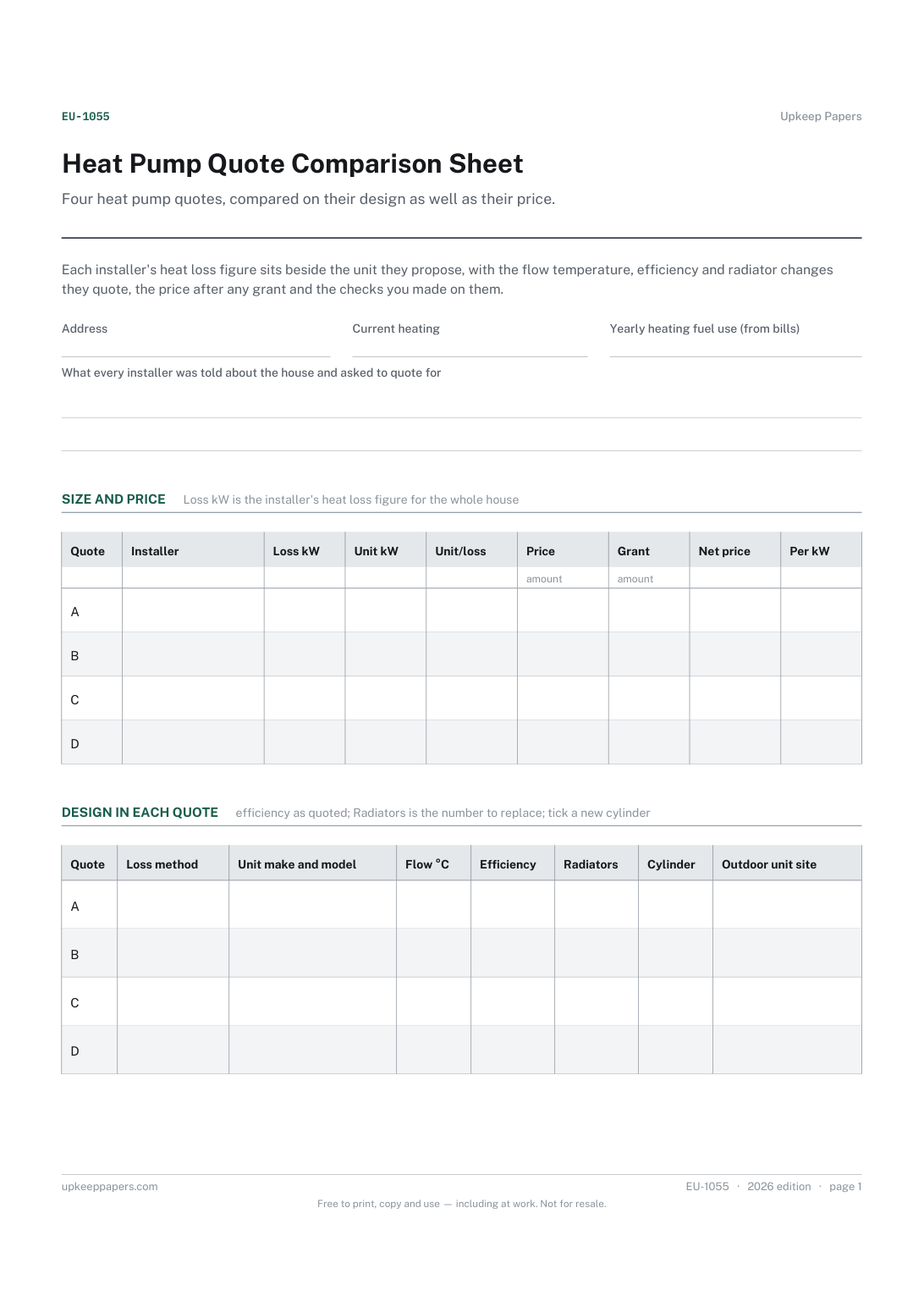
Each installer's heat loss figure and how it was worked out.
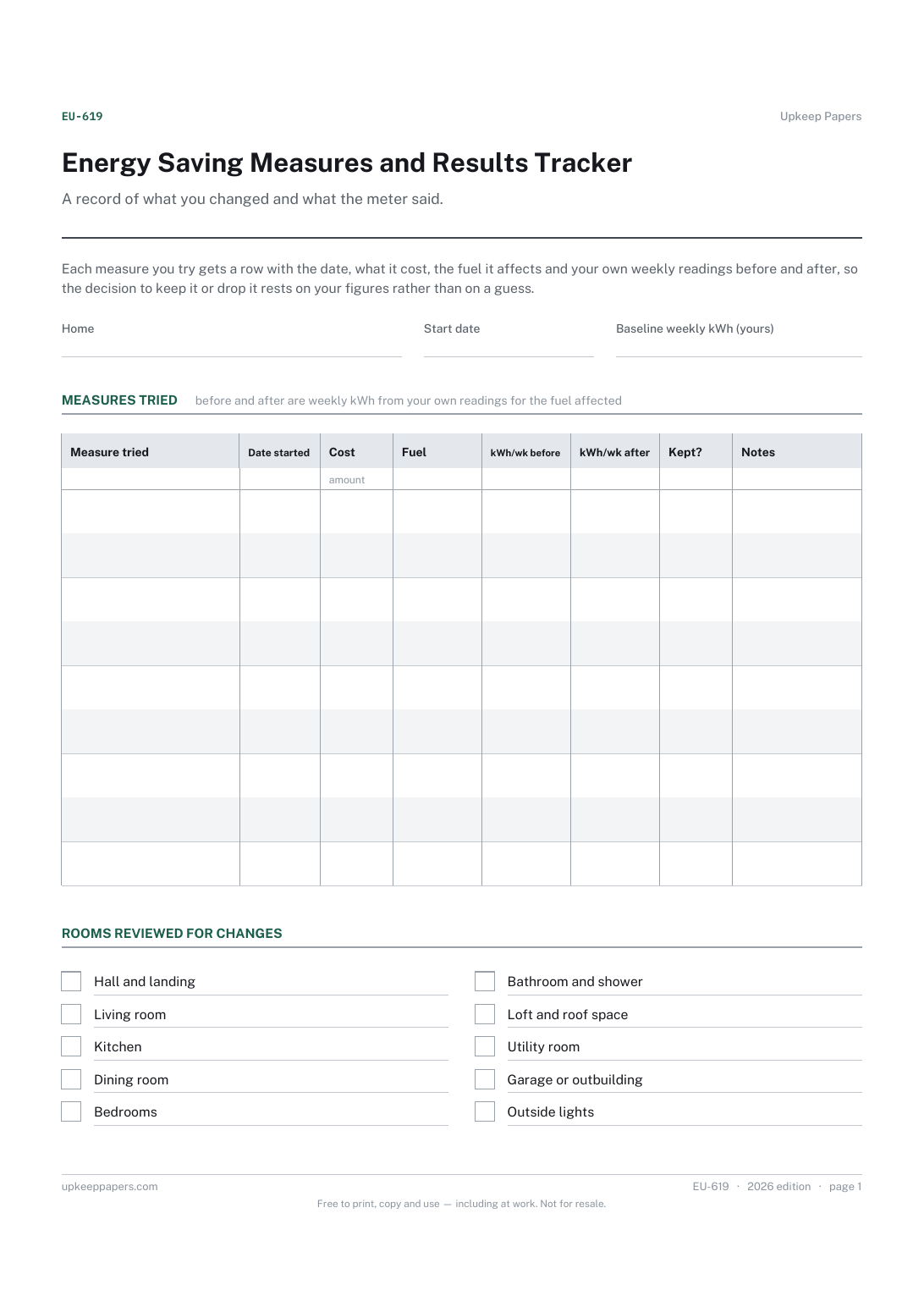
Each measure tried and the date it started.
Printable sheets, workbooks and tools on the same subject.
A room-by-room build budget holding quoted against actual, with the variance on every line and a contingency you set yourself.

Every sheet, binder, game and puzzle on Upkeep Papers is free to download, with no email and no account. Making them is not free: each one takes days of research, design and checking, and the site costs money to run. If something here saved you time, you can buy us a coffee. It is entirely optional: nothing is locked, and nothing changes if you don’t.
Buy us a coffee Opens PayPal in a new tab. Any amount, and nothing changes if you would rather not.