Guide · Home systems
How Often Should You Service Everything in Your Home?
A reference to how often the systems and machines in a house need servicing, why the intervals differ, and how to find the right figure for yours.
Published
There is no single answer to this question, and any page that gives you one is guessing. Service intervals depend on the equipment, how hard it works, the water and air it works in, and — for anything under warranty — on what the manufacturer decided to require. What can be said usefully is which things need a schedule at all, what governs each interval, and where to find the right number for your own house.
That last part matters more than it sounds. Most people do not skip maintenance because they are careless. They skip it because they never established what “on schedule” meant in the first place.
The three kinds of interval
Almost every maintenance interval in a house is set by one of three things.
Time. Anything that degrades whether or not you use it. Boiler and heating servicing, chimney sweeping, alarm testing, water testing, extinguisher checks. A boiler that sat unused all summer still needs its annual service, because the point is inspection, not wear.
Use. Anything with an hour meter or an obvious duty cycle. Mowers, tractors, generators, compressors, boat engines. A generator used for forty hours in a bad winter needs more attention than one used for four. Small engine manufacturers nearly always specify hours, and a machine without an hour meter is usually specified per season instead.
Condition. Anything you should be looking at rather than counting. Filters, gutters, roof coverings, tyres, drive belts. The interval is a prompt to check, and the check tells you whether to act.
Confusing the three is where most maintenance goes wrong. People change a filter annually because that is what they read somewhere, when the real answer is that a filter in a house with three dogs loads up in a quarter of the time.
What genuinely needs a schedule
The list below is not a set of intervals. It is a list of the things in a typical house that need some schedule, grouped by what governs them, so you can build a schedule that fits your property rather than a generic one.
Time-based
- Heating appliance — boiler, furnace or heat pump. Annual servicing is the usual manufacturer requirement and is very often a warranty condition. Record the engineer’s registration number as well as the date; that is the detail warranty departments ask for.
- Chimney or flue, for any solid fuel appliance. Frequency depends on the fuel and how much you burn. Ask your sweep what they recommend for your appliance, and keep the certificate.
- Smoke and carbon monoxide alarms — tested regularly, and the whole unit replaced at its printed end-of-life date. The test button checks the sounder, not the sensor.
- Fire extinguishers — an owner’s visual check at short intervals, professional servicing at a longer one.
- Private water supply — testing frequency is usually set by your local authority or health department.
- Septic tank or treatment plant — emptying frequency depends on tank size and household size, and in some areas is set by local rules.
Use-based
- Mowers, tractors and ride-ons — engine oil, air filter, spark plug, blade.
- Generators — a monthly exercise run under load matters more than the annual service.
- Pressure washers and compressors — pump oil, and for compressors, draining the tank after every session.
- Chainsaws — chain and bar wear are continuous; sharpen far more often than you service.
- Vehicles — mileage or time, whichever comes first, from your own handbook.
Condition-based
- Filters of every kind — heating, ventilation, extraction, water. Check them on a schedule and change them when they are dirty.
- Gutters — twice a year is common where there are trees, once where there are not.
- Roof — a ground-level look twice a year and after any serious storm.
- Tyres — tread and pressure regularly, and age for anything that sits parked.
- Seals and sealant — around windows, in wet rooms, on caravans and boats.
Why we do not print manufacturer schedules
You will notice this site does not publish specific service intervals for named appliances or vehicles, and that is deliberate for two reasons.
The first is that they differ far more than people expect. Two versions of the same car model, or the same boiler in a different installation, can carry materially different requirements. Printing a generic figure would be worse than printing nothing, because a wrong interval used confidently is how warranties get voided.
The second is that those schedules are the manufacturer’s own work. Reproducing them is not ours to do. What we can do is give you a sheet built to hold your figures, which is why the Vehicle Maintenance Schedule Planner and the specification blocks on the machine sheets arrive blank.
Building your own schedule
The practical method is unglamorous and takes an afternoon.
- Walk the property and list what needs servicing. Include the things you have been ignoring — the extractor filter, the sump pump, the softener. The Appliance and Equipment Register is built for this pass, and it is worth photographing every rating plate as you go.
- Find the interval for each one, from its handbook, its warranty terms or the trade that services it. Write it down. This is the step people skip, and it is the whole exercise.
- Put the time-based items on a calendar, grouped into a spring round and an autumn round so you are doing one session rather than twelve errands. The Home Maintenance Schedule is laid out this way for exactly that reason.
- Give the use-based machines a sheet each, because their intervals will not line up with anything else.
- Record what you actually did. A schedule with no record beside it decays within two years, because you stop being able to tell what has been done.
The part that pays for itself
Maintenance records are worth keeping for their own sake, but they earn their keep in three specific moments: a warranty claim, an insurance claim, and a sale. In all three, someone asks what was done and when, and a confident verbal answer is worth much less than a dated line with an invoice number against it.
That is the entire argument for the Home Service History Register, and it is why almost every sheet here has a date column and a space for who did the work.
From the library
Sheets mentioned here
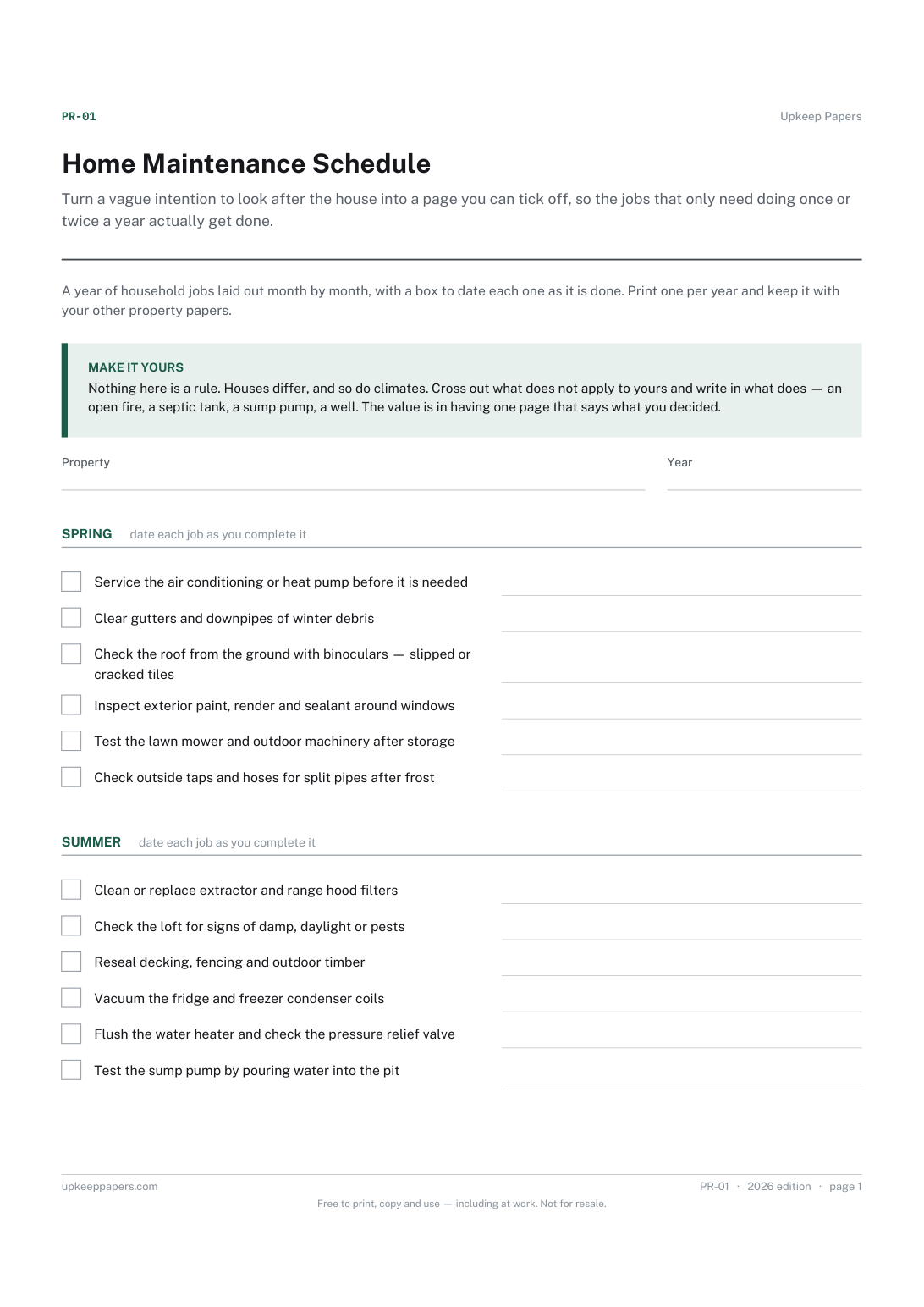
Home Maintenance Schedule
Turn a vague intention to look after the house into a page you can tick off, so the jobs that only need doing once or twice a year actually get done.
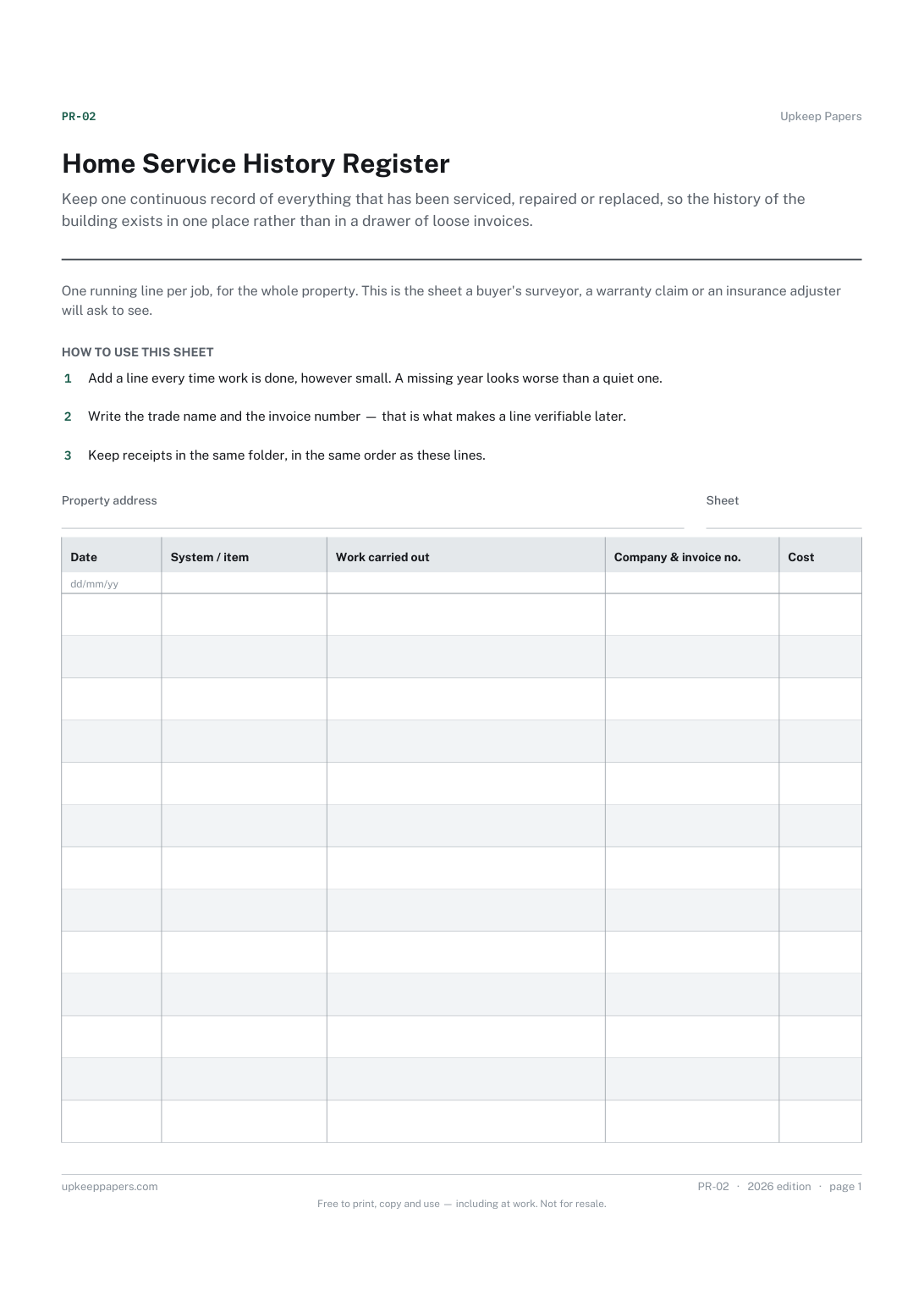
Home Service History Register
Keep one continuous record of everything that has been serviced, repaired or replaced, so the history of the building exists in one place rather than in a drawer of loose invoices.
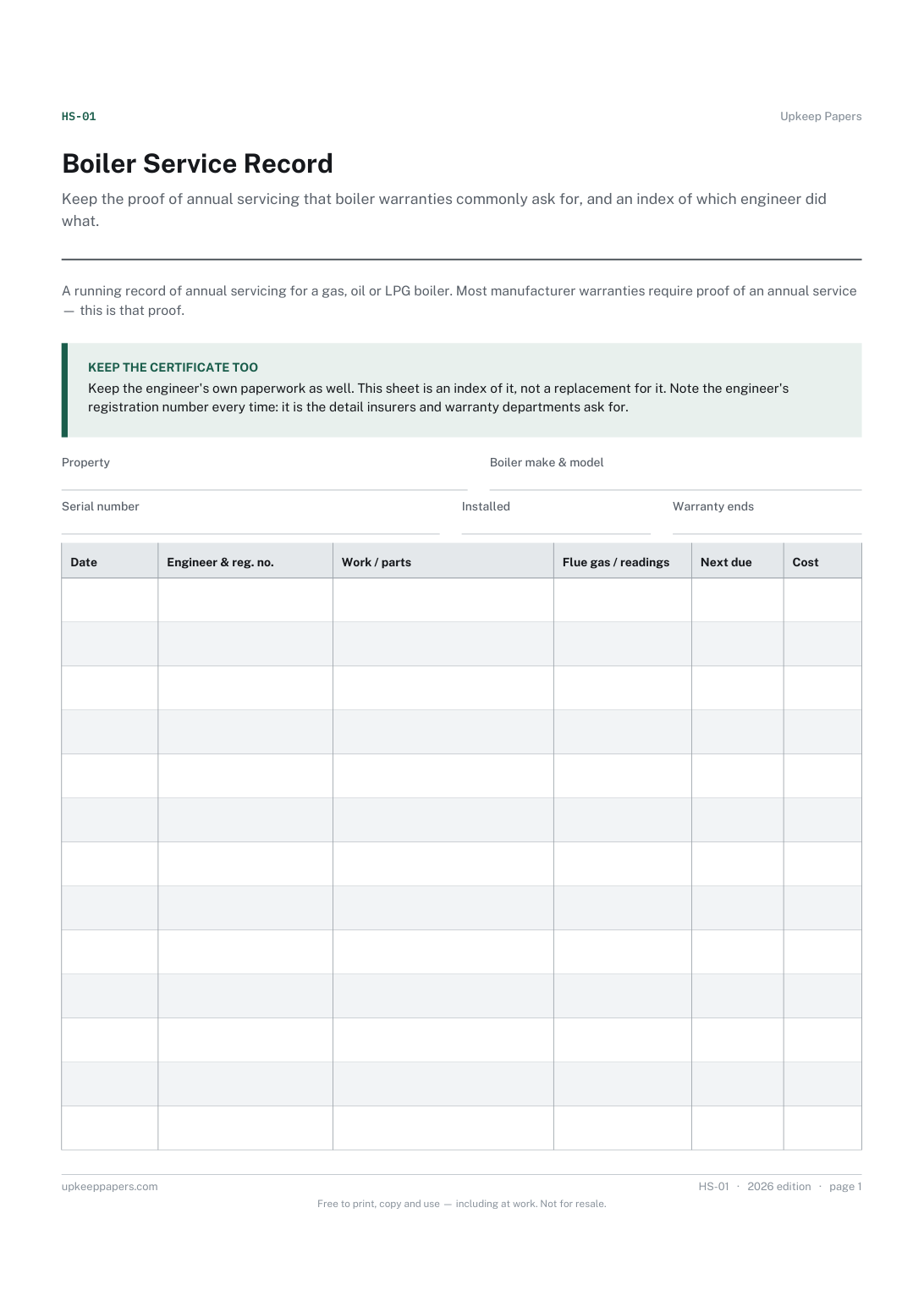
Boiler Service Record
Keep the proof of annual servicing that boiler warranties commonly ask for, and an index of which engineer did what.
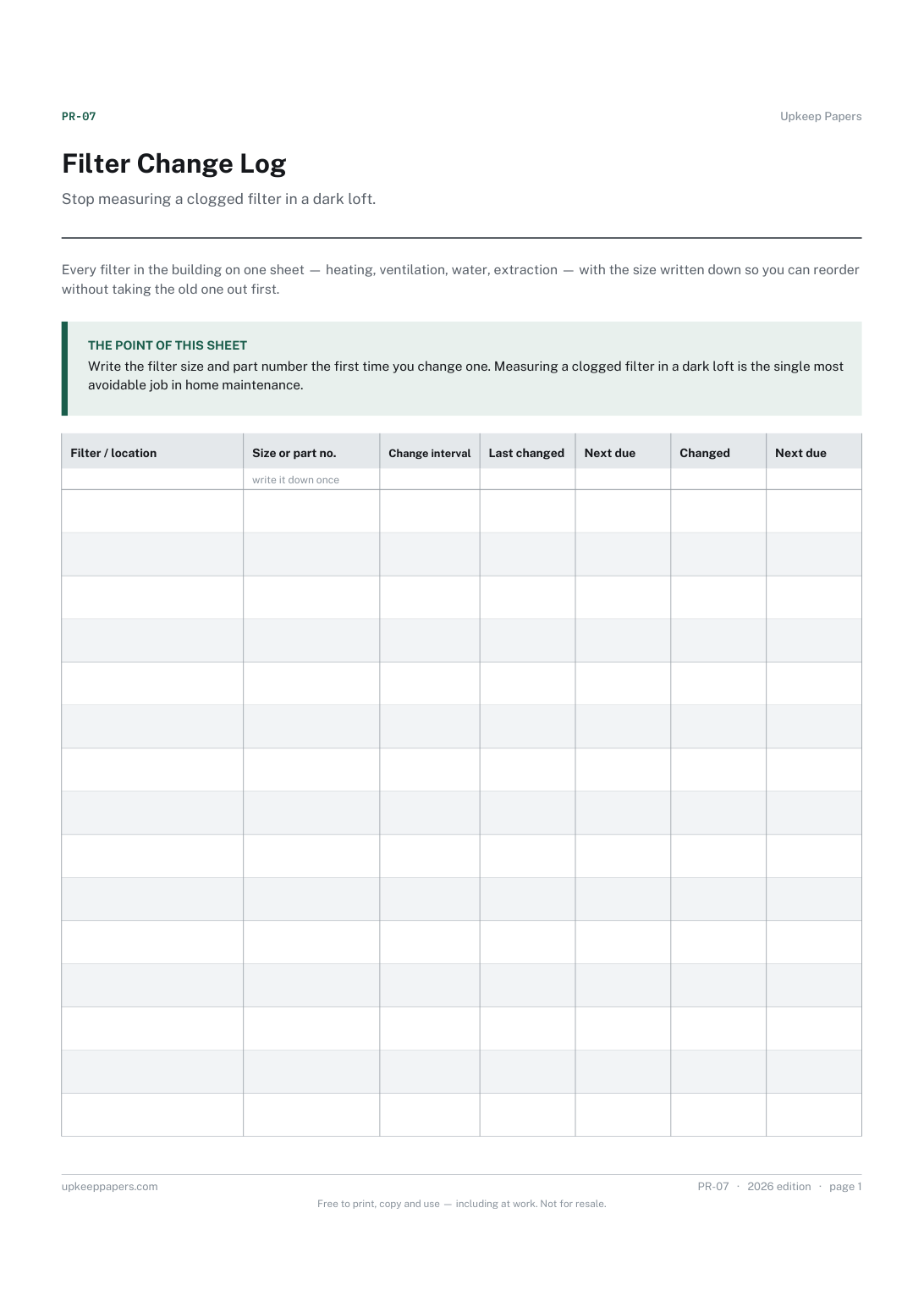
Filter Change Log
Stop measuring a clogged filter in a dark loft. Write the size down the first time, then reorder without taking the old one out.
More guides
How Often to Change Every Filter in Your House
A walk through every filter in a typical house, what actually governs each interval, why annually is usually the wrong answer, and the size trick worth doing once.
Private Well Water Testing Records
A single water test tells you about one moment at one tap. A run of results tells you what your supply actually does, and that is where the value is.
Septic Tank Record Keeping
A private drainage system is invisible and entirely yours. What to establish about it, why emptying dates matter more than they look, and the warning signs.