Guide · Home systems
How Often to Change Every Filter in Your House
A walk through every filter in a typical house, what actually governs each interval, why annually is usually the wrong answer, and the size trick worth doing once.
Published
A house contains more filters than most people can list from memory, and almost all of them are on the wrong schedule. Some get changed far too late, which costs efficiency and occasionally causes damage. Some get changed far too early, which costs money for nothing. The reason is nearly always the same: someone picked a calendar interval because a calendar is easy, when the thing that actually governs the filter is how much has gone through it.
What actually sets a filter interval
Three things, in roughly this order.
Load. How much air, water or grease has passed through, and how dirty it was. This is the real variable, and it swings enormously between houses. A heating filter in a rural house with two dogs and a gravel drive loads up in a fraction of the time of the identical filter in a first-floor flat.
What happens when it blocks. For some filters, a blockage is just reduced performance. For others — anything with a fan or a pump behind it — restriction is actively harmful, because the machine keeps trying and something else takes the strain.
Whether it is cleanable or consumable. A metal grease filter can be washed indefinitely. An activated carbon cartridge cannot be cleaned at all; once it is used up it is a piece of decoration that water or air flows straight through.
Why “annually” is usually wrong
Annual intervals exist because a year is a memorable unit, not because a year means anything to a filter. The figure survives because it is rarely catastrophic in either direction, which is exactly what makes it hard to notice as a bad answer.
The useful reframe is that most filters should be checked on a schedule and changed on condition. The schedule is a prompt to look. The look tells you what to do.
There are two exceptions worth naming. Filters you cannot see the condition of — carbon cartridges, recirculating cooker hood filters — genuinely do need a counted interval, because inspection tells you nothing. And anything specified as a warranty condition follows the manufacturer’s figure whatever your judgement says, because the argument you would have to win is not a technical one.
Going round the house
Heating and air conditioning
The filter in a ducted heating or cooling system exists to protect the equipment as much as the air. When it blocks, airflow across the heat exchanger or coil drops, and the consequences are real: longer run times, higher energy use, and on a cooling coil the risk of it icing up, at which point performance collapses entirely.
The interval depends on how hard the system runs, how dusty the air is, and how fine the filter is. A higher-efficiency filter catches more and therefore blocks sooner — a fact that surprises people who upgrade the filter and then leave it in for the same length of time. Check monthly through any season of heavy running, and record what you find on the HVAC and Heat Pump Service Log so you can see how quickly yours actually loads.
Cooker hood grease filters
The metal mesh panels under an extractor hood are washable, and washing them is genuinely the whole job — most go in a dishwasher. Interval is set by what you cook: frying loads them fast, boiling pasta barely at all.
Two reasons to take these seriously. A saturated grease filter stops extracting, which is why hoods are so often accused of being useless when they are simply clogged. And grease is combustible, sitting directly above the hob.
Recirculating hood carbon filters
If your hood does not vent outside, there is a carbon filter inside it, and it is the most commonly forgotten filter in any kitchen. It cannot be washed, it gives no visual sign of being spent, and once it is saturated the hood is moving smells around the room rather than removing them. This is one of the genuine counted-interval filters — follow the manufacturer’s figure and log the date, because nothing else will tell you.
Ventilation and heat recovery units
An MVHR or similar unit usually has two filters: one on incoming outdoor air, one on air extracted from the house. The supply filter deals with whatever your outdoor air carries — pollen in early summer, road dust if you are near a busy road — so its interval is seasonal and location-specific. Blocked filters unbalance the system, make the fans work harder, and quietly undo the reason the unit was installed. Most units will not warn you.
Vacuum cleaners
Bagless machines have a pre-motor filter and usually a fine post-motor filter. Lost suction is most often a full bin or a blockage, but a clogged pre-motor filter is the next suspect. Where they are washable, the commonest mistake is refitting one still slightly damp, which produces a smell you will then blame on the machine.
Tumble dryers
The lint screen is a per-load job, not a periodic one. Beyond it, condenser and heat pump dryers have a second, deeper filter or heat exchanger that also clogs, and that one is the usual explanation for a dryer that has gradually started taking two cycles to do one load. Lint is also a fire risk, which puts this in a different category from mild inefficiency.
Water filters
Sediment filters are the one type where inspection works well — pull the cartridge and you can see exactly what your water is carrying. Carbon cartridges are the opposite: their life is set by the volume of water through them, they give no warning, and an exhausted one simply stops doing anything. Reverse osmosis membranes run much longer than the pre-filters that protect them, so the pre-filters are the ones that actually need managing.
A water softener is not a filter, but it lives in the same cupboard and gets forgotten in the same way. Salt level, brine tank condition and any pre-filter belong on the Water Softener Log.
Fridge water and ice filters
Volume-based, and most fridges have an indicator light. Be clear about what that light is: on the great majority of machines it is a timer or a flow counter, not a sensor measuring the filter. It tells you what the manufacturer assumed, not what your filter is doing.
Ponds and outdoor pumps
Mechanical foam in a pond filter needs rinsing rather than replacing, and it must be rinsed in pond water — rinsing biological media under a tap kills the bacteria colony doing the actual work, and the pond then takes weeks to recover. Frequency follows fish load and water temperature.
The trick worth doing once
The first time you change any filter, before the old one goes in the bin, photograph the printing on its edge and write the size and part number down permanently — on the Filter Change Log, and in marker pen on the inside of the appliance door or the unit housing.
This sounds like a small convenience. It is the difference between a filter change taking four minutes and taking a fortnight, because the real reason filters go unchanged is not laziness. It is standing in front of an open unit with no idea what size to order, deciding to measure it later, and never doing so.
Once you know the size, buy several — not having one in the cupboard is the usual barrier to changing a filter on time. Record what the machine is and where it lives on the Appliance and Equipment Register at the same time, and the job is done for good.
From the library
Sheets mentioned here
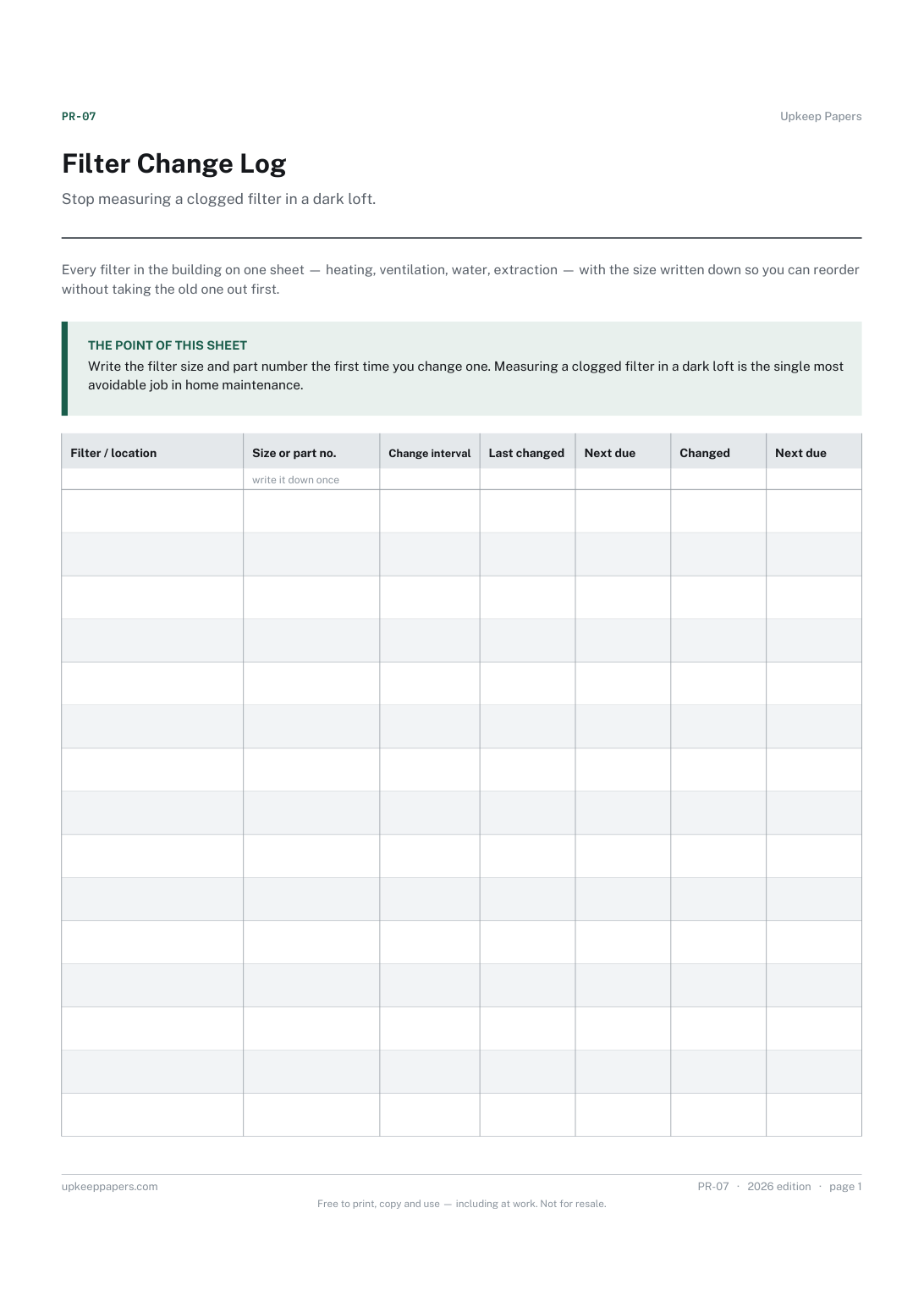
Filter Change Log
Stop measuring a clogged filter in a dark loft. Write the size down the first time, then reorder without taking the old one out.
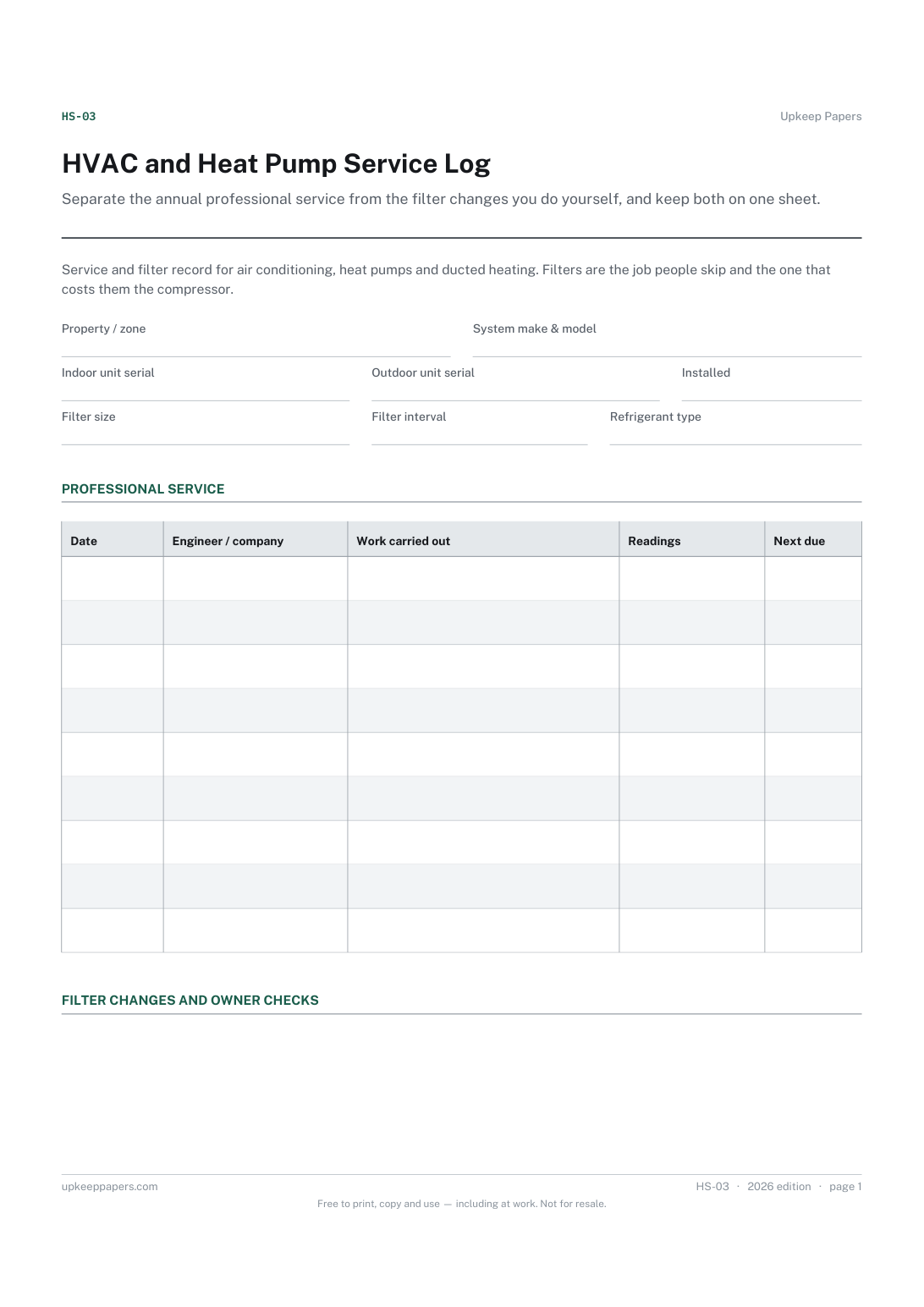
HVAC and Heat Pump Service Log
Separate the annual professional service from the filter changes you do yourself, and keep both on one sheet.
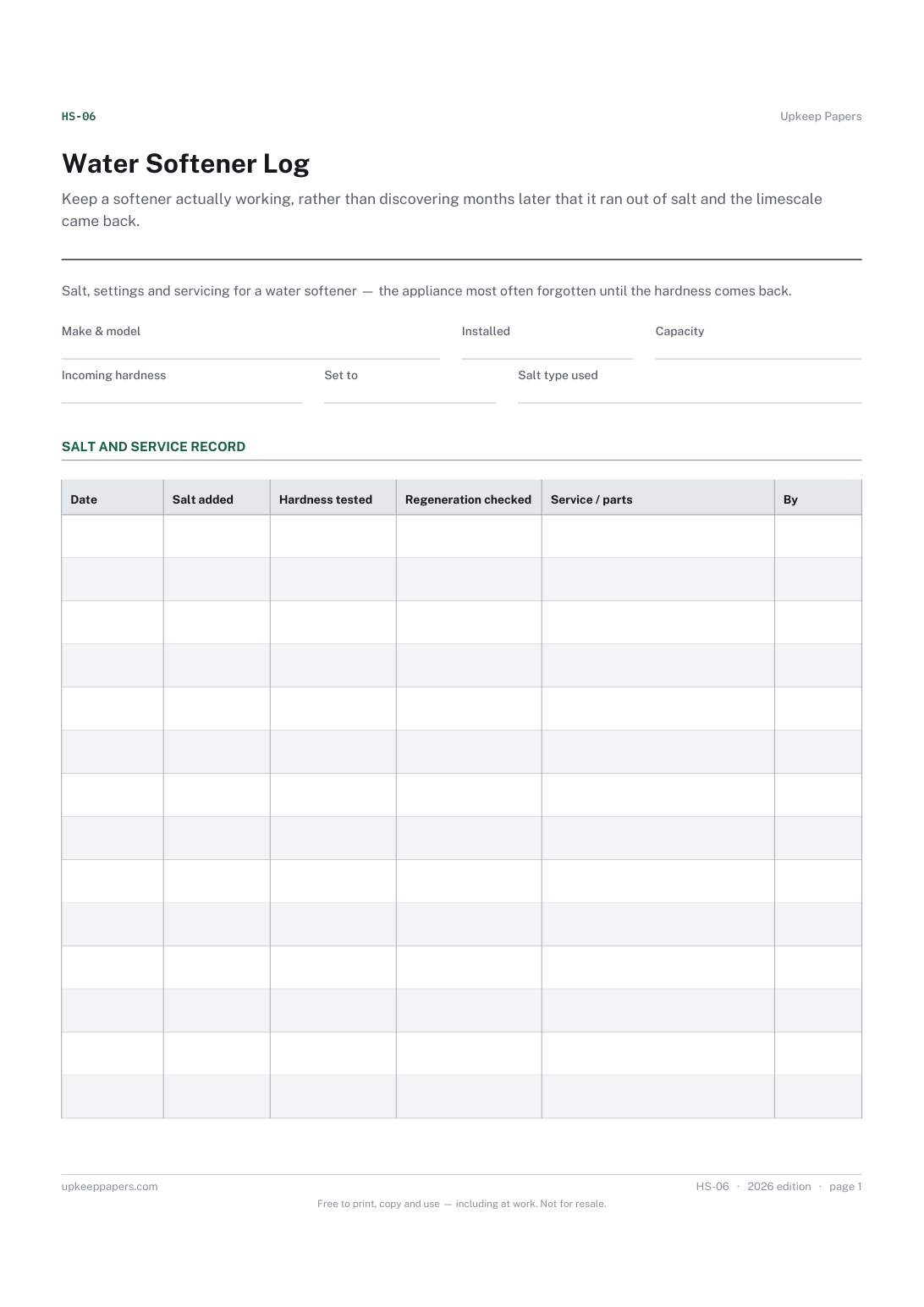
Water Softener Log
Keep a softener actually working, rather than discovering months later that it ran out of salt and the limescale came back.
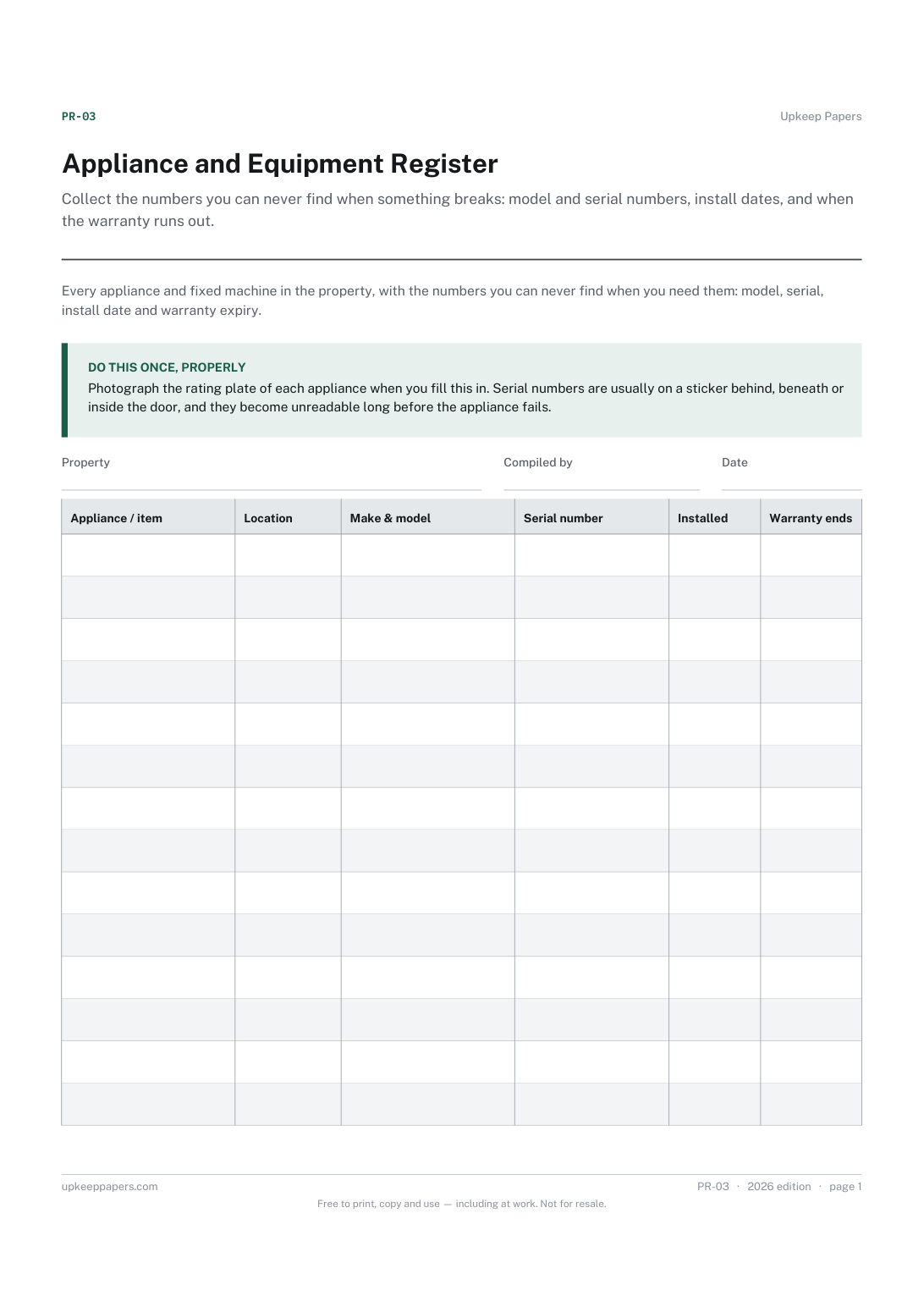
Appliance and Equipment Register
Collect the numbers you can never find when something breaks: model and serial numbers, install dates, and when the warranty runs out.
More guides
How Often Should You Service Everything in Your Home?
A reference to how often the systems and machines in a house need servicing, why the intervals differ, and how to find the right figure for yours.
Private Well Water Testing Records
A single water test tells you about one moment at one tap. A run of results tells you what your supply actually does, and that is where the value is.
Septic Tank Record Keeping
A private drainage system is invisible and entirely yours. What to establish about it, why emptying dates matter more than they look, and the warning signs.