Guide · Home systems
Private Well Water Testing Records
A single water test tells you about one moment at one tap. A run of results tells you what your supply actually does, and that is where the value is.
Published
A mains supply is tested continuously by somebody whose job it is. A private supply — borehole, well or spring — is tested when you decide to test it, and a single result on its own is worth much less than most people assume.
That is not an argument against testing. It is an argument for keeping the results, because what you actually want is not in any one report. It is in the sequence.
What this page will not tell you
What you should test for, how often, and what counts as an acceptable result are not general questions. They depend on the type of source, the local geology, the land use around you, and the rules where you live — and they are set by your local authority, health department or environmental regulator, not by a website.
So there are no parameters listed here and no limits quoted. Ask your local authority or health department what they recommend for a private supply in your area; in many places they publish guidance, maintain lists of approved laboratories, and sometimes offer testing. That conversation comes before any of the record-keeping below is worth anything.
Why a single test is weak evidence
Water from a private source is not a constant. It varies with rainfall, with the season, with the water table, with how much you have been drawing, and with what has been happening on the land around you. A clear result from a sample taken on a dry afternoon in July tells you the water was acceptable on that afternoon in July. It says considerably less about the tap during a wet week in November.
The most diagnostically useful pattern in private supplies is exactly the one a single test cannot show: a supply that is fine most of the time and not fine after heavy rain. That points at surface water reaching the source — damaged headworks, a poor seal, a shallow inflow — and it is invisible unless you have results from both conditions to compare.
Hence the discipline of building a run. Six or eight results, taken across different seasons and recorded properly, tell you what your supply does. Two or three tell you very little.
Taking a sample so the result means something
A badly taken sample produces a result about your tap, your hand or the bottle. Laboratories give their own instructions and those override anything general, but a few points hold up regardless.
Use the laboratory’s bottles and follow their procedure exactly. Bacteriological bottles are sterile and often contain a preservative. Rinsing one out defeats the point of it.
Note precisely where the sample came from — which tap, and whether it is upstream or downstream of any treatment. This determines what the result means, and it is the detail most often left off.
Note how you took it — whether the tap was run first and for how long, whether the aerator was removed, whether the tap was disinfected. These affect results, particularly bacteriological ones.
Get it to the laboratory within their stated window, kept cool if they say so. A sample left in a warm car produces a number about the car.
Sample the same way from the same point every time. Change the sample point and you have started a new sequence rather than continuing the old one. And take a matched pair at least once — raw water before treatment, and water after it — because that pair is the only thing telling you what your treatment is actually doing.
Reading a laboratory report
Reports vary between laboratories, but the components are consistent.
- The sample identity: where it came from, when it was taken, when the laboratory received it.
- The parameters tested. Only what you asked and paid for. This is the most misread part of any water report: a report showing everything within limits means everything that was tested was within limits — not a general statement about the water.
- The results, with units. The same parameter is reported in different units by different labs, and results are not comparable across them without conversion.
- “Less than” values. A result expressed as less than some figure means the laboratory could not detect it above its limit of detection. Not zero — and that limit differs between methods, which matters when comparing reports from different labs.
- A reference or limit column. Check which standard the laboratory printed there, and whether it applies where you live. Labs serving several regions do not always print the right one.
If anything on a report concerns you, take it to your local authority or health department rather than interpreting it yourself. Their interpretation is the one that counts.
What to record alongside the result
The report is the evidence. The log holds the context the report does not.
- Date and time the sample was taken, not just the report date.
- The sample point, and whether it was before or after treatment.
- Weather in the preceding week, particularly whether there had been heavy rain. This is the single most valuable contextual field.
- Which laboratory, and which parameters were requested.
- The results, copied across so a run is readable on one page without pulling out eight reports.
- Anything unusual: work on the borehole, flooding, livestock moved nearby, new drainage on adjacent land, a change in taste, smell or appearance.
A Private Well Water Test Log laid out as one row per test does one job: it makes the sequence visible. A gradual drift across four years is obvious in a column of figures and invisible in a folder of separate reports.
Some events warrant a test whatever interval you settle on: work on the well or pump; flooding; a change in taste, smell, colour or clarity; a new septic system or intensive land use nearby.
Treatment maintenance is part of the record
Where a supply is treated, the treatment is only as good as its upkeep, and most treatment fails silently.
Ultraviolet disinfection is the clearest example. The lamp’s output falls over its service life while it continues to glow, so a lit lamp tells you the electricity is on and nothing else. Lamps have a stated replacement interval, the quartz sleeve needs cleaning because a filmed sleeve blocks the light, and pre-filtration matters because particles shield organisms from the lamp. Record every lamp change and sleeve clean — here the record is the only evidence the system works.
Cartridge filters exhaust on volume rather than time, and a spent carbon cartridge gives no indication of being spent. Keep them on the Filter Change Log with the size and part number written down the first time, because chasing a cartridge specification is the usual reason a change slips by three months.
Softeners and dosing equipment need salt, calibration and periodic attention to the tank; a Water Softener Log covers that. If the property also has private drainage, keep the Septic Tank and Treatment Plant Log in the same section.
Why the run is worth keeping
Two situations make a documented history valuable to somebody other than you.
The first is a sale. A buyer’s solicitor will ask about the water supply, and several years of results with treatment maintenance alongside is a materially better answer than a single test commissioned the month the property went on the market.
The second is any occasion where somebody competent has to work out what is happening. The first thing they will want is the history. With it, the diagnosis starts from evidence. Without it, it starts from a new sample and a wait of several months to see whether the problem repeats.
From the library
Sheets mentioned here
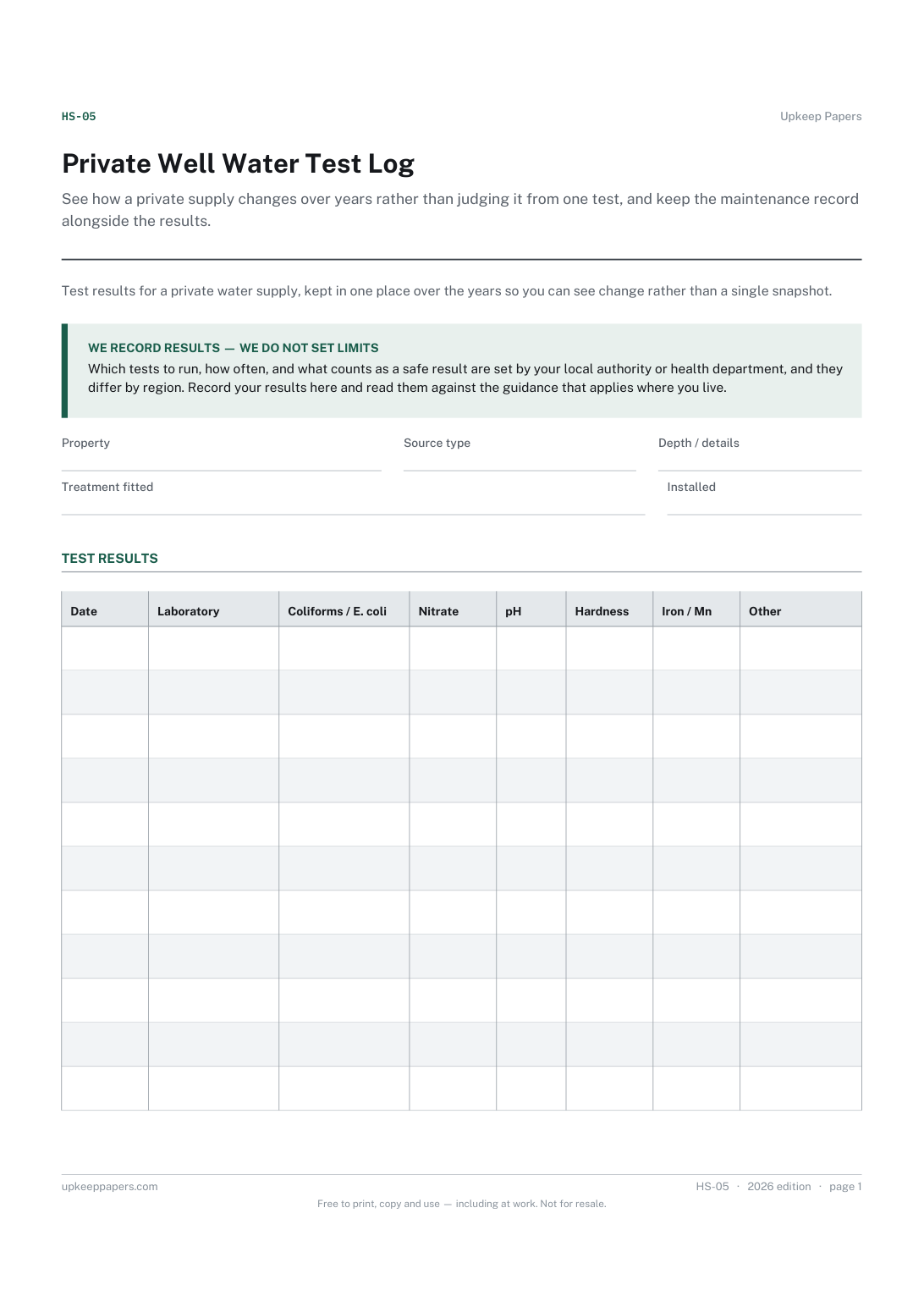
Private Well Water Test Log
See how a private supply changes over years rather than judging it from one test, and keep the maintenance record alongside the results.
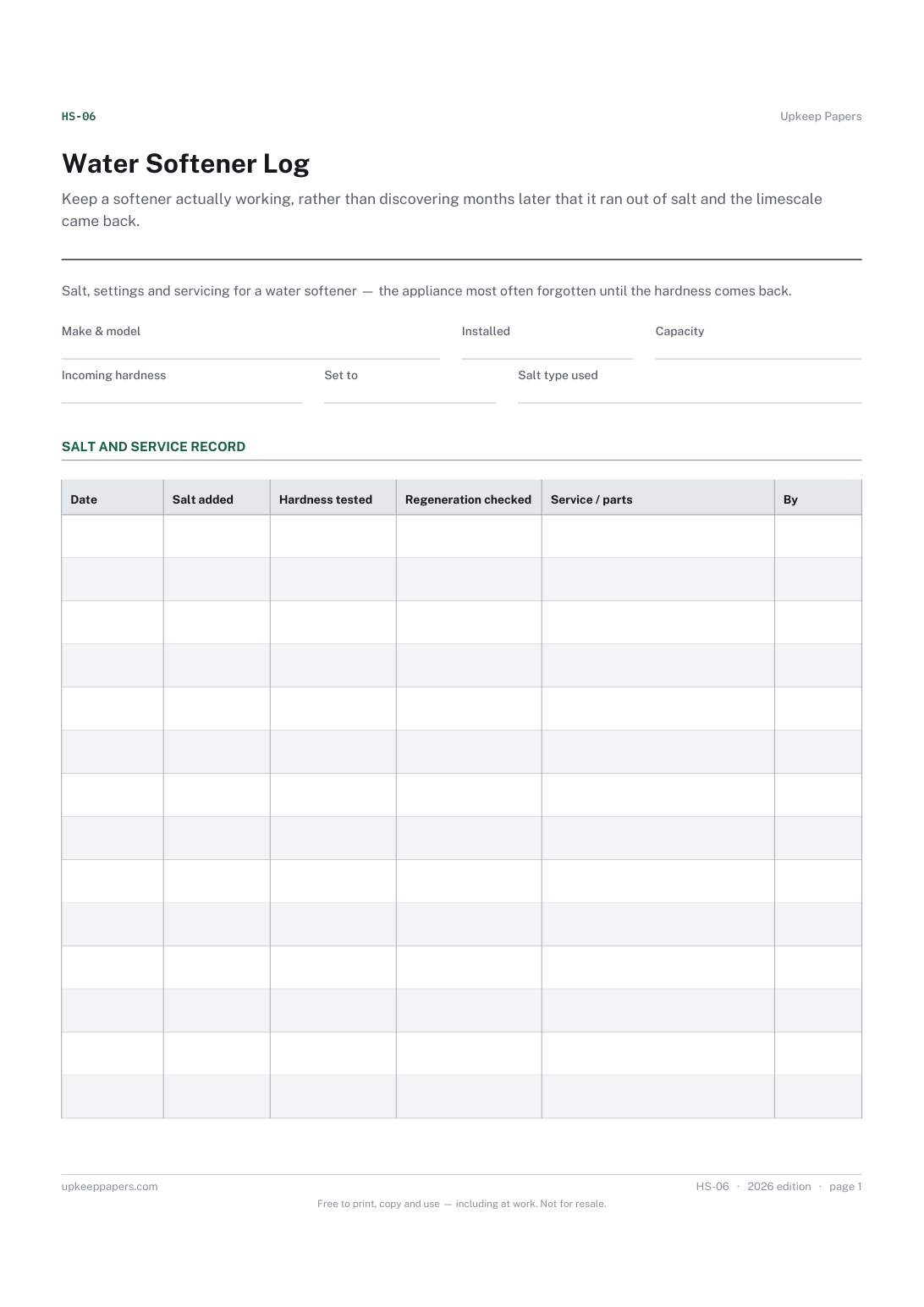
Water Softener Log
Keep a softener actually working, rather than discovering months later that it ran out of salt and the limescale came back.
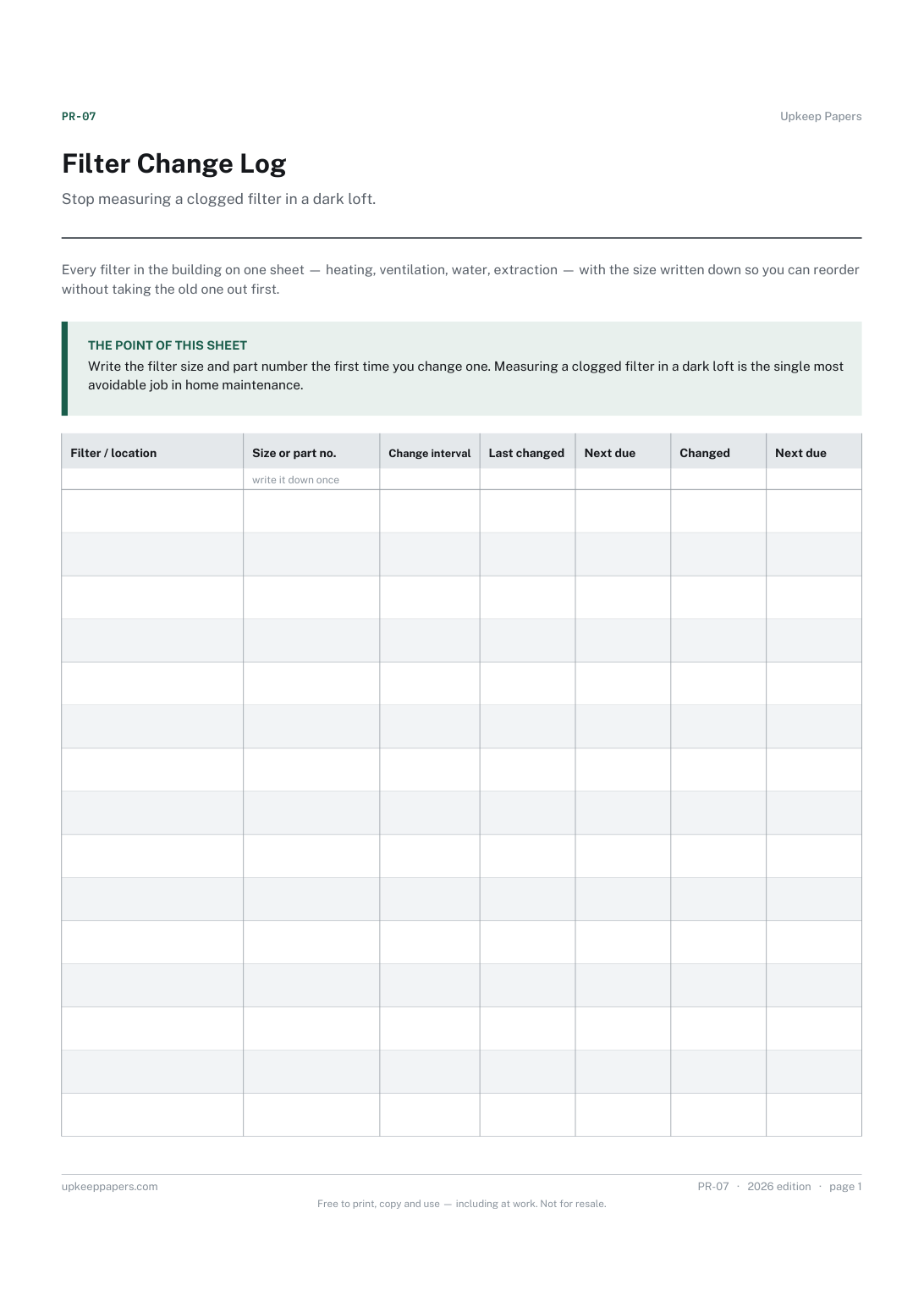
Filter Change Log
Stop measuring a clogged filter in a dark loft. Write the size down the first time, then reorder without taking the old one out.
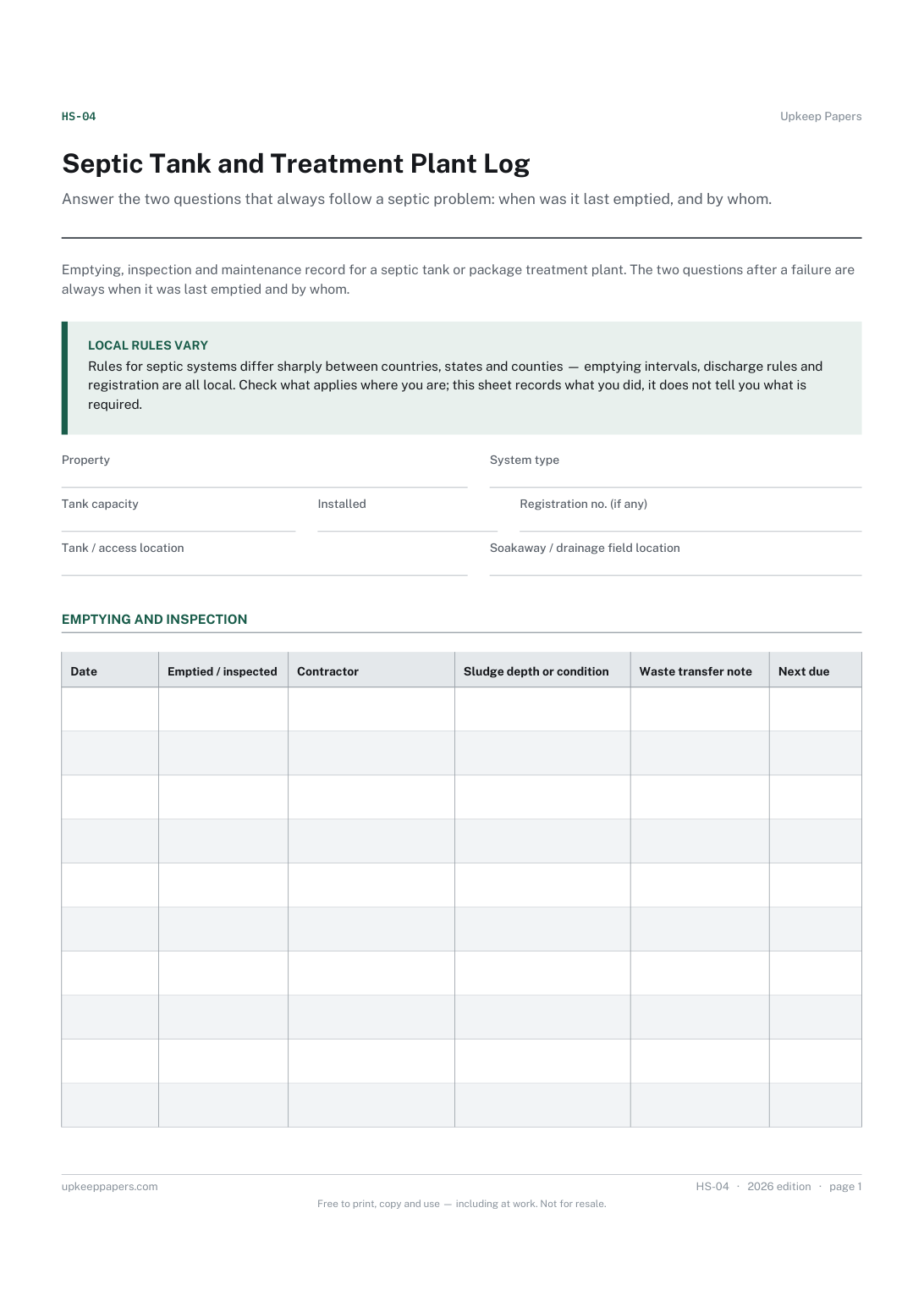
Septic Tank and Treatment Plant Log
Answer the two questions that always follow a septic problem: when was it last emptied, and by whom.
More guides
How Often to Change Every Filter in Your House
A walk through every filter in a typical house, what actually governs each interval, why annually is usually the wrong answer, and the size trick worth doing once.
How Often Should You Service Everything in Your Home?
A reference to how often the systems and machines in a house need servicing, why the intervals differ, and how to find the right figure for yours.
Septic Tank Record Keeping
A private drainage system is invisible and entirely yours. What to establish about it, why emptying dates matter more than they look, and the warning signs.