Guide · Home systems
Septic Tank Record Keeping
A private drainage system is invisible and entirely yours. What to establish about it, why emptying dates matter more than they look, and the warning signs.
Published
A private drainage system is the only part of a house that is completely invisible, completely unforgiving and completely your problem. Most people who have one inherited it when they bought the property, were told approximately nothing about it, and have been running it on optimism ever since.
That works until it does not, and the failure is expensive in a way other household failures are not, because the part that fails is buried under the garden.
The rules are not on this page
Registration, permitted discharges, emptying frequency, required documentation, what type of system may be installed, and what happens when a property changes hands are all governed by local rules — and those rules differ sharply between countries, between regions, and sometimes between one side of a catchment and the other. Proximity to a watercourse, a borehole or a protected area can change the position entirely for two houses a few hundred metres apart.
So there is no interval, no requirement and no permitted practice stated anywhere below. Find out what applies to your property from your local environmental regulator, water authority or council. If you are buying a property with private drainage, find out before you buy.
Establish what you actually have
Which kind of system is it? These get spoken about interchangeably and are not the same thing.
- A traditional septic tank settles solids and discharges liquid to a drainage field or percolation area, where the ground does the rest of the treatment. No power supply.
- A package treatment plant aerates the effluent, usually with an electric blower, and produces a much cleaner discharge. It has power, moving parts, and a servicing requirement a septic tank has not.
- A cesspool or holding tank treats nothing. It is a sealed container that fills and is emptied.
Confusing the first two is consequential, because a treatment plant that has lost power for a fortnight is functioning, at best, as a poor septic tank.
Where is everything? The tank, the chambers, the lids, the inlet and outlet, and — importantly — where the drainage field runs and how far it extends. Draw it: a sketch with measurements from two fixed points on the house is what stops somebody parking a skip on the percolation area.
How old is it, who installed it, and is there paperwork? On a property you have just bought, ask the seller while you still have a line to them, and record it on a New Home Record Sheet.
Why emptying dates matter more than they look
A septic tank works by keeping still. Solids settle as sludge, fats and light material float as a crust, and relatively clear liquid leaves from the middle to the drainage field.
As the sludge layer grows, the clear zone in the middle shrinks. Past a certain point solids carry over into the drainage field, and solids in a drainage field do not come back out. They clog the ground, the field stops accepting liquid, and the remedy is excavation and replacement.
That is the entire economics of the thing: emptying a tank is a routine cost, replacing a drainage field is not. Every emptying you skip is a small bet against a large number.
Finding the right interval for your system
There is no general figure, and anyone quoting one does not know your tank. The interval depends on capacity, how many people live in the house, how much water they use, and what goes into it — a large family with a washing machine running daily is a different load entirely from two people.
The way to establish your own figure is to measure rather than guess. At each emptying, ask the contractor how deep the sludge and crust layers were, and record it against the interval since the last visit. After two or three cycles you have a real answer for your property, and it is usually not the number you assumed. Keep it on a dedicated Septic Tank and Treatment Plant Log, because the value is entirely in the sequence.
What a contractor should leave you with
Ask for all of this, and file it:
- A dated document naming the company, with the property address on it.
- The volume removed.
- Documentation of where the waste went. Some jurisdictions require this to be evidenced; whether yours does is one to check, but keeping it is sensible regardless.
- The condition of what they could see: baffles or dip pipes, cracked lids, root ingress, evidence of solids carrying over, water levels that look wrong.
- Any recommendation on when to come back, and why.
That condition note is the part most people never ask for and the part most worth having. A dip pipe that has broken off is a cheap fix preventing an expensive one, and the only person going to see it is the one with the lid off.
Treatment plants have a service, not just an emptying
If your system has power, it has serviceable parts — blowers or pumps, diffusers, filters, media, and usually an alarm — needing attention on their own schedule, separate from desludging.
Find out what the alarm sounds like before it ever goes off, because unfamiliar beeping in an outbuilding is easy to ignore for a week. And note the electricity supply on your records: a tripped breaker in a garage consumer unit is a common cause of a treatment plant quietly failing for a month.
Warning signs worth recognising
Individually these have other explanations. Together, or persistently, they point at the drainage system.
- Several fixtures draining slowly at once. One slow sink is a blocked sink. The whole house slowing down is a different problem.
- Gurgling from drains or toilets, especially when another fixture is used.
- Standing water, soft ground or a strikingly green strip over the drainage field in dry weather. Grass visibly greener along a line tells you where the field is and that it is over-saturated.
- Persistent smell outdoors near the tank or field.
- Backing up after heavy rain, and only after heavy rain. Diagnostic: groundwater is getting into the system, or the field is saturated by rainfall.
- An alarm on a treatment plant, which is urgent rather than annoying.
Record these when you notice them, with the date and the weather. “Slow drains, following three days of heavy rain”, written twice a year for three years, is a diagnosis; the same observation half-remembered is nothing.
Habits that extend a system’s life
Nothing that will not break down goes in. Wipes, sanitary items and kitchen fat cause most trouble, and fat is the quiet one — it coats and accumulates over years. Be moderate with bleach and disinfectants, too: a septic tank works because of a biological population, and enough disinfectant kills it.
Water volume matters as much as content. A leaking cistern running continuously puts a remarkable amount of extra water through a system, and hydraulic overload is a failure mode independent of solids. If you have a water softener, ask your installer and the tank manufacturer where its regeneration discharge should go — guidance on that differs.
Where it connects to the rest of your records
If the property also has a private water supply, keep a Private Well Water Test Log alongside the drainage log; the dates are worth having side by side. Then index both on the Home Service History Register. Private drainage is one of the first things a buyer’s solicitor asks about, and a documented run of emptyings with condition notes is the difference between a straightforward answer and a survey recommendation that the whole system be investigated.
From the library
Sheets mentioned here
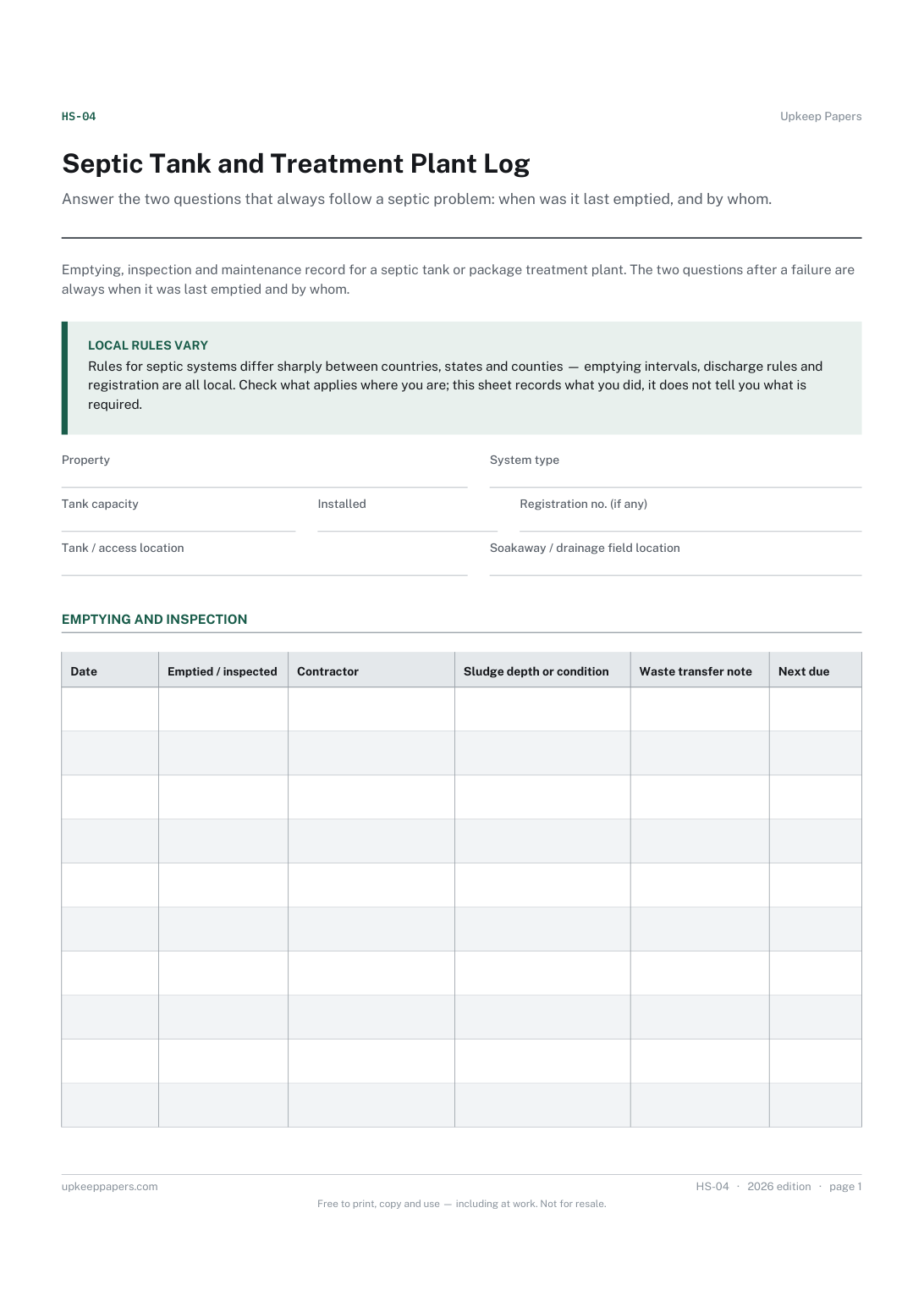
Septic Tank and Treatment Plant Log
Answer the two questions that always follow a septic problem: when was it last emptied, and by whom.
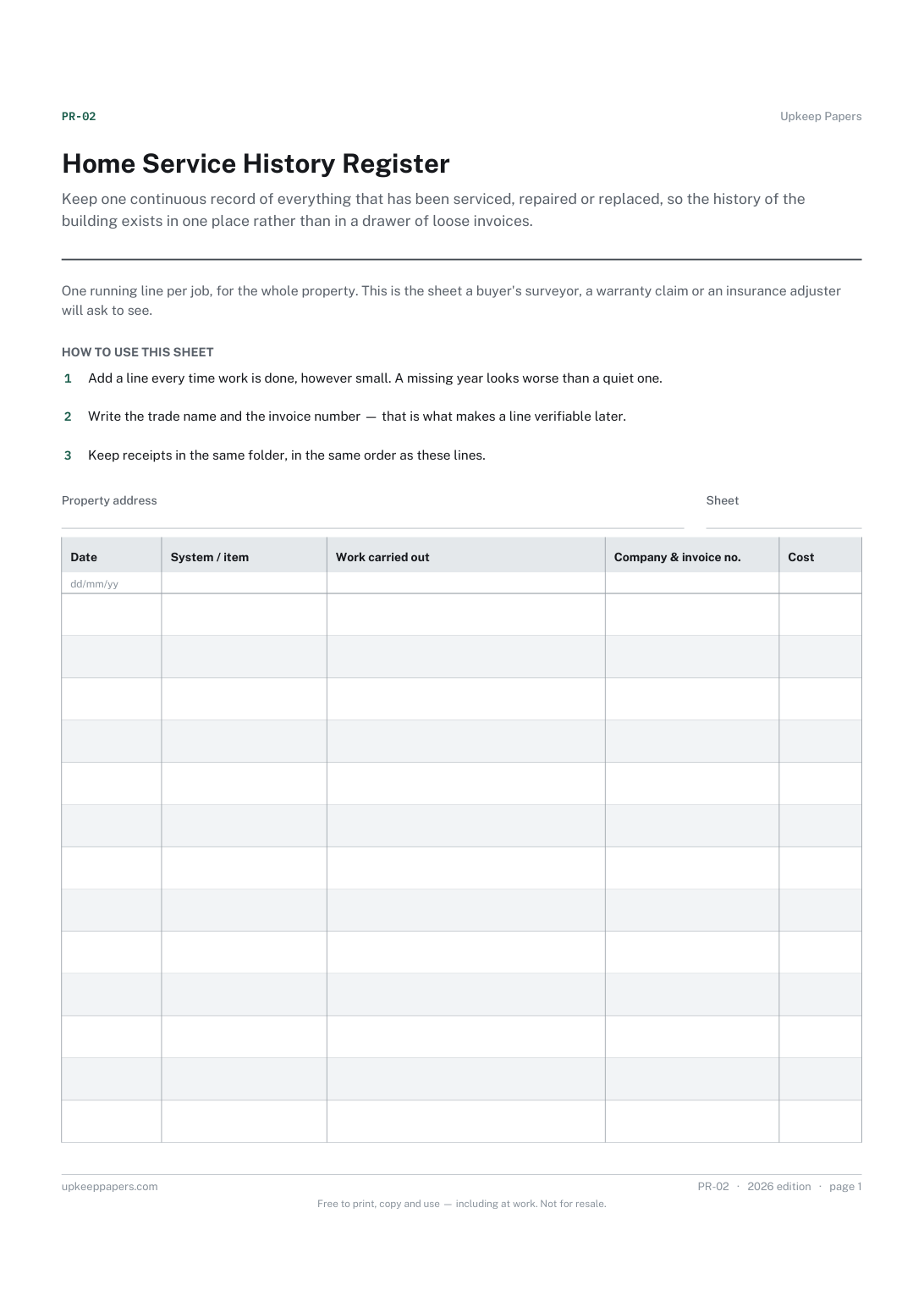
Home Service History Register
Keep one continuous record of everything that has been serviced, repaired or replaced, so the history of the building exists in one place rather than in a drawer of loose invoices.
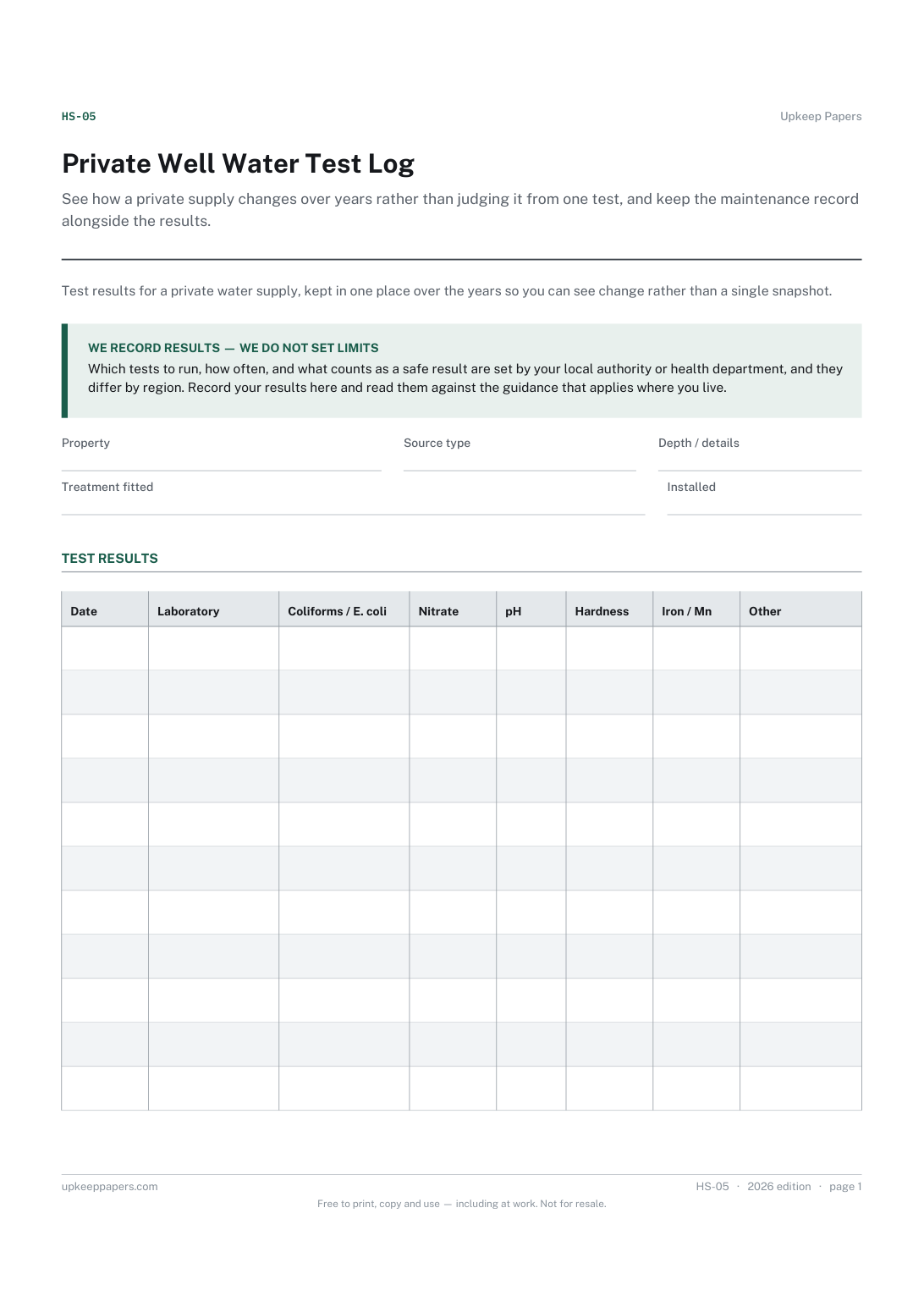
Private Well Water Test Log
See how a private supply changes over years rather than judging it from one test, and keep the maintenance record alongside the results.
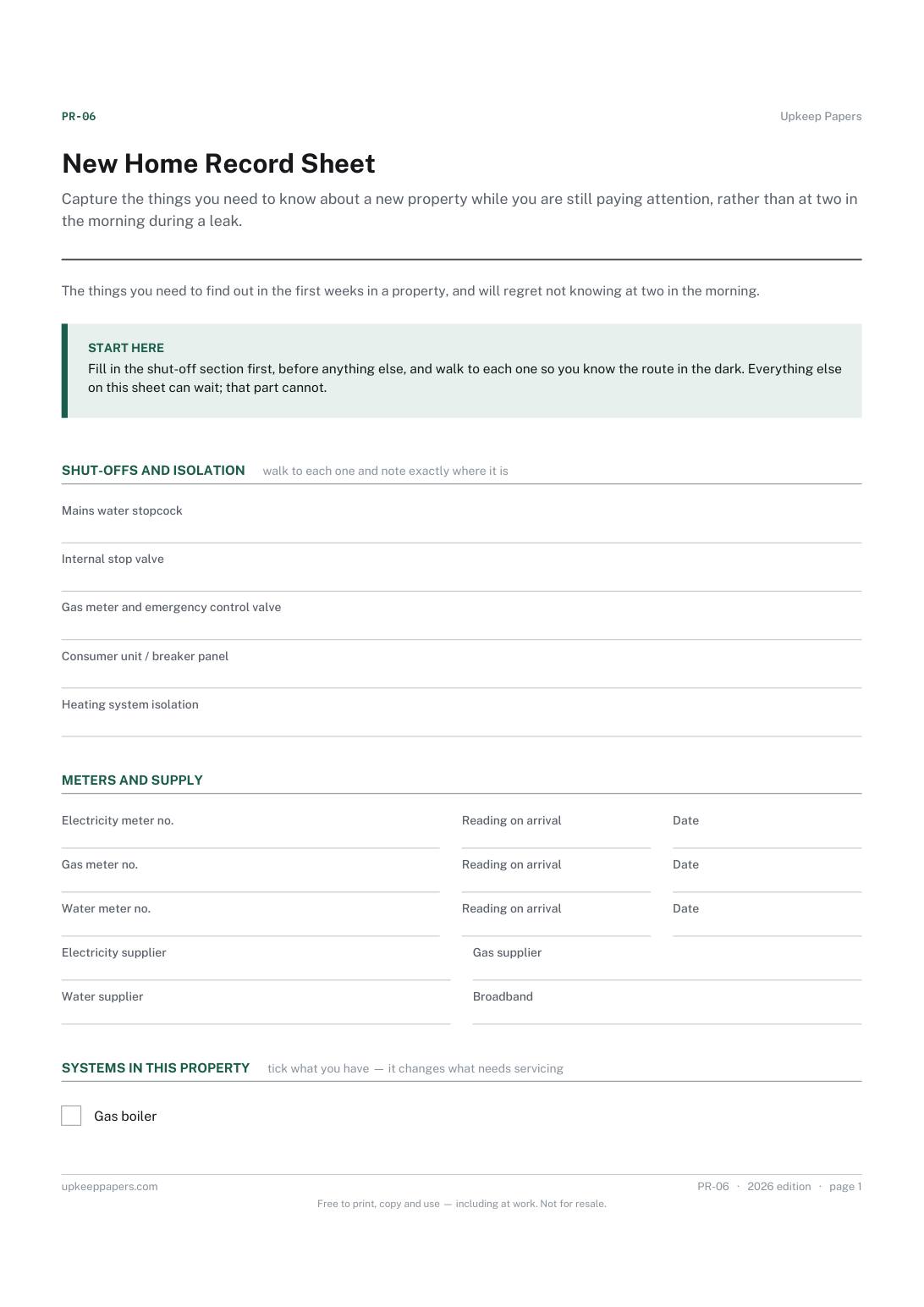
New Home Record Sheet
Capture the things you need to know about a new property while you are still paying attention, rather than at two in the morning during a leak.
More guides
How Often to Change Every Filter in Your House
A walk through every filter in a typical house, what actually governs each interval, why annually is usually the wrong answer, and the size trick worth doing once.
How Often Should You Service Everything in Your Home?
A reference to how often the systems and machines in a house need servicing, why the intervals differ, and how to find the right figure for yours.
Private Well Water Testing Records
A single water test tells you about one moment at one tap. A run of results tells you what your supply actually does, and that is where the value is.