Classroom Supplies Inventory
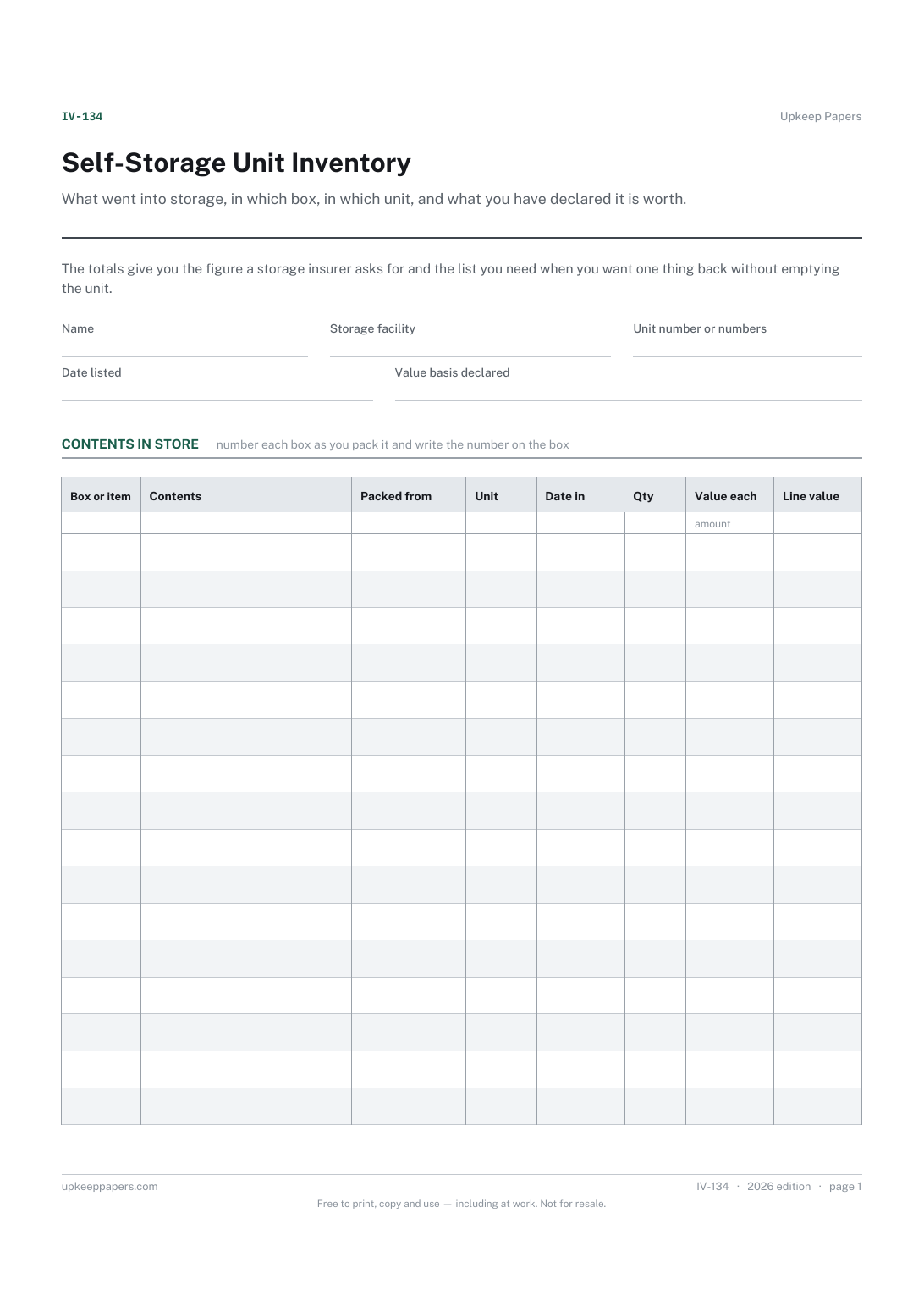
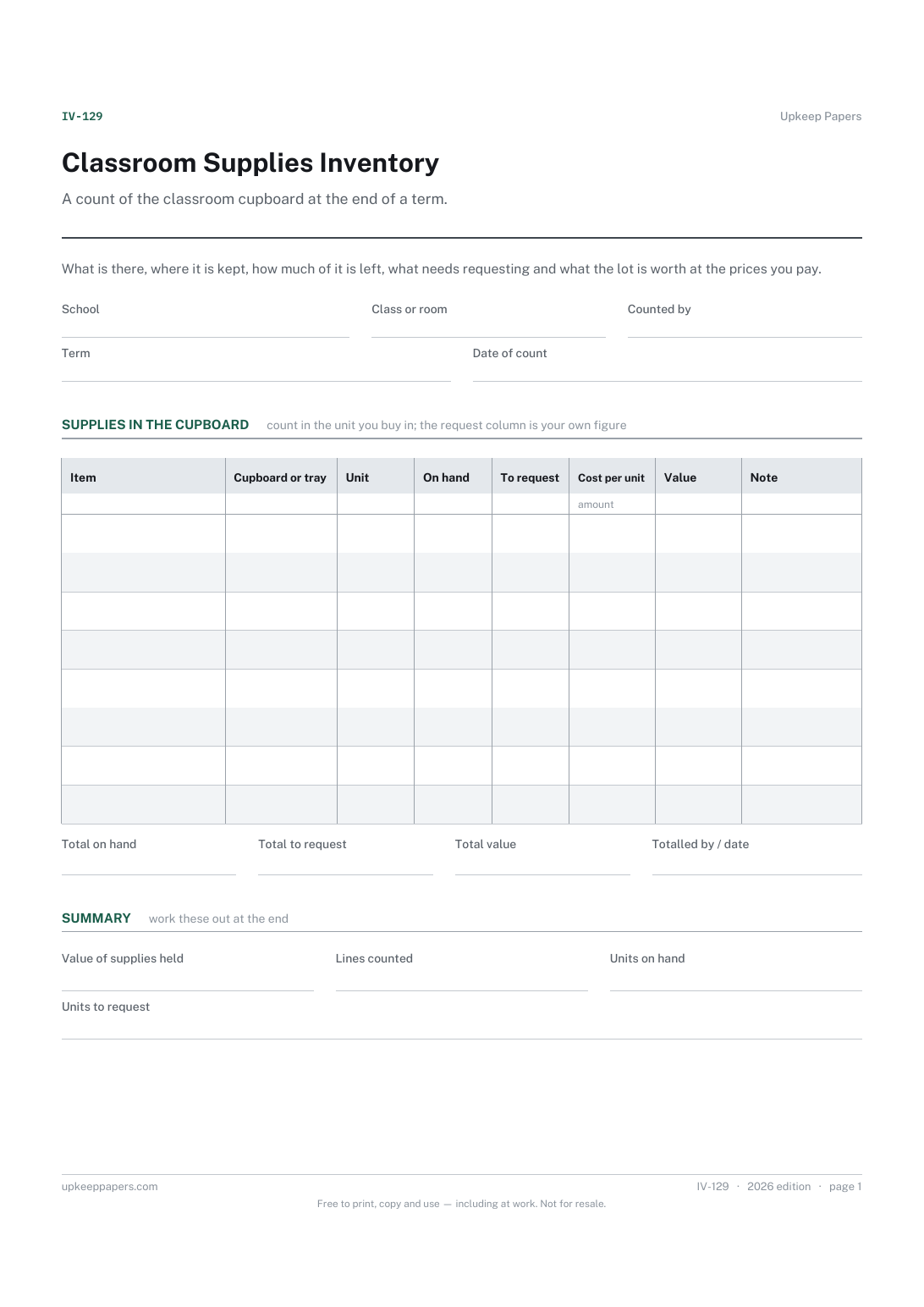
What is held in each cupboard, tray or store, and in what pack size.
IV-129 Inventory PDF Excel Online
Everything here is free. Making it takes time and money. Everything here is free.
 Buy us a coffee
Inventories and stocktakes · IV-130 · Inventory
Free art and craft materials inventory — paints, paper, clay and thread by colour, size and store, counted and valued. Excel, PDF and browser versions.
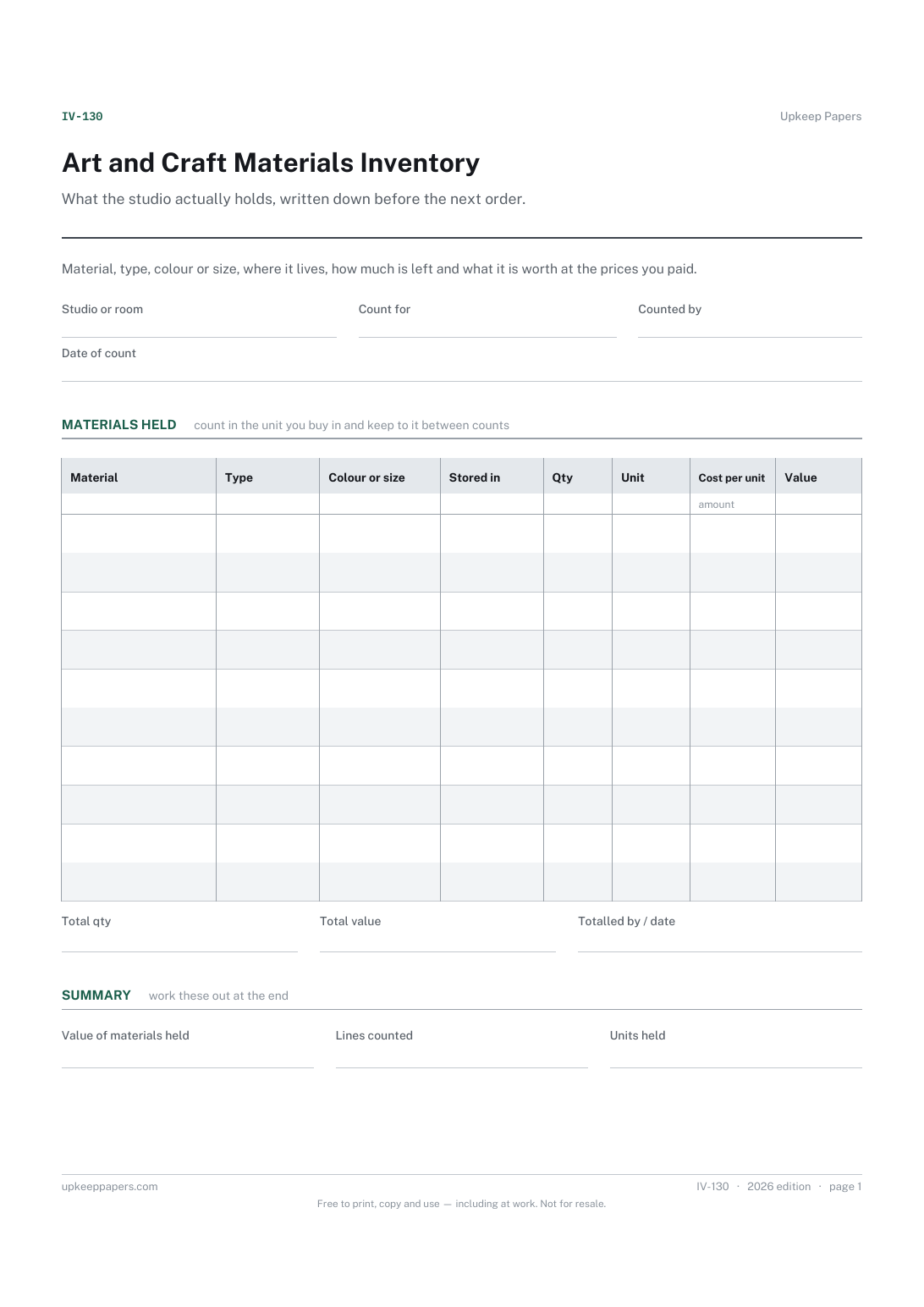
One page. The A4 and US Letter files are laid out identically, so neither is shrunk to fit.
Print it and write on it
Fillable PDF type and save
Spreadsheet formulas included
The fillable versions have real form fields — open them in any PDF reader, type into them and save. Printing help.
The same sheet, on screen. Totals and figures are worked out as you type, rows can be added or removed, and you can print it or download the completed version as a PDF. Everything stays in your browser — your entries are kept in this browser's own storage on this device, nothing is uploaded, and there is no account.
What the studio actually holds, written down before the next order. Material, type, colour or size, where it lives, how much is left and what it is worth at the prices you paid.
Artists and makers with a studio to restock, craft tutors preparing for a class, and anyone selling work who needs a materials figure for their accounts or their insurance.
The printable is laid out inside a box that fits both A4 and US Letter, so the two files are identical and neither one is scaled. The fillable PDF has real form fields. The workbook uses plain formulas only — SUM, IF, COUNTIF and the like — so it opens in Excel, LibreOffice and Google Sheets without anything breaking, and every calculated cell is grey so you can see which figures it worked out.
Download the A4 or US Letter file to match the paper in your printer, open it in a PDF reader and print at 100% — not "fit to page", which shrinks the writing space. Both files leave a 14 mm margin, which clears the unprintable edge on home printers. To print the online version with your entries in it, use the Print this sheet button, which prints only the sheet and none of the page around it. More on printing.
Count them however you can describe consistently — half a tube is a half, a part-roll is a rough metre figure. Precision matters less than using the same method every time.
It can, though a large stash is better served by the yarn and fabric stash inventory, which is built around fibre, weight and dye lot. This sheet suits a mixed studio holding several kinds of material.
Two reasons: it gives you a figure for insurance, and if you sell your work it feeds into what a piece costs to make. The sheet totals what you enter and leaves the pricing to you.
Yes — name the project in the header and count only what it uses. Keeping a studio-wide sheet as well is worth the effort, as it is the one an insurer would ask for.
What is held in each cupboard, tray or store, and in what pack size.
What is in each numbered box or on each pallet, in enough detail to find it again.
Each device, where it is and the battery type and size it takes.
Printable sheets, workbooks and tools on the same subject.
Get the ball band's detail onto paper before the band is lost, especially the dye lot, which exists nowhere else once it is gone.
Record the things a finished object cannot tell you later: which dye lot, which hook you really used, and how much was left over.
Keep a catalogue of finished work and where it went, which is the record galleries, insurers and tax authorities ask for and working artists rarely have.

Every sheet, binder, game and puzzle on Upkeep Papers is free to download, with no email and no account. Making them is not free: each one takes days of research, design and checking, and the site costs money to run. If something here saved you time, you can buy us a coffee. It is entirely optional: nothing is locked, and nothing changes if you don’t.
Buy us a coffee Opens PayPal in a new tab. Any amount, and nothing changes if you would rather not.