Guide · Home systems
What a Boiler Service Should Actually Include
What a competent heating service involves, what should appear on the paperwork afterwards, the questions worth asking, and what to keep in your own records.
Published
A boiler service is an inspection, not a repair. That distinction explains most of what confuses people about it — why you pay for a visit that appears to change nothing, why two services can cost very different amounts, and why a service can be done badly without anything obviously going wrong for another two years.
This page describes what a thorough service involves so that you can tell a real one from a token one, understand the paperwork you are handed, and know what to record. It is not a set of instructions. Work on gas and oil appliances is for qualified engineers, and the registration schemes that define who is qualified differ substantially between countries and, in some places, between regions. Check what applies where you live rather than assuming the rules you have read about elsewhere carry over.
The parts of a service you will not see
Most of the value is in checks that produce no visible change to the appliance.
The look around before anything is touched. A competent engineer spends the first few minutes not on the boiler but on its situation: ventilation openings, clearances, the flue route and where it terminates, the condensate discharge and whether it is routed somewhere that will freeze, staining or corrosion on or near the case, and the condition of the pipework. Several of the most serious faults a heating system can develop are visible from across the room to somebody who knows what they are looking at.
Combustion. This is the safety core of the service. Readings are taken with a flue gas analyser and compared against what the manufacturer specifies for that appliance. It is the single most informative thing done during the visit, and it is also the part most often skipped, because it takes time and equipment and nobody watching would know it had been missed.
Flue integrity. Depending on the appliance and the installation, this can involve inspection of accessible joints, checks at the terminal, and — where the design calls for it — access via inspection points. On a room-sealed appliance the flue is the barrier between combustion products and the room, so its condition is not a detail.
The parts you would recognise as work
Opening up and cleaning. Case off, burner and combustion chamber inspected and cleaned, heat exchanger checked for debris and corrosion, ignition and sensing electrodes cleaned or replaced, condensate trap cleared, and case seals checked and refitted properly. A case seal that is not seating is a genuine fault, not a cosmetic one, on a room-sealed boiler.
The expansion vessel. Charge pressure is checked and adjusted. This is the item most frequently left out of a hurried service, and it is the reason a great many systems lose pressure repeatedly and get topped up every few weeks by an owner who assumes there is a leak somewhere.
Safety devices and controls. Pressure relief, thermostats and cut-outs operating as they should, and the appliance’s own diagnostics read where it keeps a fault history.
System condition. System pressure, whether the radiators are heating evenly, the state of any magnetic filter, and the inhibitor level in the water. Some of these are properly part of a service and some are chargeable extras — worth agreeing beforehand rather than discovering on the invoice.
Oil appliances differ in the detail rather than the principle. A service normally includes replacing the nozzle and the oil filter, setting combustion, and checking the tank, the line and any fire valve. The tank and its surroundings are worth a look of your own between services, because tanks fail slowly and visibly.
What a service is not
It is not a visual check and a sticker. If an engineer is in and out in a very short time with the case never removed and no analyser used, you have bought a visit rather than a service, and the paperwork will usually reflect that by being vague.
It is also not a guarantee that nothing will go wrong. A service catches deterioration and unsafe conditions. It does not prevent a component failing three months later, and an engineer who implies otherwise is overselling.
What should appear on the paperwork
Ask for a written record, and check it contains the things that make it useful later:
- The date, and the name of the engineer or business.
- The engineer’s registration or licence number under whatever scheme applies locally.
- The appliance make, model and serial number — not just “boiler”.
- What was actually done, in enough detail to distinguish a full service from a check.
- The combustion readings, as numbers. “Combustion tested” is not a record. The figures are.
- Any parts fitted.
- Any defects found, what was done about them, and how they were classified if the local scheme classifies them.
- The date the next service is due.
The numbers matter more than any single one of them looks, because their value is as a series. One year’s combustion reading tells you whether the appliance was within specification on the day. Four years of readings tell you whether it is drifting, which is information you cannot get any other way and which nobody will give you unless you kept the previous sheets.
Questions worth asking while the engineer is there
None of these are confrontational, and a good engineer will answer them happily.
- What were the combustion figures, and how do they compare with what the manufacturer specifies?
- Was the expansion vessel checked, and did it need re-pressurising?
- What condition is the heat exchanger in?
- Is anything visibly on its way out, even if it is working today?
- What is the system pressure doing between visits, and is the inhibitor level adequate?
- Is there anything about the installation itself — ventilation, flue, condensate — that you would change?
That last question is the most useful one to ask about an appliance you inherited when you bought the house, because installation faults do not develop over time. They were there from the day it went in, and the person who lived there before you may never have had anyone look.
What to keep
File the engineer’s paperwork, and write your own line in a Boiler Service Record at the same time: date, who came, what was done, the combustion readings, anything replaced, and anything flagged for next time. The engineer’s document is the evidence. Your line is what makes a run of them readable at a glance.
Add the appliance itself to the Appliance and Equipment Register once, with the make, model, serial number, installation date and where the rating plate is, because those are the details a warranty department or a parts supplier asks for and the details nobody can ever find. If the property has a separate hot water cylinder or unvented system, that has its own service requirements and belongs on a Water Heater Maintenance Log rather than being folded into the boiler record.
Then index the whole lot on the Home Service History Register. An unbroken run of annual services is the strongest single piece of evidence you can hold about a heating system, and it is worth something in three separate situations: a warranty claim, an insurance claim, and a sale. In all three, the question is the same — when was it last serviced, by whom, and can you show it.
From the library
Sheets mentioned here
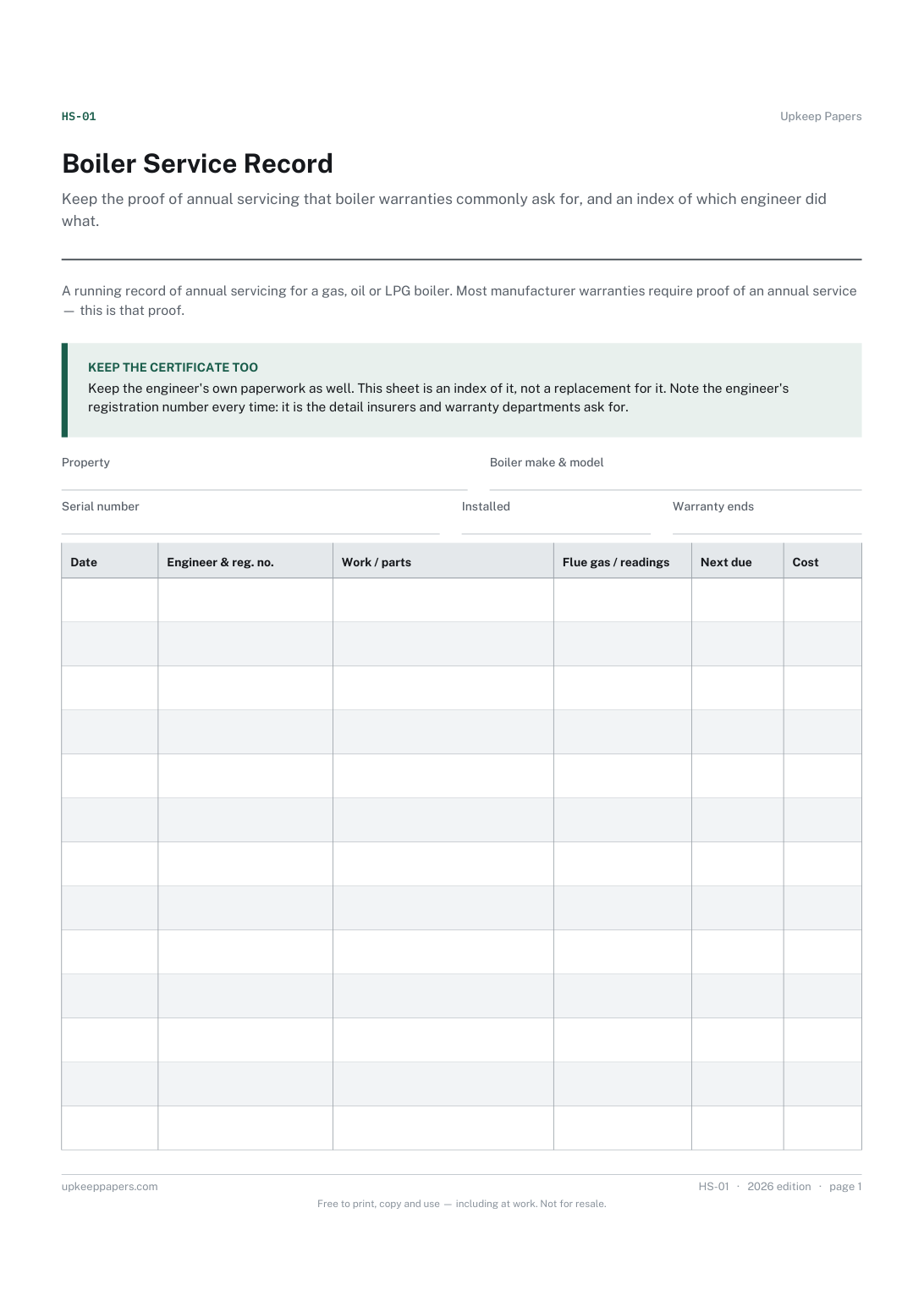
Boiler Service Record
Keep the proof of annual servicing that boiler warranties commonly ask for, and an index of which engineer did what.
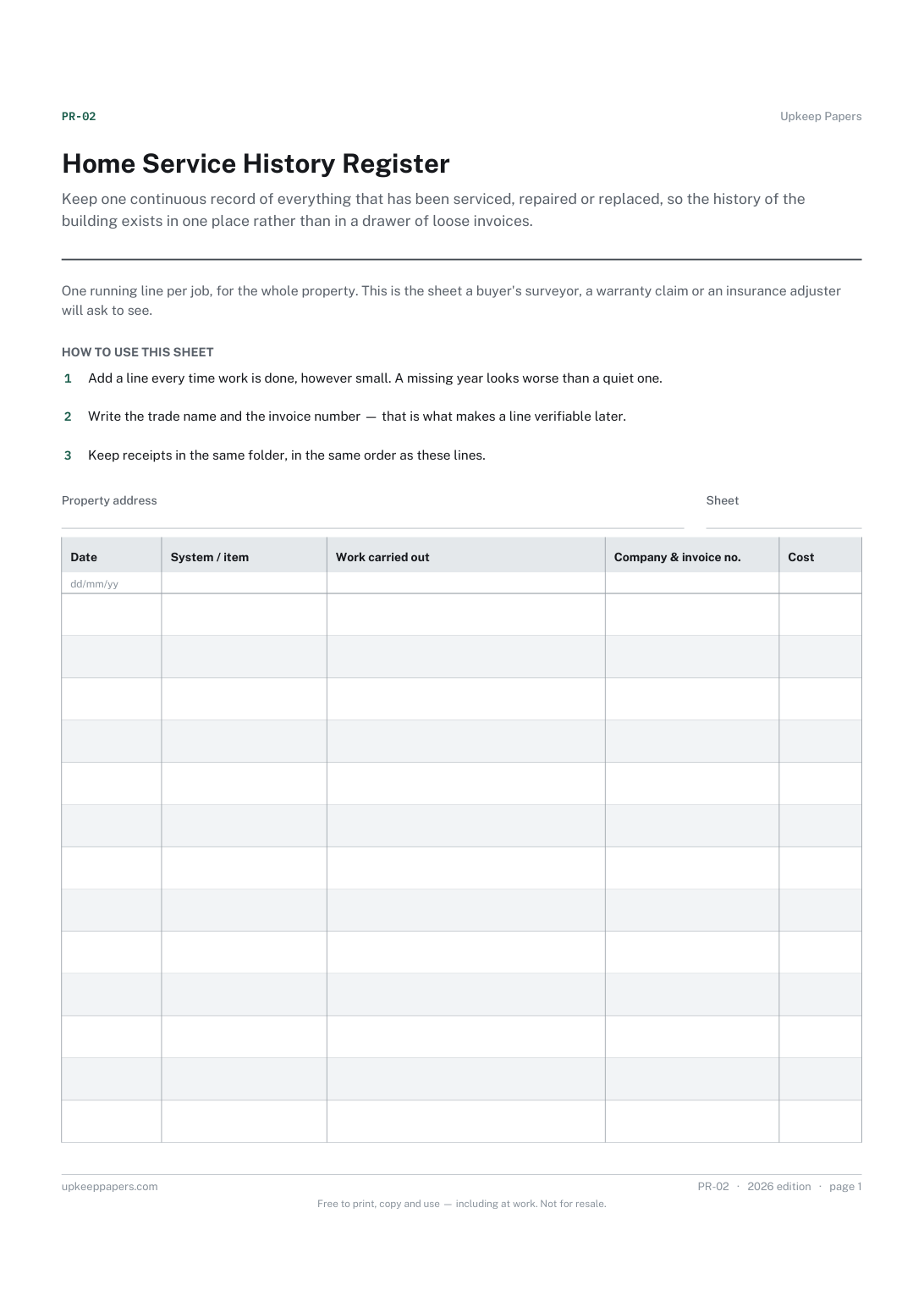
Home Service History Register
Keep one continuous record of everything that has been serviced, repaired or replaced, so the history of the building exists in one place rather than in a drawer of loose invoices.
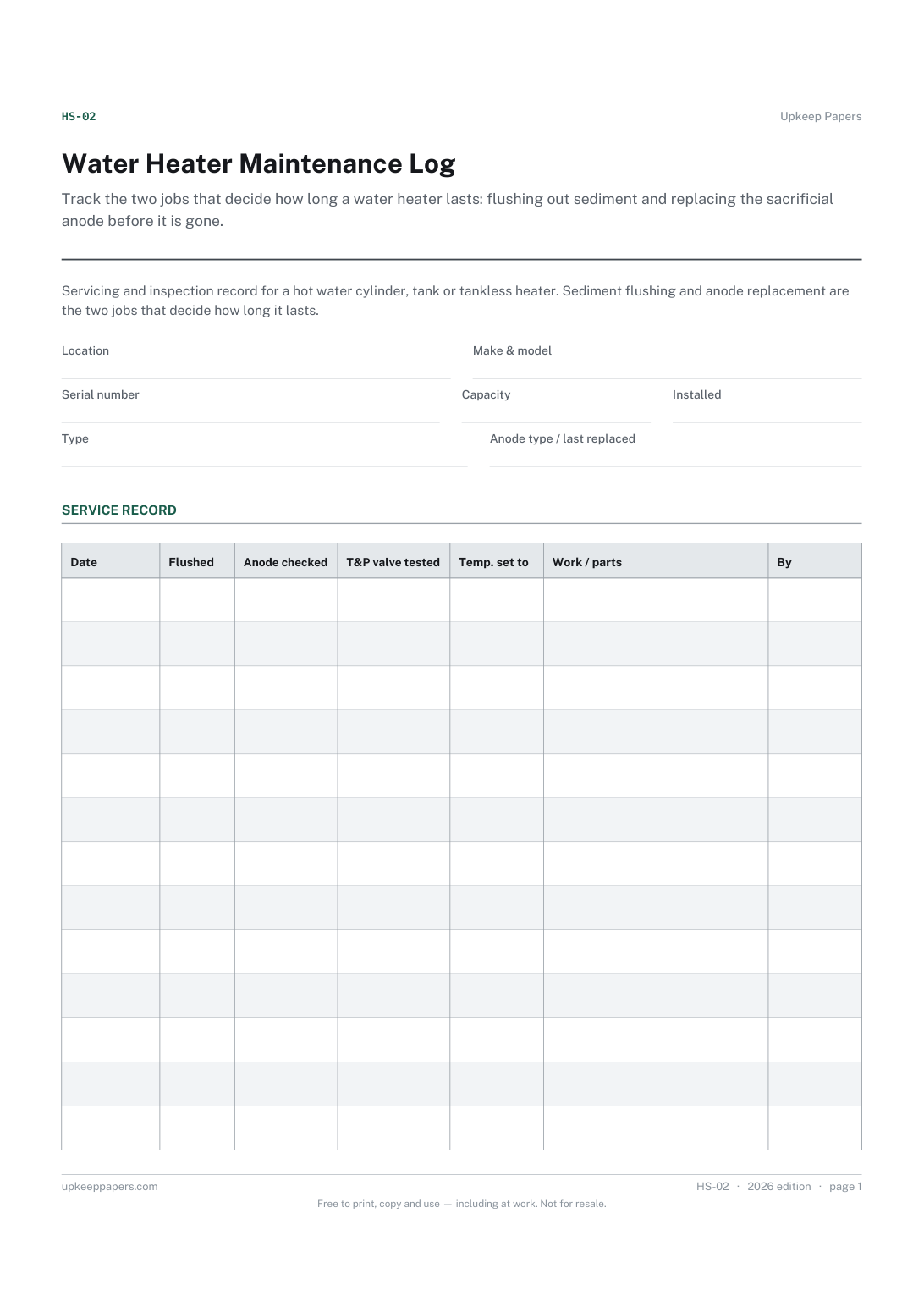
Water Heater Maintenance Log
Track the two jobs that decide how long a water heater lasts: flushing out sediment and replacing the sacrificial anode before it is gone.
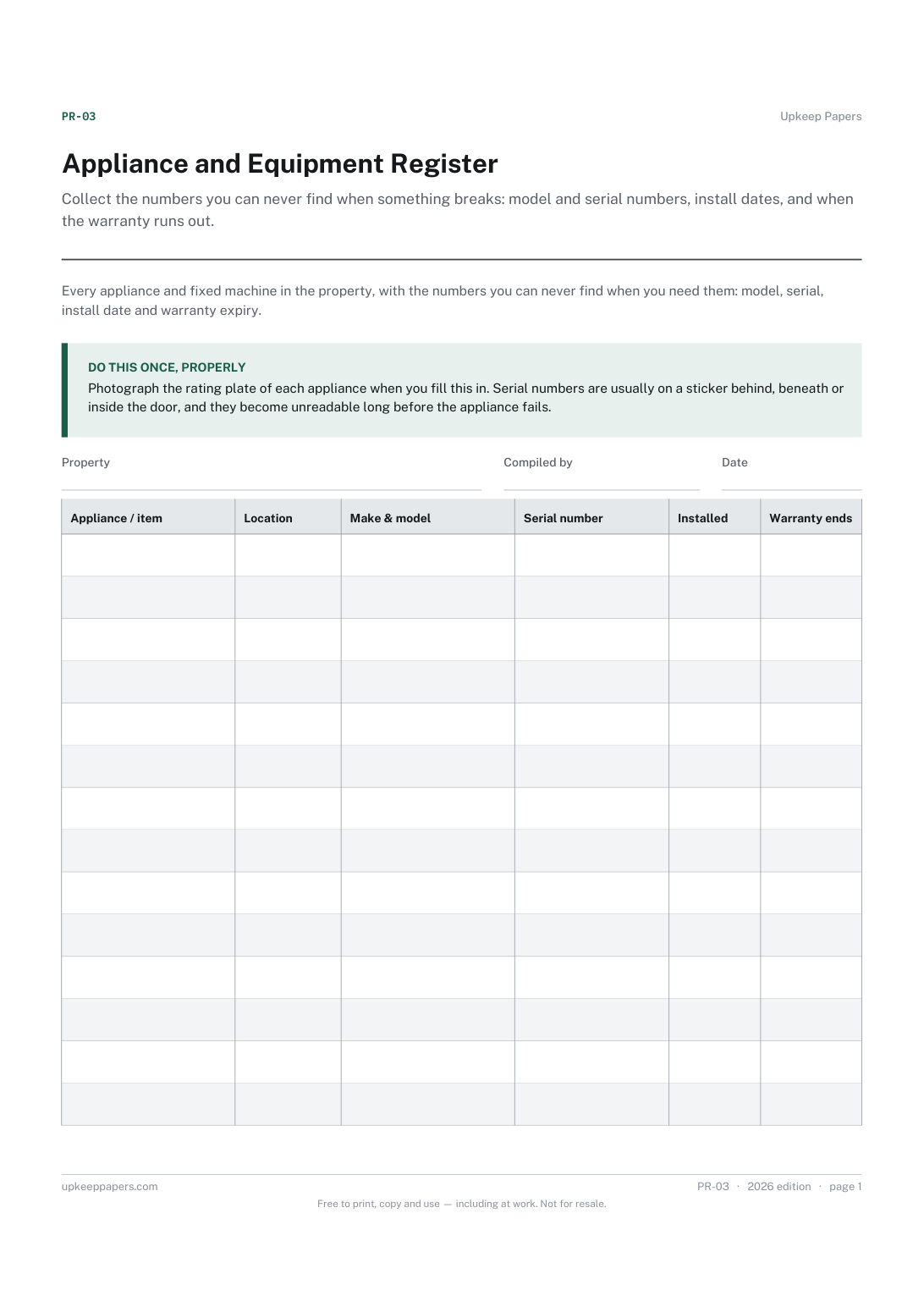
Appliance and Equipment Register
Collect the numbers you can never find when something breaks: model and serial numbers, install dates, and when the warranty runs out.
More guides
How Often to Change Every Filter in Your House
A walk through every filter in a typical house, what actually governs each interval, why annually is usually the wrong answer, and the size trick worth doing once.
How Often Should You Service Everything in Your Home?
A reference to how often the systems and machines in a house need servicing, why the intervals differ, and how to find the right figure for yours.
Private Well Water Testing Records
A single water test tells you about one moment at one tap. A run of results tells you what your supply actually does, and that is where the value is.