Cashbook with Running Balance
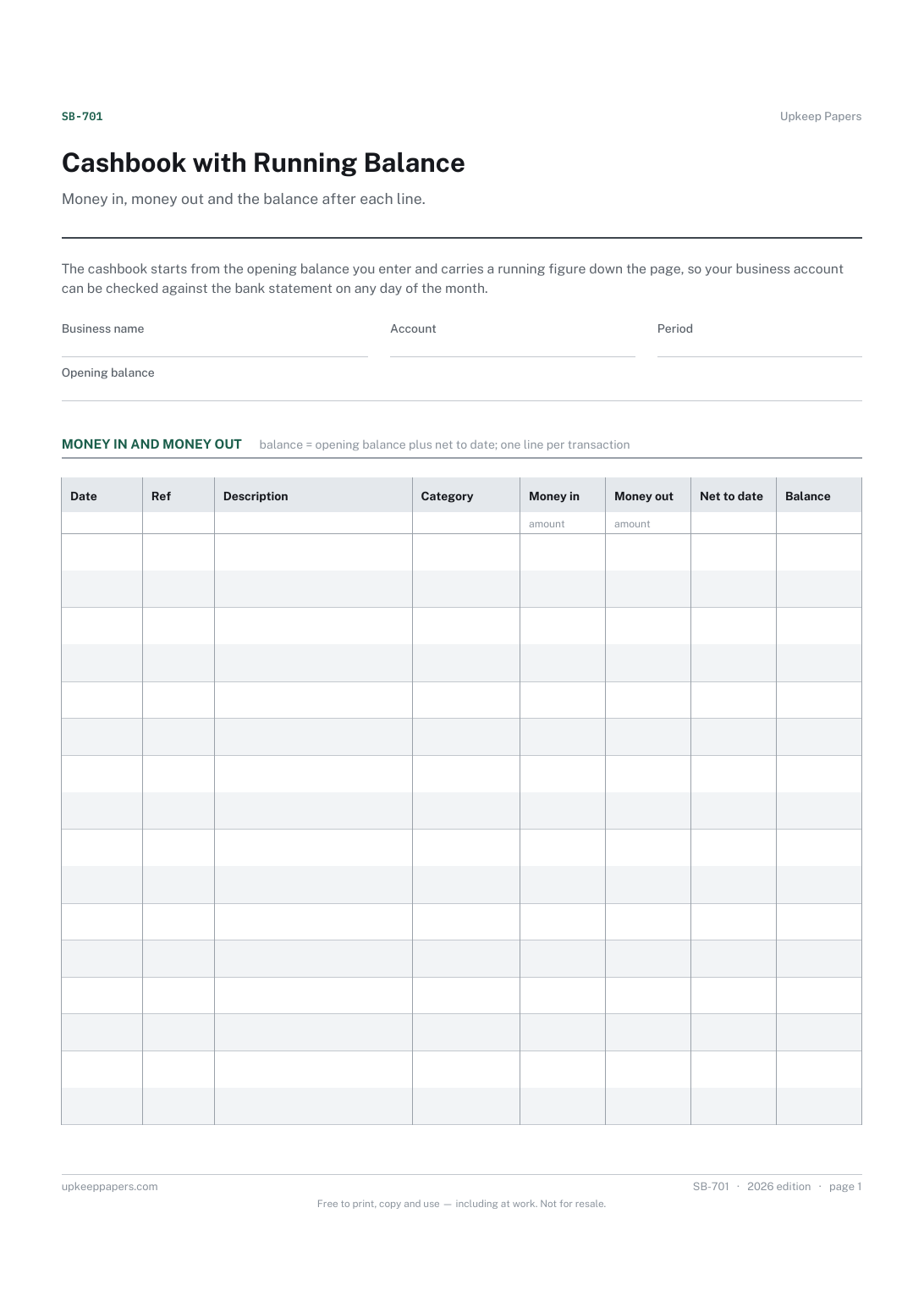
Every receipt and payment for the period, in date order.
SB-701 Log PDF Excel Online
Everything here is free. Making it takes time and money. Everything here is free.
 Buy us a coffee
Self-Employed Bookkeeping Sheets · SB-719 · Log
Owner drawings log for sole traders: money taken out and put in, how it moved, a running net figure and yearly totals. PDF, Excel and browser.
2 pages. The A4 and US Letter files are laid out identically, so neither is shrunk to fit.
Print it and write on it
Fillable PDF type and save
Spreadsheet formulas included
The fillable versions have real form fields — open them in any PDF reader, type into them and save. Printing help.
The same sheet, on screen. Totals and figures are worked out as you type, rows can be added or removed, and you can print it or download the completed version as a PDF. Everything stays in your browser — your entries are kept in this browser's own storage on this device, nothing is uploaded, and there is no account.
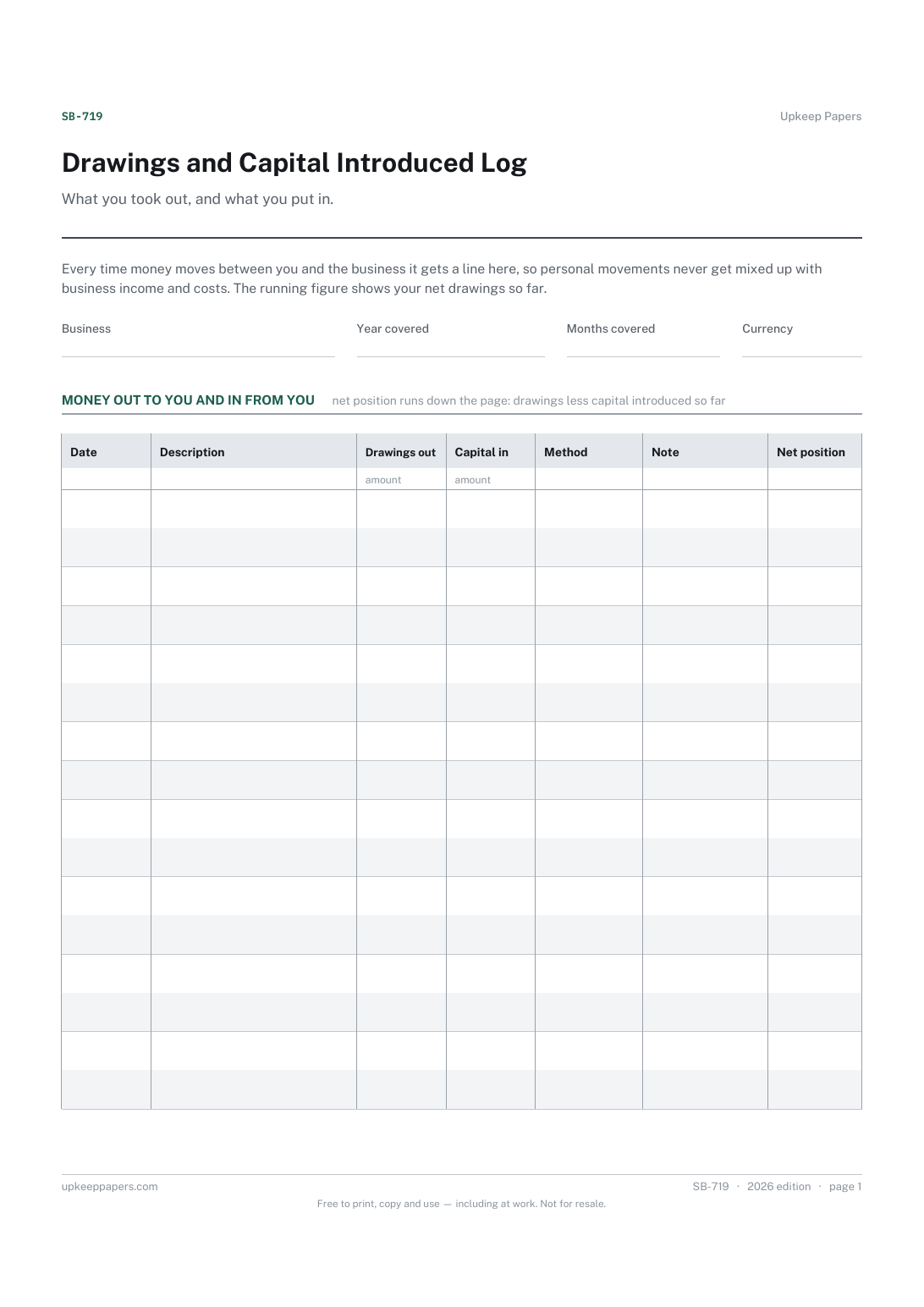
What you took out, and what you put in. Every time money moves between you and the business it gets a line here, so personal movements never get mixed up with business income and costs. The running figure shows your net drawings so far.
Sole traders who pay themselves from the business account, who sometimes top the business up from savings, or who pay business costs from a personal card and need to record it.
The printable is laid out inside a box that fits both A4 and US Letter, so the two files are identical and neither one is scaled. The fillable PDF has real form fields. The workbook uses plain formulas only — SUM, IF, COUNTIF and the like — so it opens in Excel, LibreOffice and Google Sheets without anything breaking, and every calculated cell is grey so you can see which figures it worked out.
Download the A4 or US Letter file to match the paper in your printer, open it in a PDF reader and print at 100% — not "fit to page", which shrinks the writing space. Both files leave a 14 mm margin, which clears the unprintable edge on home printers. To print the online version with your entries in it, use the Print this sheet button, which prints only the sheet and none of the page around it. More on printing.
Money or goods you take out of the business for yourself: transfers to a personal account, cash from the takings, stock taken home. It is not a business cost, so it does not go in your expenses records.
Because the business owes you for them. Recording them as capital in keeps the books honest: the cost goes in your expense records as usual, and this log shows that the money came from you.
A running total of drawings less capital introduced since the start of the log. A rising figure means more has gone out to you than has come in from you.
Total drawings divided by the number of months you enter at the top. Enter the months the log actually covers, so a part year gives a fair figure.
Every receipt and payment for the period, in date order.
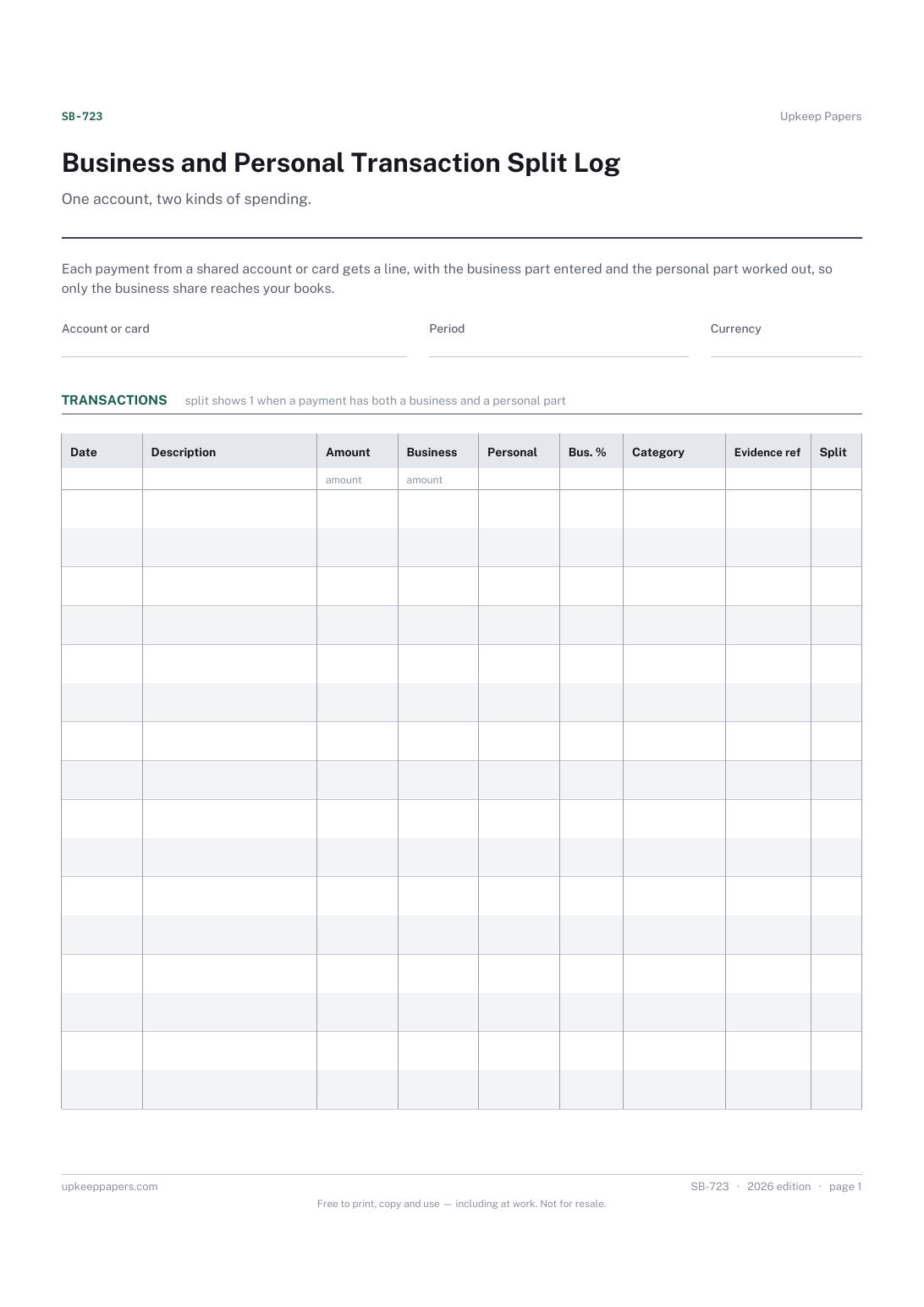
Every payment from the shared account or card in the period.
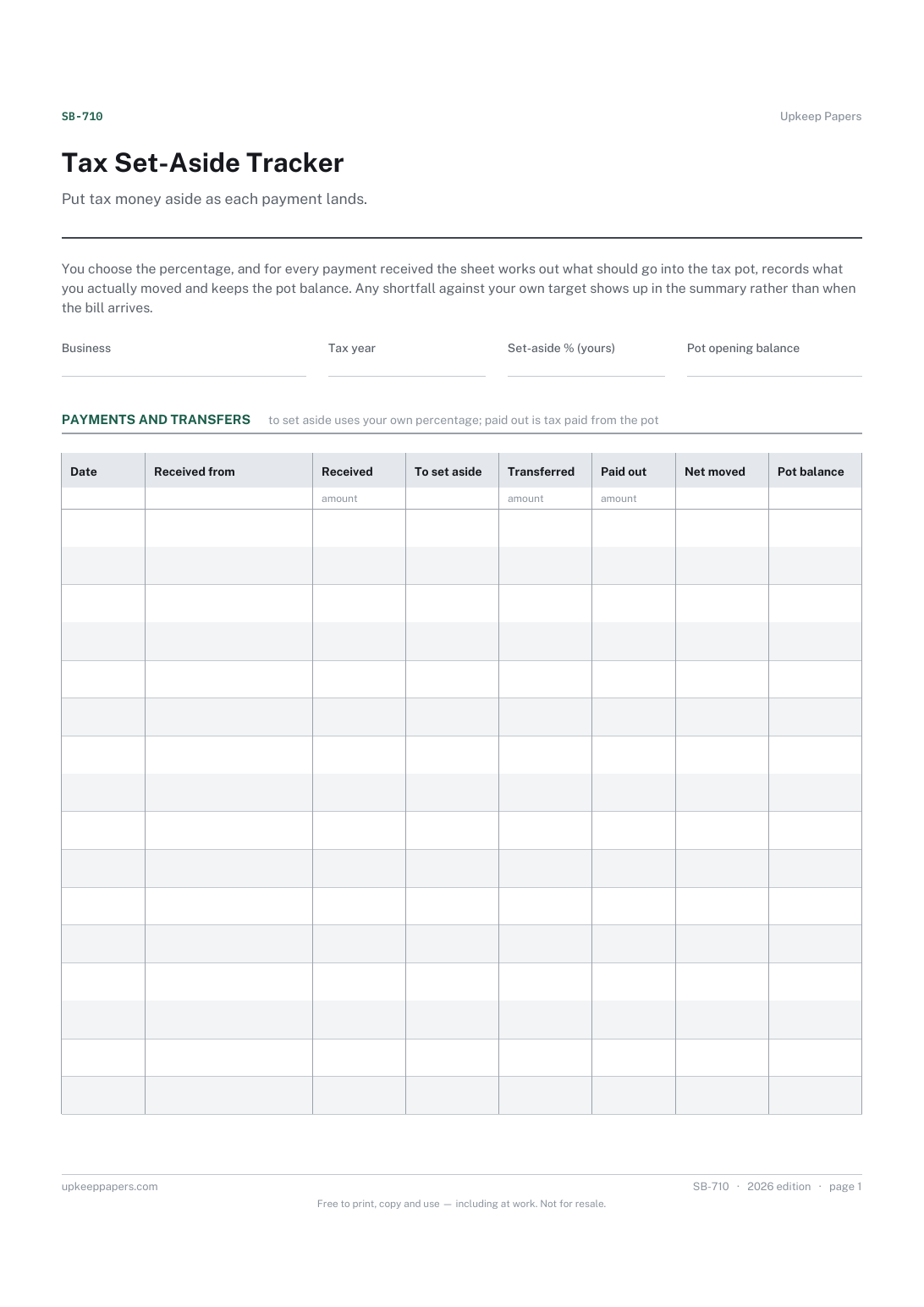
Each payment received, who it came from and when.
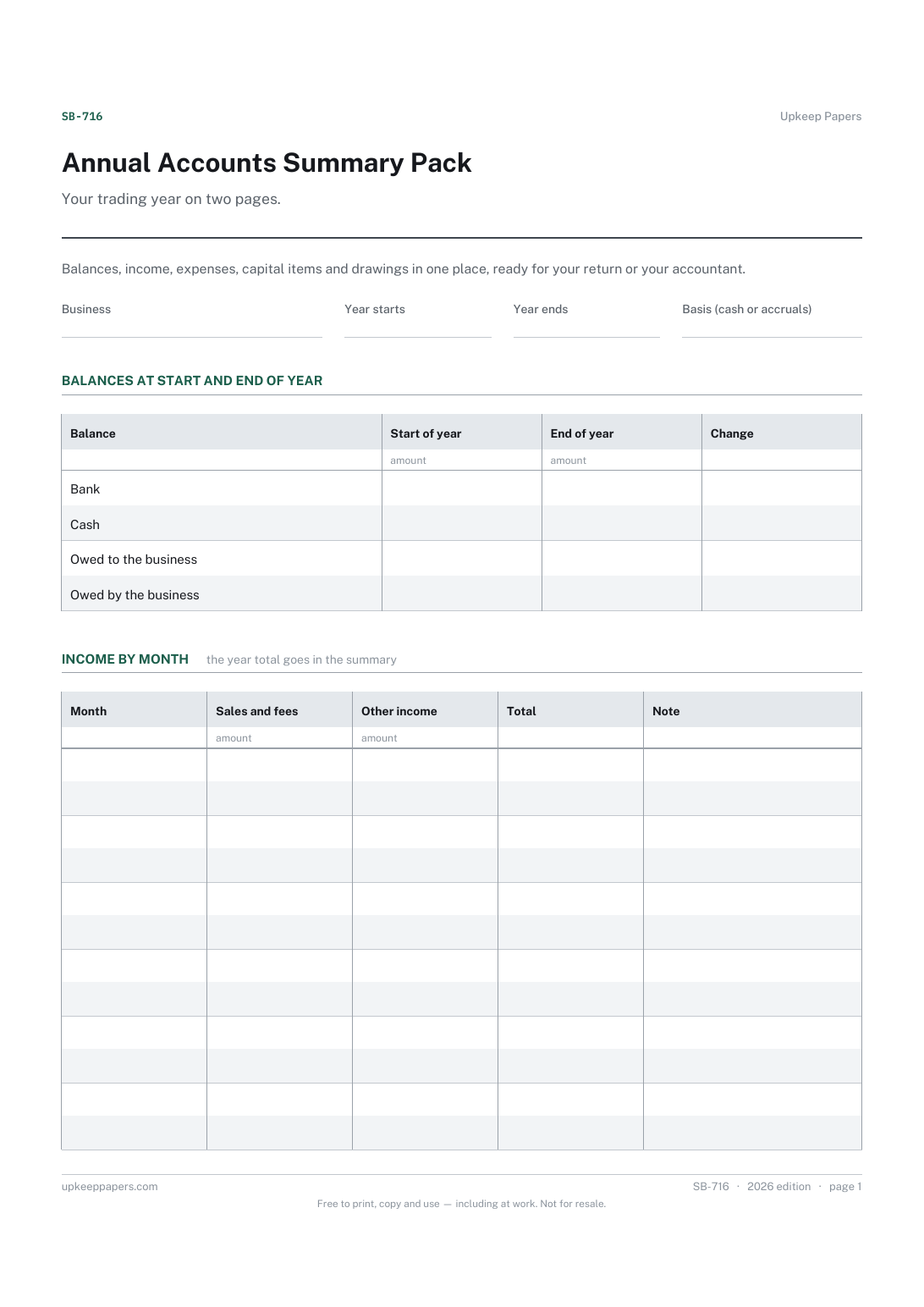
Income for each month of the trading year.
Printable sheets, workbooks and tools on the same subject.
Keep a plain, readable record of one account that you can follow down the page and total at the foot.

Every sheet, binder, game and puzzle on Upkeep Papers is free to download, with no email and no account. Making them is not free: each one takes days of research, design and checking, and the site costs money to run. If something here saved you time, you can buy us a coffee. It is entirely optional: nothing is locked, and nothing changes if you don’t.
Buy us a coffee Opens PayPal in a new tab. Any amount, and nothing changes if you would rather not.