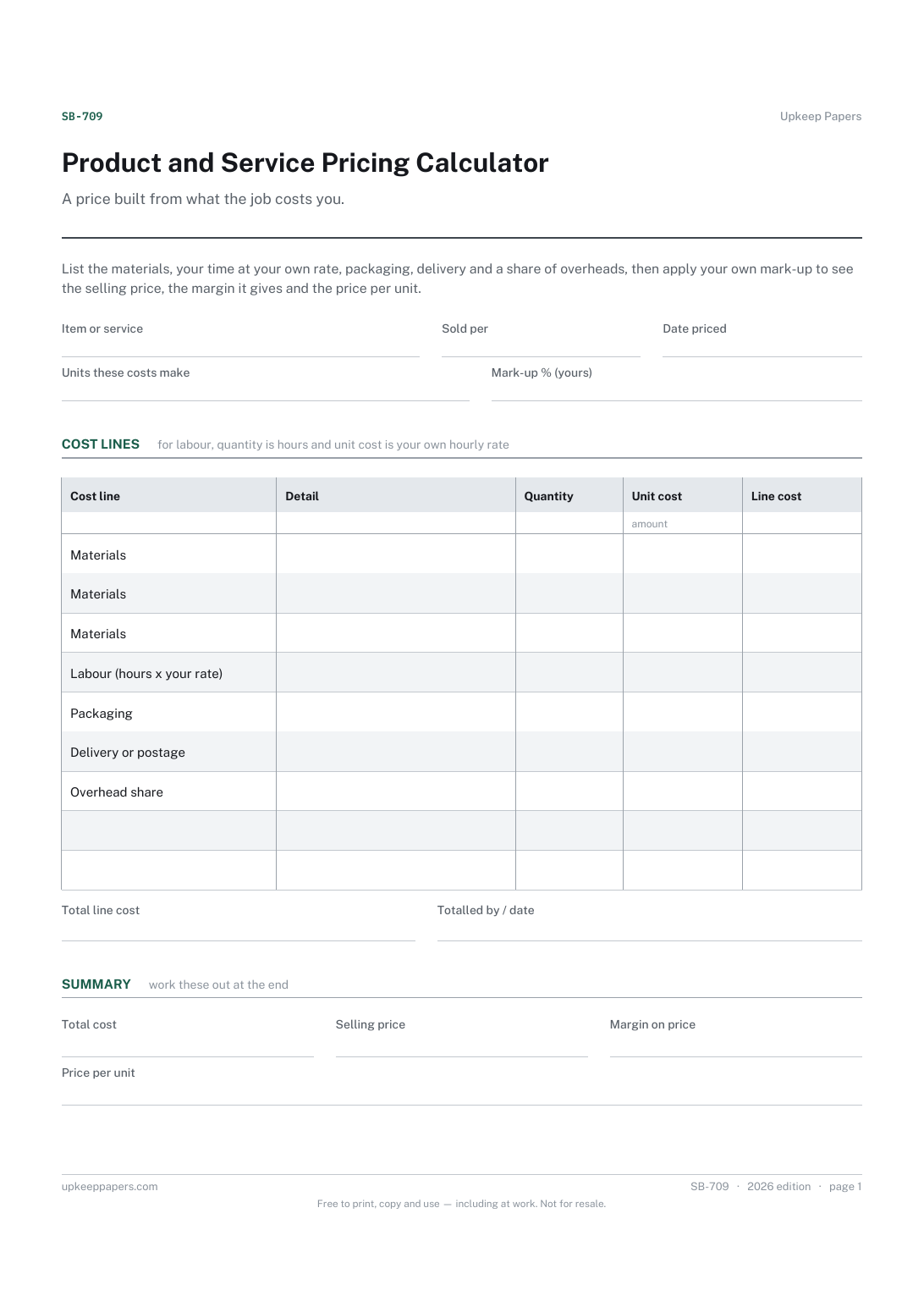
Product and Service Pricing Calculator
Every cost that goes into one item or one job.
SB-709 Form PDF Excel Online
Everything here is free. Making it takes time and money. Everything here is free.
 Buy us a coffee
Self-Employed Bookkeeping Sheets · SB-708 · Form
Free freelance rate calculator: works out the hourly and day rate you need from your own income target, costs and billable hours. Excel, PDF and browser.
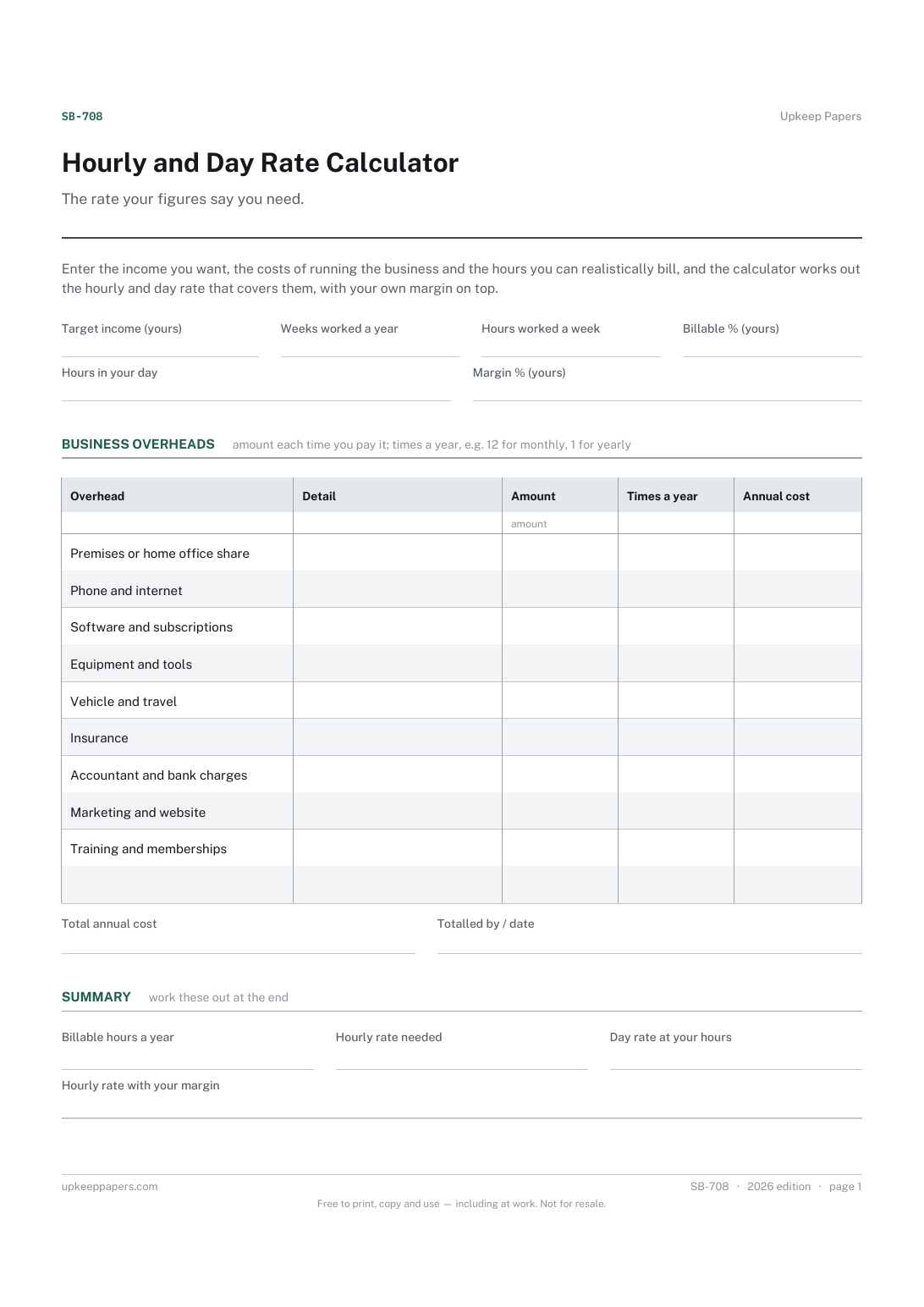
One page. The A4 and US Letter files are laid out identically, so neither is shrunk to fit.
Print it and write on it
Fillable PDF type and save
Spreadsheet formulas included
The fillable versions have real form fields — open them in any PDF reader, type into them and save. Printing help.
The same sheet, on screen. Totals and figures are worked out as you type, rows can be added or removed, and you can print it or download the completed version as a PDF. Everything stays in your browser — your entries are kept in this browser's own storage on this device, nothing is uploaded, and there is no account.
The rate your figures say you need. Enter the income you want, the costs of running the business and the hours you can realistically bill, and the calculator works out the hourly and day rate that covers them, with your own margin on top.
Freelancers and sole traders setting a rate for the first time, or reviewing one that has not changed in years, who want the number to come from their own costs rather than from what others charge.
The printable is laid out inside a box that fits both A4 and US Letter, so the two files are identical and neither one is scaled. The fillable PDF has real form fields. The workbook uses plain formulas only — SUM, IF, COUNTIF and the like — so it opens in Excel, LibreOffice and Google Sheets without anything breaking, and every calculated cell is grey so you can see which figures it worked out.
Download the A4 or US Letter file to match the paper in your printer, open it in a PDF reader and print at 100% — not "fit to page", which shrinks the writing space. Both files leave a 14 mm margin, which clears the unprintable edge on home printers. To print the online version with your entries in it, use the Print this sheet button, which prints only the sheet and none of the page around it. More on printing.
Because not every working hour is billable and the business has costs of its own. Leaving either out produces a rate that looks fine on paper and leaves you short at the end of the year.
Your own. Look back at a few typical weeks and compare hours you invoiced with hours you worked. The sheet does not suggest a figure because it varies too much between trades and between people.
Income tax is usually worked out on profit, so it is often simpler to set a target income that allows for it. How you treat it is up to you and the rules where you are.
A cushion above the break-even rate for quiet months, unpaid invoices or investment in the business. It is entered as your own percentage; leave it at zero to see the bare rate.
Every cost that goes into one item or one job.
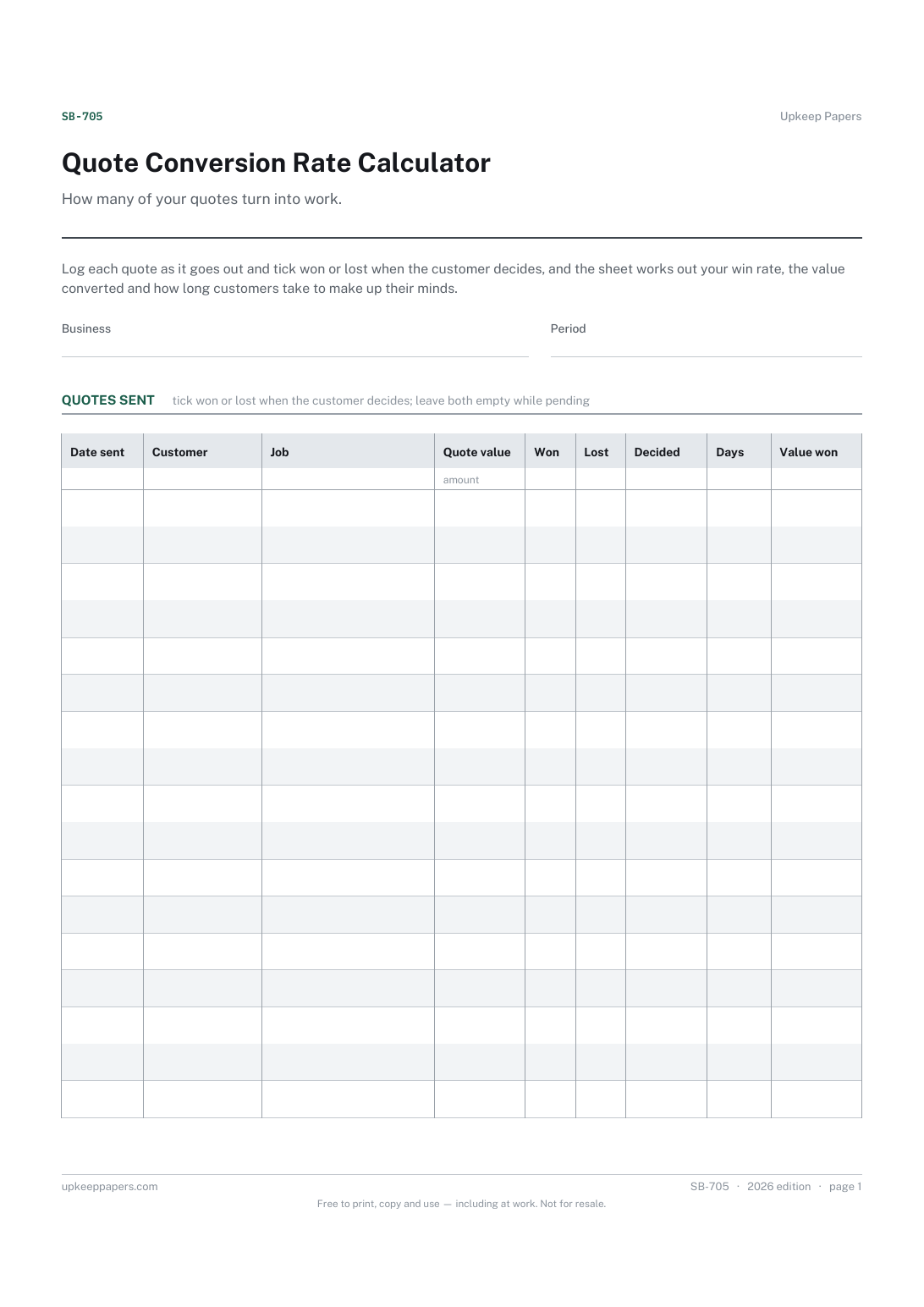
Every quote sent, to whom and for how much.
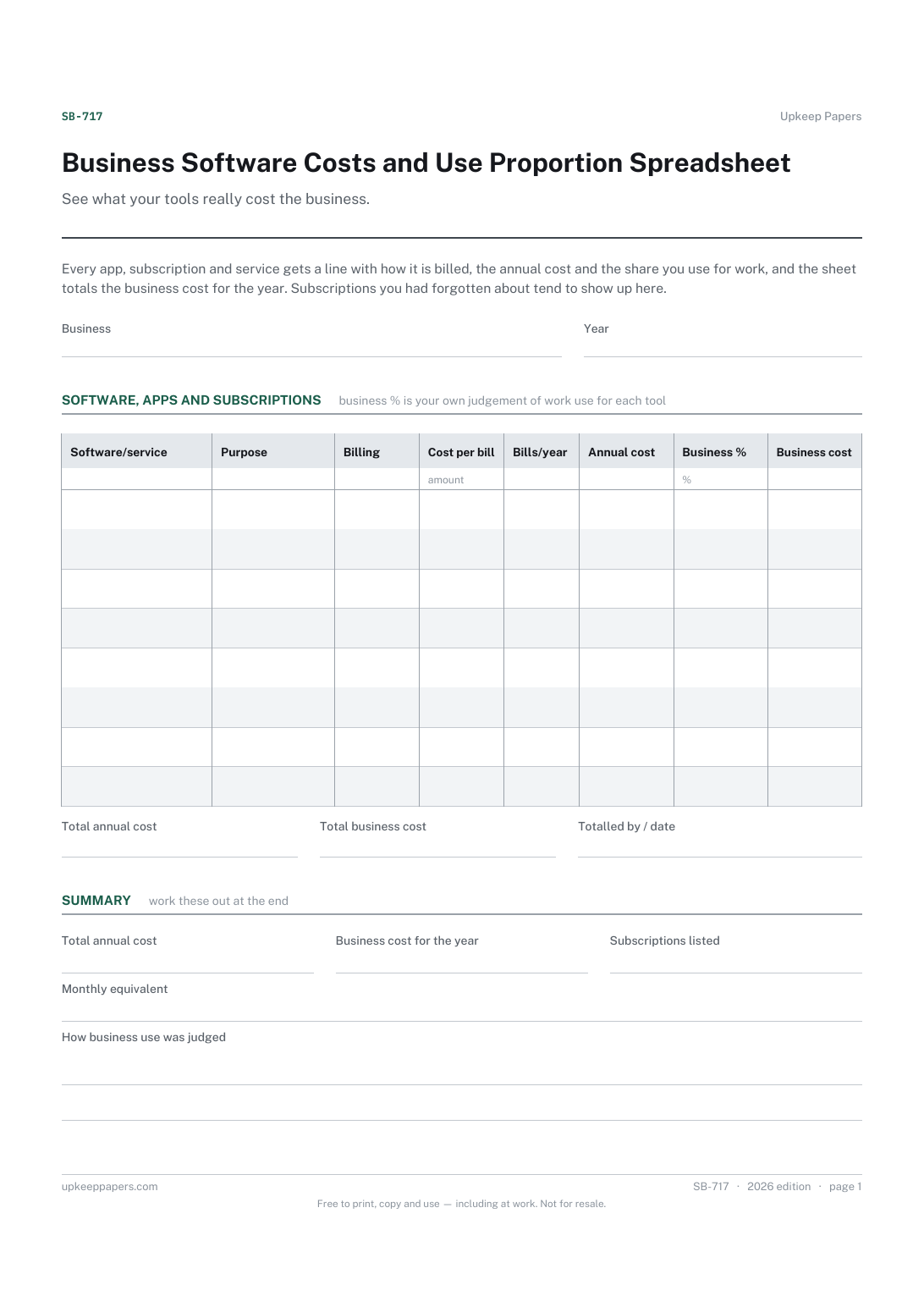
Every app, tool and subscription you pay for, and what it is for.
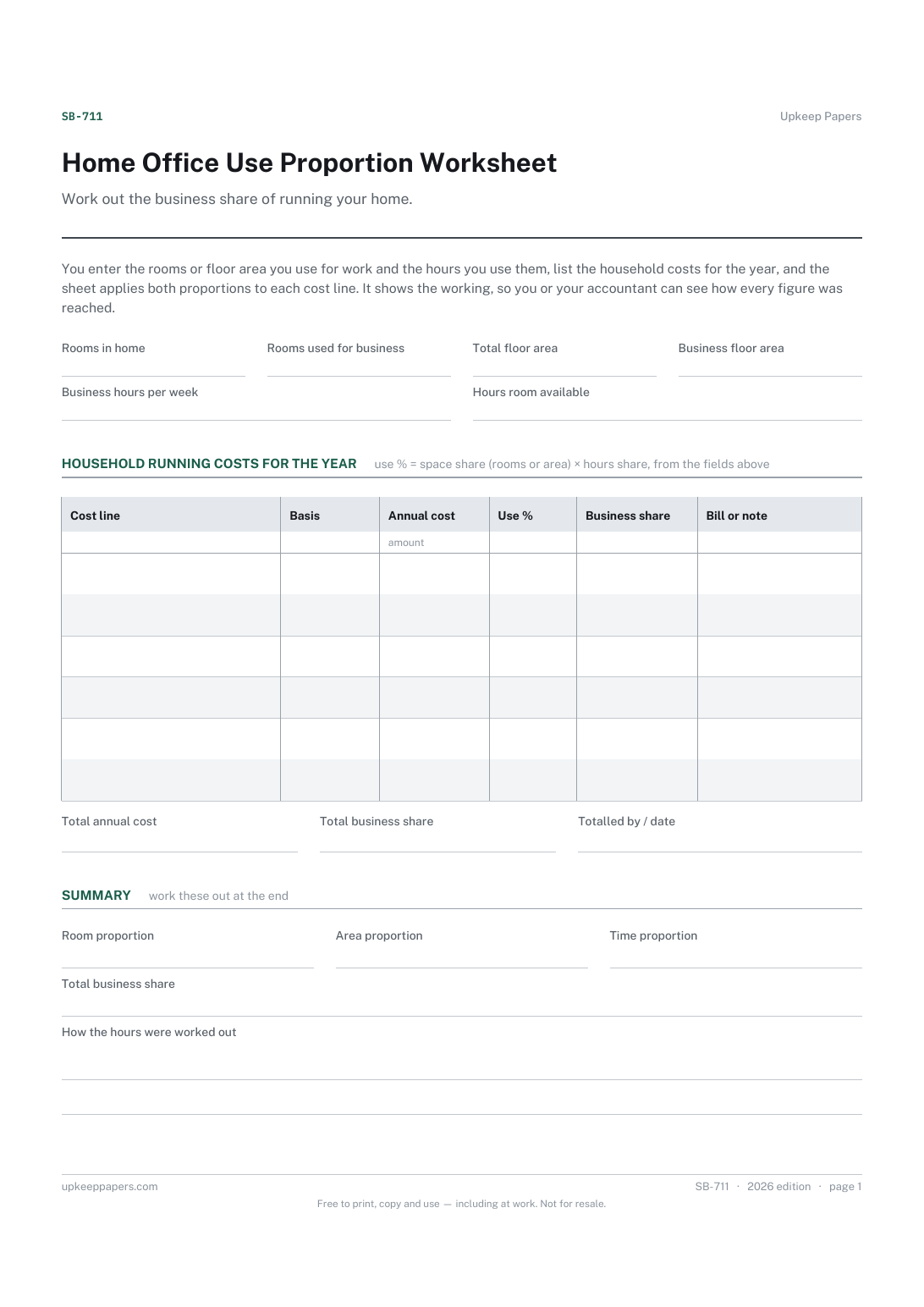
The room count and floor area of the home and of the space used for work.
Printable sheets, workbooks and tools on the same subject.
Publish your prices with the inclusions spelled out beside them, which is what stops the conversation about what was and was not covered.

Every sheet, binder, game and puzzle on Upkeep Papers is free to download, with no email and no account. Making them is not free: each one takes days of research, design and checking, and the site costs money to run. If something here saved you time, you can buy us a coffee. It is entirely optional: nothing is locked, and nothing changes if you don’t.
Buy us a coffee Opens PayPal in a new tab. Any amount, and nothing changes if you would rather not.