Wallpaper Roll Calculator
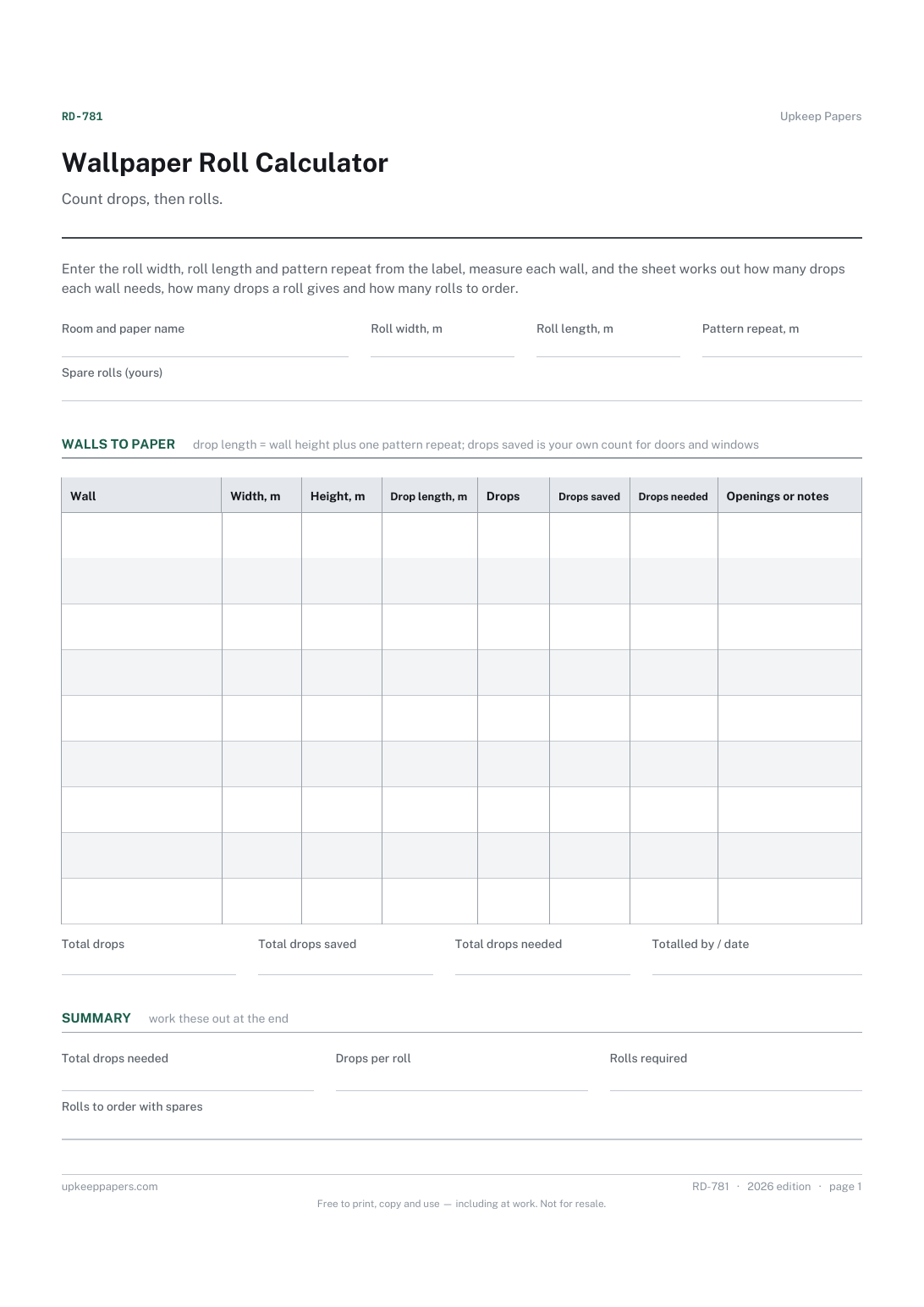
How many drops each wall needs at your roll width.
RD-781 Form PDF Excel Online
Everything here is free. Making it takes time and money. Everything here is free.
 Buy us a coffee
Renovation and DIY Projects · RD-780 · Form
Paint calculator — walls, ceilings and woodwork measured room by room, openings taken off, litres and tins from your own tin's coverage. Excel, PDF and browser.
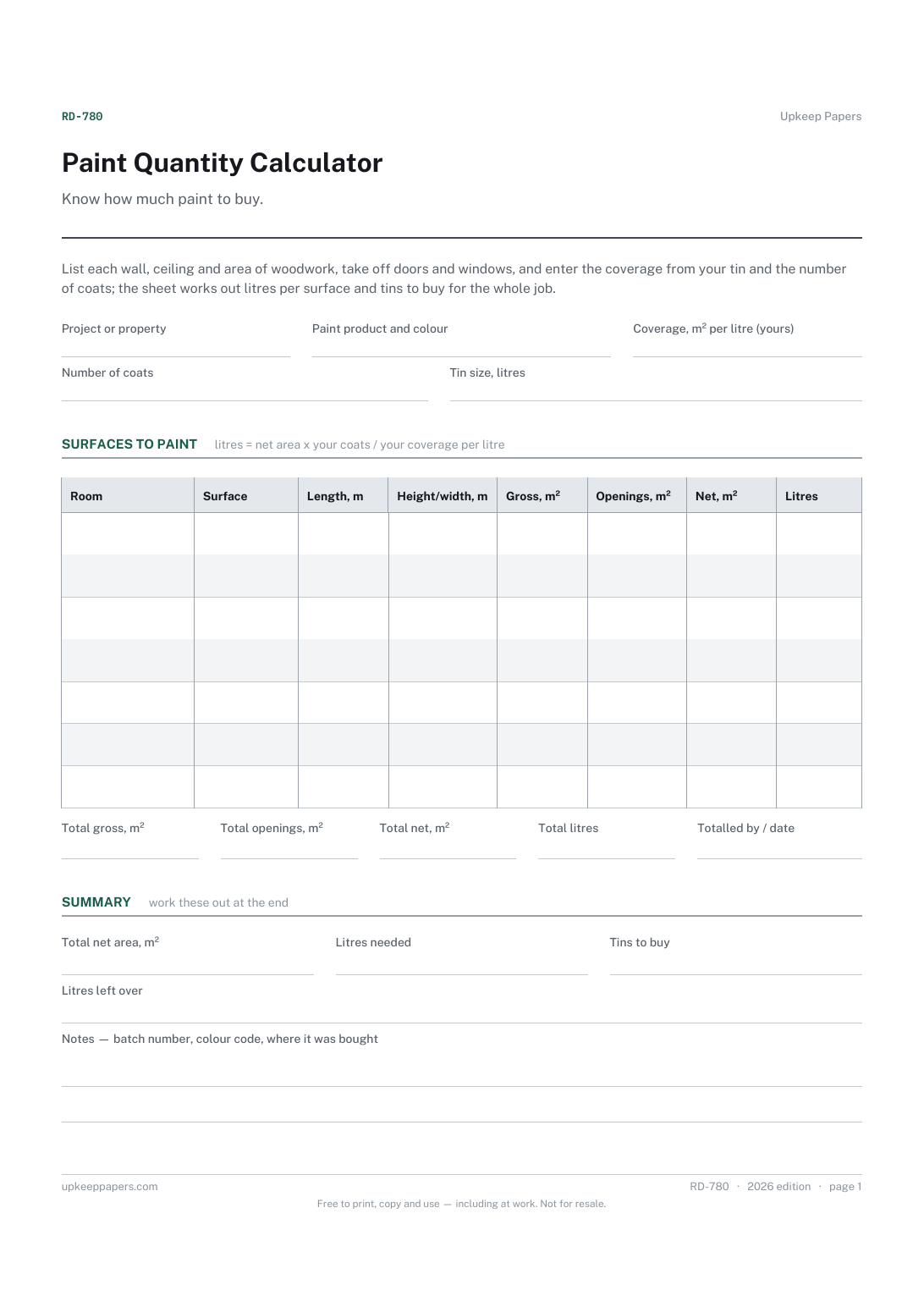
One page. The A4 and US Letter files are laid out identically, so neither is shrunk to fit.
Print it and write on it
Fillable PDF type and save
Spreadsheet formulas included
The fillable versions have real form fields — open them in any PDF reader, type into them and save. Printing help.
The same sheet, on screen. Totals and figures are worked out as you type, rows can be added or removed, and you can print it or download the completed version as a PDF. Everything stays in your browser — your entries are kept in this browser's own storage on this device, nothing is uploaded, and there is no account.
Know how much paint to buy. List each wall, ceiling and area of woodwork, take off doors and windows, and enter the coverage from your tin and the number of coats; the sheet works out litres per surface and tins to buy for the whole job.
Homeowners decorating one room or a whole floor, and anyone who has bought three tins too many or run out halfway down the last wall.
The printable is laid out inside a box that fits both A4 and US Letter, so the two files are identical and neither one is scaled. The fillable PDF has real form fields. The workbook uses plain formulas only — SUM, IF, COUNTIF and the like — so it opens in Excel, LibreOffice and Google Sheets without anything breaking, and every calculated cell is grey so you can see which figures it worked out.
Download the A4 or US Letter file to match the paper in your printer, open it in a PDF reader and print at 100% — not "fit to page", which shrinks the writing space. Both files leave a 14 mm margin, which clears the unprintable edge on home printers. To print the online version with your entries in it, use the Print this sheet button, which prints only the sheet and none of the page around it. More on printing.
From the tin. Manufacturers print a coverage in square metres per litre, often as a range. The sheet supplies none; use the figure for your product, and the lower end of a range if the surface is rough or porous.
That depends on the colour change, the surface and the paint. The sheet uses whatever number you enter for every surface on it, so use a separate sheet if the ceiling and walls need different numbers of coats.
Yes, as long as they use the same paint. Write the room on each row and the litres are added up across all of them, so the tins figure covers the whole job.
Woodwork is usually a different paint with a different coverage, so give it its own sheet with that product's figures. The surface list includes woodwork so the same layout works for it.
How many drops each wall needs at your roll width.
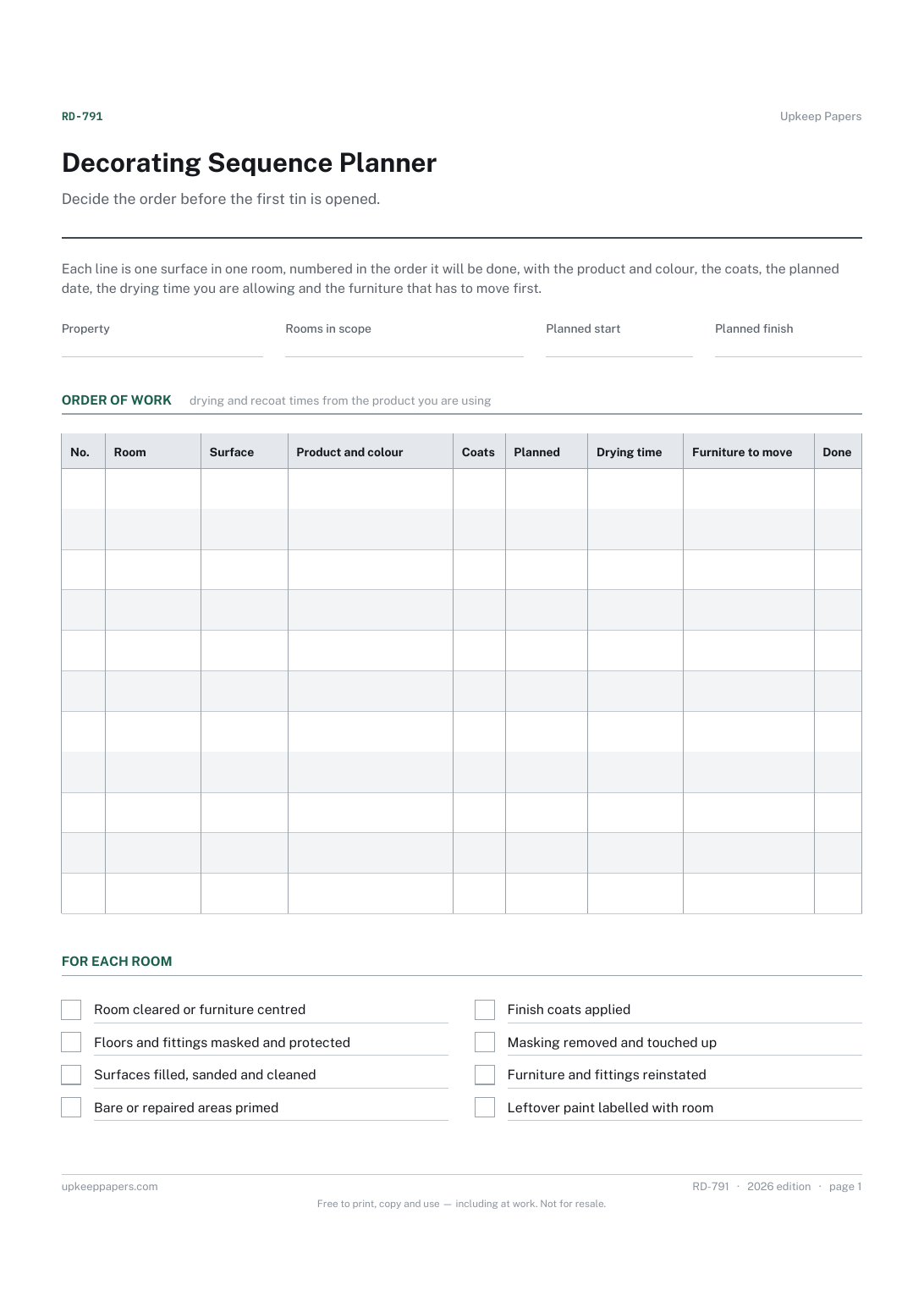
The order rooms and surfaces will be decorated in.
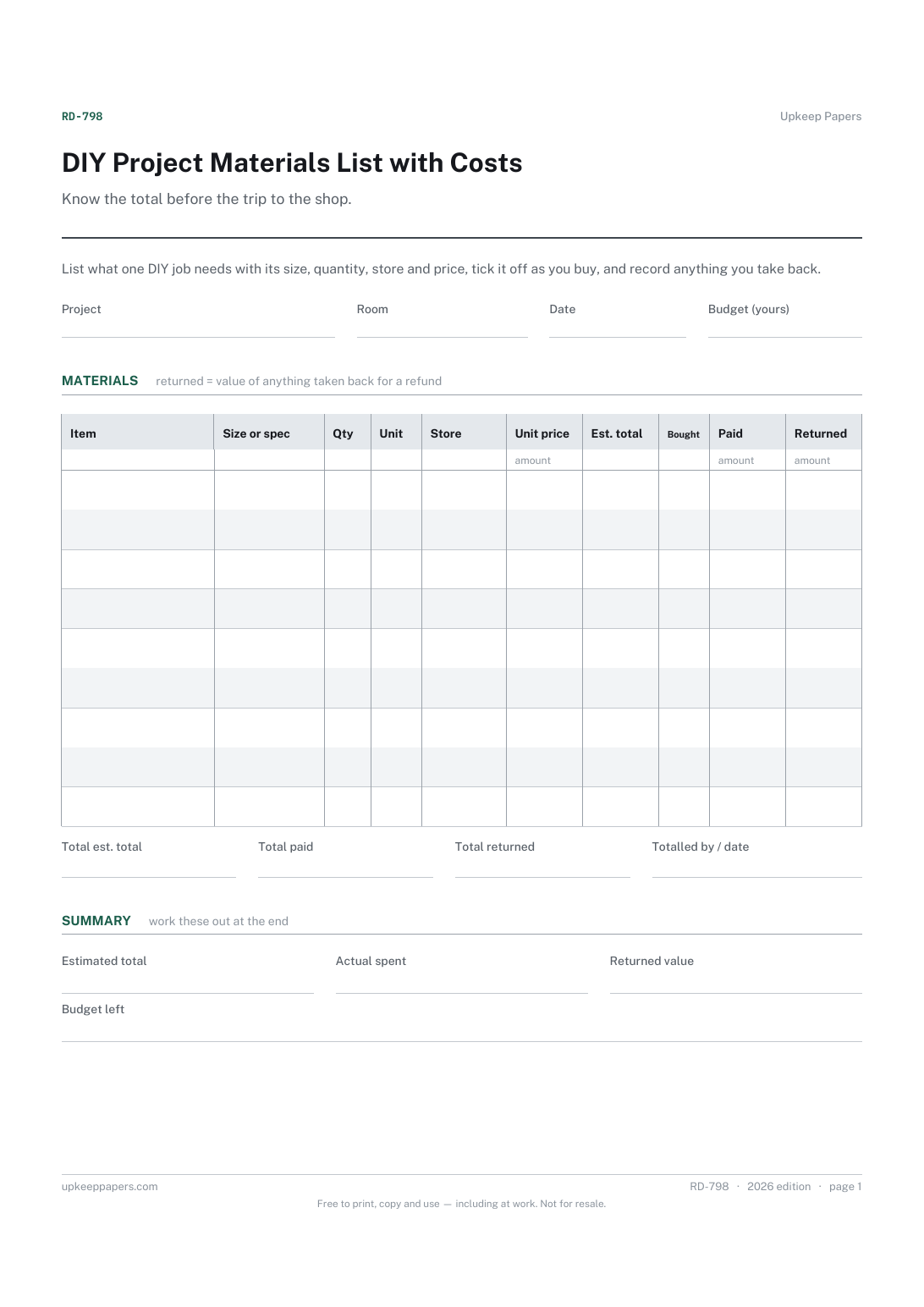
Every item the job needs, with its size or specification.
Printable sheets, workbooks and tools on the same subject.
Record what went on which wall so a touch-up in three years is one trip to one shop instead of an afternoon of matching.
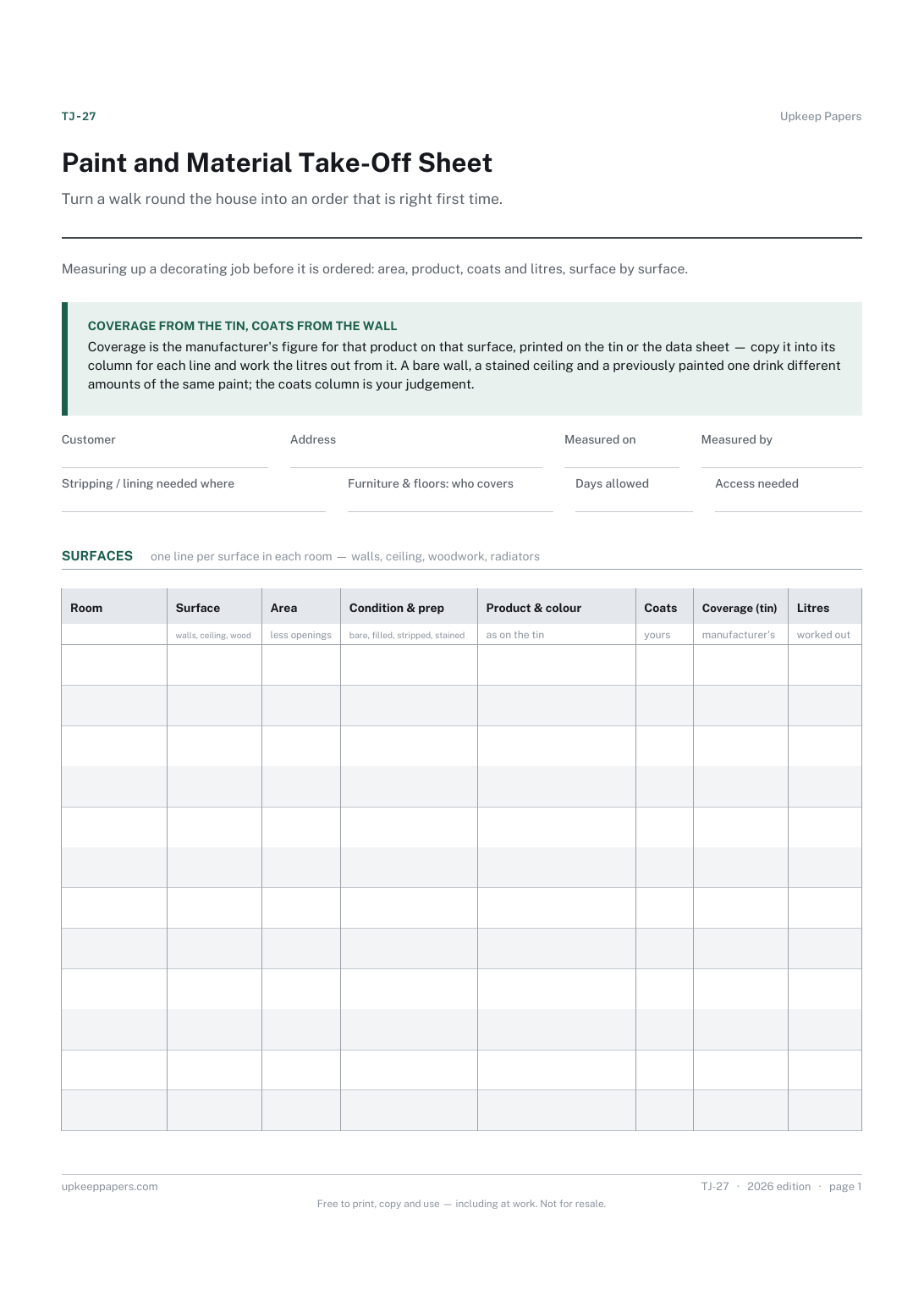
Turn a walk round the house into an order that is right first time. The working is shown, so a short tin can be traced back to the wall that caused it.

Every sheet, binder, game and puzzle on Upkeep Papers is free to download, with no email and no account. Making them is not free: each one takes days of research, design and checking, and the site costs money to run. If something here saved you time, you can buy us a coffee. It is entirely optional: nothing is locked, and nothing changes if you don’t.
Buy us a coffee Opens PayPal in a new tab. Any amount, and nothing changes if you would rather not.