Series and Set Completion Checklist
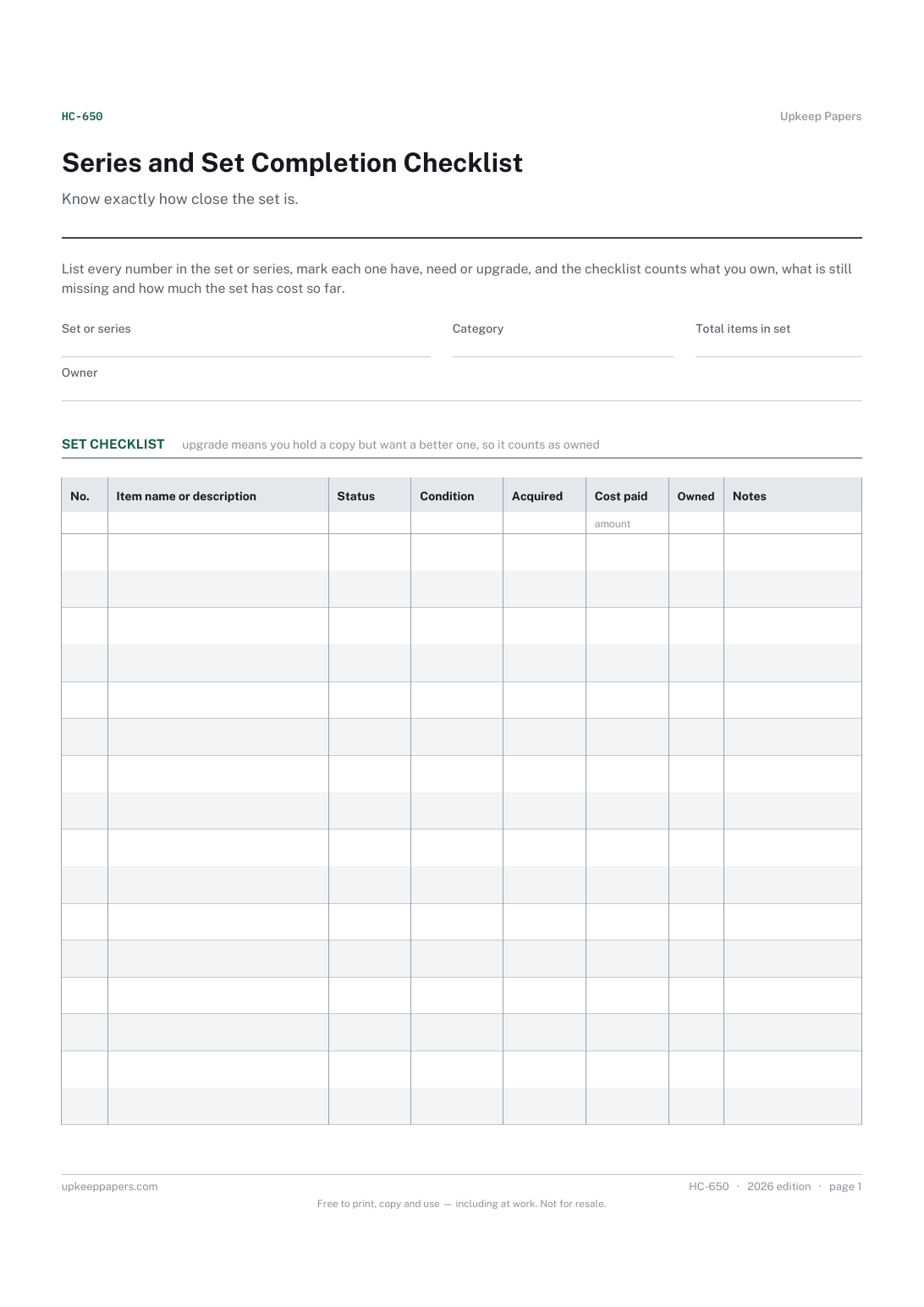
Every item in the set by number and name.
HC-650 Checklist PDF Excel Online
Everything here is free. Making it takes time and money. Everything here is free.
 Buy us a coffee
Hobbies and Collections · HC-635 · Inventory
Comic book collection spreadsheet — every issue with grade, bagging, cost and your own value estimate, totalled per long box. Excel, PDF and browser.
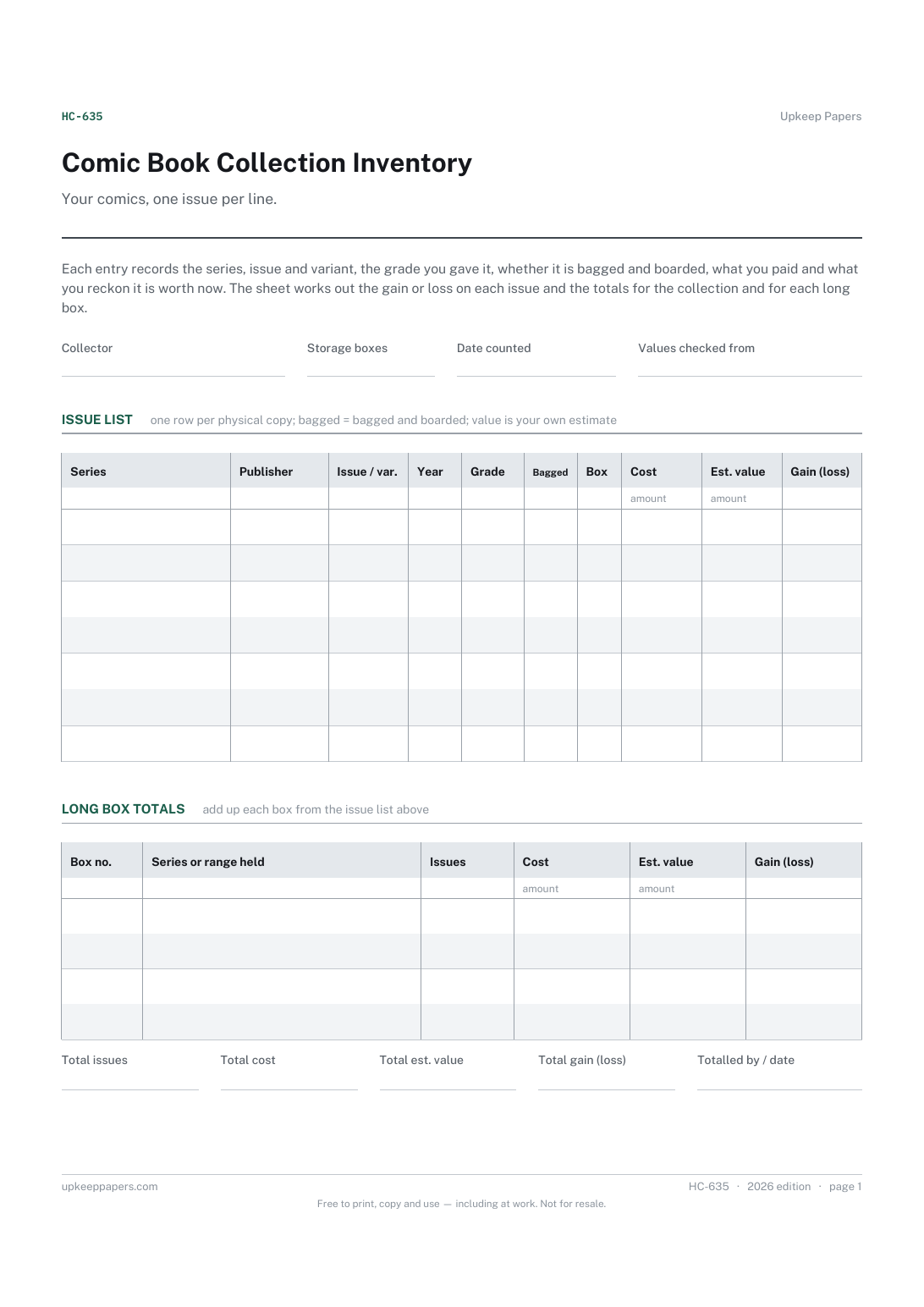
2 pages. The A4 and US Letter files are laid out identically, so neither is shrunk to fit.
Print it and write on it
Fillable PDF type and save
Spreadsheet formulas included
The fillable versions have real form fields — open them in any PDF reader, type into them and save. Printing help.
The same sheet, on screen. Totals and figures are worked out as you type, rows can be added or removed, and you can print it or download the completed version as a PDF. Everything stays in your browser — your entries are kept in this browser's own storage on this device, nothing is uploaded, and there is no account.
Your comics, one issue per line. Each entry records the series, issue and variant, the grade you gave it, whether it is bagged and boarded, what you paid and what you reckon it is worth now. The sheet works out the gain or loss on each issue and the totals for the collection and for each long box.
Comic collectors with more issues than they can keep in their head, from someone filling gaps in one run to a reader with a wall of long boxes.
The printable is laid out inside a box that fits both A4 and US Letter, so the two files are identical and neither one is scaled. The fillable PDF has real form fields. The workbook uses plain formulas only — SUM, IF, COUNTIF and the like — so it opens in Excel, LibreOffice and Google Sheets without anything breaking, and every calculated cell is grey so you can see which figures it worked out.
Download the A4 or US Letter file to match the paper in your printer, open it in a PDF reader and print at 100% — not "fit to page", which shrinks the writing space. Both files leave a 14 mm margin, which clears the unprintable edge on home printers. To print the online version with your entries in it, use the Print this sheet button, which prints only the sheet and none of the page around it. More on printing.
From you. Recent sold listings, a dealer's offer or a price guide you trust are the usual sources. The sheet supplies no values or grades; it only adds up the figures you enter, so note in the notes area where they came from.
Put it in the issue column after the number, such as 12 var B or 1 foil. Keeping it on the same line as the issue means each physical copy has one row, which is what the issue count and totals rely on.
Whatever scale you already use, whether a numeric grade, a word such as fine or near mint, or a professional slab grade. Keep to one scale across the sheet so copies can be compared.
The box table has a line per box. Add up the issues, cost and value for that box from the list; the gain column is worked out for you. It shows at a glance which boxes hold the copies that matter most.
Every item in the set by number and name.
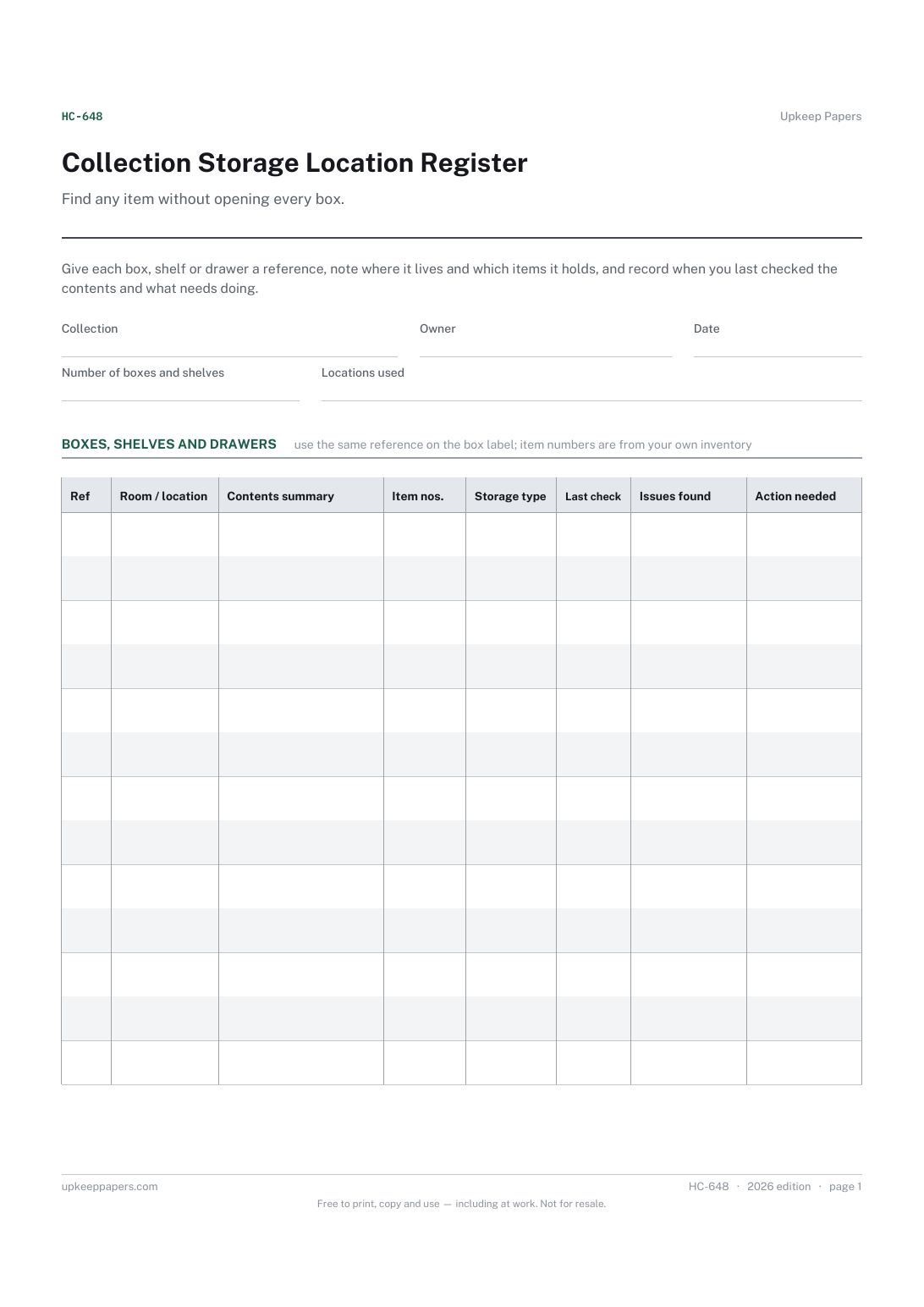
Every box, shelf and drawer with its own reference.
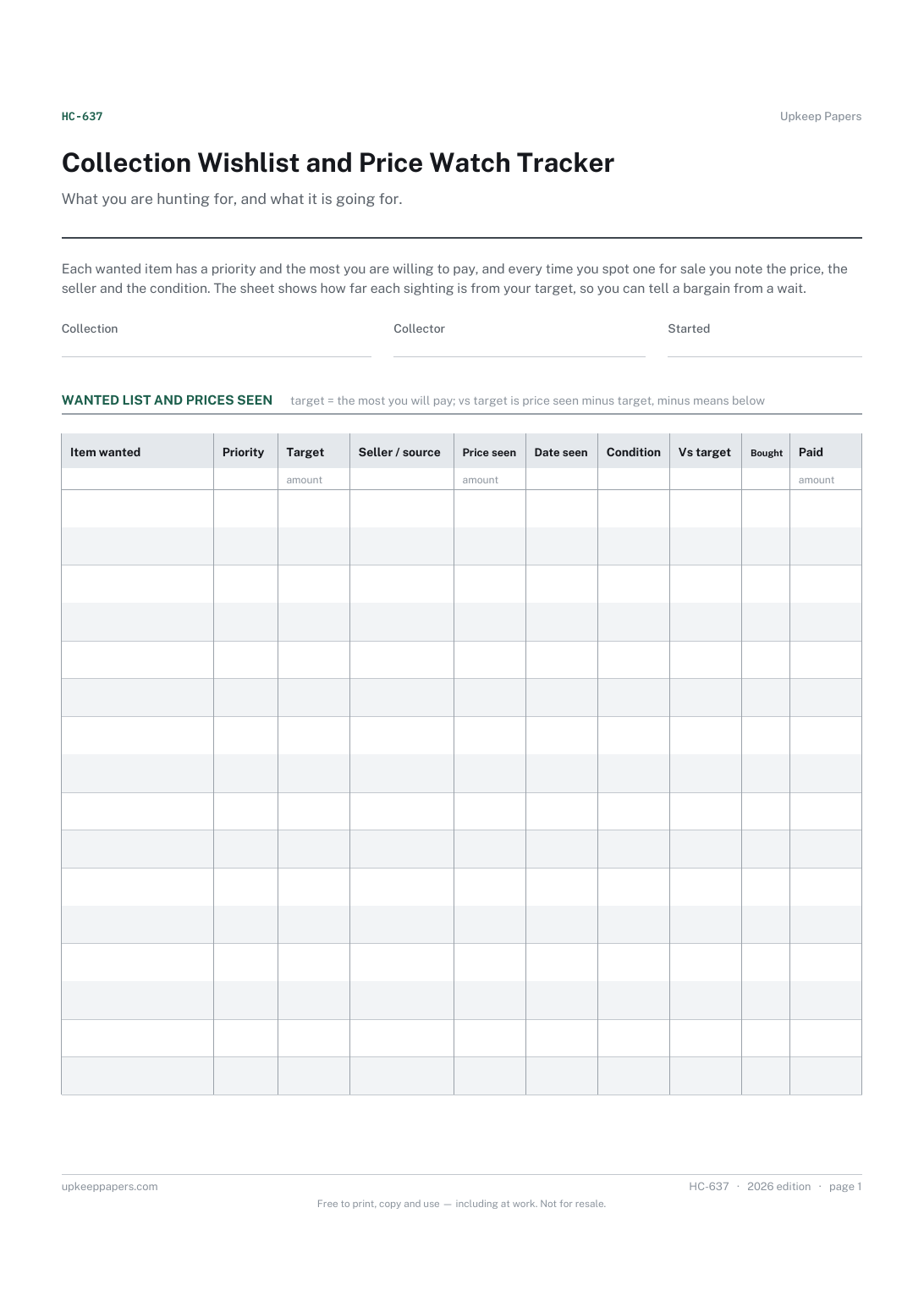
Every item still wanted, with its priority.
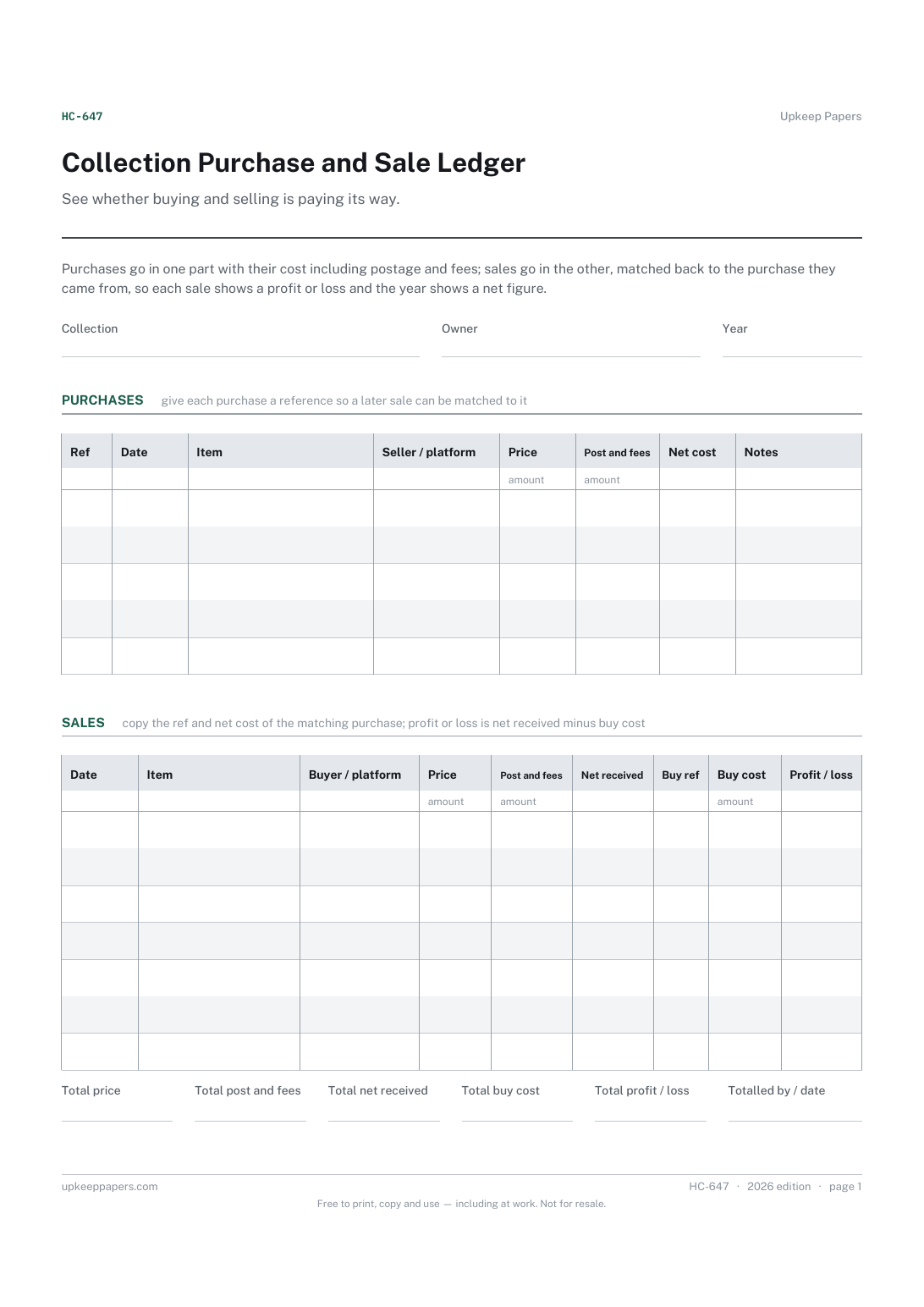
Every purchase with its seller or platform and full cost.
Printable sheets, workbooks and tools on the same subject.
Room-by-room contents with what each thing cost and what it would cost to replace, totalled per room and overall — the list an insurer asks for.

Every sheet, binder, game and puzzle on Upkeep Papers is free to download, with no email and no account. Making them is not free: each one takes days of research, design and checking, and the site costs money to run. If something here saved you time, you can buy us a coffee. It is entirely optional: nothing is locked, and nothing changes if you don’t.
Buy us a coffee Opens PayPal in a new tab. Any amount, and nothing changes if you would rather not.