Guide · Property records
What Your Insurer Asks For After a Leak or a Fire
Home insurance claims turn on evidence of maintenance and evidence of loss. What that means in practice, and what to record before anything happens.
Published
Insurance claims are decided on documents. Not on what happened, not on what you remember, but on what can be shown. That is not cynicism about insurers — it is simply how a claim is assessed by someone who was not there.
Two categories of evidence come up almost every time, and both are much easier to produce if you started before the incident.
Evidence that the thing was maintained
Most home policies contain wording requiring the property to be kept in a reasonable state of repair, and many contain specific conditions for particular risks — heating appliances, solid fuel appliances, alarms, and in some policies escape of water. The precise wording varies enormously between insurers and countries, which is why the only reliable advice is to read your own policy.
What is consistent is the type of thing that gets asked for:
- When was the appliance last serviced, and by whom?
- Was the person qualified or registered to do that work?
- Was the chimney swept, and how often?
- Were the alarms working?
- Had the problem been reported before and left?
Notice that every one of those is a question about a date and a name. That is exactly the shape of a maintenance record, which is why sheets like the Boiler Service Record and the Chimney Sweep and Stove Record put the engineer or sweep’s identity in a column of its own rather than leaving it in a note.
The uncomfortable version of this is that a claim can be reduced or declined where a policy condition was not met. Whether that happens in a given case depends on the wording, the facts and the jurisdiction — but the way to be on the right side of it is to have kept the records, and to be able to find them.
Evidence of what was lost
The second category is the loss itself. After a fire or a flood, someone will ask you to itemise what was damaged, and you will be doing it from memory, in a stressful week, possibly from somewhere else.
Two things make this dramatically easier.
A register of the big items — appliances, equipment, tools — with make, model and serial number. This is what the Appliance and Equipment Register is for, and it takes an afternoon to complete for an average house.
Photographs, taken now. Walk each room and photograph it, including inside cupboards, the garage and the loft. Photographs establish that things existed and roughly what condition they were in, and they cost nothing. Keep them somewhere that is not in the house.
The reporting sequence
The other thing that gets scrutinised is timing. Policies generally require prompt notification, and they generally require you to take reasonable steps to prevent further damage. In practice that means:
- Stop the source. Water off at the stopcock, power off at the consumer unit if it is safe. This is exactly why the Emergency Shut-Off Locations Sheet is worth filling in before you need it — a stopcock discovered during a leak is very often seized.
- Photograph everything before you clear up. Wide shots and close shots. This is the evidence and it disappears the moment you start tidying.
- Notify the insurer promptly, and write down when you did and who you spoke to.
- Keep receipts for emergency work. Reasonable costs incurred preventing further damage are often recoverable, but only with receipts.
- Do not dispose of damaged items until you are told you can. The adjuster may want to see them.
What to do this month
None of this is difficult, but all of it has to happen before an incident to be worth anything.
- Fill in the shut-off sheet and walk to each valve to check it turns.
- Complete an appliance register with serial numbers.
- Photograph every room.
- Find your policy and read the conditions attached to heating, solid fuel and unoccupancy — the unoccupancy clause catches people out when a property is empty for a few weeks.
- Start a service register if you do not have one, and put the existing certificates behind it.
That is one afternoon, and it converts a future claim from a memory exercise into a filing exercise.
This is general information about how claims tend to be assessed, not advice about your policy. Terms differ between insurers and between countries — yours is the one that governs.
From the library
Sheets mentioned here
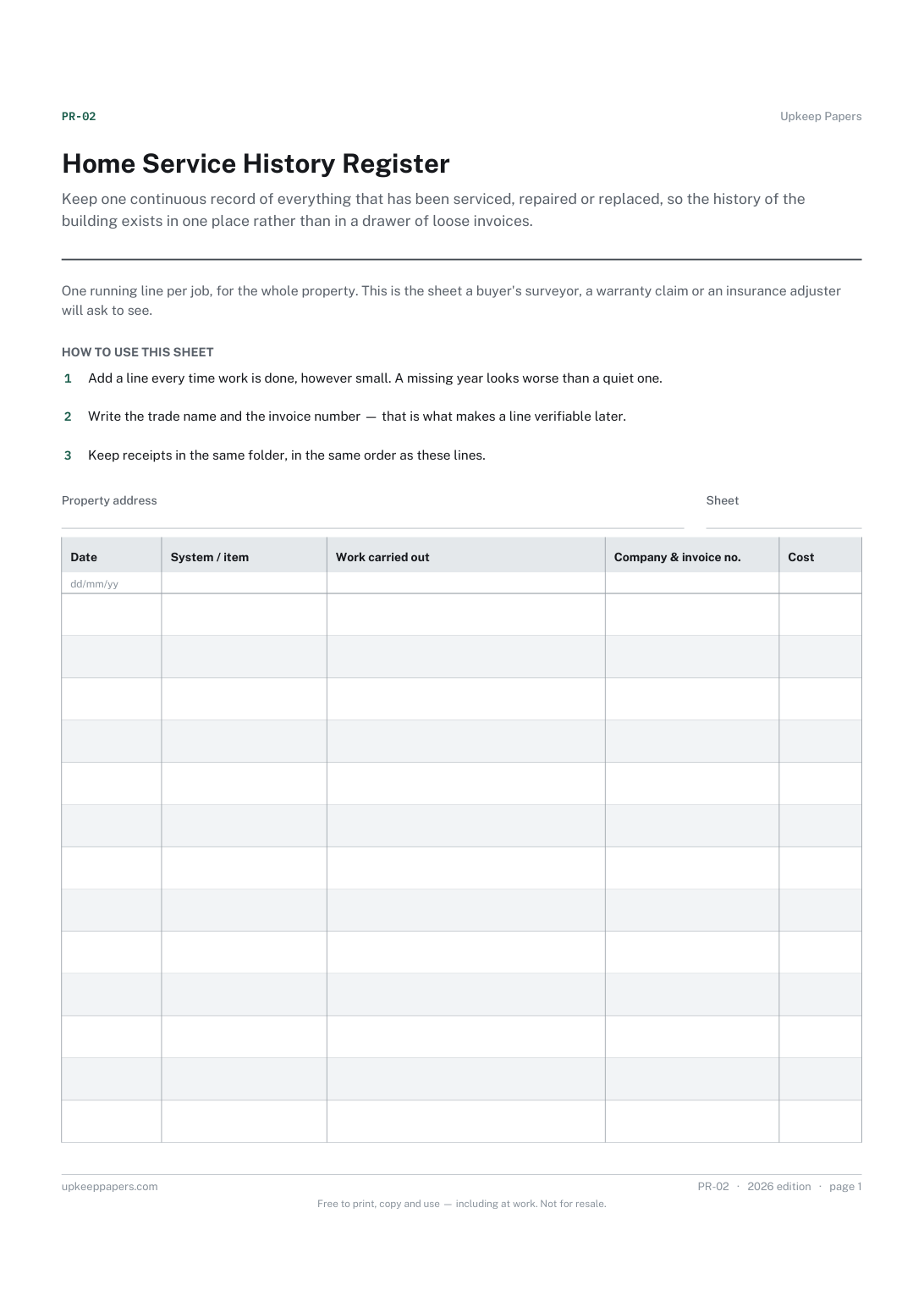
Home Service History Register
Keep one continuous record of everything that has been serviced, repaired or replaced, so the history of the building exists in one place rather than in a drawer of loose invoices.
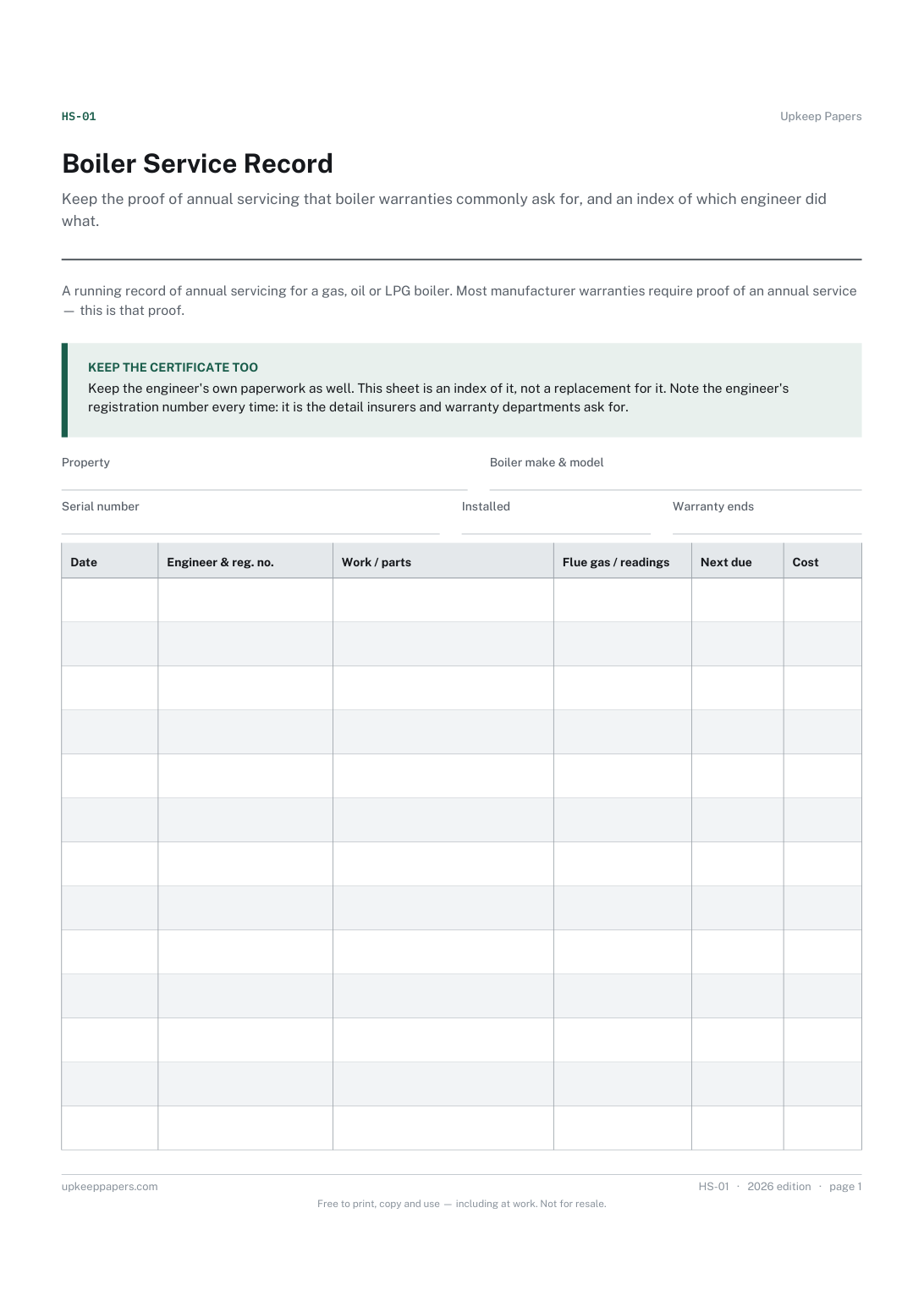
Boiler Service Record
Keep the proof of annual servicing that boiler warranties commonly ask for, and an index of which engineer did what.
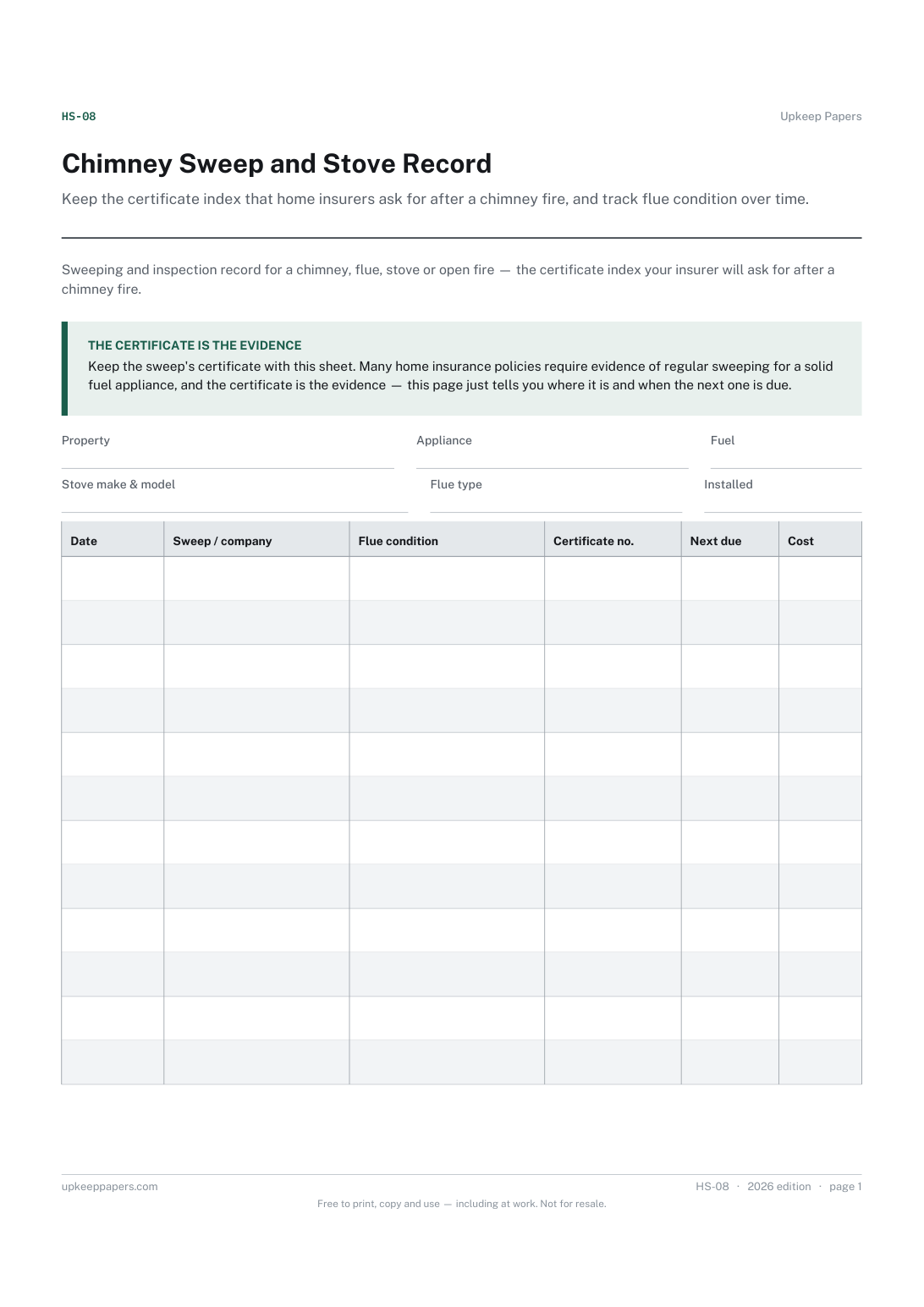
Chimney Sweep and Stove Record
Keep the certificate index that home insurers ask for after a chimney fire, and track flue condition over time.
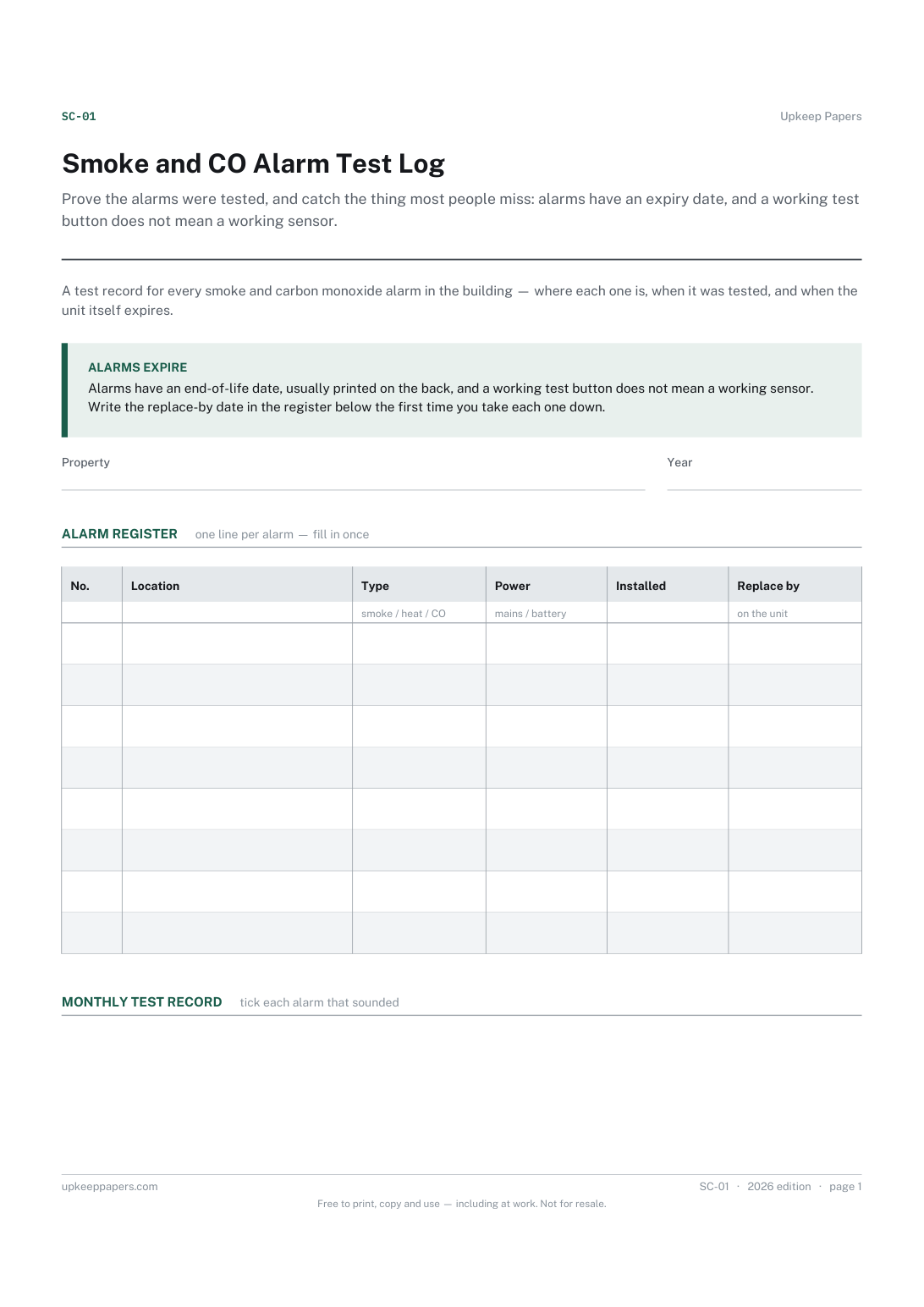
Smoke and CO Alarm Test Log
Prove the alarms were tested, and catch the thing most people miss: alarms have an expiry date, and a working test button does not mean a working sensor.
More guides
How to Build a Home Maintenance Binder That Survives
A ring binder beats an app for house records, but most binders die within a year. The sections that work, what to file, and how to keep it alive.
What Home Service Records Are Worth When You Sell
Why a documented maintenance history changes how buyers and surveyors behave, and which records are actually worth keeping for a sale.
Winterising Your House and Outbuildings
Frost damage is a drainage problem more than an insulation problem. What to drain, what to isolate, and how to leave a property that will not burst.