Guide · Property records
How to Build a Home Maintenance Binder That Survives
A ring binder beats an app for house records, but most binders die within a year. The sections that work, what to file, and how to keep it alive.
Published
Most home maintenance binders are built on a single enthusiastic weekend and abandoned by the following spring. They are not abandoned because the idea was wrong. They are abandoned because the version built on the enthusiastic weekend had fourteen sections, colour-coded tabs, and a plan to scan every manual in the house — and nobody sustains that.
A binder that survives is a smaller, duller object than the one people imagine when they start. It has about six sections, most of them nearly empty, and it takes perhaps ten minutes of attention a year plus a minute each time a tradesperson leaves the house.
Why paper, when everything else is an app
This is not nostalgia. There are three specific reasons paper wins for this particular job.
The records belong to the house, not to you. When a property changes hands, a folder crosses the kitchen table in about four seconds. An account on a service does not transfer, and the next owner inherits nothing. The same applies within a household: anyone can open a binder.
It works when nothing else does. The moment you most need to know where the stopcock is, is a moment involving water, and often darkness. A page in a folder by the door does not need a charged phone, a signal, or a remembered password.
Writing is faster than logging. The difference between a record kept and a record not kept is almost always friction at the moment of the event. Writing one line on a page already open in front of you takes seconds. Finding an app, waiting for it to load and tapping through three screens takes long enough that you decide to do it later, and later does not come.
None of that means digital is useless. Photograph certificates as they arrive and keep the images somewhere that backs itself up. Paper as the working record, images as the insurance against a burst pipe reaching the shelf the folder sits on.
What to actually buy
Keep this deliberately cheap. An expensive system creates a reluctance to scribble in it.
- One A4 ring binder, ordinary capacity. Resist the largest one on the shelf — a constraint on space is a constraint on ambition, and that is helpful here.
- Five or six dividers. Not twelve.
- A hole punch that lives in the same cupboard.
- Punched pockets only for things you genuinely cannot punch: certificates you want to keep unmarked, and small receipts, which are better stapled to a sheet of paper than loose in a wallet.
- A pen clipped inside the front cover. This sounds trivial. It is the most load-bearing item on the list, because the alternative is walking to another room and deciding not to bother.
The sections, in the order they should sit
The order matters more than it looks, because the front of a binder gets used and the back does not.
1. Emergency information
The first page should be the one somebody else needs when you are not there: where the water shuts off, where the gas or oil isolates, where the consumer unit is, which switch does what, where the meters are and what their serial numbers are. The Emergency Shut-Off Locations Sheet is built for this, and it is worth filling in with a torch in your hand rather than from memory, because memory is confidently wrong about which valve does what.
2. The register
One sheet, at the front, listing what has been done to the house and when. This is the spine of the whole thing. Everything else in the binder is supporting evidence for a line on this sheet, which is what the Home Service History Register is for. If you maintain only one page, maintain this one.
3. The schedule
What is due, and roughly when. A Home Maintenance Schedule grouped by season works better than a list of dates, because you will do these jobs in batches on the two or three weekends a year when you are in the mood, not on the anniversary of the last one.
4. What is actually in the house
Make, model, serial number, install date and where the rating plate is, for the boiler, the water heater, the softener, the pump, the alarms and the major appliances. The Appliance and Equipment Register covers this. Fill it in by walking round with your phone camera — photograph every rating plate, then copy the numbers off the photographs at the kitchen table rather than crouching behind a boiler with a pen.
5. Service records, one log per system
Heating, chimney, water, drainage, alarms, and any machine you maintain yourself. Individual logs rather than one combined sheet, because their intervals do not line up and a combined sheet becomes unreadable within two years.
6. Warranties, receipts and contractors
The Warranty and Receipt Register at the back, with proofs of purchase filed behind it, and a page recording who did what work so you can call the right person again.
What not to put in it
Manuals. They are bulky, almost all of them are available online, and they push the binder past the point where you will open it. Record the model number instead; that is the only part of a manual you cannot look up.
Every receipt for everything. Filing a receipt for a light fitting is how a system starts to feel like work. Keep proofs of purchase for things with a warranty and things worth insuring.
Deeds and legal documents. These belong wherever you keep important papers, not in a working folder that lives near the back door and occasionally gets rained on.
The four ways a binder dies
Over-ambition. Fourteen sections, a scanning project and an intention to log every light bulb. Build the small version. You can always add a divider.
Retrospective backfilling. People decide they must reconstruct the last twelve years before they can start, find they cannot, and stop. You cannot recover history you did not record. Write today’s date on the first line, note plainly that the record begins here, and move on.
No filing moment. An engineer hands you a certificate, it goes on the worktop, the worktop gets tidied, and the certificate is gone. The fix is mechanical: the certificate goes in the binder before the van has left the drive, and the register line gets written at the same time.
Perfectionism. A binder with untidy handwriting and three gaps in it is enormously more useful than a beautiful one that stopped in March.
Keeping it alive
Location does most of the work. A binder in the utility room or the hall cupboard gets used. A binder in the loft is a memory. Put it where you stand when a tradesperson is talking to you.
Then hold to one habit: write the register line before you file the document. The document is the evidence, but the register is what makes it findable, and a filed certificate nobody indexed is functionally lost.
Once a year, ideally alongside some other annual job so you remember, read the register from the top. It takes ten minutes, it tells you what has slipped, and it is the only review the system needs.
Accept that it will be incomplete. Every real one is. A note reading “no record of the flue being swept before 2024” is itself useful information — it tells the next reader, including you, exactly how much weight the file can carry.
From the library
Sheets mentioned here
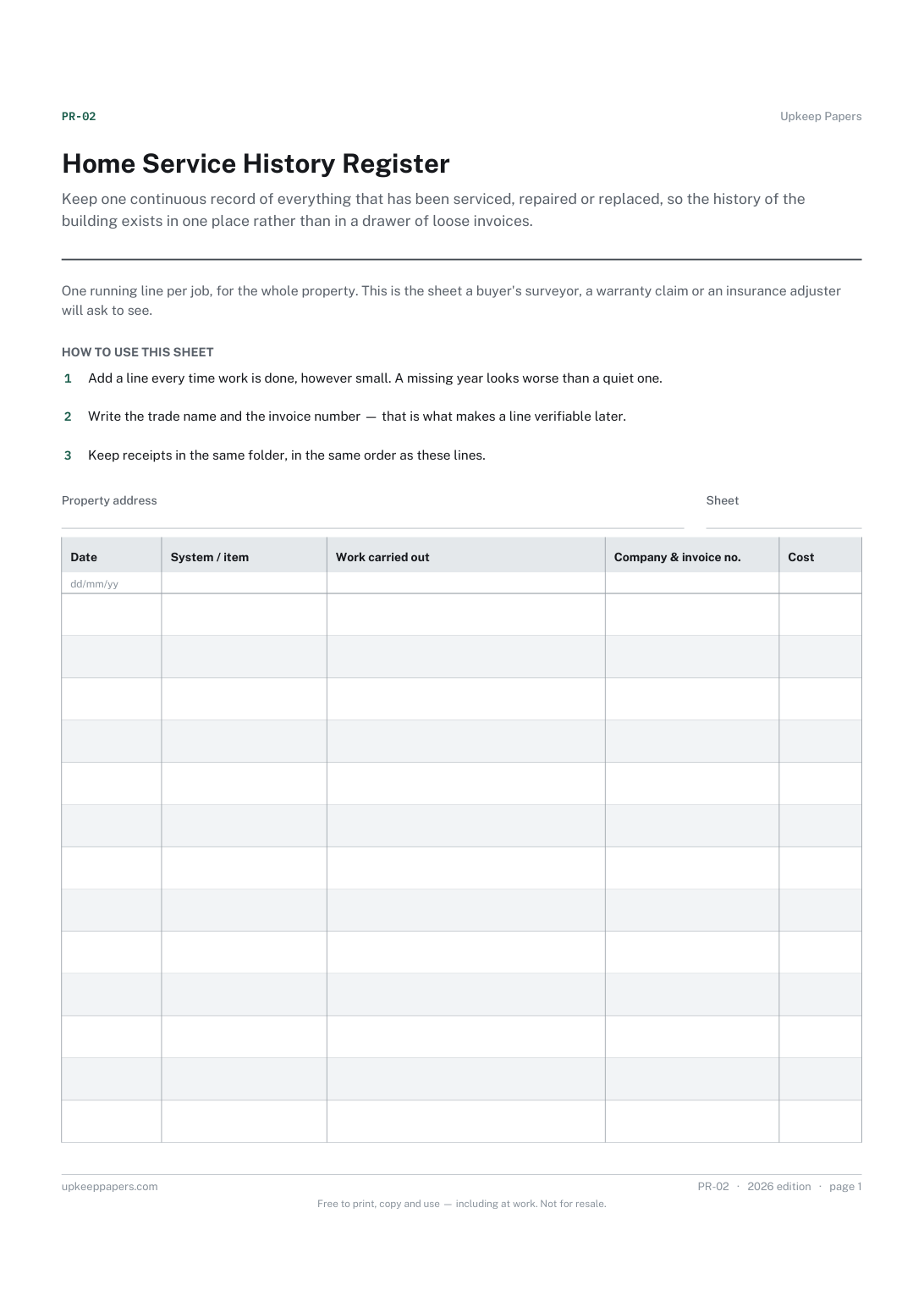
Home Service History Register
Keep one continuous record of everything that has been serviced, repaired or replaced, so the history of the building exists in one place rather than in a drawer of loose invoices.
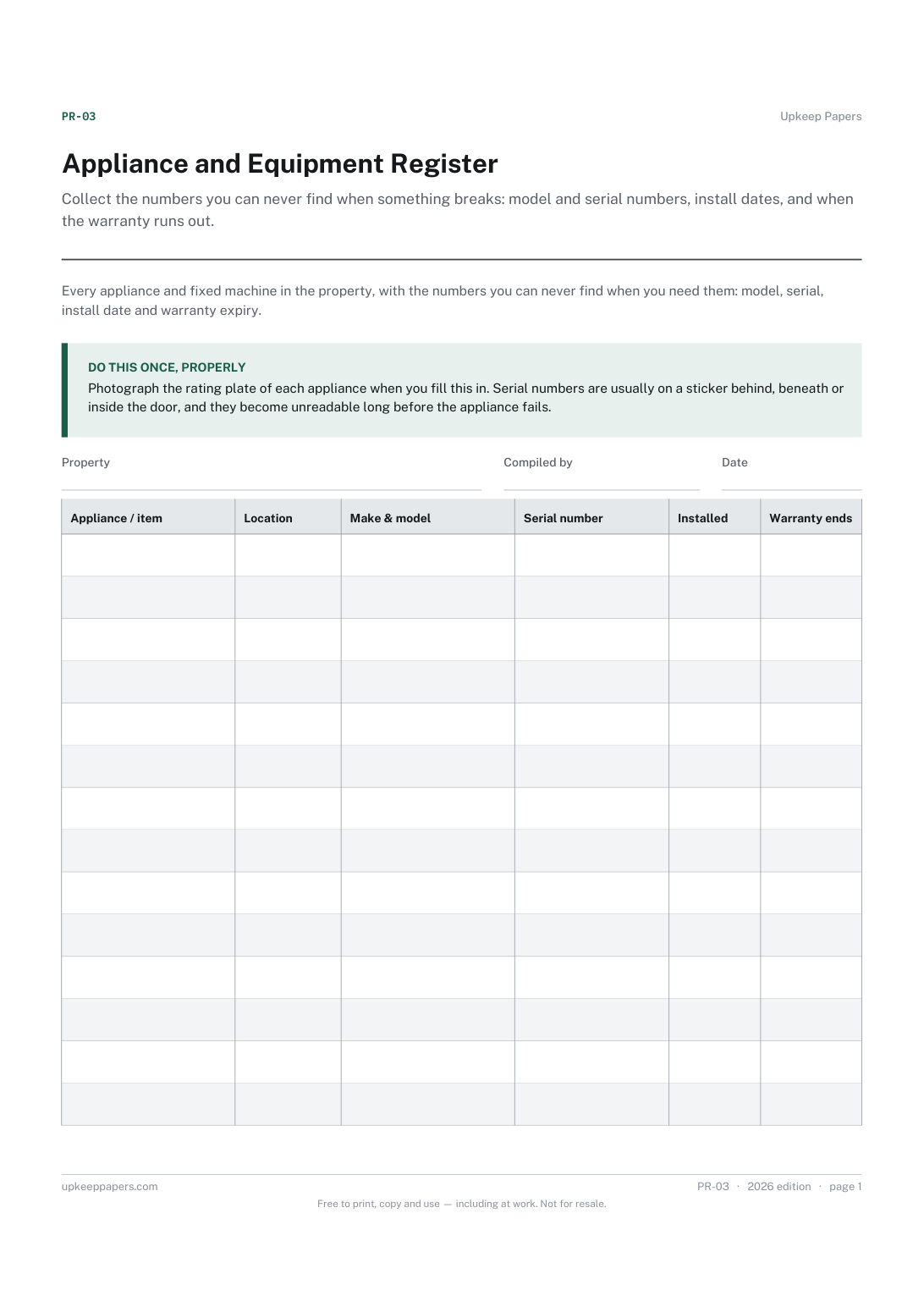
Appliance and Equipment Register
Collect the numbers you can never find when something breaks: model and serial numbers, install dates, and when the warranty runs out.
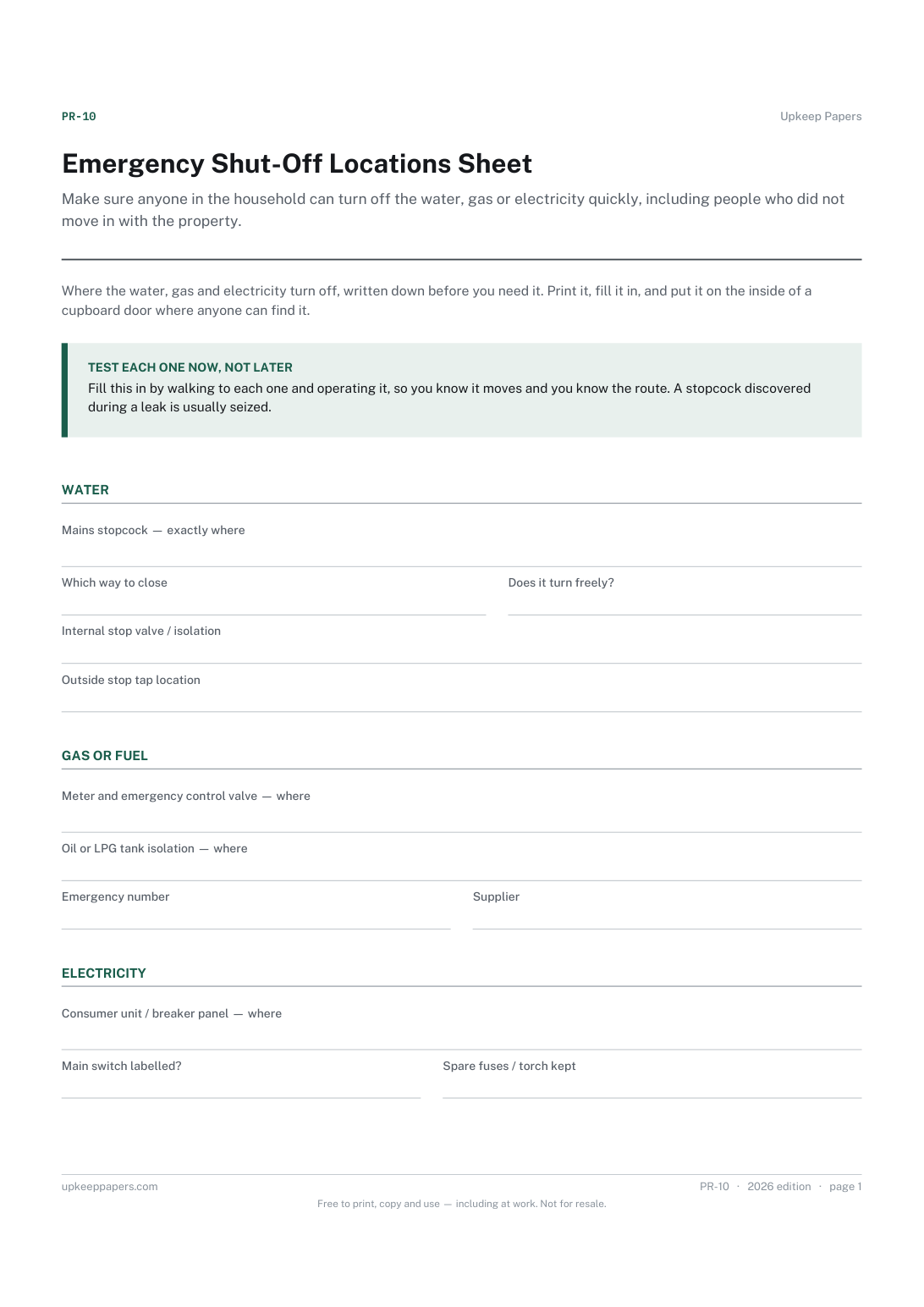
Emergency Shut-Off Locations Sheet
Make sure anyone in the household can turn off the water, gas or electricity quickly, including people who did not move in with the property.
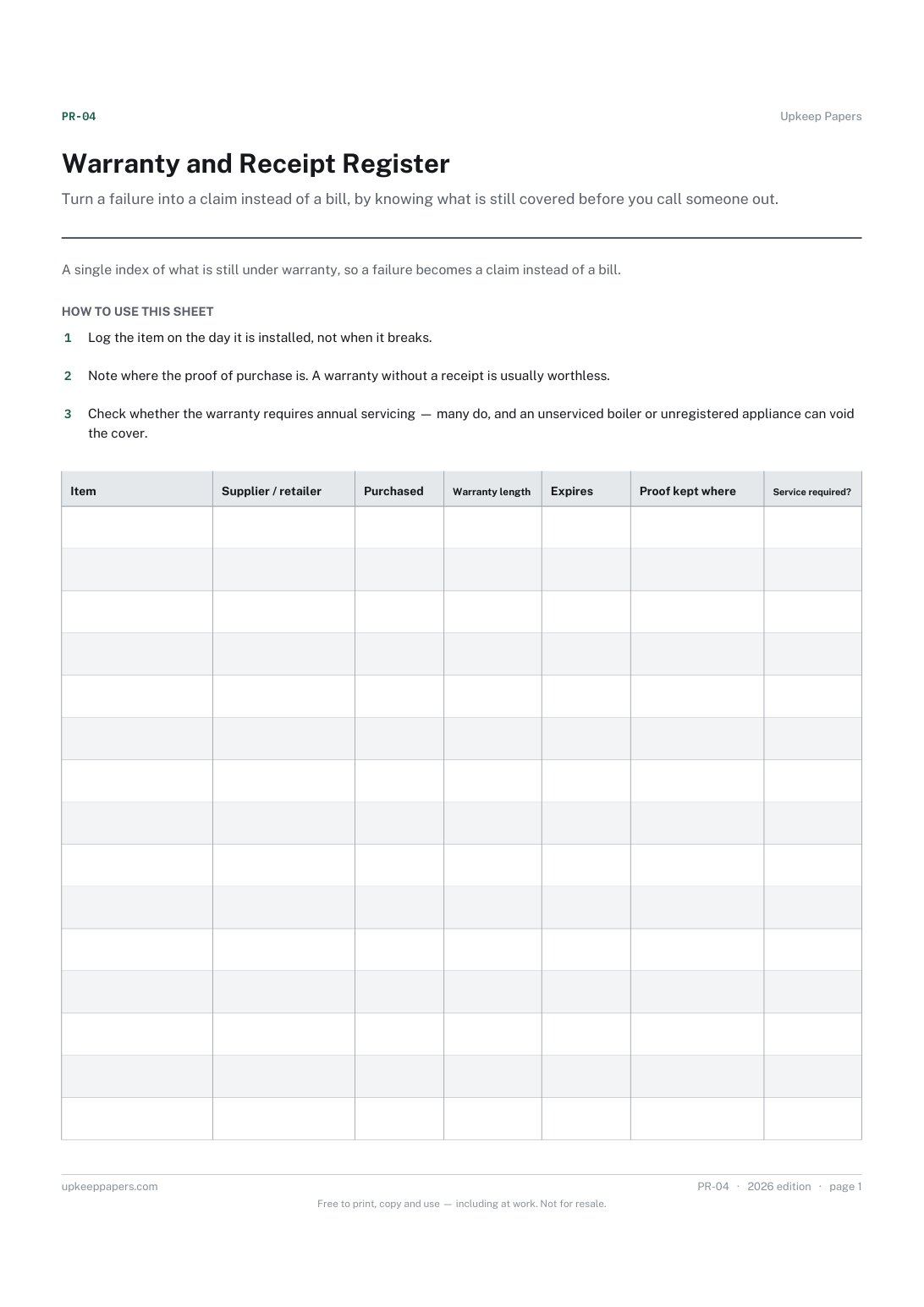
Warranty and Receipt Register
Turn a failure into a claim instead of a bill, by knowing what is still covered before you call someone out.
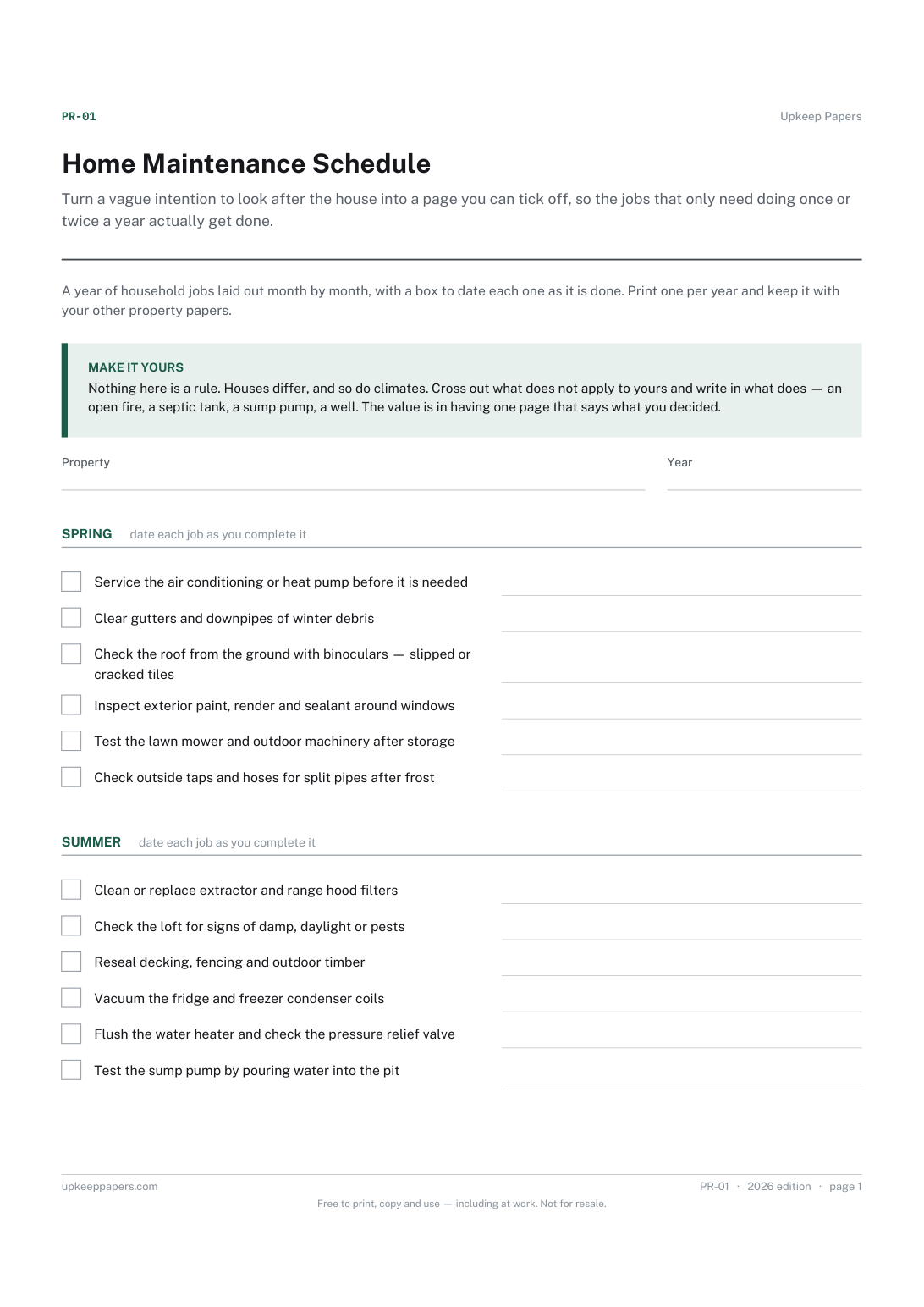
Home Maintenance Schedule
Turn a vague intention to look after the house into a page you can tick off, so the jobs that only need doing once or twice a year actually get done.
More guides
What Home Service Records Are Worth When You Sell
Why a documented maintenance history changes how buyers and surveyors behave, and which records are actually worth keeping for a sale.
What Your Insurer Asks For After a Leak or a Fire
Home insurance claims turn on evidence of maintenance and evidence of loss. What that means in practice, and what to record before anything happens.
Winterising Your House and Outbuildings
Frost damage is a drainage problem more than an insulation problem. What to drain, what to isolate, and how to leave a property that will not burst.