Guide · Property records
Winterising Your House and Outbuildings
Frost damage is a drainage problem more than an insulation problem. What to drain, what to isolate, and how to leave a property that will not burst.
Published
Two facts about frost damage explain most of what you need to do about it, and both are slightly counter-intuitive.
The first is that pipes do not usually split where the ice is. Ice blocks the bore, and the water trapped between that plug and a closed tap has nowhere to go as the plug keeps growing. The failure happens at whatever is weakest — frequently a fitting, sometimes a long way from the ice. So insulation alone is an incomplete answer, and the reliable protection is having no water in the pipe.
The second is that the damage announces itself on the thaw, not the freeze. A split pipe full of ice leaks nothing. It leaks when everything warms up, often two days later, and often after somebody has left for the weekend reassured that the cold snap passed without incident.
Hence the priority order: drain what you can, isolate what you cannot drain, insulate the rest.
Outside taps
The most common winter burst, and the easiest to prevent.
Find the isolating valve for the outside tap — usually inside, on the branch feeding it, and in a great many houses nobody has ever identified it. Close it, then open the outside tap and leave it open. The pipe between valve and tap drains, and an open tap gives any remaining water somewhere to expand into.
Disconnect the hose first. A hose left screwed on holds a column of water against the tap and defeats the whole exercise; it is the most common reason a “frost-proof” tap fails, since self-draining taps cannot drain with a hose attached.
Do the same for garden irrigation: drain the lines, or blow them through if the system allows, and leave drain points open.
The pipes inside that actually freeze
Not the ones in heated rooms. The vulnerable runs are in places you do not go in winter.
Lofts. This is the trap that catches people who have just improved their insulation. Insulating a loft floor makes the loft colder, because you have stopped the house heating it, so any pipework or tank up there is now considerably more exposed. Lag the pipes, insulate the sides and lid of any tank, and deliberately leave the ceiling directly beneath a tank uninsulated so a little warmth reaches it.
Unheated garages, porches and outbuildings with plumbing running through them, and pipes in outside walls, under suspended floors, and in unheated extensions — notionally indoors but sitting in cold air.
Lagging slows heat loss; it does not stop freezing during a long cold spell. In a space that will be genuinely cold for days, draining is the only certain answer.
Boiler condensate pipes
A condensing boiler produces condensate that has to drain away, and where that pipe runs outside it can freeze and block. The boiler locks out and stops — during the coldest weather of the year, when it is hardest to get an engineer.
If yours runs externally, it should be insulated and of adequate bore, and re-routing it internally is worth asking about at your next service. Learn where it is now, so that at six in the morning in a hard frost you are not investigating an unfamiliar pipe by torchlight. Thawing one is usually a matter of warm water along the outside of the pipe — warm, not boiling. And treat a freeze as information: it recurs next winter unless the installation changes.
Heating, and the “turn it off while we’re away” mistake
Heating a house you are not in feels wasteful, and turning it off entirely is how properties get damaged. Use a setback instead — a low temperature maintained continuously. Open internal doors to airing cupboards and any room containing vulnerable pipework, and leave loft hatches ajar in severe weather if you have tanks up there.
If the heating is on a timer, check it will do what you think while you are away, and that the boiler is not going to lock out on low pressure the day after you leave.
Sheds, garages and workshops
Anything in an unheated building that holds water is a candidate for splitting.
- Drain the machines. Pressure washers hold water in the pump, and a frozen pump is usually a replaced pump. Drain compressor tanks. Empty hoses, sprayers and watering cans and turn them over.
- Move liquids that do not like frost — water-based paints, adhesives, some additives.
- Bring batteries somewhere frost-free. A lead-acid battery left flat through a cold winter often does not recover.
- Deal with the machinery properly, because fuel, oil, cleaning and battery all matter. Doing every machine in one session against an Outdoor Machinery Winterising Checklist is quicker and more reliable than doing them one weekend at a time until you lose track.
Water butts and outdoor water
A full water butt freezes as a solid mass and can split the butt or shear the tap off. Drain it to well below the tap, leave the tap open, and disconnect the diverter from the downpipe so winter rain runs to the drain rather than refilling it. Pumps that are not running should not sit in freezing water either.
Before the freeze, not during it
Some of the most useful winter jobs are done in autumn.
Gutters and downpipes. A blocked gutter overflows down a wall, and in freezing weather that water freezes into and behind the masonry. Clear them after the leaves have finished falling, and record it on a Gutter Cleaning Log so you can see whether once a year is enough for your property.
Sump pump, if you have one. Test it before you need it, and check the discharge line does not run somewhere it will freeze — a pump discharging into a frozen pipe achieves nothing while sounding exactly like a working pump. A Sump Pump Test Log is mostly there to prove you tested it recently rather than a year ago.
Empty property
This is where the serious losses happen, because nothing is noticed for weeks.
There are two defensible approaches and one bad one. Keep the property heated at a setback and have somebody check it regularly. Or drain the system down properly — water off at the main, system drained, taps left open, toilets and traps dealt with appropriately. The bad approach is the half-measure: heating off, water still on, nobody visiting. Draining down is more involved than turning a tap, and getting it wrong on a heating system causes its own damage, so have it explained by somebody who knows the system the first time.
Insurance matters here too. Many policies contain specific conditions about properties left unoccupied — how long, what must be done, what heating must be maintained — and those conditions vary enormously between insurers and countries. Read your own policy before you leave, not after.
Write the procedure down once
The reason winterising goes badly is almost never that people do not know it matters. It is that in October nobody can remember which valve isolates the outside tap, where the heating system’s drain point is, or which of the three stopcocks is the real one.
Work it out once, with a torch, and write it down. The Emergency Shut-Off Locations Sheet is for exactly this, and its real value is that it works for somebody who is not you — a neighbour with a key, or you at two in the morning.
Then keep the seasonal jobs on one page so the round takes an afternoon rather than six weekends. An Autumn and Winter Home Checklist with the date against each job also tells you which you got round to last year, and which you have now skipped twice.
From the library
Sheets mentioned here
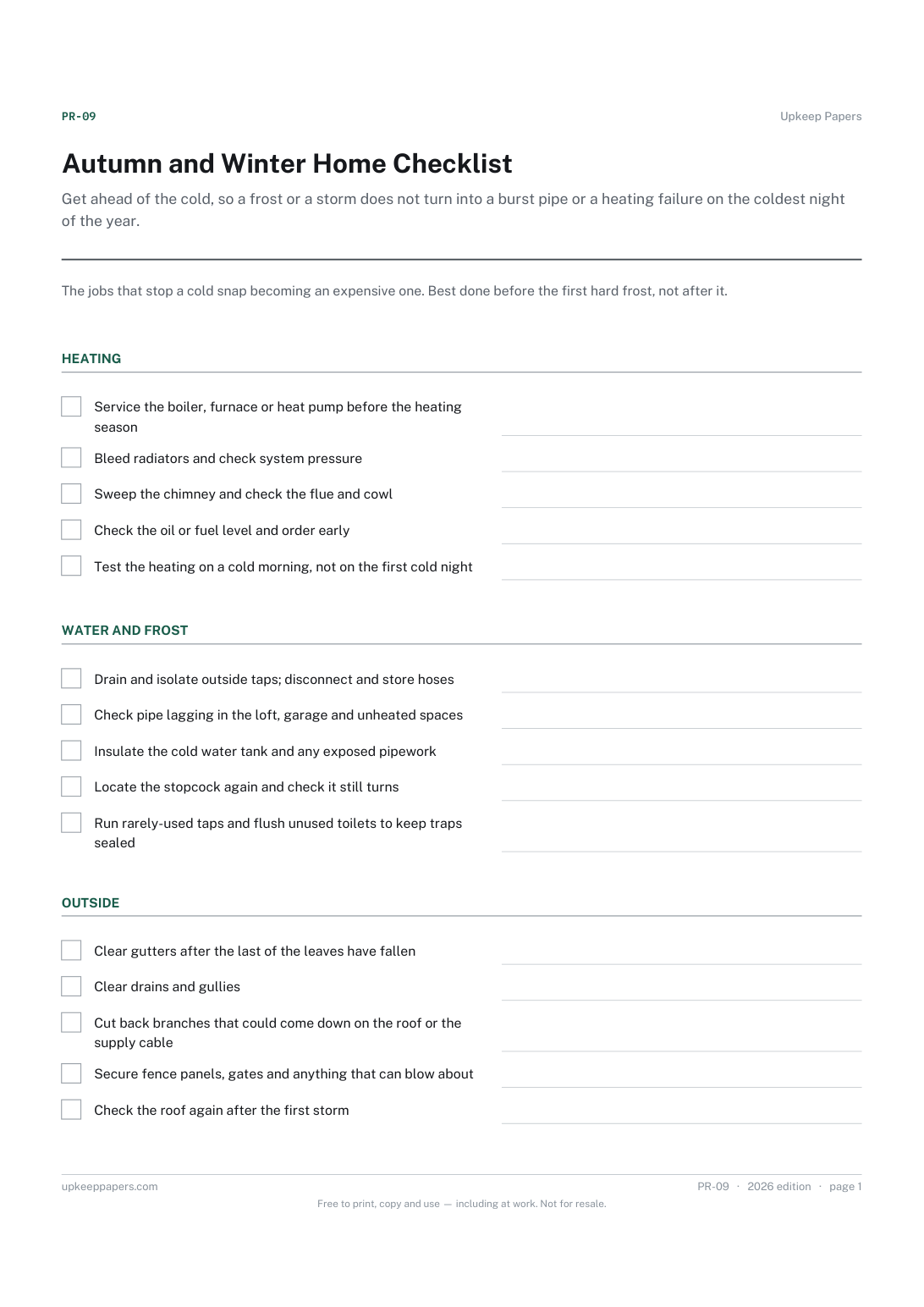
Autumn and Winter Home Checklist
Get ahead of the cold, so a frost or a storm does not turn into a burst pipe or a heating failure on the coldest night of the year.
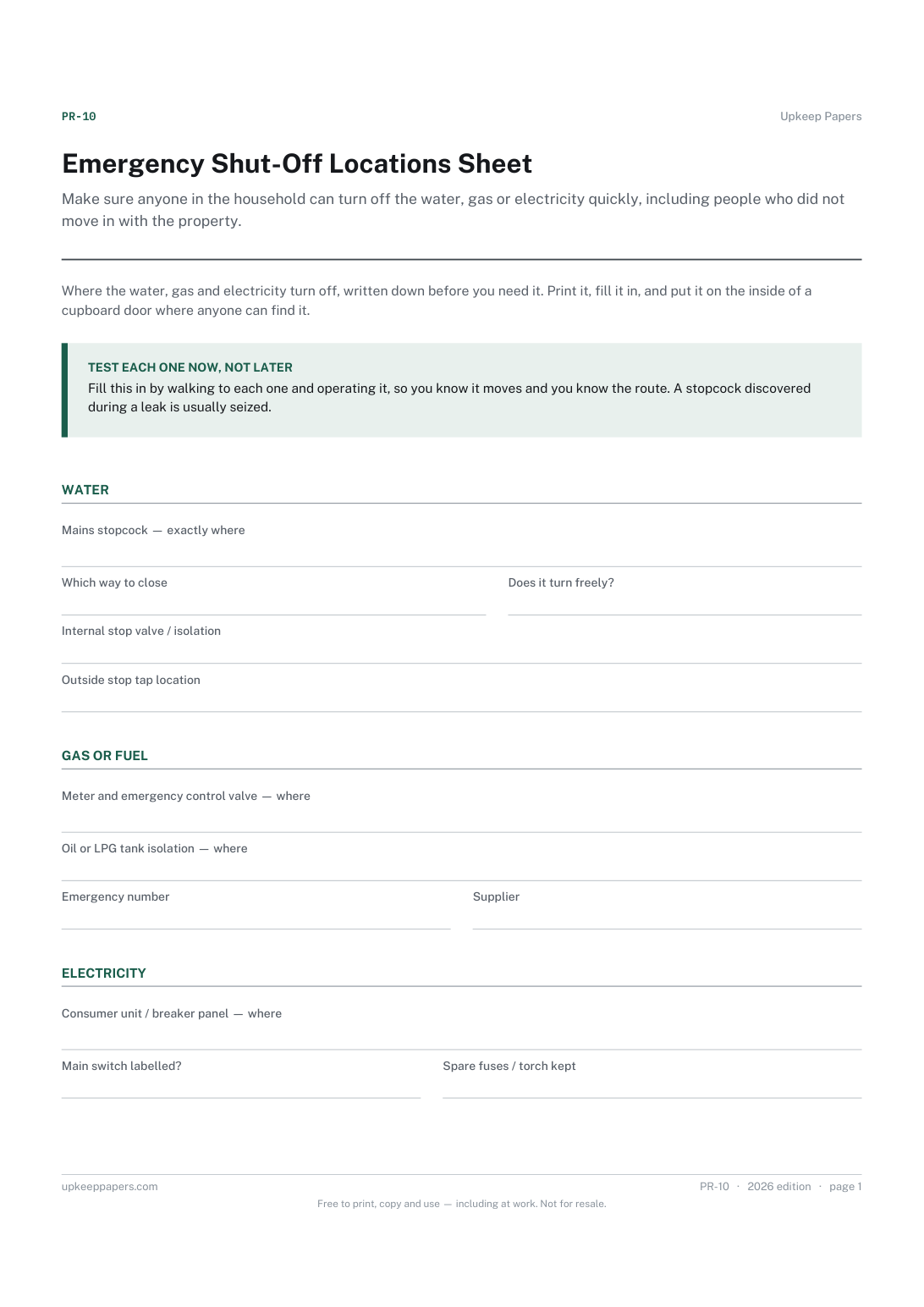
Emergency Shut-Off Locations Sheet
Make sure anyone in the household can turn off the water, gas or electricity quickly, including people who did not move in with the property.
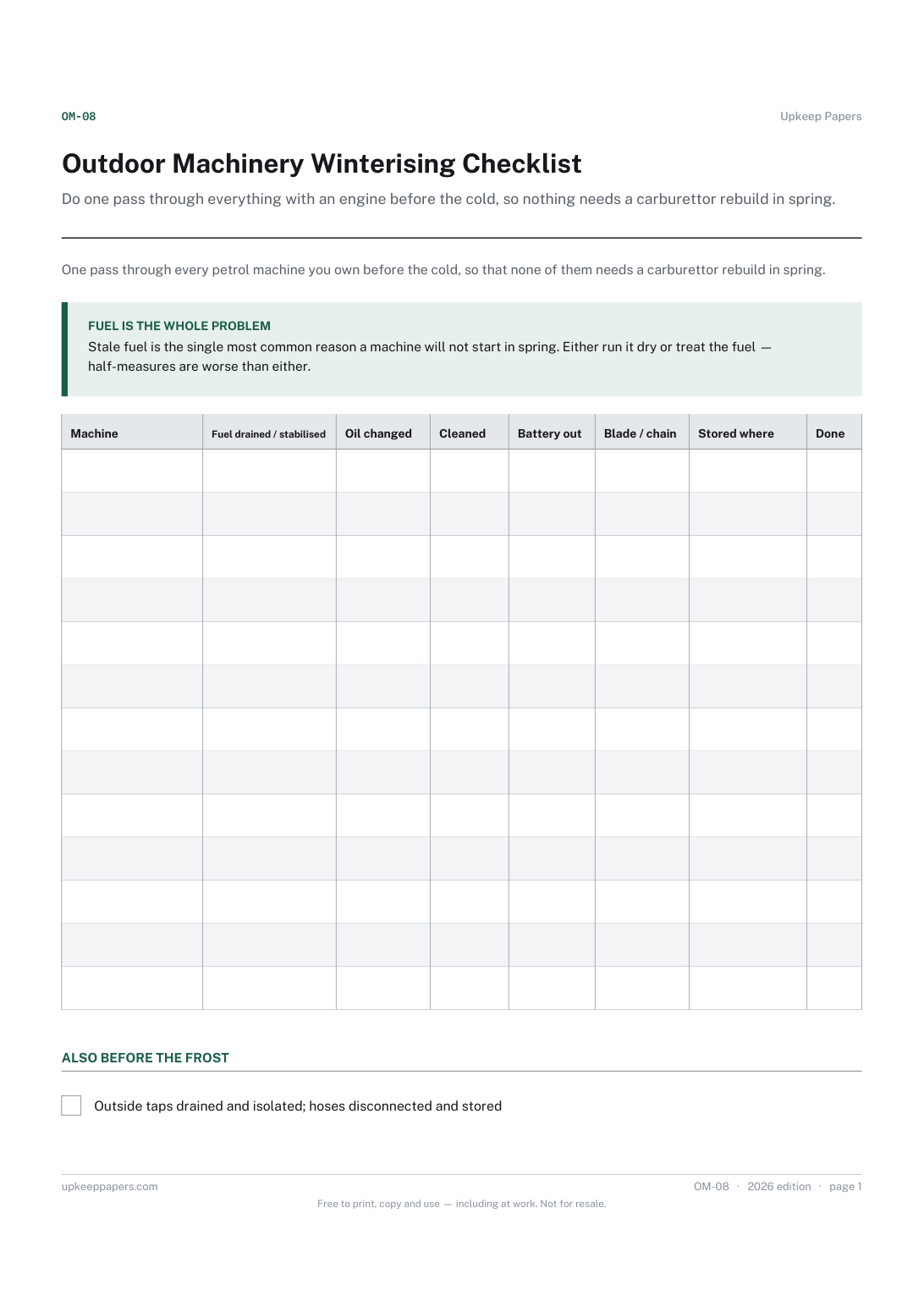
Outdoor Machinery Winterising Checklist
Do one pass through everything with an engine before the cold, so nothing needs a carburettor rebuild in spring.
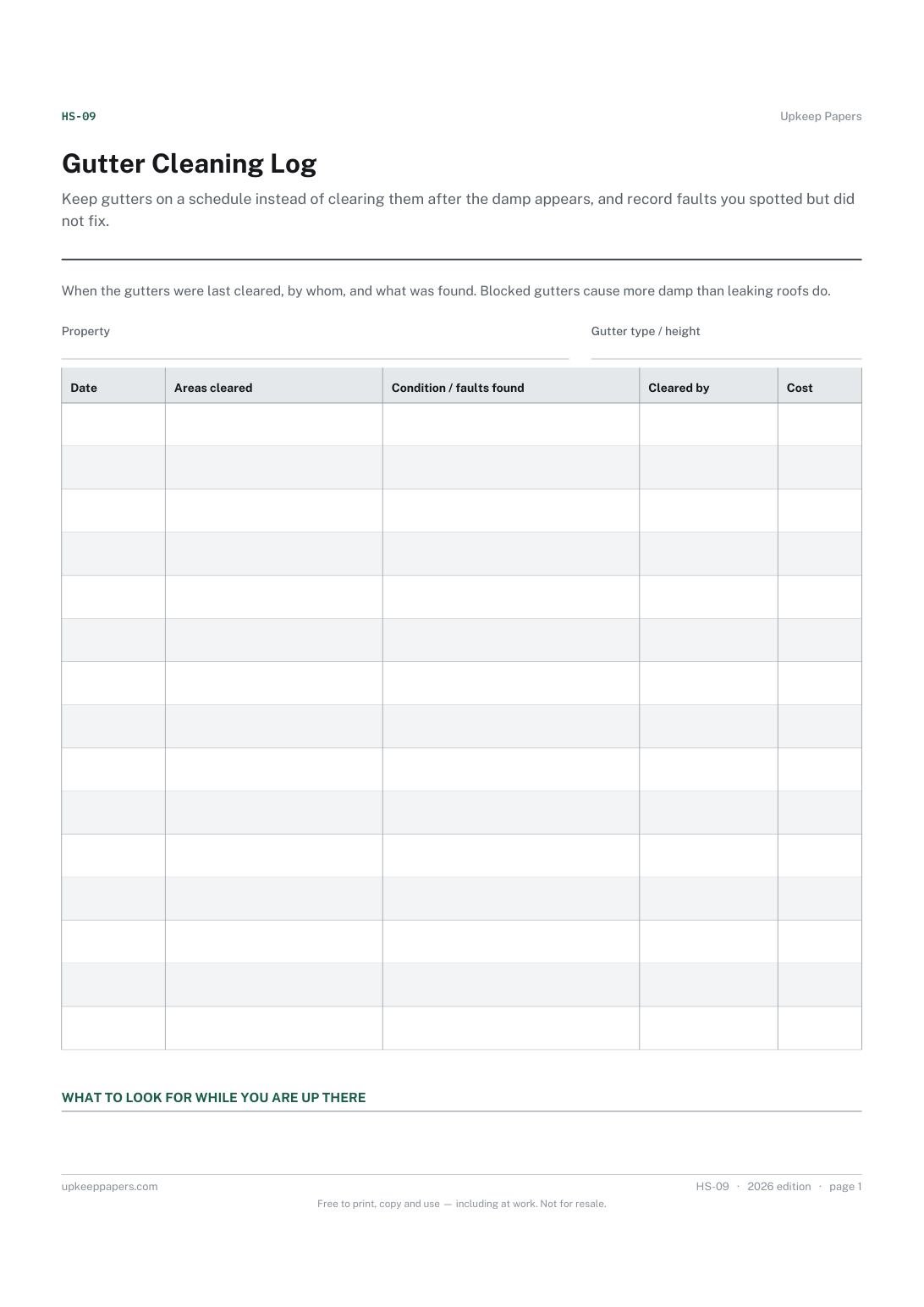
Gutter Cleaning Log
Keep gutters on a schedule instead of clearing them after the damp appears, and record faults you spotted but did not fix.
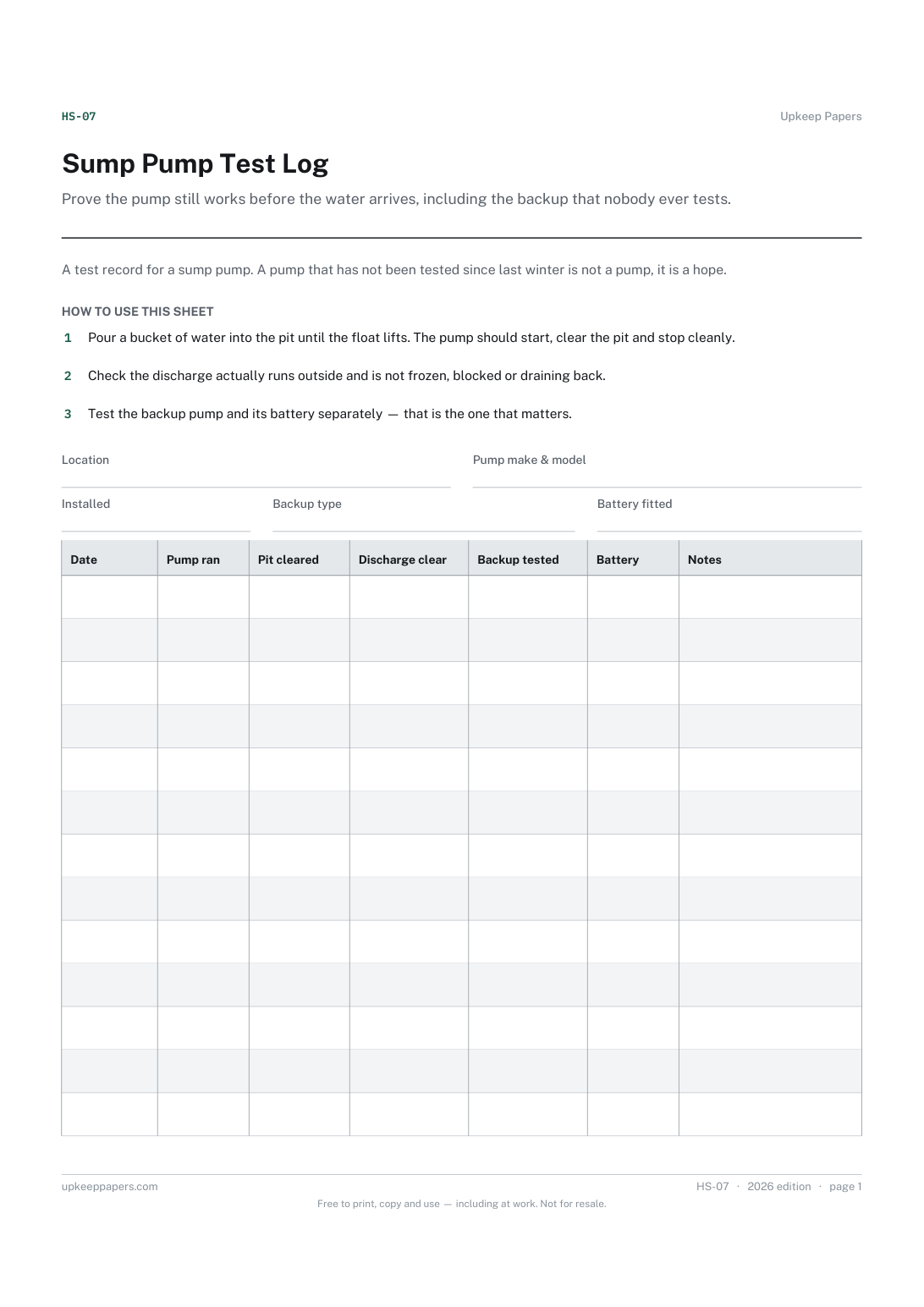
Sump Pump Test Log
Prove the pump still works before the water arrives, including the backup that nobody ever tests.
More guides
How to Build a Home Maintenance Binder That Survives
A ring binder beats an app for house records, but most binders die within a year. The sections that work, what to file, and how to keep it alive.
What Home Service Records Are Worth When You Sell
Why a documented maintenance history changes how buyers and surveyors behave, and which records are actually worth keeping for a sale.
What Your Insurer Asks For After a Leak or a Fire
Home insurance claims turn on evidence of maintenance and evidence of loss. What that means in practice, and what to record before anything happens.