Guide · Property records
What Home Service Records Are Worth When You Sell
Why a documented maintenance history changes how buyers and surveyors behave, and which records are actually worth keeping for a sale.
Published
Nobody buys a house because the paperwork is tidy. But a documented history changes the shape of a sale, and it does so at the point where sales most often go wrong: after the survey, when a buyer is deciding how much of what they have just read is a real problem.
What a survey actually produces
A surveyor inspects what is visible and then hedges. That is their job. The result is a report containing a number of items flagged for further investigation, several of which will be phrased in a way that sounds alarming to someone who has never read one before.
A buyer looking at that list is trying to answer one question: is this a house that has been looked after, or one that has been let go? In the absence of evidence they will assume the worse of the two, because that is the safer assumption when you are about to spend a very large amount of money.
Service records are the evidence that answers the question. A surveyor notes the flue needs inspection; you produce four years of sweep certificates. The item does not disappear, but it stops being a reason to renegotiate.
Which records carry weight
Not everything you keep is equally useful. In rough order of how much they matter:
Regulated work with certificates. Gas, electrical, oil and solid fuel work, and any statutory inspection required where you live. These come with paperwork issued by someone qualified and are the strongest documents you have. Keep the originals; the Home Service History Register is an index telling you where they are.
Annual servicing of major plant. Heating appliance, hot water, ventilation. A continuous run of annual services is a genuinely strong signal, and gaps in it get noticed.
Anything with a warranty attached. A boiler with a transferable warranty still in force is worth real money to a buyer, and validity usually depends on the servicing having been done and recorded. See the Warranty and Receipt Register.
Work on the things buyers fear. Roof, damp, drainage, subsidence, trees. These are the items that kill sales. Documentation of work done, with the contractor named, moves them from unknown to known.
Everything else. Redecoration, appliance repairs, garden work. Nice to have, rarely decisive.
The gap problem
The most common failure is not an absence of records but an inconsistent run of them. Three years of boiler services, then nothing for four years, then a service last month because the sale was coming.
That pattern reads badly, and it reads badly for a reason: it is exactly what a property looks like when someone stopped paying attention. If you have a gap it is better to be able to explain it — a tenancy, a period abroad, a replaced appliance — than to leave it hanging.
This is the argument for recording continuously rather than assembling the file when you decide to sell. A register kept from the start costs you a line of writing a few times a year. Reconstructed afterwards it is largely guesswork, and it looks like guesswork.
Records for work you did yourself
Work you carried out personally still counts, but it needs to be recorded differently to be credible. Date it, say what you did, and keep the receipts for materials and parts. A line reading “replaced both bathroom extractor fans, units and receipt attached” is worth having. A line reading “did some work upstairs” is not.
The Contractor and Tradesperson Log has a column for who did the work precisely so that self-performed work is distinguishable from trade work rather than blurred into it.
A realistic expectation
It would be dishonest to claim a folder of records adds a specific amount to a sale price. Property values are driven overwhelmingly by location, condition and the market on the day, and anyone quoting you a percentage is inventing it.
What records do, reliably, is reduce friction. They shorten the list of things a buyer wants investigated, they give your agent something concrete to say, and they make post-survey renegotiation harder to justify. On a transaction of that size, removing one round of haggling is not a small thing.
The cost is a page in a folder and a minute of writing a few times a year.
Practical filing
Keep it physically simple, because a system you do not maintain is worse than none.
- One folder, one register at the front, everything filed behind it in date order.
- Photograph or scan certificates as you receive them, so a lost original is an inconvenience rather than a problem.
- Keep the register with the house paperwork, not in a drawer with the manuals.
- When you sell, hand the whole folder over. It is genuinely useful to the next owner, and a buyer who receives it starts out believing the house was cared for.
From the library
Sheets mentioned here
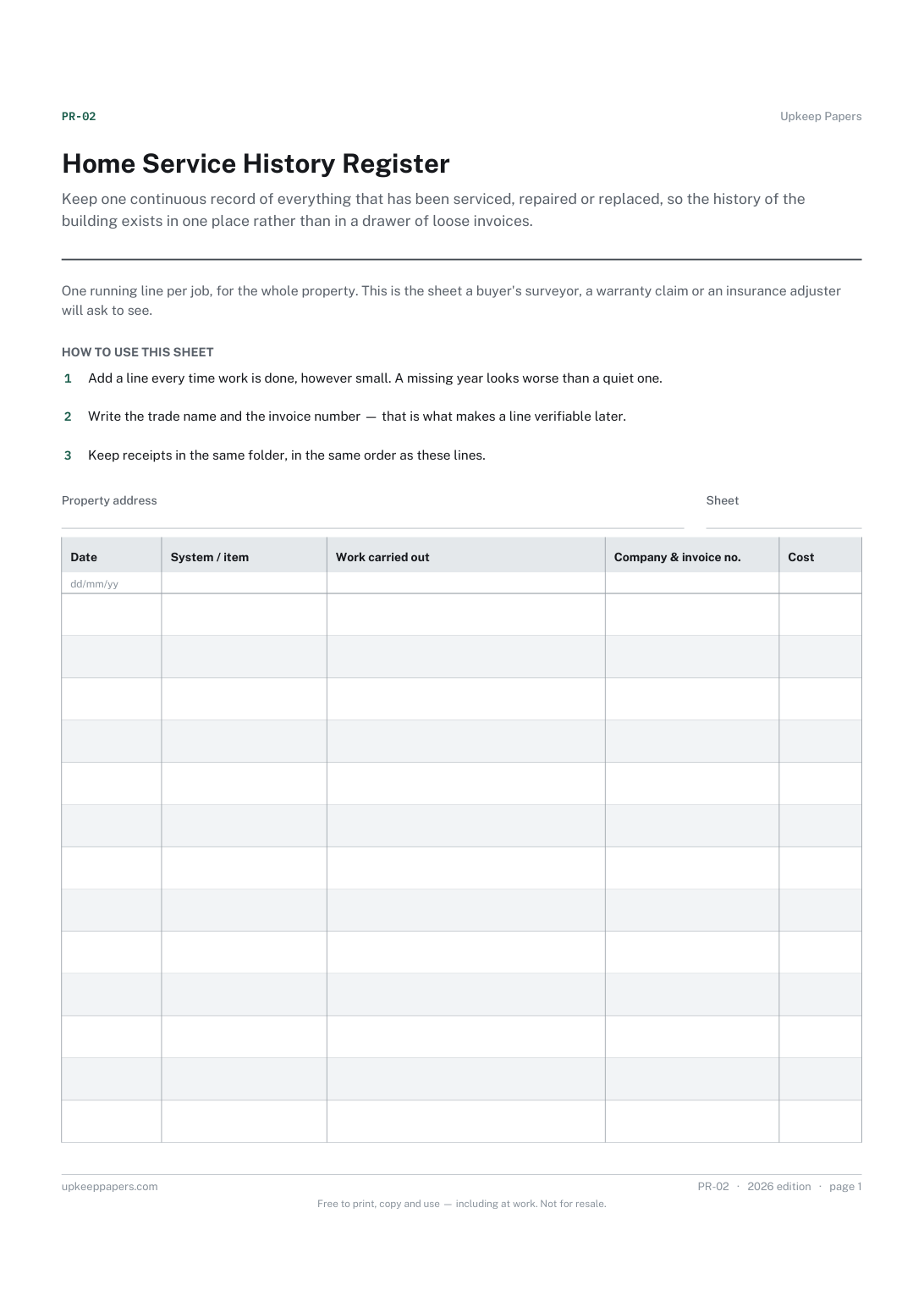
Home Service History Register
Keep one continuous record of everything that has been serviced, repaired or replaced, so the history of the building exists in one place rather than in a drawer of loose invoices.
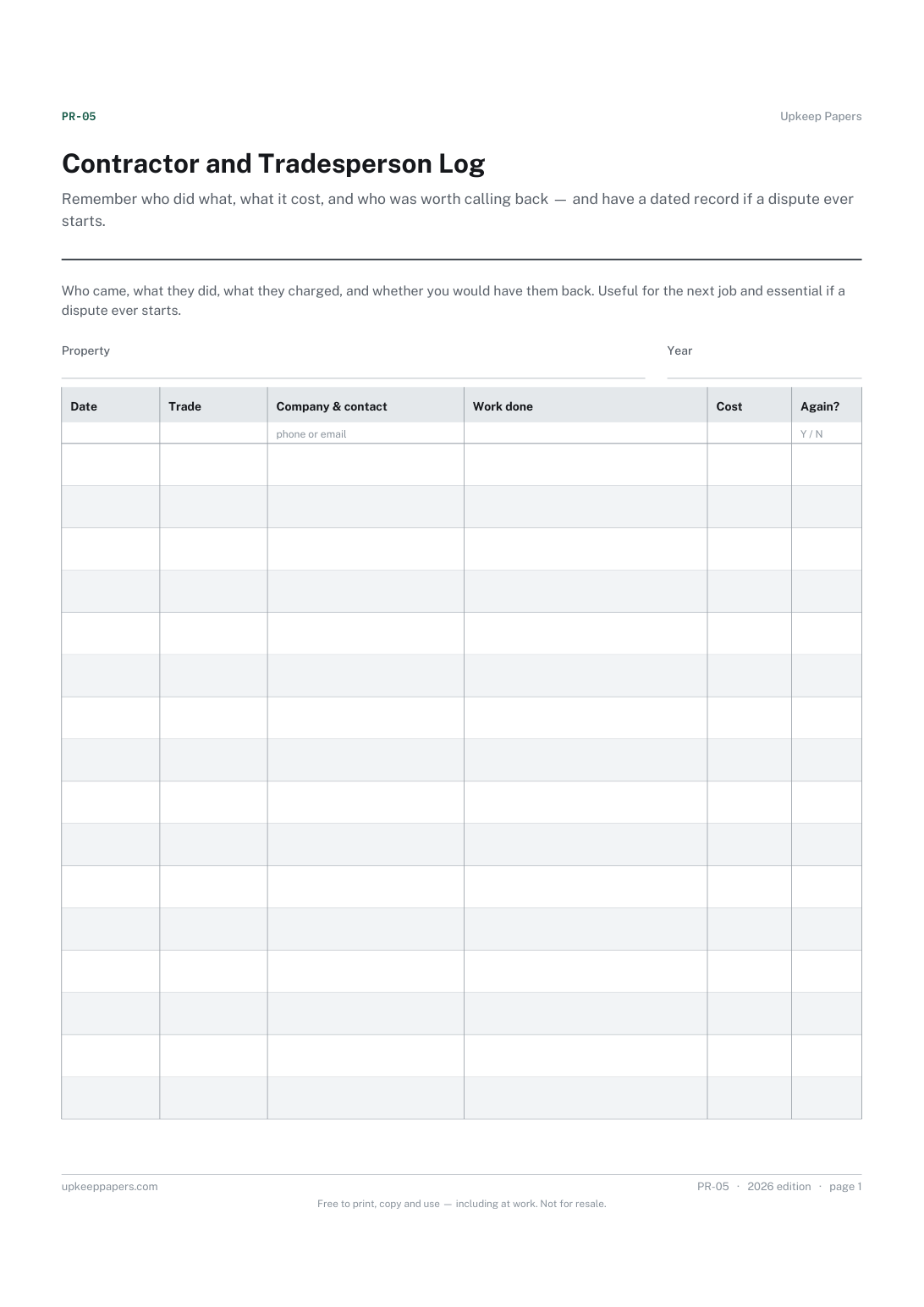
Contractor and Tradesperson Log
Remember who did what, what it cost, and who was worth calling back — and have a dated record if a dispute ever starts.
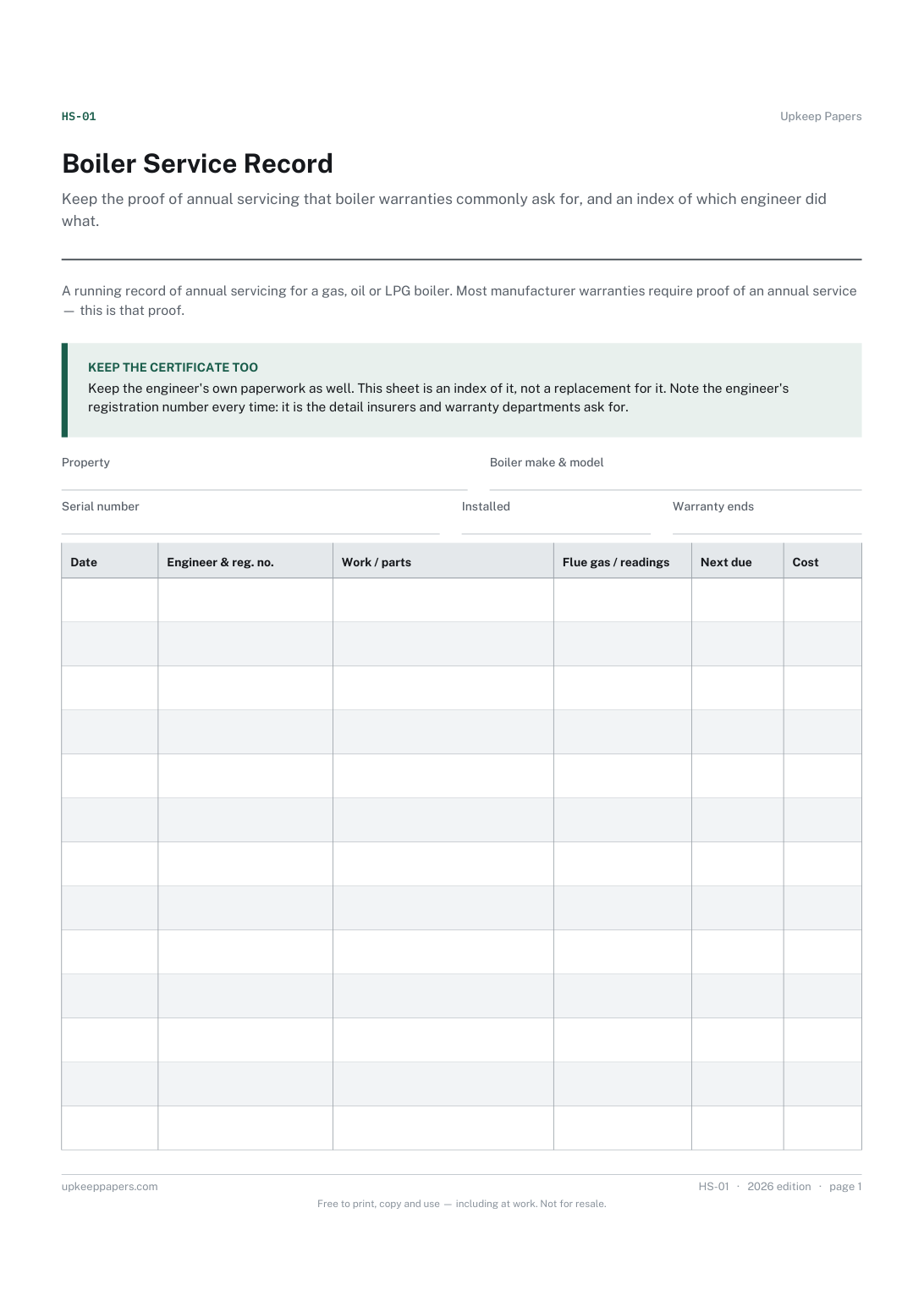
Boiler Service Record
Keep the proof of annual servicing that boiler warranties commonly ask for, and an index of which engineer did what.
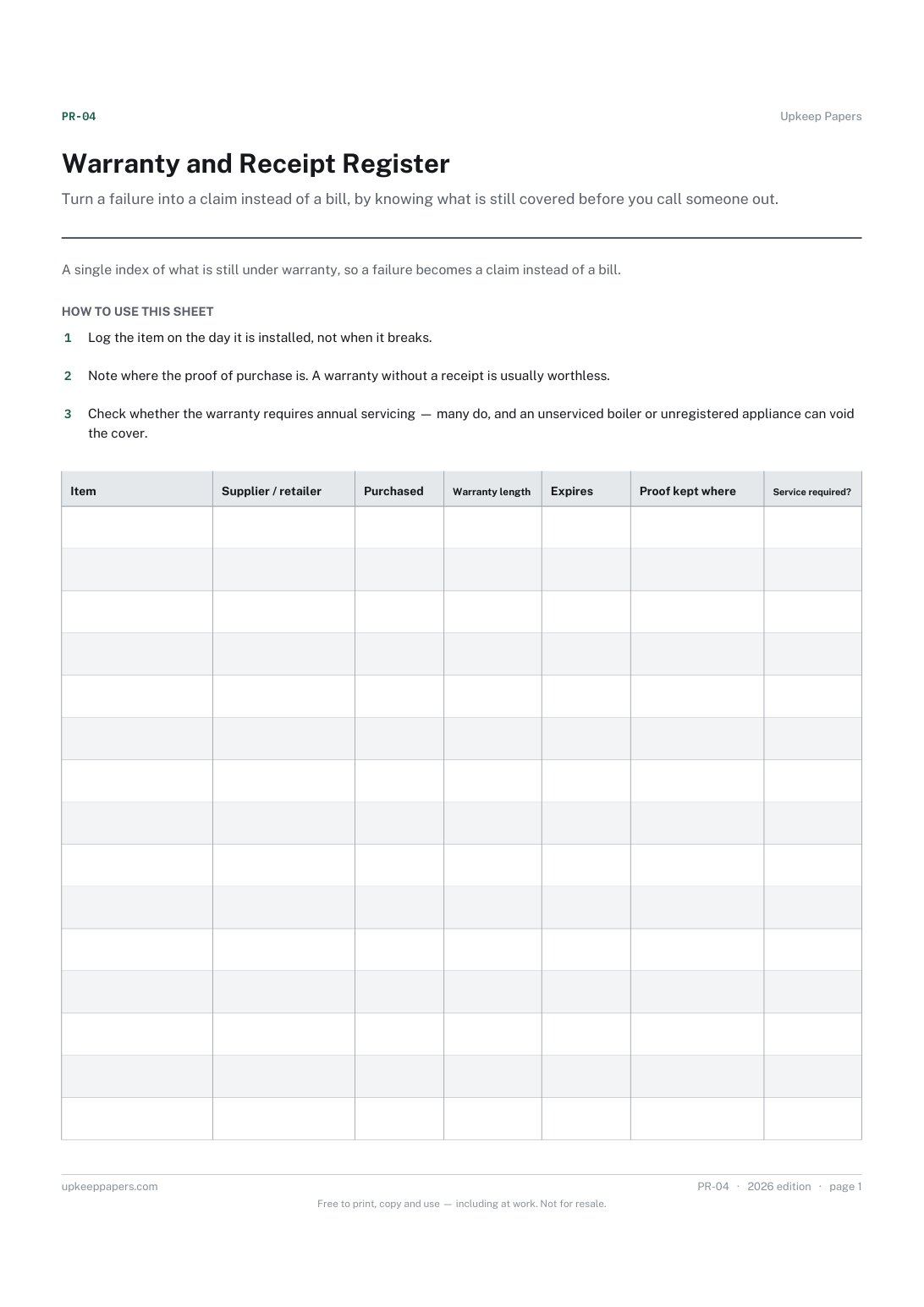
Warranty and Receipt Register
Turn a failure into a claim instead of a bill, by knowing what is still covered before you call someone out.
More guides
How to Build a Home Maintenance Binder That Survives
A ring binder beats an app for house records, but most binders die within a year. The sections that work, what to file, and how to keep it alive.
What Your Insurer Asks For After a Leak or a Fire
Home insurance claims turn on evidence of maintenance and evidence of loss. What that means in practice, and what to record before anything happens.
Winterising Your House and Outbuildings
Frost damage is a drainage problem more than an insulation problem. What to drain, what to isolate, and how to leave a property that will not burst.