
How we work
A Checklist and a Log Are Not the Same Sheet
Pool maintenance splits into two different kinds of record. Printing both on one table is why so many free pool sheets are hard to keep up.
Water and pools has had two sheets on this site since launch, and both of them are logs: a running table of chemistry readings, one for a pool and one for a hot tub. Adding five more sheets to that category this week meant looking hard at what a log actually is, and noticing that a good chunk of pool maintenance is not that at all.
A log is a series of measurements you take over time so you can see a trend. Chlorine today, chlorine last week, chlorine the week before. The value of the sheet is in the comparison, and the comparison only works if every row is the same kind of thing: a number, on a date, from the same test.
A checklist is different. It is a fixed set of jobs that either happened or did not. Skim the surface. Brush the walls. Backwash the filter if the pressure has crept up. None of those produce a number worth trending. They produce a yes or a no, and the useful question a fortnight later is not “what was the value” but “did we do it.”
Why mixing them produces a worse sheet
Try to put both on one table and you end up with a row that has a chlorine reading in one column and a tick for “vacuumed” in the next, and the table stops doing either job well. The chemistry columns want to be scanned down, so a drift shows up as a line sloping across five rows. The checklist columns want to be scanned across, so a skipped week shows up as a gap. Squeeze both into the same grid and neither pattern is easy to see, because your eye cannot scan two directions at once on the same table.
It also produces a worse habit. A log invites you to write in whatever number you measured, even if it is a bad one. A checklist invites you to tick a box, and ticking a box you did not really do is a much smaller lie to tell yourself than inventing a reading. Keep them apart and the honest one stays honest.
This is the reason the two new pool sheets this week are a checklist (weekly jobs, ticked) and a log (equipment servicing, by date), rather than one combined table trying to do both. The existing Pool Chemical and Maintenance Log keeps doing the chemistry. The new Weekly Pool Maintenance Checklist only tracks whether the physical round happened, and says as much on the sheet itself, so nobody wonders why there is no room for a pH figure on it.
The same split shows up elsewhere on the site
Once you notice it, the checklist-versus-log question runs through most of what is here. A boiler service record is a log: date, engineer, reading, one row a year, meant to be compared across years. A trailer pre-tow inspection is a checklist: coupling, lights, load, done every time before you tow, and last week’s inspection tells you nothing useful about this week’s.
The two new pool opening and closing sheets are checklists for the same reason a spring and autumn home checklist is a checklist rather than a log — they are one-off sequences you work through in order, not readings you compare year on year. Doing them out of order, or skipping the equipment shutdown before fitting a winter cover, is the actual failure mode, and a checklist is built to stop that. A log would just leave a gap in a column and let you notice it in April.
The new Pool Equipment Service Log sits on the log side of the line but deliberately away from water chemistry. A pump seal or a heater fault is a servicing event on a piece of equipment, not a water-quality reading, and burying it in the same table as chlorine and pH made it too easy to miss when a repair was actually due. Splitting it out gives the equipment its own history, the way the Warranty and Receipt Register already gives every appliance in a house its own trail rather than folding it into a general maintenance log.
What this does not solve
None of this tells you what your chlorine level should be, and none of the five new sheets says otherwise. Target ranges depend on your sanitiser system, your pool surface and, for a let property, on rules that differ by where you are. That question was already answered, correctly, by the existing chemical log, and nothing about splitting checklists from logs changes it. What it does is stop a genuinely different kind of information — did the physical round happen, is the equipment overdue a service — from being squeezed into a table that was never built to hold it.
The Hot Tub Drain and Refill Record is the clearest small example. A drain-and-refill is an event, not a reading, and it belongs on its own log rather than as an extra column on the existing water chemistry sheet, where it would either get skipped or crowd out the readings either side of it. Once the two kinds of record are separated, deciding where something new belongs gets a lot easier: ask whether you are comparing numbers over time or ticking off a fixed job, and the sheet it belongs on follows from the answer.
From the library
Sheets mentioned here
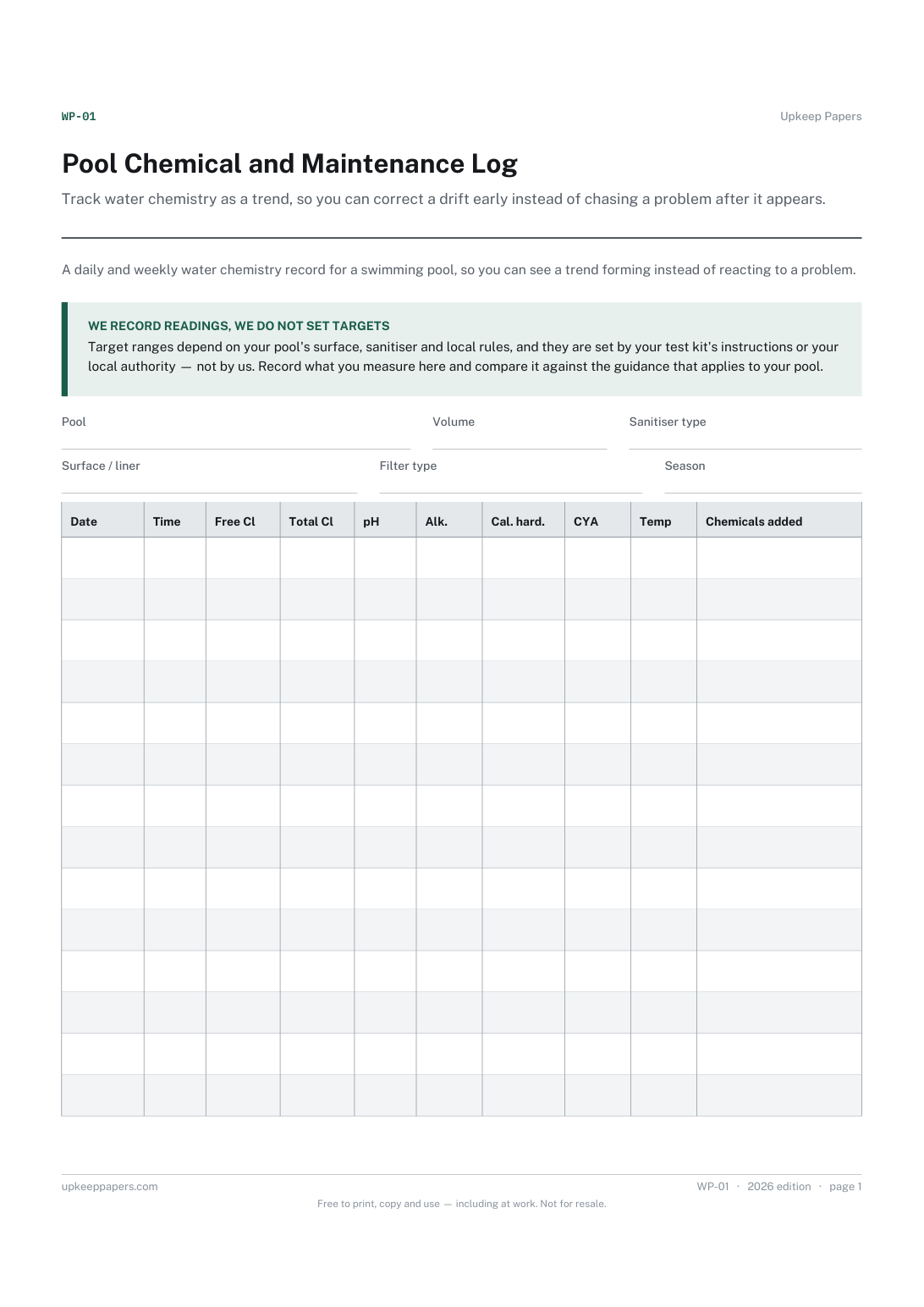
Pool Chemical and Maintenance Log
Track water chemistry as a trend, so you can correct a drift early instead of chasing a problem after it appears.
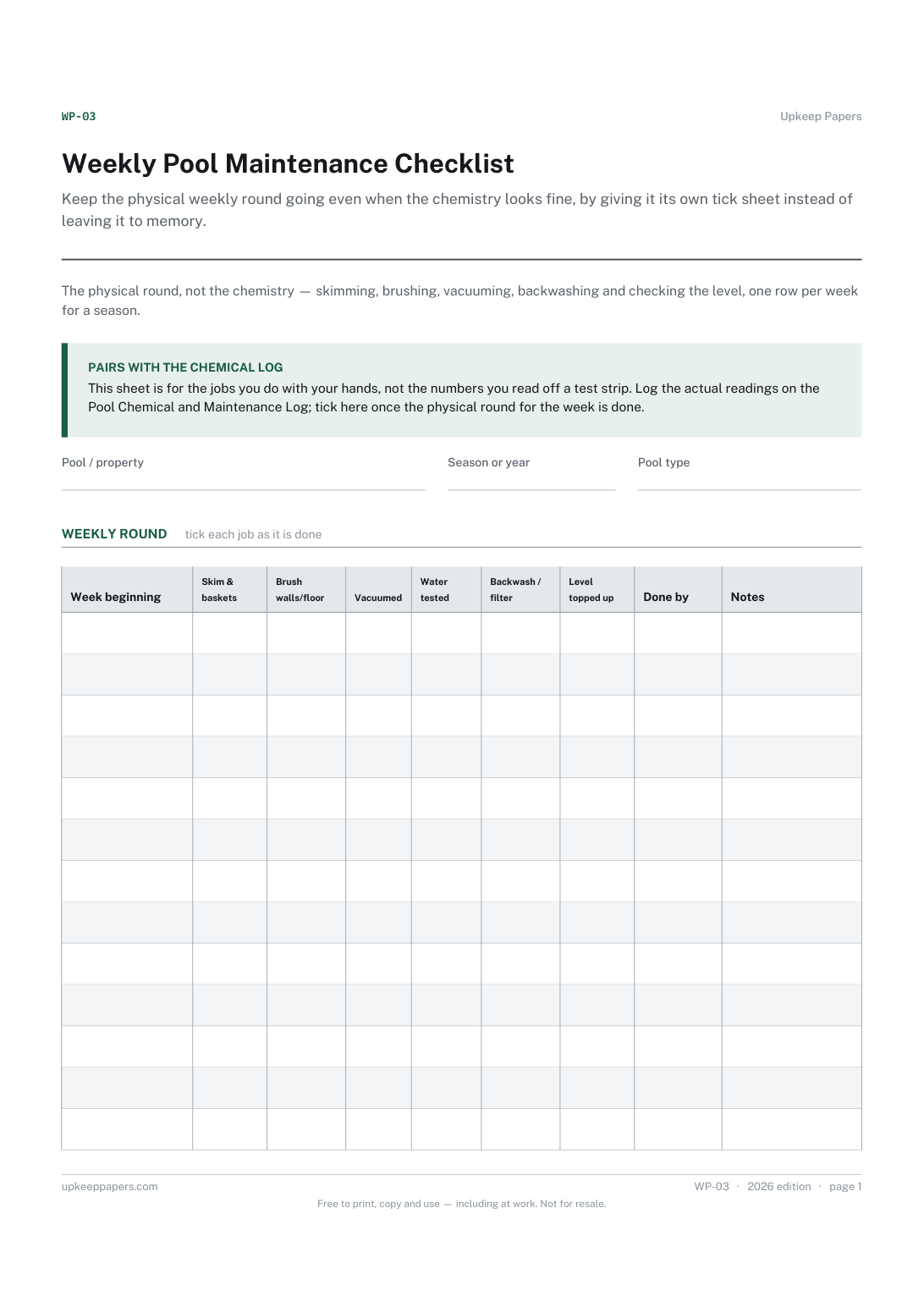
Weekly Pool Maintenance Checklist
Keep the physical weekly round going even when the chemistry looks fine, by giving it its own tick sheet instead of leaving it to memory.
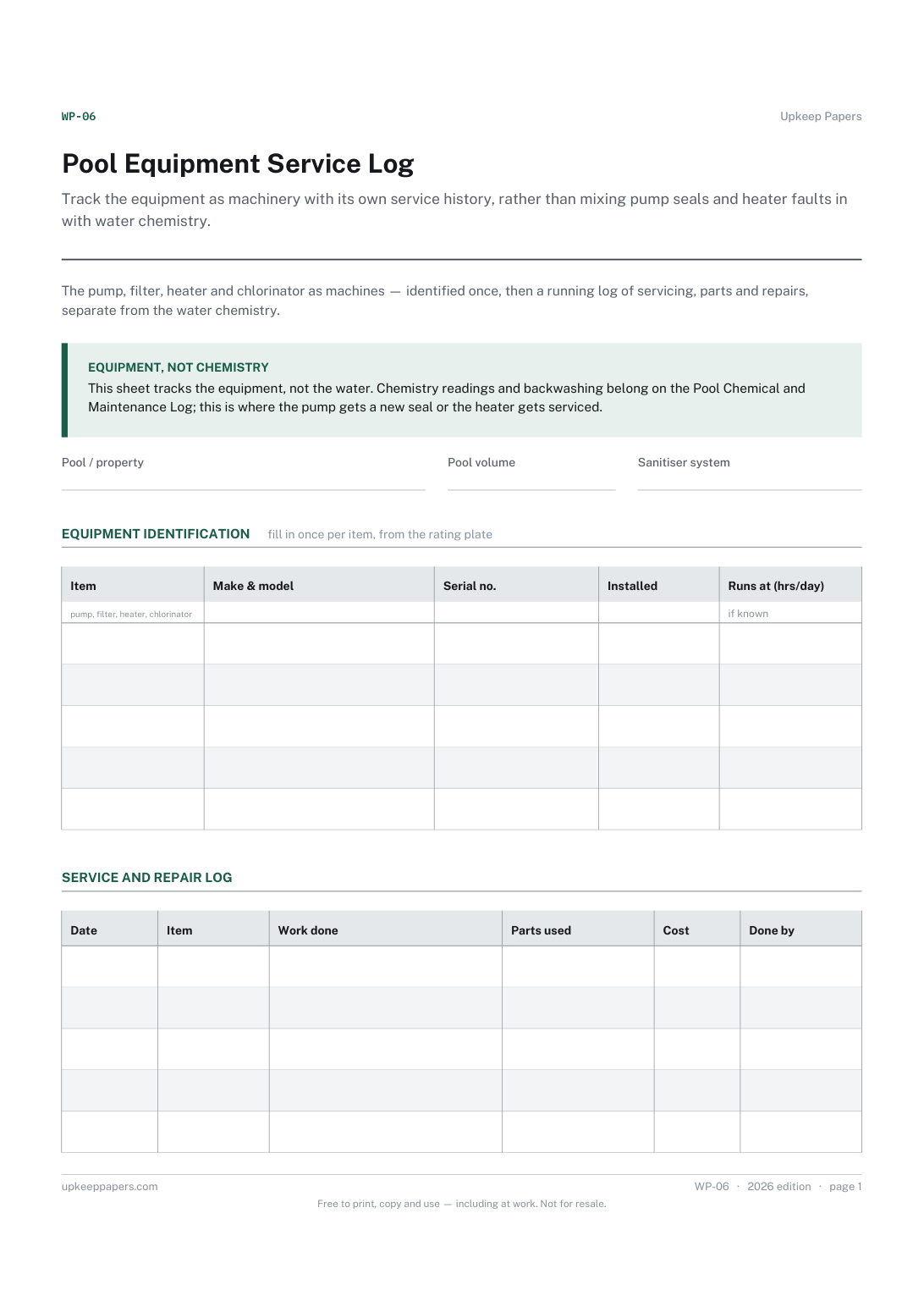
Pool Equipment Service Log
Track the equipment as machinery with its own service history, rather than mixing pump seals and heater faults in with water chemistry.
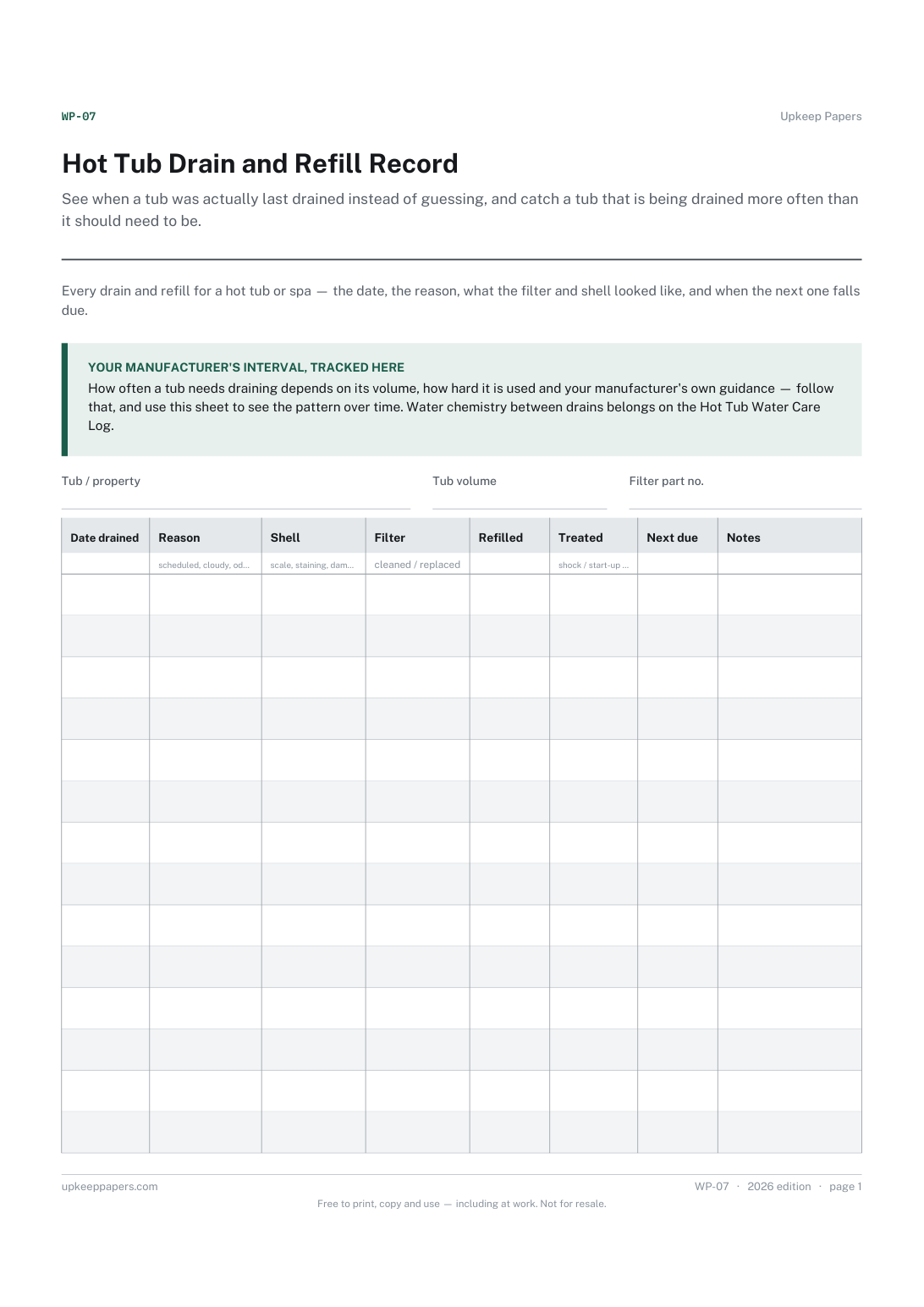
Hot Tub Drain and Refill Record
See when a tub was actually last drained instead of guessing, and catch a tub that is being drained more often than it should need to be.
More posts
A Gap in the Data Is Not Always a Gap on the Site
Two of this week's five measured keyword gaps already had a page. Here is the test that caught it, and the three that survived.
When the Roadmap Runs Out, Measure Instead of Guessing
The 200-sheet roadmap this site started with is finished. Here is what we built instead of guessing, and why four of five sheets came from one measured gap.
When a New Sheet Earns Its Own Page
Five sheets this week could easily have been three. Here is the test we use to tell a genuinely different record from the same one wearing a new title.
