Move-Out Property Inventory
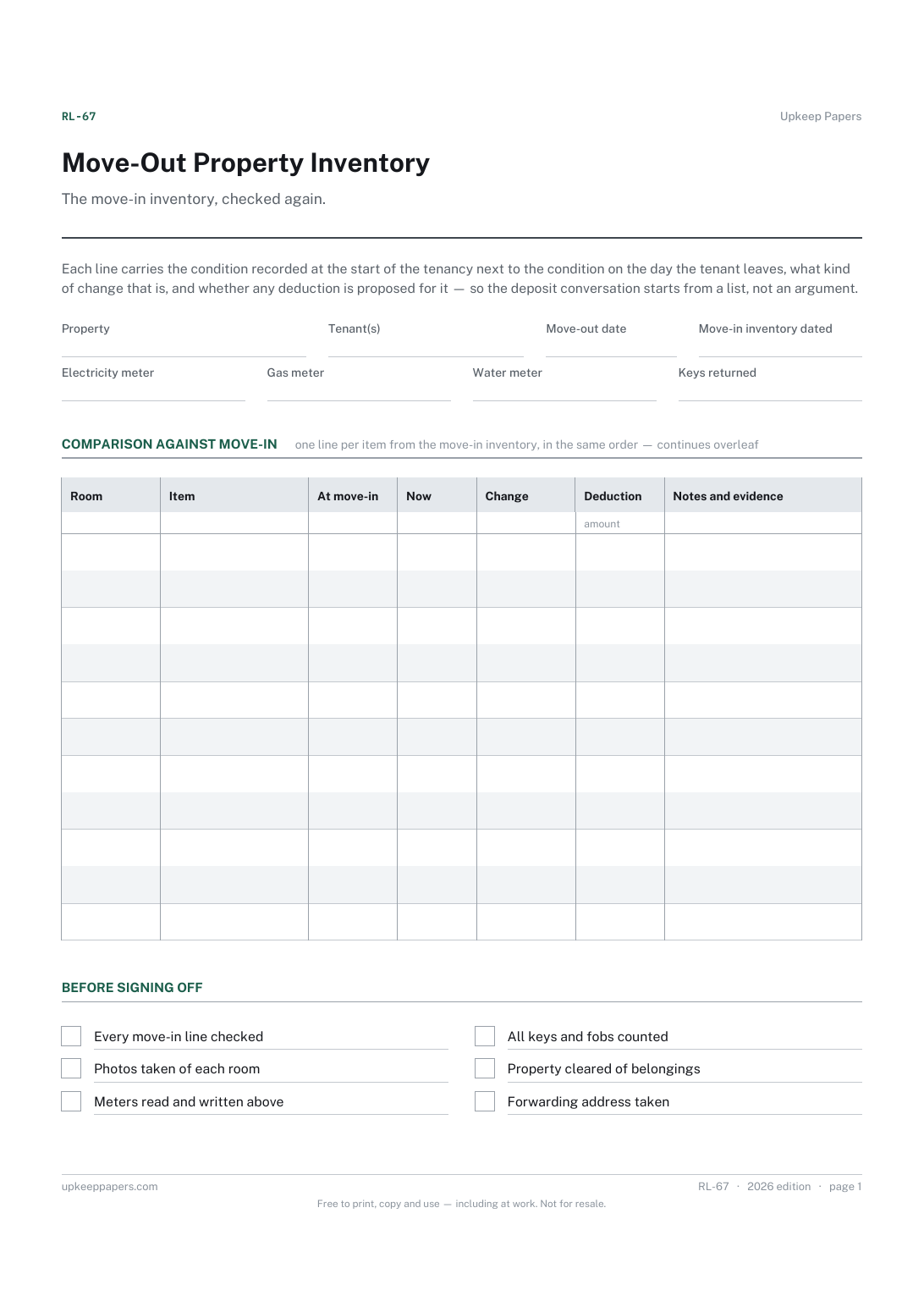
Condition at the start and at the end, side by side, for every item.
RL-67 Inventory PDF Online
Everything here is free. Making it takes time and money. Everything here is free.
 Buy us a coffee
Rental property and landlord · RL-66 · Inventory
Free move-in property inventory — room by room, every item with its condition at the start of the tenancy, meter readings and signatures. PDF and browser.
2 pages. The A4 and US Letter files are laid out identically, so neither is shrunk to fit.
Print it and write on it
Fillable PDF type and save
Or no download needed
Fill it in onlineThe fillable versions have real form fields — open them in any PDF reader, type into them and save. Printing help.
The same sheet, on screen. Tick, type, add or remove rows, then print it or download the completed version as a PDF. Everything stays in your browser — your entries are kept in this browser's own storage on this device, nothing is uploaded, and there is no account.
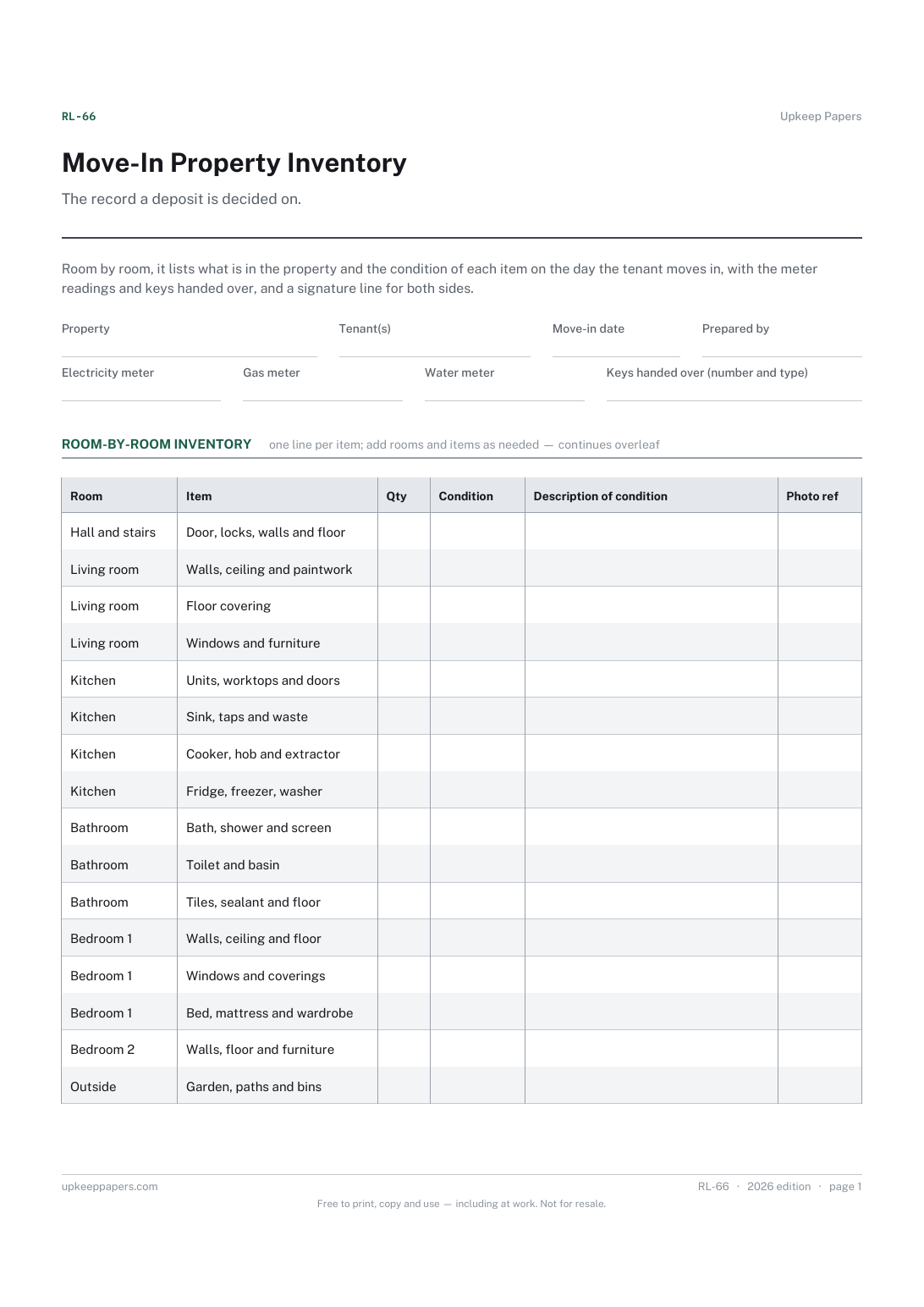
The record a deposit is decided on. Room by room, it lists what is in the property and the condition of each item on the day the tenant moves in, with the meter readings and keys handed over, and a signature line for both sides.
Landlords, agents and tenants at the start of a tenancy — whoever prepares it, both parties should agree it and keep a copy.
The printable is laid out inside a box that fits both A4 and US Letter, so the two files are identical and neither one is scaled. The fillable PDF has real form fields. The online version keeps what you enter in your own browser and builds the completed PDF on your device.
Download the A4 or US Letter file to match the paper in your printer, open it in a PDF reader and print at 100% — not "fit to page", which shrinks the writing space. Both files leave a 14 mm margin, which clears the unprintable edge on home printers. To print the online version with your entries in it, use the Print this sheet button, which prints only the sheet and none of the page around it. More on printing.
Enough that someone who was not there could picture it. 'Scuff on wall left of window, about hand-sized' is useful; 'walls fair' is not. Photographs with dates do most of the work.
Anyone can. What matters is that both sides walk it, agree it and sign it. Where the tenant disagrees with a line, write the disagreement in the notes rather than leaving it unsaid.
The fixed items are still there: walls, ceilings, floors, doors, windows, kitchen units, bathroom fittings, light fittings. Most of the prefilled lines are those; delete the furniture lines you do not need.
Whether and in what form is set by the rules where the property is. What is true everywhere is that a dispute without an inventory is decided on memory.
Condition at the start and at the end, side by side, for every item.
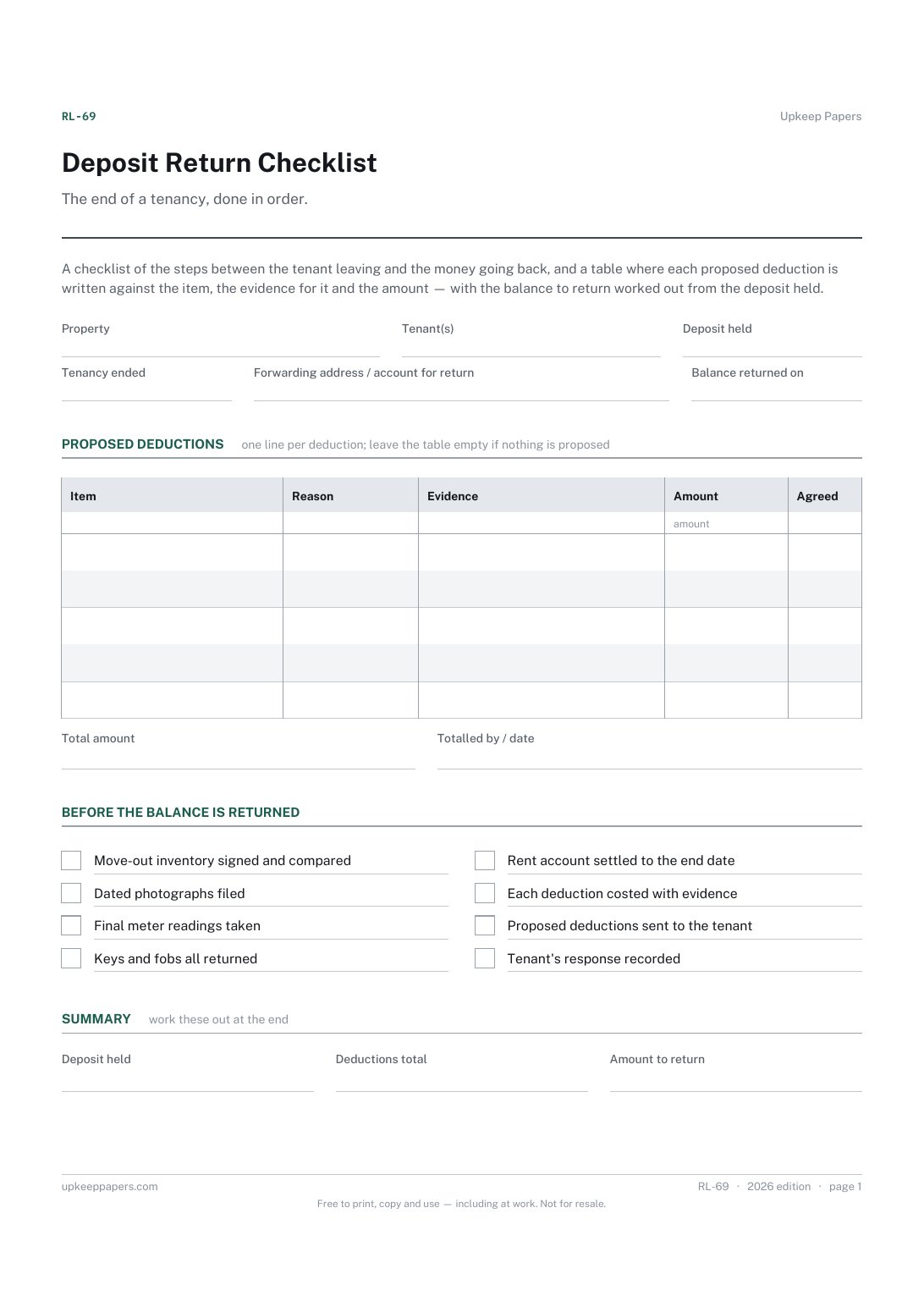
The steps to complete before any money moves, ticked in order.
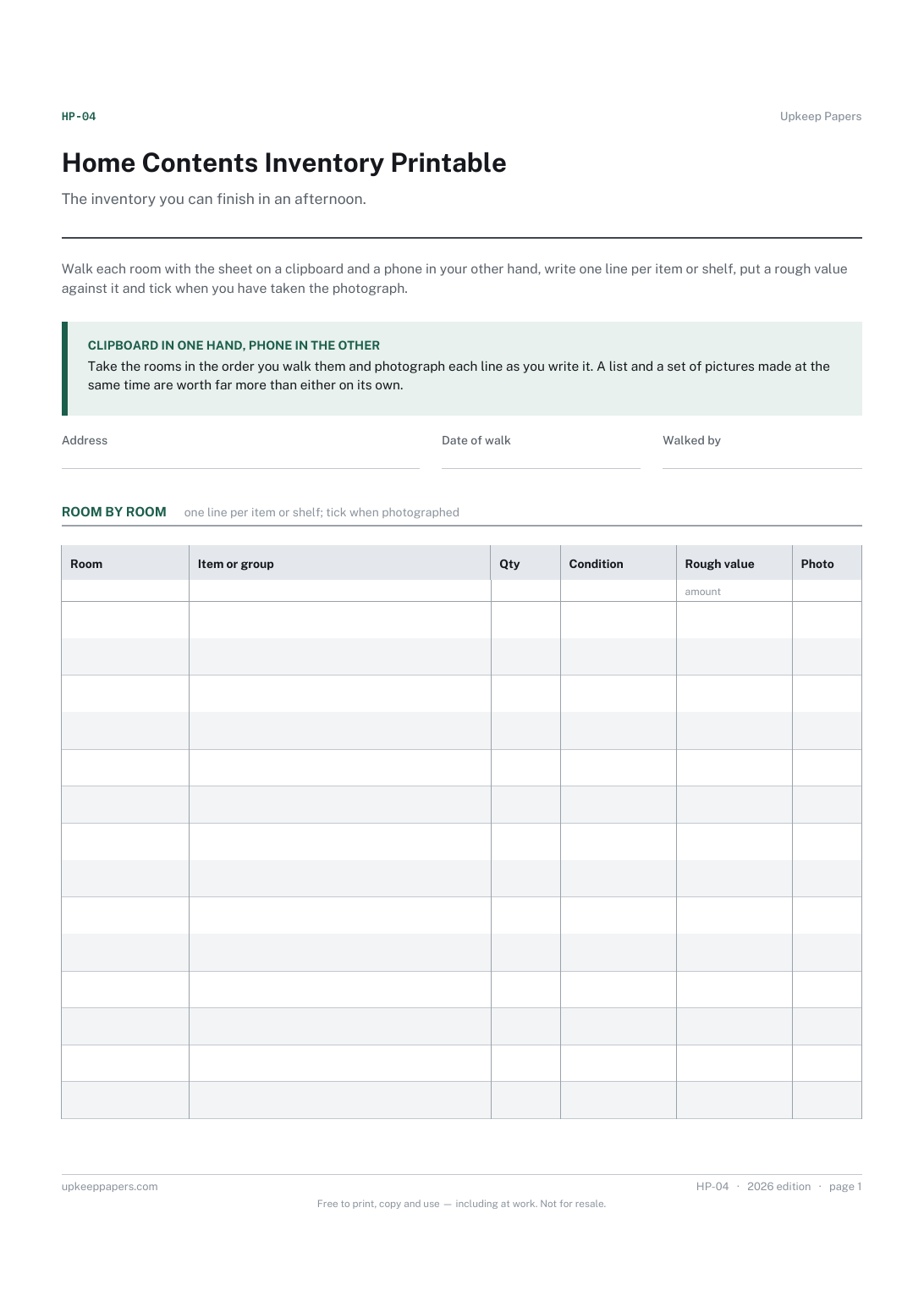
What is in each room, in the order you walked it.
Printable sheets, workbooks and tools on the same subject.
Establish what the property was like on day one, in a document both sides signed, so the end of the tenancy is not an argument from memory.
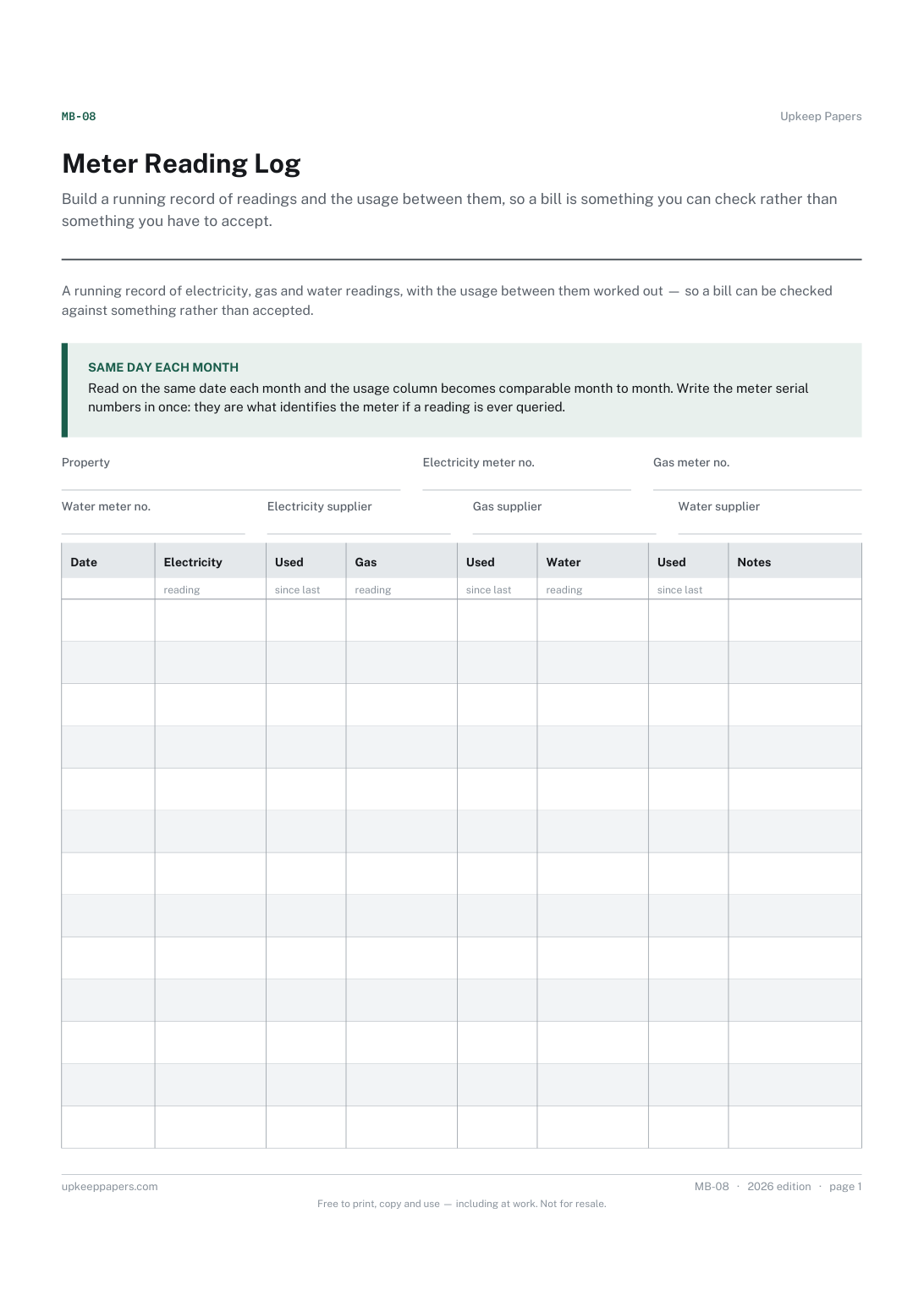
Build a running record of readings and the usage between them, so a bill is something you can check rather than something you have to accept.
Know how many keys exist and where they are, so you can tell whether a lock actually needs changing.

Every sheet, binder, game and puzzle on Upkeep Papers is free to download, with no email and no account. Making them is not free: each one takes days of research, design and checking, and the site costs money to run. If something here saved you time, you can buy us a coffee. It is entirely optional: nothing is locked, and nothing changes if you don’t.
Buy us a coffee Opens PayPal in a new tab. Any amount, and nothing changes if you would rather not.