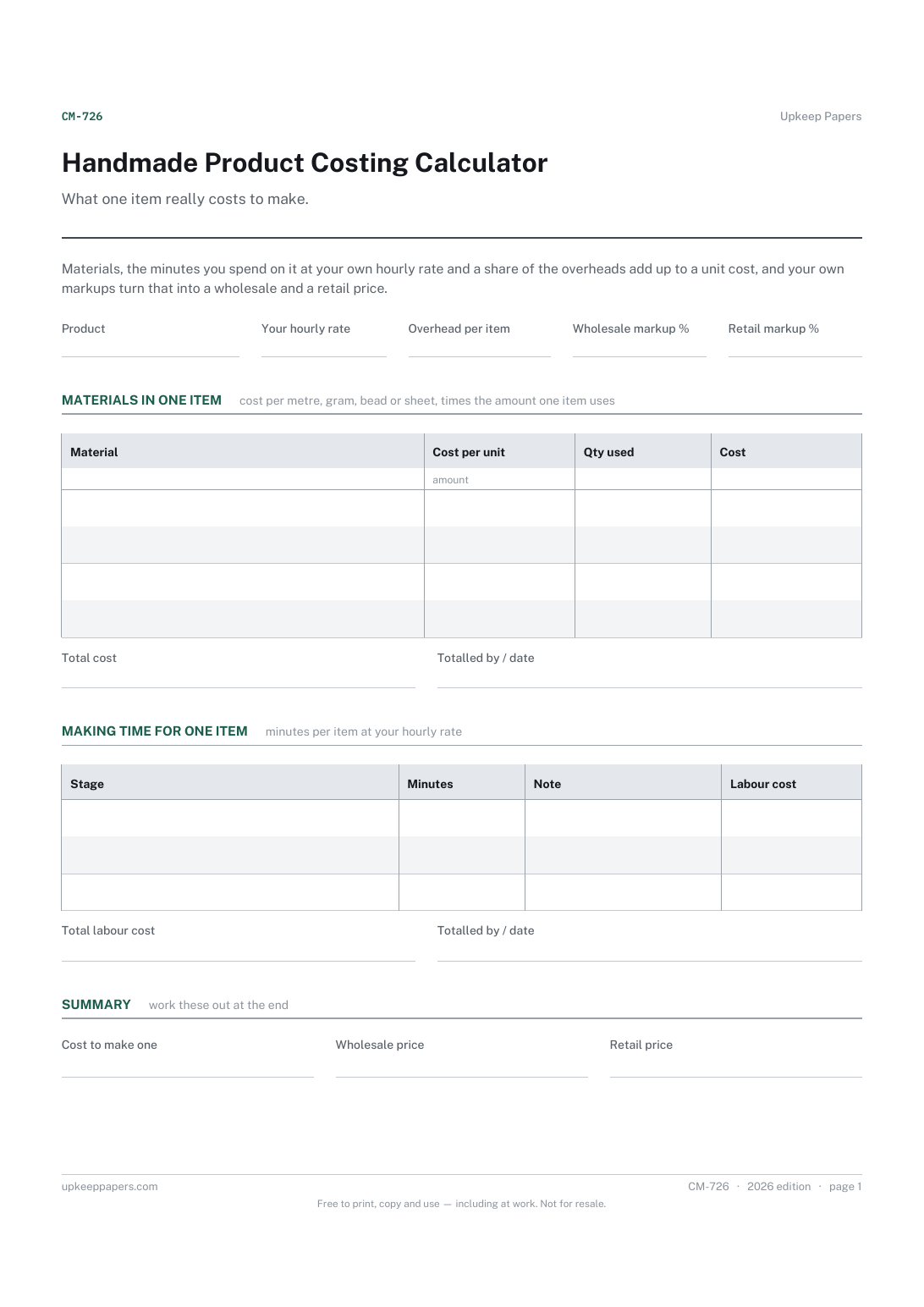
Handmade Product Costing Calculator
Every material in the item and what the amount used actually costs.
CM-726 Form PDF Excel Online
Everything here is free. Making it takes time and money. Everything here is free.
 Buy us a coffee
Makers and Craft Business · CM-739 · Form
Free craft fair break-even calculator — add up stall, travel and display costs and see how many sales cover them. PDF, Excel and browser.
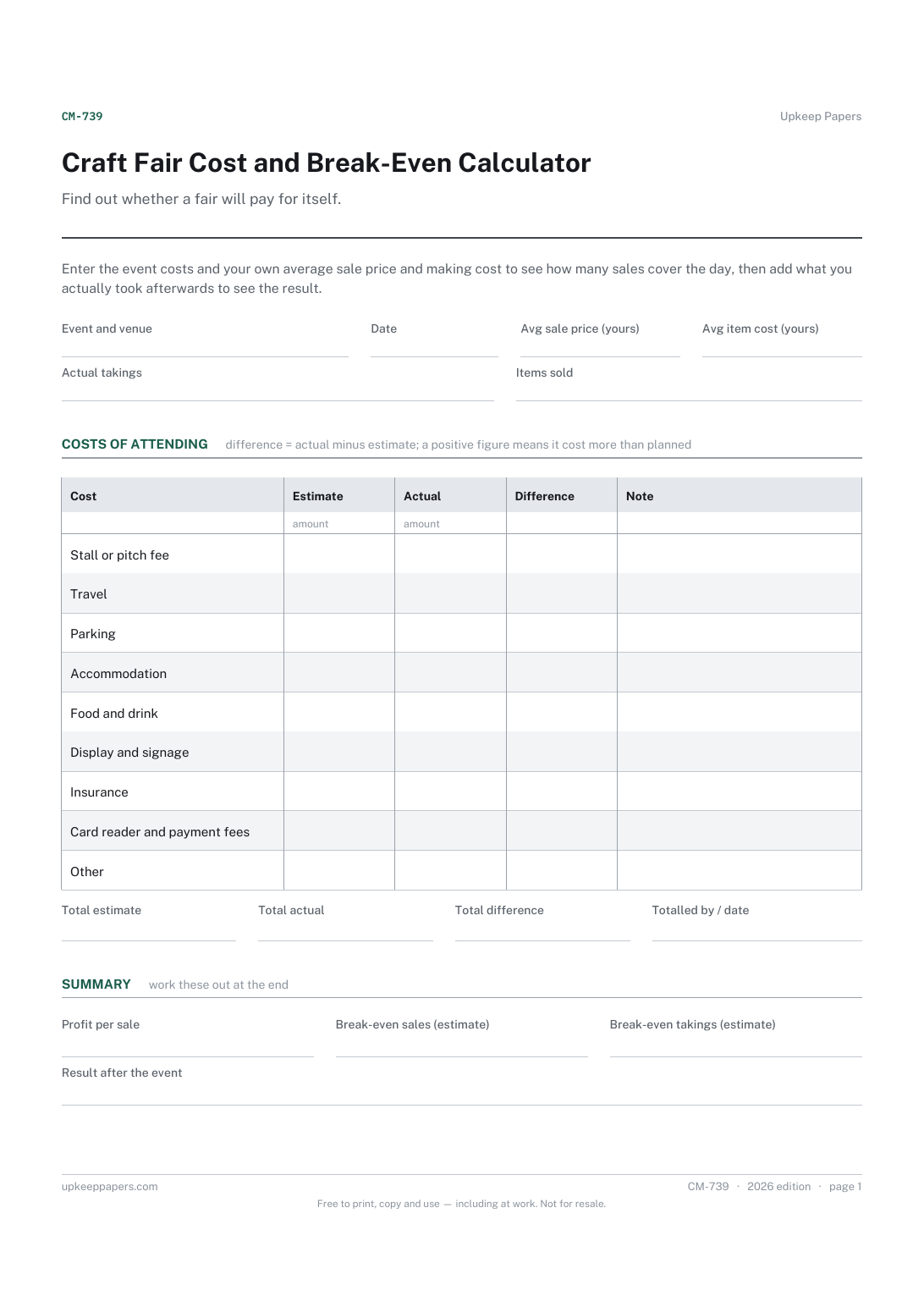
One page. The A4 and US Letter files are laid out identically, so neither is shrunk to fit.
Print it and write on it
Fillable PDF type and save
Spreadsheet formulas included
The fillable versions have real form fields — open them in any PDF reader, type into them and save. Printing help.
The same sheet, on screen. Totals and figures are worked out as you type, rows can be added or removed, and you can print it or download the completed version as a PDF. Everything stays in your browser — your entries are kept in this browser's own storage on this device, nothing is uploaded, and there is no account.
Find out whether a fair will pay for itself. Enter the event costs and your own average sale price and making cost to see how many sales cover the day, then add what you actually took afterwards to see the result.
Makers deciding whether to book a craft fair, market or show, and wanting to compare the figures afterwards before booking the same event again.
The printable is laid out inside a box that fits both A4 and US Letter, so the two files are identical and neither one is scaled. The fillable PDF has real form fields. The workbook uses plain formulas only — SUM, IF, COUNTIF and the like — so it opens in Excel, LibreOffice and Google Sheets without anything breaking, and every calculated cell is grey so you can see which figures it worked out.
Download the A4 or US Letter file to match the paper in your printer, open it in a PDF reader and print at 100% — not "fit to page", which shrinks the writing space. Both files leave a 14 mm margin, which clears the unprintable edge on home printers. To print the online version with your entries in it, use the Print this sheet button, which prints only the sheet and none of the page around it. More on printing.
What one typical item you sell costs you to make, from your own costing: materials and packaging, plus labour and overheads if you include them. Use the same basis every time so events can be compared.
You cannot sell part of an item, so the figure is rounded up to the next whole sale. Selling that many at your average price and cost covers the day's costs.
If you want the result to show whether the day was worth your time, add a line under other for your own hourly figure times the hours. Leave it out if you only want to cover cash costs.
It gives a reasonable estimate. For a closer figure, work out the average from a past event's takings divided by items sold, and use that.
Every material in the item and what the amount used actually costs.
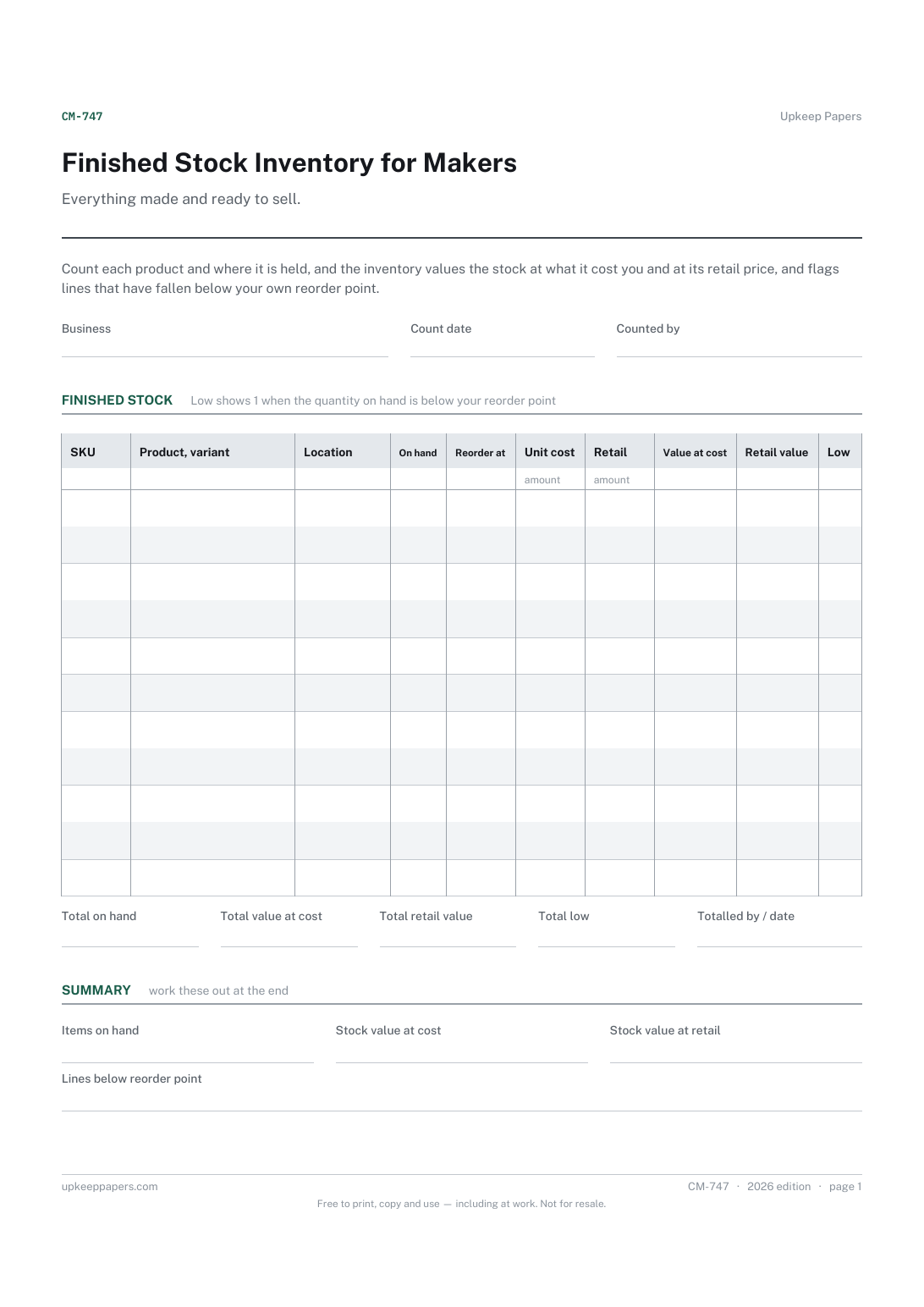
Each product and variant by SKU and where it is held.
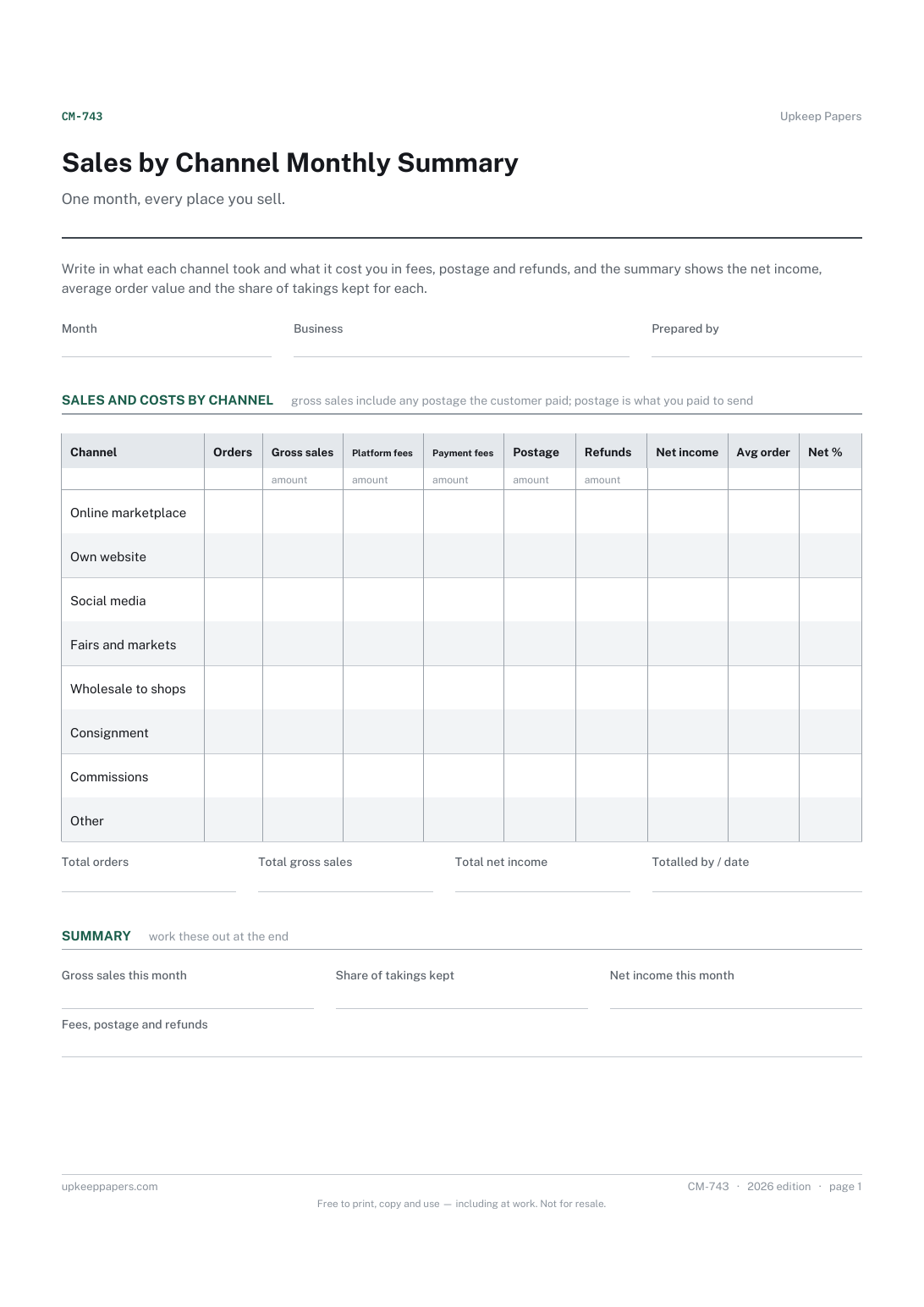
Orders and gross sales for each selling channel in the month.
Printable sheets, workbooks and tools on the same subject.
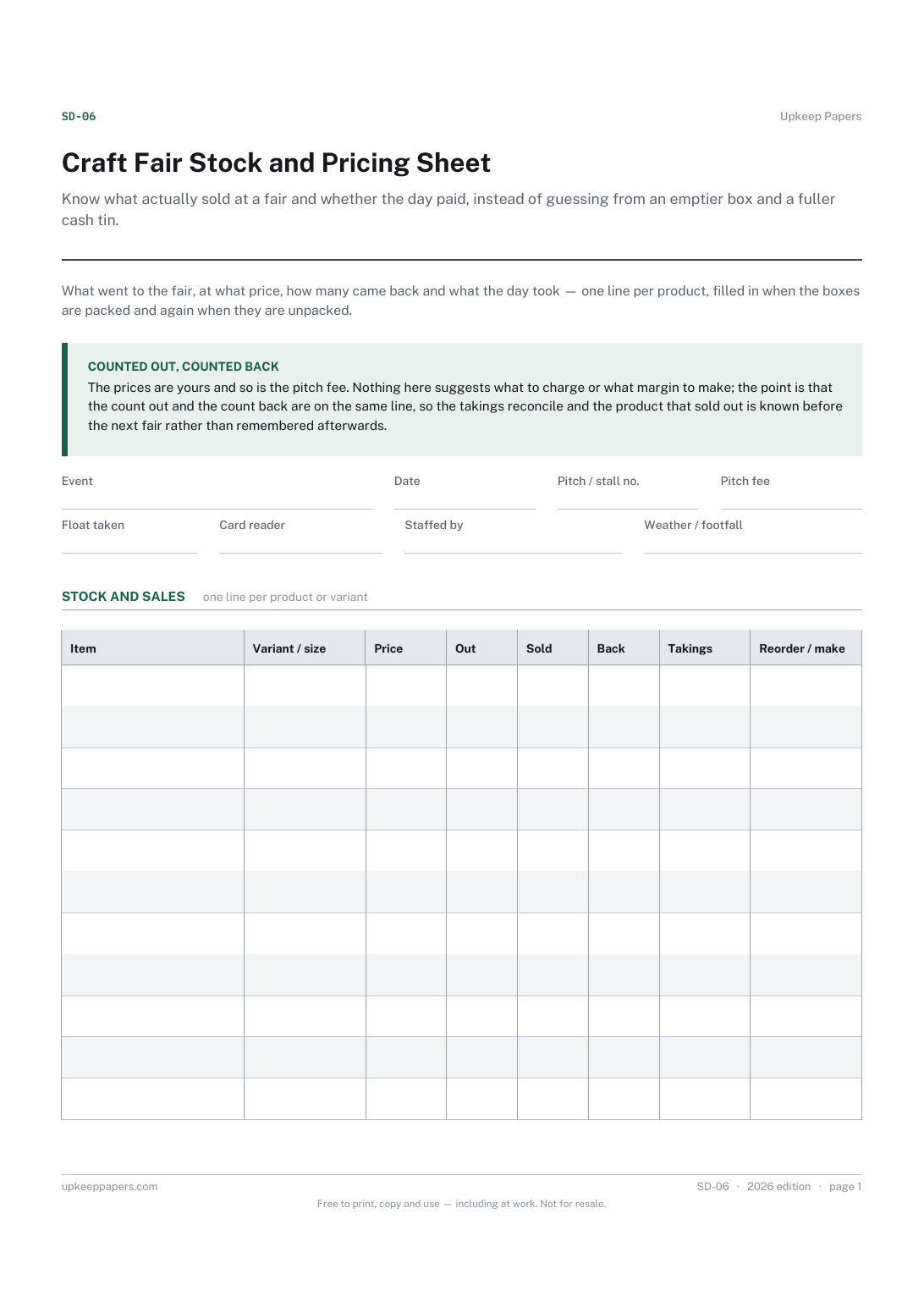
Know what actually sold at a fair and whether the day paid, instead of guessing from an emptier box and a fuller cash tin.
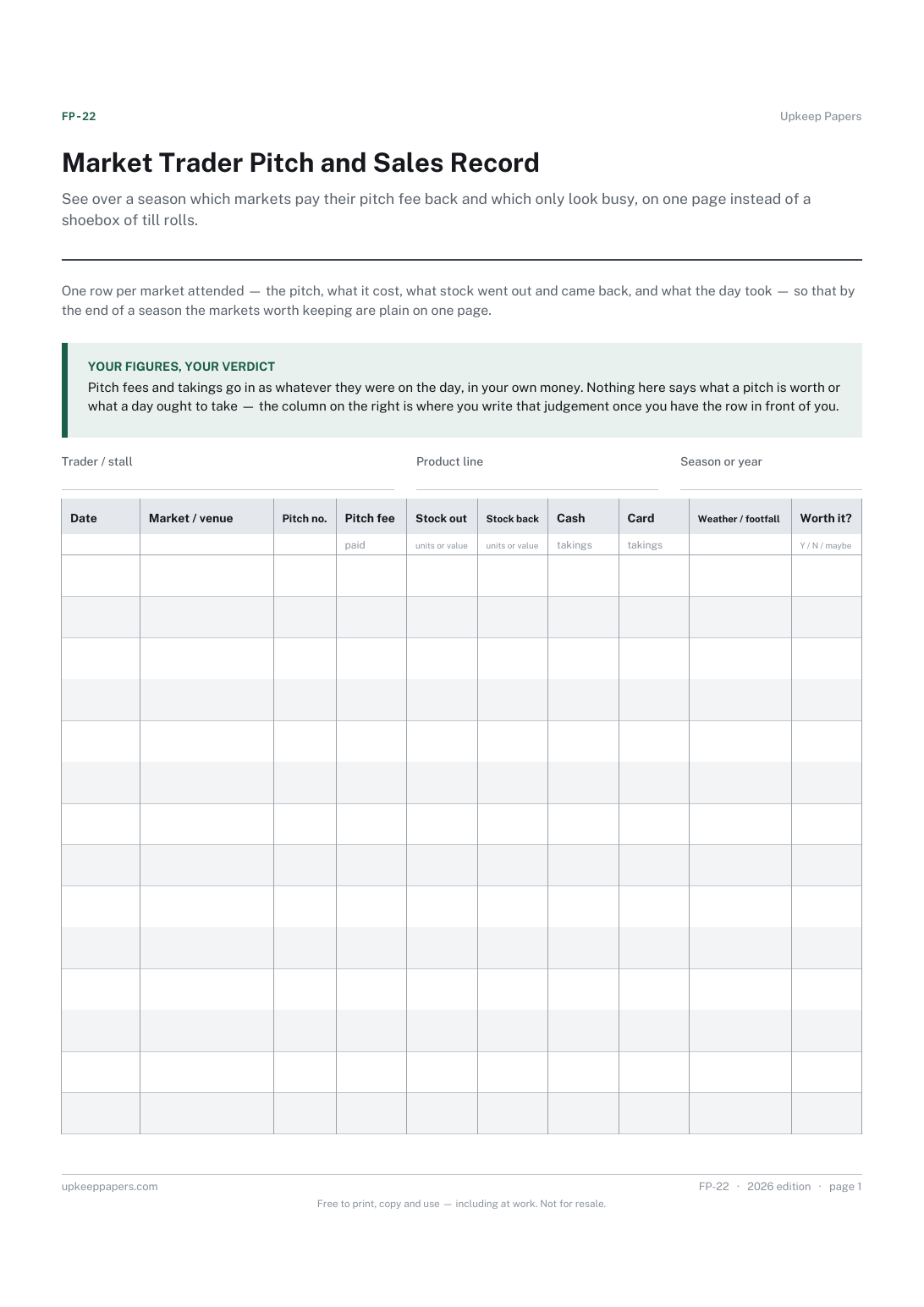
See over a season which markets pay their pitch fee back and which only look busy, on one page instead of a shoebox of till rolls.

Every sheet, binder, game and puzzle on Upkeep Papers is free to download, with no email and no account. Making them is not free: each one takes days of research, design and checking, and the site costs money to run. If something here saved you time, you can buy us a coffee. It is entirely optional: nothing is locked, and nothing changes if you don’t.
Buy us a coffee Opens PayPal in a new tab. Any amount, and nothing changes if you would rather not.