Guide · Safety checks
Testing Smoke Alarms Properly
The test button does not test the sensor. What it actually checks, why alarms have an expiry date, and how to keep a register that tells you which one you tested.
Published
Press the button, hear the noise, walk away. That is what almost everybody means by testing a smoke alarm, and it is worth doing — but it is not what most people think it is.
On the great majority of domestic alarms, the test button runs a self-check of the circuit. It confirms there is power, that the electronics are alive, and that the sounder works. What it generally does not confirm is that the sensing chamber would still detect smoke — which is the question the alarm exists to answer.
What the button checks, and what it does not
The distinction matters because of how these devices fail. An alarm with a flat battery announces itself. An alarm with a dead sounder is caught by the button. But a sensing chamber that has drifted out of specification, filled with dust, or been colonised by insects fails silently — and it will pass a button test every time, right up to the night it matters.
Some alarms do more than a circuit check when you press the button, and manufacturers vary in what they claim for it. The instructions that came with yours are the only reliable source, and they are usually available on the manufacturer’s website by model number.
Testing the sensor
The way to test detection is with aerosol test smoke made for the purpose, applied as the alarm manufacturer directs. It is inexpensive and it takes seconds.
Two cautions. Some manufacturers specify particular products or advise against aerosols entirely for certain sensor types, so check the instructions for your alarm rather than assuming all alarms are the same. And never test with a real flame, a blown-out candle or smouldering paper: soot particles contaminate the sensing chamber, and you will have degraded the device you were trying to verify.
Whichever method you use, check you can actually hear it from the bedrooms with the doors shut. An alarm that works perfectly and cannot be heard through a closed door is not doing much.
Alarms expire, and the date is not the one you think
Smoke alarms have a design life. The sensor drifts over years, and the manufacturer’s answer to that is a stated replacement age after which the unit should be replaced outright rather than tested, cleaned or re-batteried.
The important detail is that the life normally runs from the date of manufacture, not the date you installed it. That date is printed on the back or side of the unit, and two things follow from it.
First, an alarm that sat in a warehouse for two years arrives with part of its life already spent. Turn the box over and look at the date before you buy.
Second, once it is on the ceiling nobody ever looks at it again. Write the end-of-life date on the unit in marker pen when you fit it, where you can read it from the floor, and write it in your records as well. Many modern alarms chirp at end of life, but the chirp is easily mistaken for a low battery, and the standard response to a chirp at three in the morning is not a considered one.
Sealed batteries or replaceable ones
Both are sold, and the choice is a real one.
Sealed long-life units have the battery built in for the life of the alarm. No battery to forget, none to remove, and — the actual argument for them — no way to disable the alarm at 3am by taking the battery out and never putting it back. That failure mode is why a great many alarms in a great many houses are decorative. At end of life the whole unit is replaced.
Replaceable-battery units cost less to buy and more to own, and they need a recurring task in your schedule that the sealed ones do not.
Mains-powered alarms have a backup battery, and it still needs attention. A mains alarm is not maintenance-free; it is an alarm whose backup you are more likely to forget because the green light is on.
Carbon monoxide alarms are a different device
They share a ceiling and a name but almost nothing else. The sensor works on a different principle, has its own service life, and cannot be checked meaningfully by the test button either. Placement logic differs too, since the two are responding to different things behaving in different ways.
Test smoke does not test a CO alarm. To verify one, use a product made for CO alarms and follow the manufacturer’s instructions. Log them alongside your smoke alarms but as their own entries, with their own end-of-life dates.
Cleaning, and what not to do
Dust and insects are the ordinary enemies of a sensing chamber. Vacuum gently around the outside of the case with a brush attachment a couple of times a year. Do not spray cleaner into it, do not take it apart, and never paint one or paint around the edge of one — paint over the vents disables an alarm permanently while leaving it looking perfect.
Why a register, when there are only four of them
Because there are rarely only four, and because you cannot remember which ones you did.
They were fitted at different times, they are different ages, and they will reach end of life in different years. Testing “the alarms” as one undifferentiated job means one of them gets missed most times, and it is usually the awkward one on the landing.
The fix is to give each alarm a number, write that number on the unit, and give it a row of its own. A Smoke and CO Alarm Test Log laid out this way turns an unmeasurable habit into a page you can look at. Against each alarm, hold:
- Its number and where it is.
- Type — smoke, heat or CO — and sensor type if the unit states one.
- Manufacture date and calculated end-of-life date.
- Power: mains with backup, replaceable battery, or sealed.
- Each test date, what kind of test it was, and whether it passed.
- Battery changes, cleaning, and the date the unit was finally replaced.
Record the model and the fitting date on the Appliance and Equipment Register as well, so that when one fails you can buy a compatible replacement without getting a ladder out to read the label.
Where the rules come in
What alarms a property must have, how many, of what type, where they must be positioned, whether they must be interlinked, and who is responsible for testing them all differ by country, and often by region, by the age and type of building, and by whether the property is owner-occupied or let. These requirements also change, and have changed materially in several places recently.
Nothing here is a statement of what is required where you live. Check with your local fire service, building control authority or housing regulator — and if you are letting a property, check what sits with you rather than the tenant, because that division varies too.
Making it happen
Put the test on the same schedule as something you already do, rather than inventing a new habit for it. Clock changes work well in countries that have them. So does the start of a heating season, which is also when a CO alarm starts to matter more.
The same visit is the natural moment to check any extinguishers, which have their own inspection interval and their own expiry, and belong on a Fire Extinguisher Check Log. Putting both on the Home Maintenance Schedule is what stops this becoming a job you are certain you did recently.
From the library
Sheets mentioned here
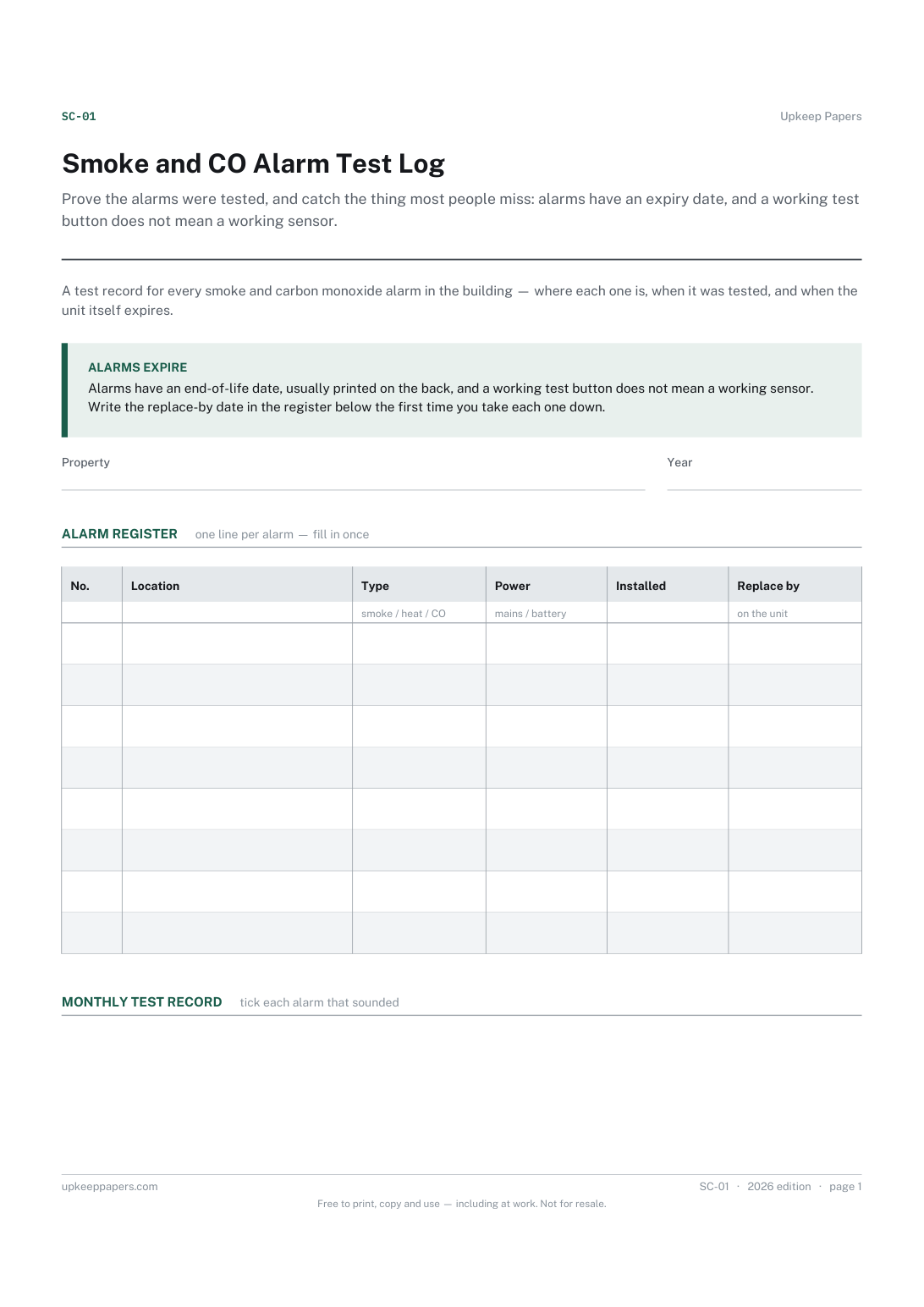
Smoke and CO Alarm Test Log
Prove the alarms were tested, and catch the thing most people miss: alarms have an expiry date, and a working test button does not mean a working sensor.
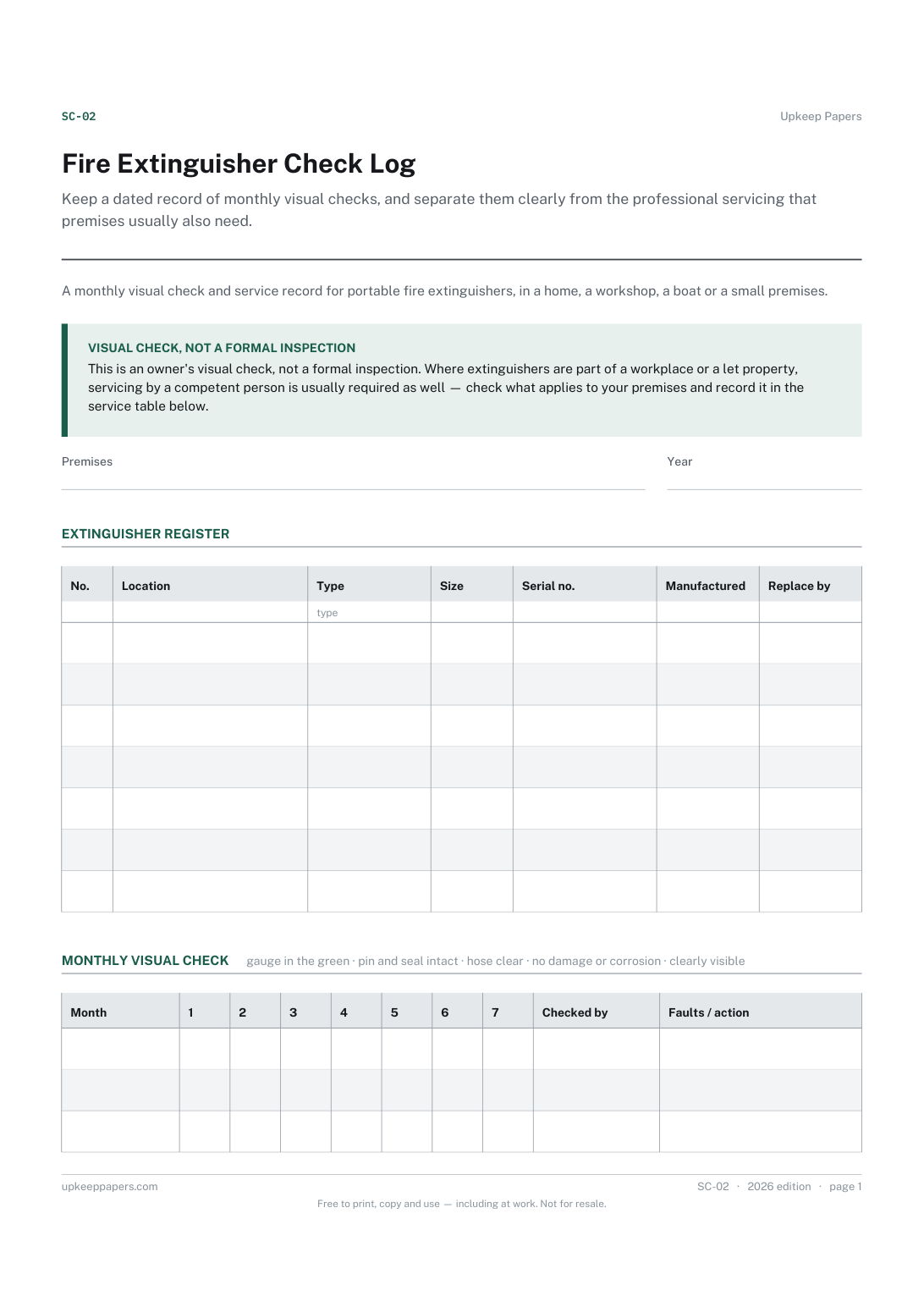
Fire Extinguisher Check Log
Keep a dated record of monthly visual checks, and separate them clearly from the professional servicing that premises usually also need.
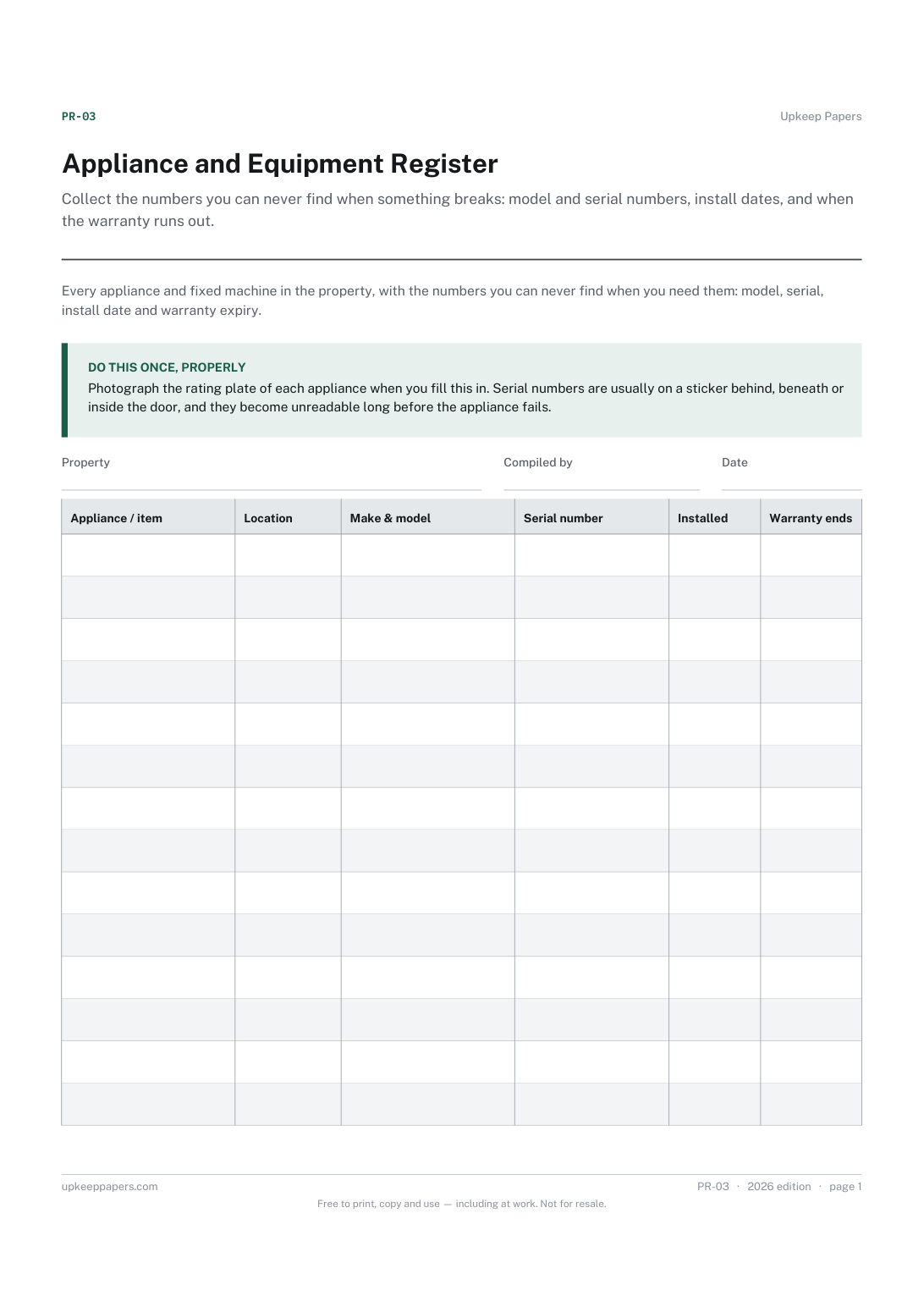
Appliance and Equipment Register
Collect the numbers you can never find when something breaks: model and serial numbers, install dates, and when the warranty runs out.
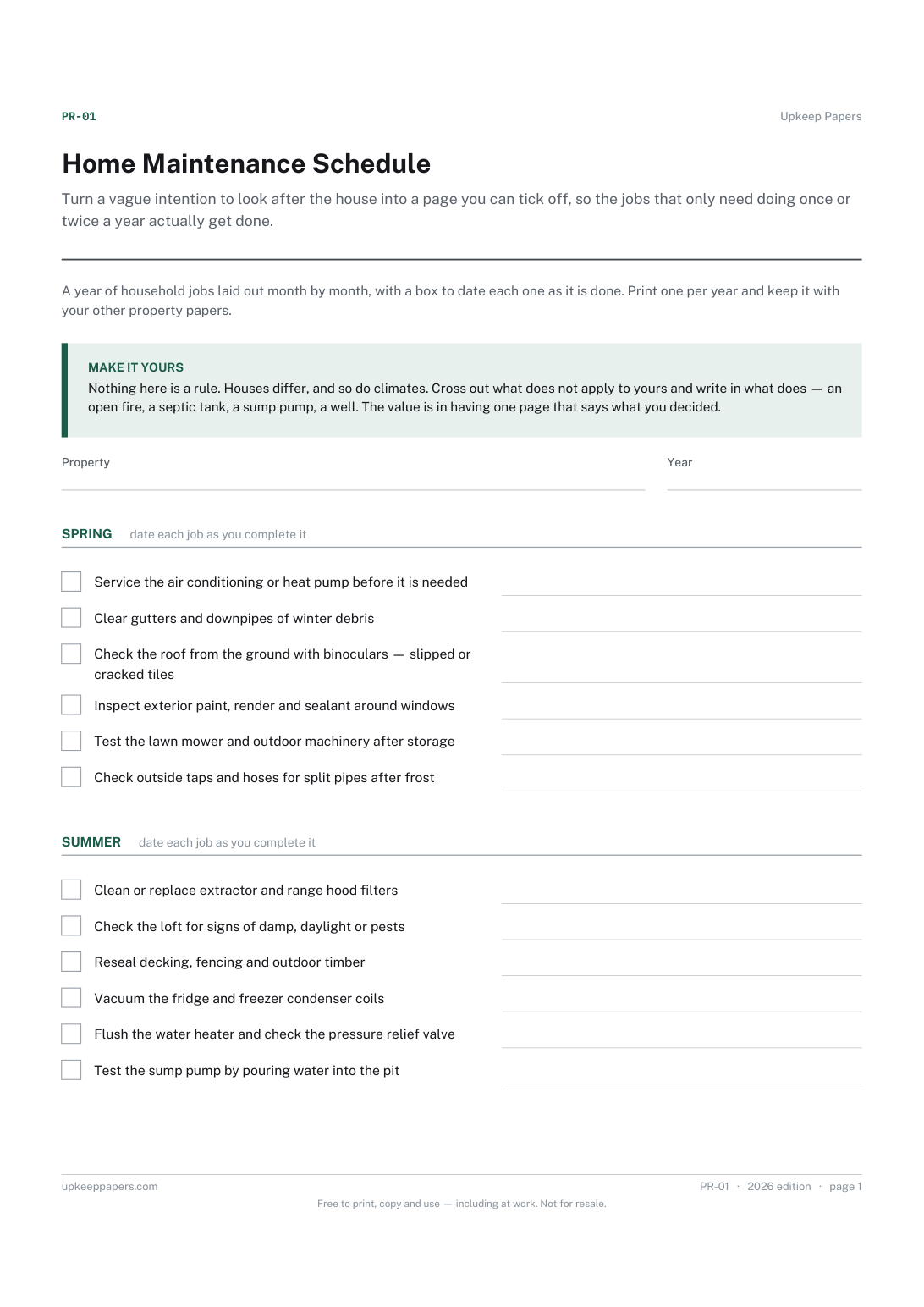
Home Maintenance Schedule
Turn a vague intention to look after the house into a page you can tick off, so the jobs that only need doing once or twice a year actually get done.
More guides
How to Build a Home Maintenance Binder That Survives
A ring binder beats an app for house records, but most binders die within a year. The sections that work, what to file, and how to keep it alive.
Car Service History: What to Keep and Why
What a service history actually consists of, how stamped books and digital records differ, what a private buyer looks for, and how to handle gaps honestly.
Free Printable Blank Forms, Log Sheets and Record Sheets
Blank forms, log sheets, record sheets and checklists as free PDFs, every one laid out to print correctly on both A4 and US Letter.