Guide · Vehicles
Car Service History: What to Keep and Why
What a service history actually consists of, how stamped books and digital records differ, what a private buyer looks for, and how to handle gaps honestly.
Published
A service history is not the little book in the glovebox. The book is an index. The history is the evidence trail behind it: invoices, part numbers, mileages, dates and the names of the people who did the work. Plenty of cars have a fully stamped book and no history worth the name, and a few have no book at all and an excellent one.
Understanding which of those you have matters at exactly two moments — a warranty conversation, and a sale — and both of them arrive too late to start assembling it.
What the history is made of
Four things, in descending order of how much weight they carry.
Dated invoices with mileage on them. This is the core. An invoice states who did the work, when, at what mileage, what was replaced and what it cost. It is difficult to fabricate convincingly and it carries far more information than a stamp.
Records of the expensive scheduled items. Timing belt or chain service, transmission fluid, brake fluid, coolant, clutch, and whatever else your particular model treats as a major interval. These are the items a buyer actually cares about, because they are the ones that turn into four-figure bills.
The stamps or the digital record. Useful as a continuity check, weak as evidence on their own.
Receipts for parts and consumables, including for work you did yourself.
Stamped books and digital records
Manufacturers have largely moved to digital service records held on their own systems, and this changes the practicalities in ways worth knowing before you need to deal with it.
A digital record is harder to falsify and impossible to lose, which is genuinely better. But it lives somewhere you do not control, and whether an independent garage can write to the manufacturer’s system varies by brand and by garage. A car serviced conscientiously by a good independent can end up with a digital record showing a gap that never happened in reality.
The practical response is the same whichever system your car uses: keep your own paper record alongside it. Ask for a printout of the digital history at each service and file it, so that when you sell you are handing over something a buyer can hold.
What a private buyer is actually looking for
Not thoroughness. Buyers looking at a used car with a folder of paperwork are checking four things, usually in under two minutes.
Continuity. Is there a record for roughly every year, or every service interval, without long silences? A consistent run of modest independent services reads better than three main dealer services and a four-year hole.
Mileage plausibility. The mileages on the records should climb steadily. A sequence that jumps or sits still for a long period invites questions, and even when there is an innocent explanation the buyer has already started discounting.
The big items. Has the timing belt been done, if the model needs one and the car is old enough? When, at what mileage, and by whom? This single question decides a surprising number of used car negotiations, and “I think the previous owner did it” is worth nothing at all.
Whether the paperwork matches the car. Registration number, VIN and mileage on invoices agreeing with the vehicle in front of them.
A Vehicle Service Record at the front of the folder answers all four in one page, which is worth doing purely because it lets a buyer confirm what they want to confirm without leafing through twenty invoices and losing patience.
Warranties, and why this page will not tell you the rules
Whether servicing has to be carried out by a franchised dealer to keep a manufacturer warranty intact, what counts as an acceptable service, and what rights you have if a claim is refused, are all governed by a combination of the warranty terms themselves and the law where the vehicle is. Both differ substantially between countries and, in some places, between states or regions. The rules also change.
So read your own warranty document, and if the answer matters financially, get the position confirmed locally rather than relying on what anybody on the internet — including this page — says the rules are. What generalises is that warranty departments ask for the same handful of things everywhere: dates, mileages, what was done, and evidence that the parts and fluids used met the manufacturer’s specification. That last one is why the invoice matters more than the stamp — the invoice lists what went in.
Servicing it yourself
Work you do yourself counts, but it has to be recorded differently to be believed, because there is no third party attesting to it.
- Keep the parts receipts, with part numbers visible. An oil filter receipt with a part number on it, dated the same week as your log entry, is the corroboration that makes the entry credible.
- Record the mileage every time, not just the date. Mileage is what a buyer cross-references.
- Record the specification of what you used, not just the quantity. “5 litres of oil” tells a future reader nothing; the grade and specification tells them whether the right thing went in. A Vehicle Fluids and Parts Reference filled in once, from the handbook, saves you looking it up every time and saves the next owner guessing.
- Photograph anything notable — a replaced part before it goes in the bin, the odometer at the time. Photographs are dated automatically, which is what a self-recorded history otherwise lacks.
- Be specific about what you did not do. An entry reading “oil and filter, brake fluid not changed, due next” is more useful and more convincing than one implying a full service happened.
Brakes and tyres deserve their own page rather than being folded into the service record, because they wear continuously and get replaced off-schedule. A Tyre and Brake Record holding fitting dates, tread depths over time and pad or disc changes answers the second most common question a buyer asks, and it is the one most sellers cannot answer.
Gaps, and what to do about them
Almost every used car has a gap. The mistake is trying to disguise one.
If you know why the gap exists — the car was off the road, it was abroad, it was in storage, an owner did the work themselves and kept nothing — write that down as a dated note and file it with the history. An explained gap is a small thing. An unexplained gap is where a buyer’s imagination goes to work, and the version they invent is always worse than the truth.
If you do not know why it is there, say so. “Purchased in 2023, no records available from before that date” is an honest, useful sentence. It draws a clear line between the history you can vouch for and the history you cannot, and it makes everything after that line more credible rather than less.
Keeping it going
The system only has to be this: one folder, one summary sheet at the front, everything else behind it in date order. Add the invoice the day you get it, and write the summary line at the same time.
The other half is knowing what is coming. Copy the intervals out of your own handbook once onto a Vehicle Maintenance Schedule Planner — they differ between models, engines and markets far more than people expect, which is why no page should be telling you what yours are. With the intervals in one place and the history filed behind them, the folder answers both questions a future owner has.
From the library
Sheets mentioned here
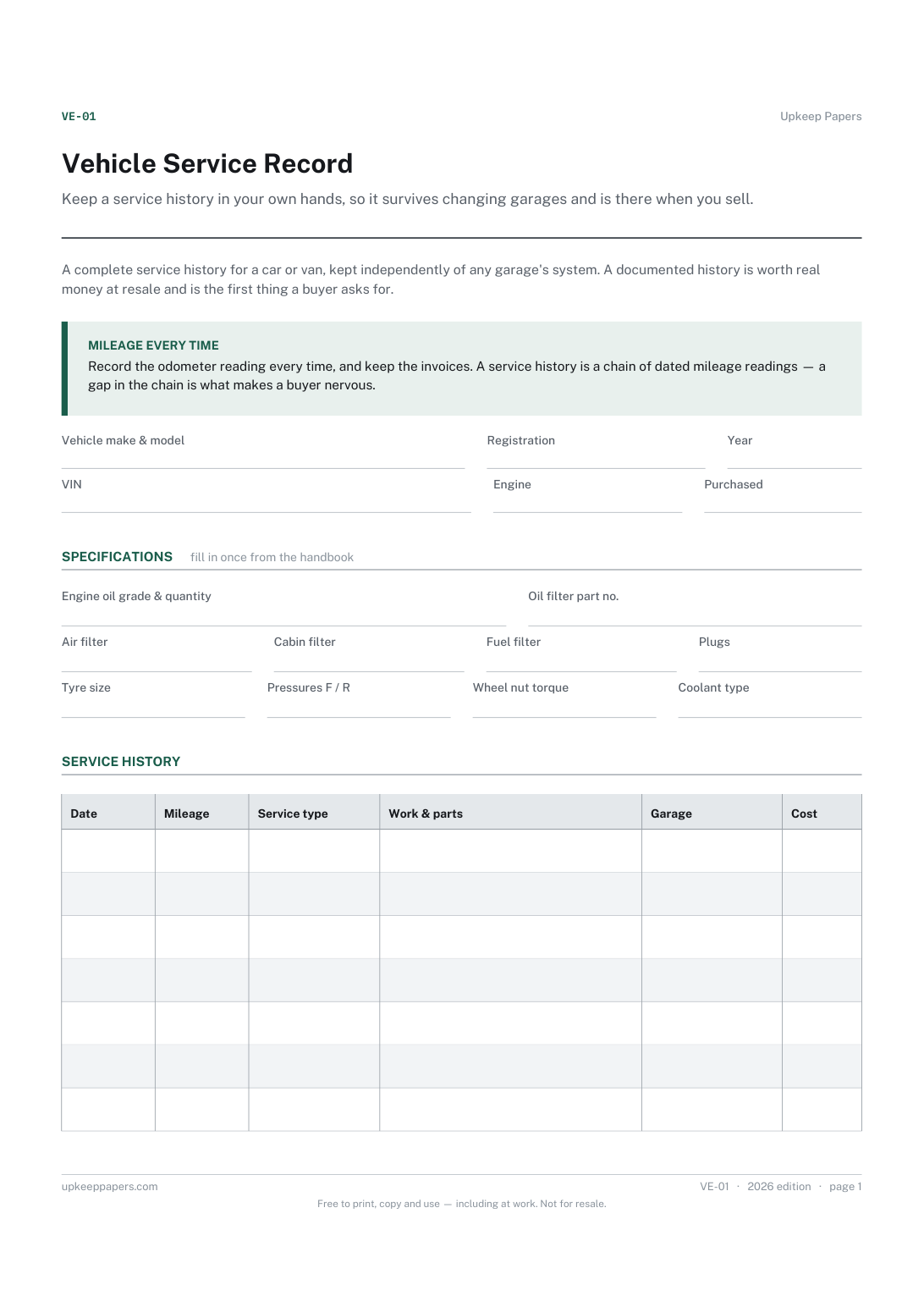
Vehicle Service Record
Keep a service history in your own hands, so it survives changing garages and is there when you sell.
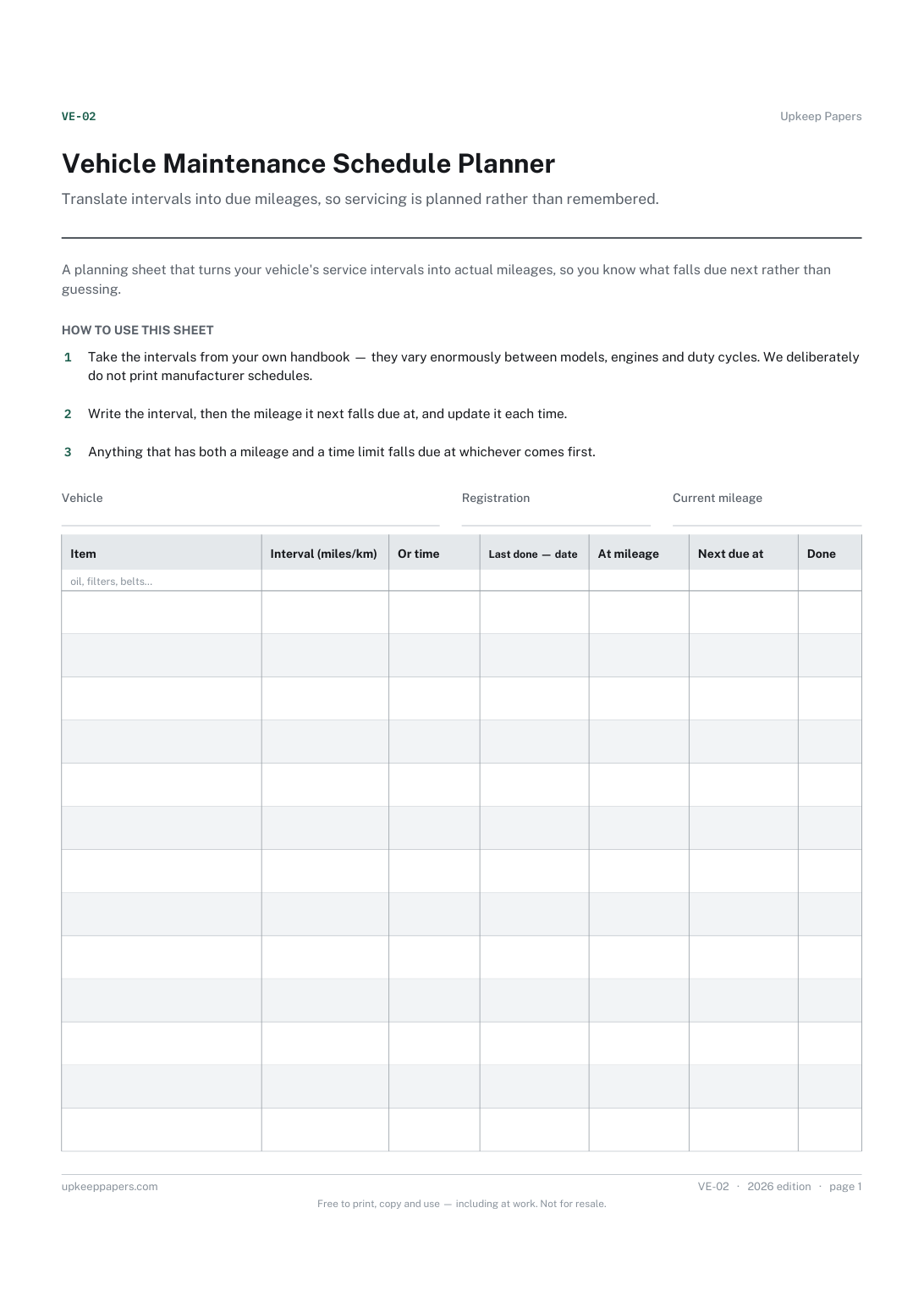
Vehicle Maintenance Schedule Planner
Translate intervals into due mileages, so servicing is planned rather than remembered.
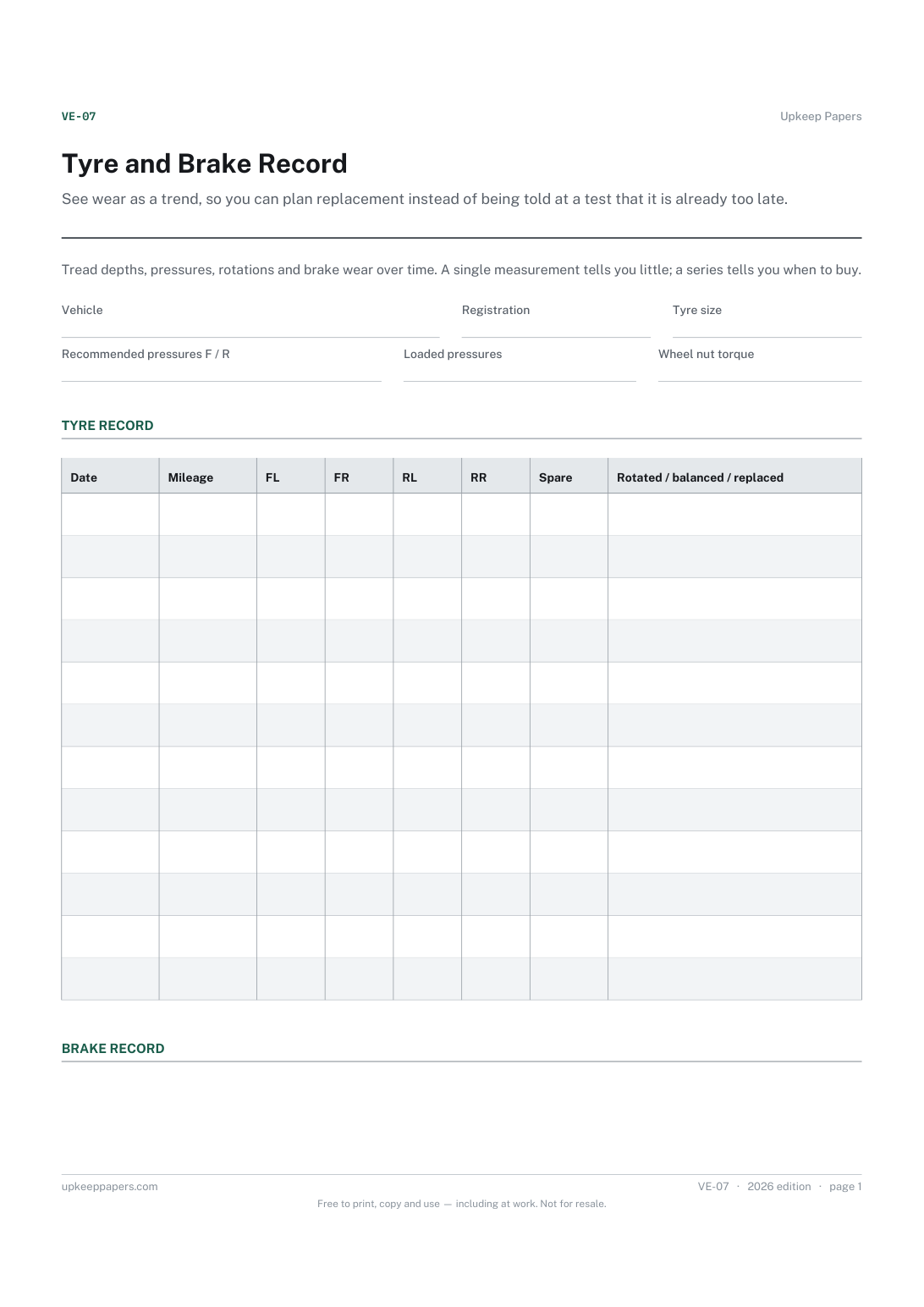
Tyre and Brake Record
See wear as a trend, so you can plan replacement instead of being told at a test that it is already too late.
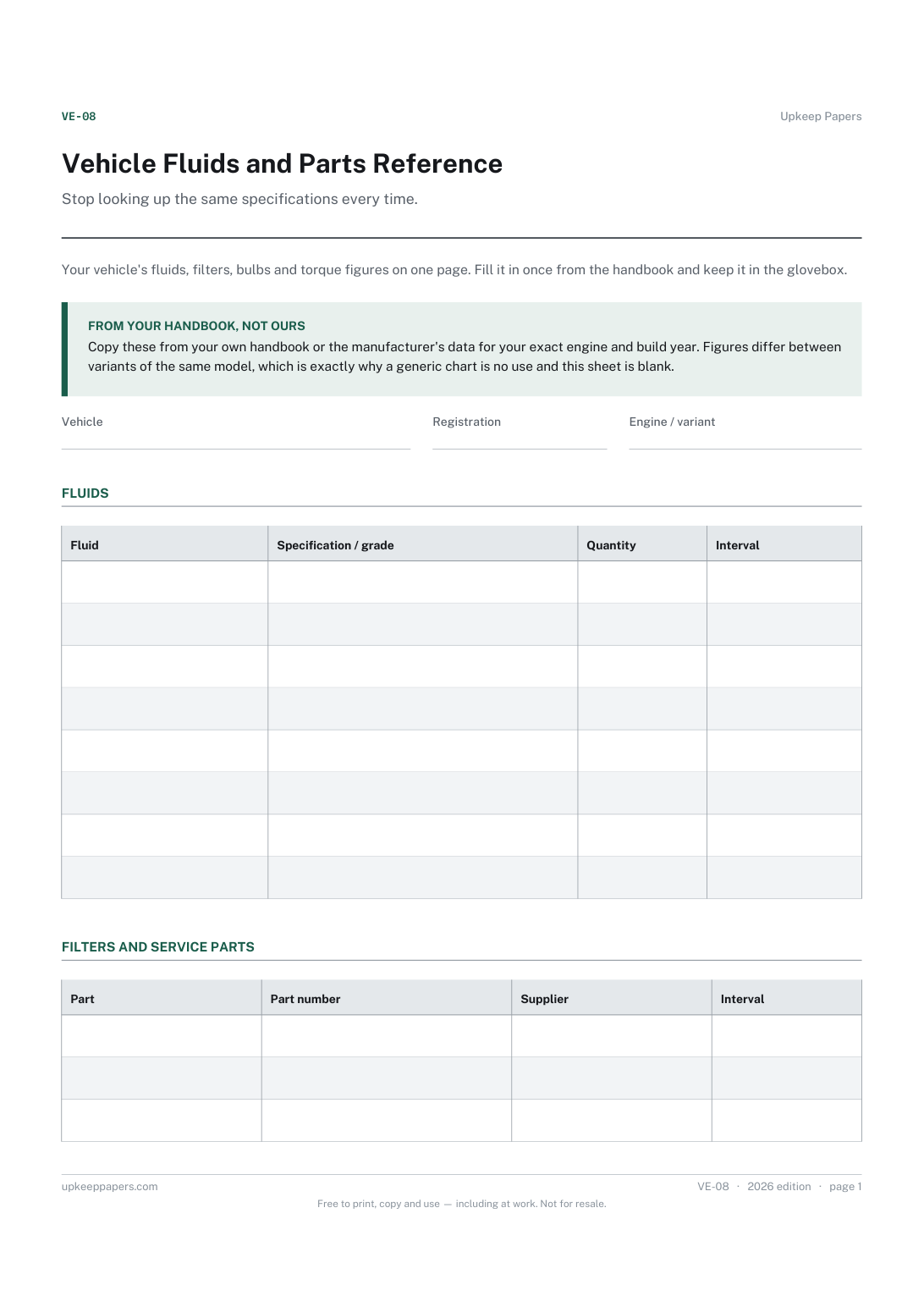
Vehicle Fluids and Parts Reference
Stop looking up the same specifications every time. Fill it in once from the handbook and keep it with the vehicle.
More guides
How to Build a Home Maintenance Binder That Survives
A ring binder beats an app for house records, but most binders die within a year. The sections that work, what to file, and how to keep it alive.
Free Printable Blank Forms, Log Sheets and Record Sheets
Blank forms, log sheets, record sheets and checklists as free PDFs, every one laid out to print correctly on both A4 and US Letter.
Hour Meters, and Why Machines Are Serviced by Hours
Small engines, tractors, generators and boats are specified in running hours rather than dates. What an hour really measures, and how to track them without a meter.