Guide · Water and pools
Pool and Hot Tub Water Records
A spot reading is one frame from a film. Logging chemistry as a series shows what your water is doing, and filter pressure tells you more than you think.
Published
Almost everybody who owns a pool or a hot tub tests the water. Rather fewer write the results down, and fewer still write down enough alongside the result for it to be worth anything later.
That is a shame, because the reading is the least interesting part. What you want to know is which direction your water is drifting and how fast — which is not visible in a number. It is visible in a column of numbers.
Where target values come from, and why they are not here
This page contains no target ranges and no acceptable values, deliberately. What your water should read depends on the sanitiser system you run, the equipment and surface you have, the manufacturer’s requirements, and — for anything shared, let, commercial or open to the public — local rules, which differ substantially between countries and regions. A figure correct for one installation can be wrong or damaging for another.
Get your targets from your test kit’s instructions, your equipment manufacturer and your chemical supplier. If anybody outside your household uses the water, find out what applies where you are.
Why a series beats a spot reading
A single reading depends heavily on when you took it. Twenty minutes after dosing, an hour into filtration, before or after six people got in — these produce different numbers from the same water, and a lone reading against a target regularly prompts a correction that was not needed.
Chasing is the standard failure. Test, find something out of range, dose heavily, over-correct, dose the other way, and spend a fortnight oscillating. A log lets you catch drift while it is small and dose gently.
The series reveals demand, which the reading cannot. How much of something it takes to move your water by a given amount is a property of the water, and it changes over the season. When it starts taking more product to achieve the same shift, that is real information — long before anything looks wrong.
What to record each time
The reading is one column. The context makes the column readable in three months.
- Date and time, and how long the pump had been running.
- Water temperature. Everything moves faster warm.
- Which test method you used, and the readings in the units your kit gives them.
- What you added, how much, and when — recorded separately from the reading, because a log mixing measurements and doses cannot be read backwards.
- Bather load since the last test. “Six people, two hours” explains the next reading.
- Weather, and whether the cover was on, since rain both dilutes and adds.
- Top-up water added, and where it came from — refilling from a different source often explains a reading that makes no sense.
- Filter pressure, and anything you can see or smell: clarity, foam, scale at the waterline.
A Pool Chemical and Maintenance Log or a Hot Tub Water Care Log is one row per test for this reason. The row is quick. The column is the point.
Test methods do not agree with each other
Strips, liquid reagent kits and electronic meters are three different measurement systems, and they do not produce the same numbers from the same water. So note the method on every entry, and if you change method write a line across the sheet saying so. Otherwise the series contains a step change caused by the equipment, and you will spend a week treating it.
The related trap is reagent age. Reagents and strips degrade in heat and sunlight, so a reading that has drifted steadily over weeks can be a drifting reagent rather than drifting water — which a log catches, because the drift stops when you open a new bottle.
Filter pressure is the diagnostic nobody uses
The gauge on a filter is the most underused instrument on a pool, because the number means almost nothing in isolation and almost everything relative to a baseline.
Establish the baseline. Immediately after cleaning or backwashing the filter, with the pump running normally and all valves in their normal positions, read the pressure and write it down — on the log and in marker pen on the filter. Every later reading is read against that figure.
Rising pressure means the filter is loading up. Normal, and the prompt to clean or backwash.
Low pressure with poor flow means something before the pump, not after it: a blocked skimmer, a full pump basket, a partly closed valve or an air leak. This is the distinction most owners never learn, and it turns a baffling symptom into a two-minute check — high pressure with low flow means a restriction downstream, low pressure with low flow upstream.
Pressure that will not return to baseline after cleaning says the media is the problem: sand that has channelled, or cartridges loaded with oils a rinse will not shift. Backwash intervals getting shorter carries the same message more slowly.
A pressure that never moves at all is suspicious. Gauges stick and fail, usually reading low, and a gauge you cannot trust is worse than no gauge because you will believe it.
Hot tubs are the same problem, compressed
A hot tub is not a small pool. It is a far more volatile system, for two reasons that compound: the water volume per bather is a fraction of a pool’s, and it is held hot. A pool absorbs a party; a hot tub does not, because four people for an hour is a significant event in that volume. That is why hot tub logs are worth keeping at a higher frequency, and why bather load matters more there than anywhere else.
Drain-down, and how to know when
Water in a spa or pool accumulates dissolved solids over its life. You add products, water evaporates and is topped up, and what was dissolved stays behind. Over time the water becomes less responsive: you dose and the reading barely moves, foam persists, and everything takes more product than it used to. No amount of further dosing fixes that.
Manufacturers and suppliers publish rules of thumb for drain intervals based on volume and bather numbers — ask yours, since they differ by system. But the log is the better guide, because it reflects your actual use. Rising chemical demand, persistent foaming and difficulty holding a stable reading are the pattern, visible in a series and invisible in a single test.
Record the drain date prominently. Everything after it is a new cycle from a known starting point, and comparing one cycle against the last is how you learn what your tub does.
Making the drain-down worth the effort
Draining is the only chance to do several jobs properly, so treat it as a service.
- Purge the pipework before you drain, using a product intended for it. Biofilm in the plumbing is invisible and is a common reason freshly filled water goes off quickly.
- Clean the shell and waterline, and inspect the cover. Waterlogged covers insulate poorly and are a slow expensive failure nobody notices early.
- Deep-clean or replace the filter cartridges. Two sets lets one soak while the other is in use. Note the cartridge model on the Filter Change Log the first time you buy one.
- Check where the water is going. Discharging treated water to a drain, watercourse or the ground is governed by local rules that differ by area.
Record the equipment once — pump, heater, filter model, cartridge part numbers, sanitiser system, install date — on the Appliance and Equipment Register. When something fails mid-summer, the difference between a same-week repair and a three-week wait is whether you can tell somebody what you have got.
From the library
Sheets mentioned here
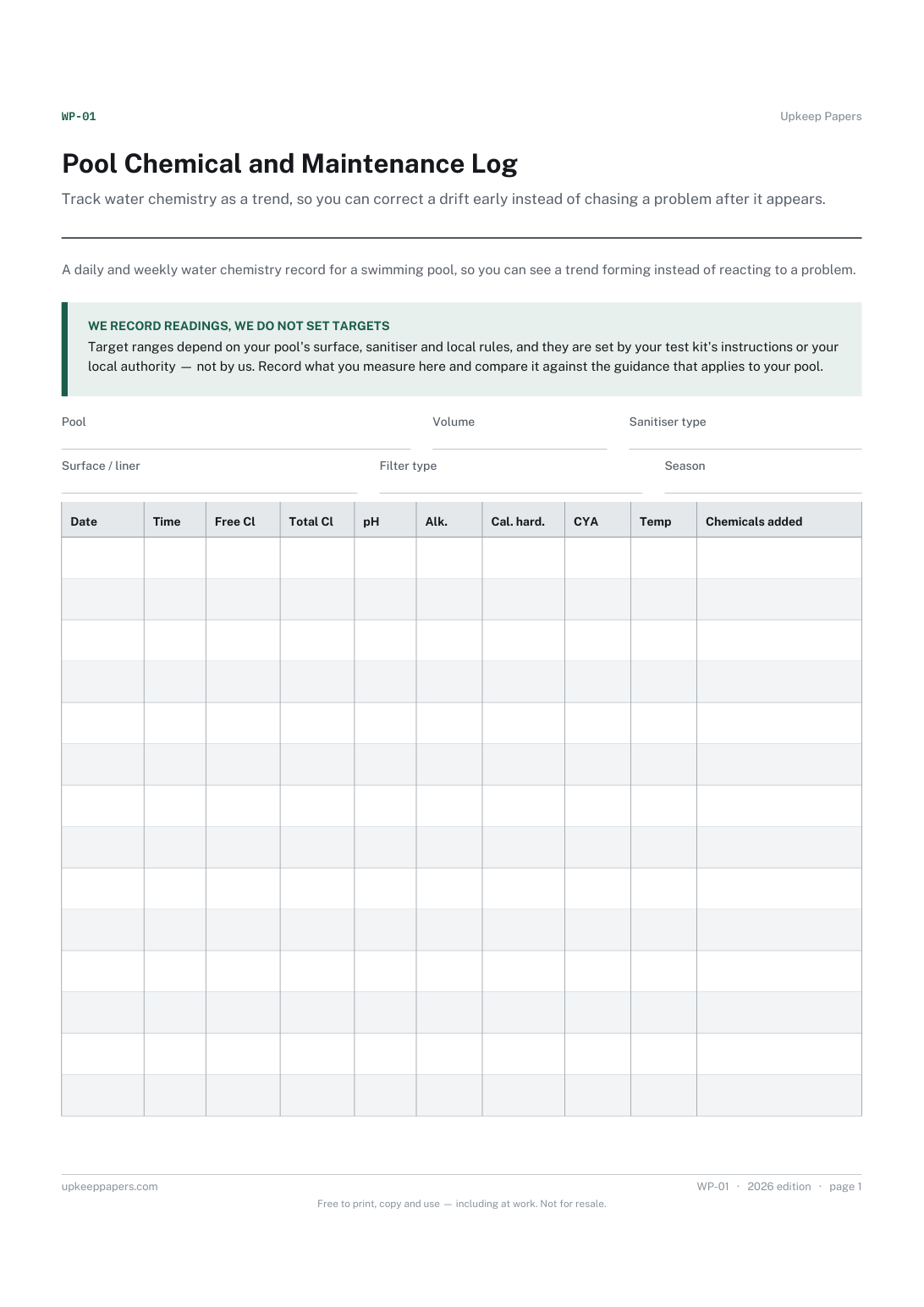
Pool Chemical and Maintenance Log
Track water chemistry as a trend, so you can correct a drift early instead of chasing a problem after it appears.
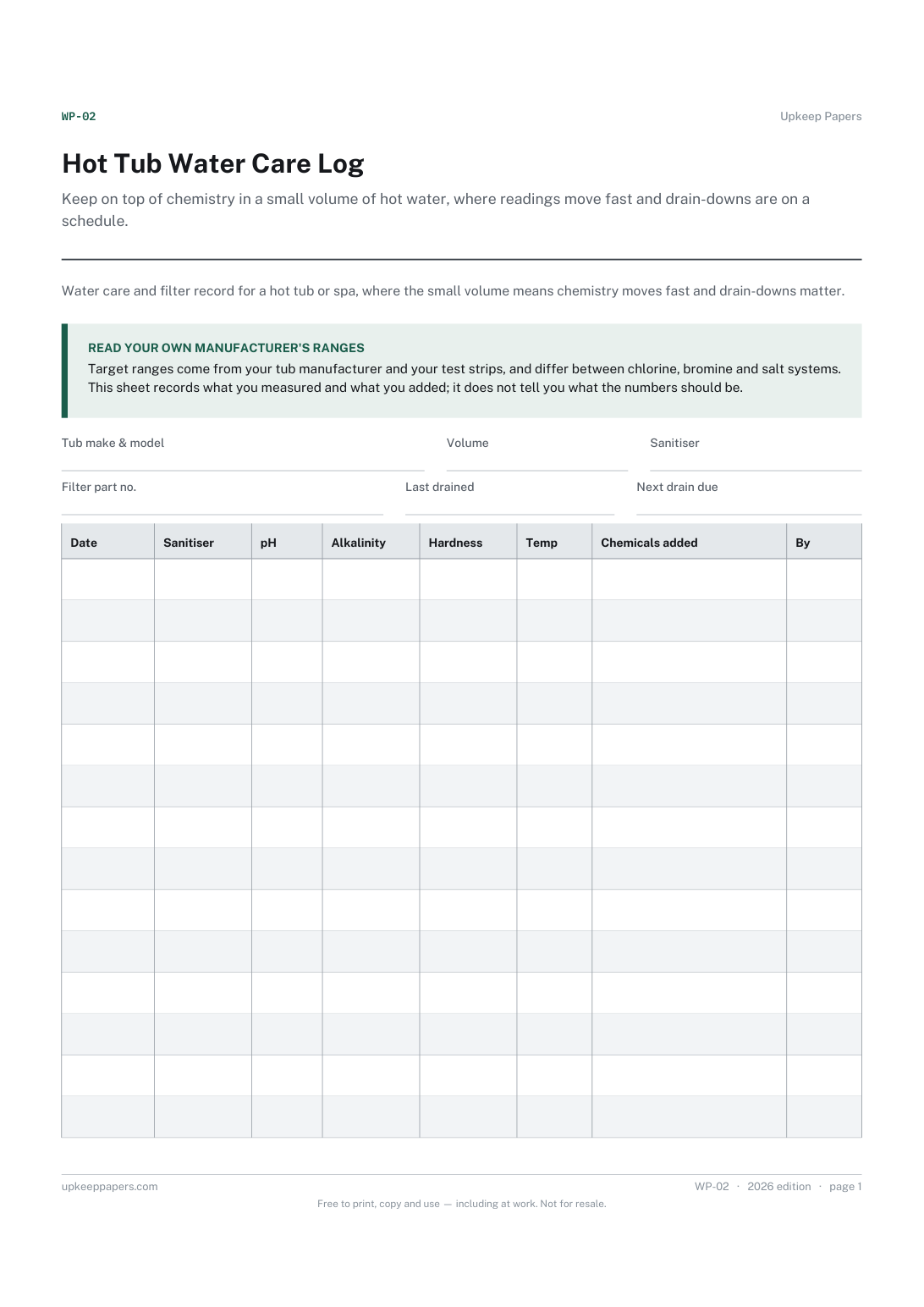
Hot Tub Water Care Log
Keep on top of chemistry in a small volume of hot water, where readings move fast and drain-downs are on a schedule.
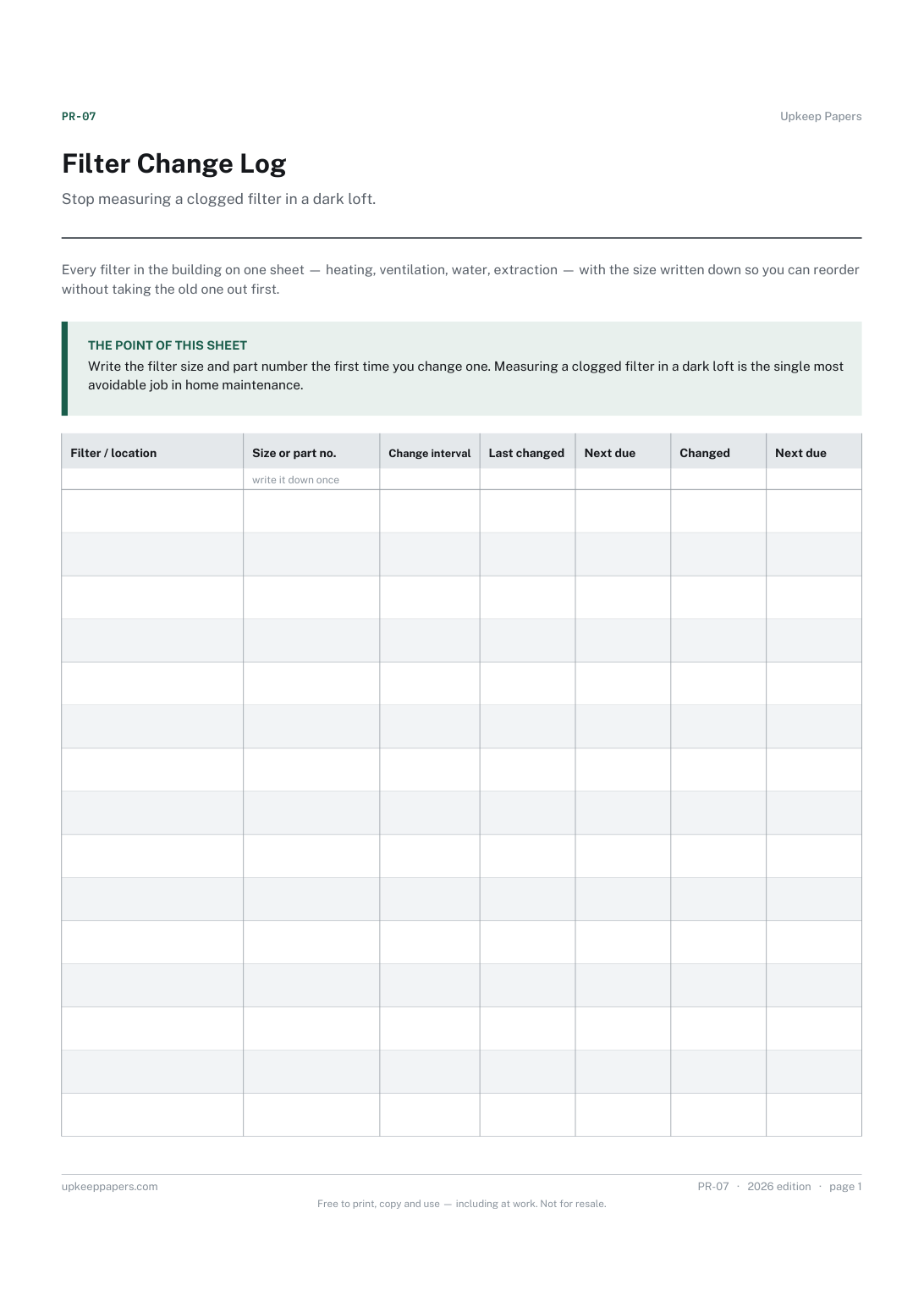
Filter Change Log
Stop measuring a clogged filter in a dark loft. Write the size down the first time, then reorder without taking the old one out.
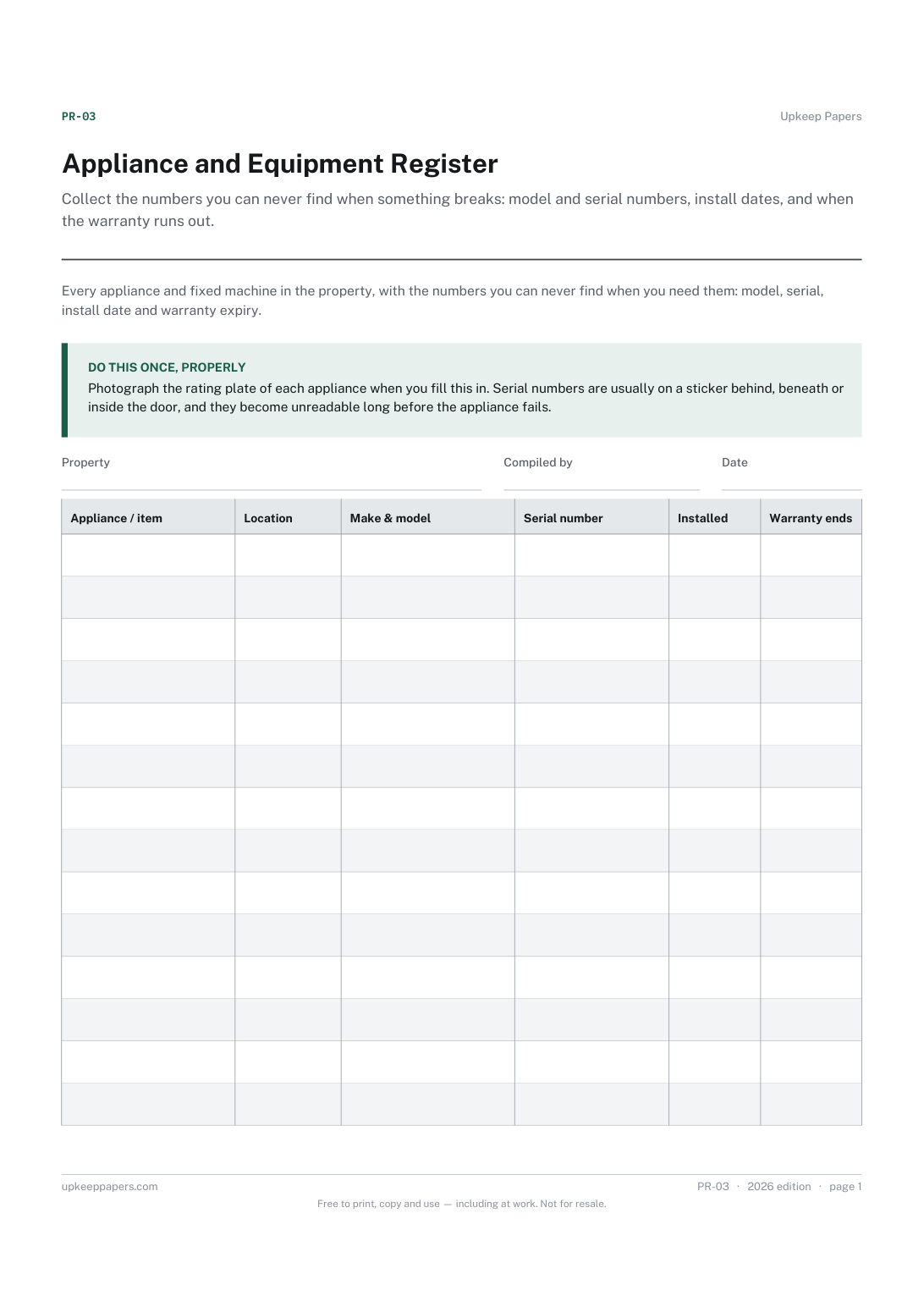
Appliance and Equipment Register
Collect the numbers you can never find when something breaks: model and serial numbers, install dates, and when the warranty runs out.
More guides
How to Build a Home Maintenance Binder That Survives
A ring binder beats an app for house records, but most binders die within a year. The sections that work, what to file, and how to keep it alive.
Car Service History: What to Keep and Why
What a service history actually consists of, how stamped books and digital records differ, what a private buyer looks for, and how to handle gaps honestly.
Free Printable Blank Forms, Log Sheets and Record Sheets
Blank forms, log sheets, record sheets and checklists as free PDFs, every one laid out to print correctly on both A4 and US Letter.