Guide · Outdoor machines
Hour Meters, and Why Machines Are Serviced by Hours
Small engines, tractors, generators and boats are specified in running hours rather than dates. What an hour really measures, and how to track them without a meter.
Published
Ask a car owner when the next service is due and they will tell you a date or a mileage. Ask the owner of a ride-on mower and you will usually get a season — “I do it in spring” — which is a reasonable habit and a poor measurement. The manufacturer did not specify a season. It specified a number of running hours, and the gap between those two ideas is where a great deal of avoidable engine wear lives.
Why hours rather than dates
An engine does not wear out by sitting there. It wears out by turning over, getting hot, and pumping oil through bearings that are separated by a film a fraction of the thickness of a human hair. The thing that consumes that oil’s ability to do its job is time spent running, not time spent existing.
Two identical mowers can be a decade apart in condition after five years of ownership. One trims a small suburban lawn for half an hour a fortnight in the growing season. The other cuts an acre and a half of rough grass every week from March to October. On a calendar they are the same age. On the only measurement that matters to the engine they are not remotely comparable, and servicing them both “in spring” means one gets serviced far too often and the other far too rarely.
This is why every machine of this type — mowers, tractors, generators, compressors, chippers, pumps, marine engines — comes with a schedule written in hours. It is the honest unit.
But the calendar has not gone away
These schedules almost always read “every X hours or annually, whichever comes first”, and the second half is not padding.
Engine oil degrades whether or not the engine runs. Combustion acids and moisture from the last time it ran sit in the sump, and cold machines in unheated buildings collect condensation through every temperature swing. Fuel degrades in storage, rubber hardens, belts crack, and grease separates. A generator that has run for four hours in a year still needs its annual attention, because the deterioration it suffered was not caused by running.
So the correct reading of an hours-based schedule is: hours count the wear, the calendar counts the decay, and you act on whichever arrives first. A machine used lightly is governed by the calendar. A machine worked hard is governed by the meter.
What an hour actually measures
This is worth being precise about, because not all hour meters count the same thing.
Most meters count elapsed running time. They start when the engine starts and stop when it stops. A generator idling on almost no load and a generator flat out both accumulate an hour per hour, even though the loaded one has done far more work and put far more heat through the oil. If you run a machine consistently hard, treat the hour figure as optimistic and service a little early. If it spends its life ticking over, the figure is pessimistic.
Some meters count scaled hours. Meters taking a signal from the ignition can be set to record hours relative to a reference engine speed, so an hour at full revs registers as more than sixty minutes. This is more honest about wear, and it is why a used machine’s hours can look strange next to its apparent condition. On anything bought second-hand, establish which kind of meter it has before drawing conclusions from the number.
Some meters only run above a threshold. Cheap vibration-activated meters start counting when they feel the engine running. They are approximate by design.
None of this makes the number useless. It makes it an estimate, which is exactly what a service interval needs. Being within ten per cent is entirely sufficient. Having no idea at all is not.
Fitting a meter, or living without one
Retrofit hour meters are cheap and easy. The two common types are vibration-activated units that attach anywhere on the machine, and inductive ones with a lead that wraps around the spark plug cable, which usually also read engine speed. Either turns a guess into a number.
If you would rather not fit one, hours can be tracked well enough by hand. In rough order of reliability:
Write the start and stop time on the sheet. Unglamorous, completely accurate, and it takes five seconds at each end of the job. It is the method that works best for machines used in discrete sessions — a chipper, a pressure washer, a chainsaw.
Count the task, then time the task once. Time one full cut of the lawn properly. If it takes fifty minutes, every subsequent cut is fifty minutes and you only need to count cuts. This works extremely well for mowers, where the job barely changes from week to week.
Use fuel as a proxy. Once you know roughly how long a machine runs on a tank, tanks become a counter. Crude, but a chainsaw that gets through six tanks in a morning is telling you something real about how hard it has worked.
Whichever method you use, record the running total in one place rather than trying to add it up later. The Small Engine Service Log and the Tractor Service Record both carry an hours column for this reason: the number is only useful if it is cumulative.
The reset problem
Hour meters get replaced. Batteries in the cheap ones die, units fail, and engines occasionally get swapped. When that happens the machine’s history is suddenly split across two numbering systems, and a year later nobody can reconstruct it.
The fix is to keep your own cumulative total in the log, separate from whatever the meter says, and to write a plain note when a meter changes: “meter failed at approximately 412 hours, new meter fitted and reset to zero, total hours continue from 412”. That one line preserves the whole history, and it is what makes a second-hand machine easy to sell honestly.
Where hours matter most
Generators. The service interval matters, but for standby machines the more important number is how recently it ran at all. A generator that has not been exercised under load for months is a machine of unknown condition at the exact moment you need it. Record exercise runs as well as service work on the Generator Service and Run Log — the run history is the part that tells you whether it will start.
Boat engines. Hours are the accepted currency for marine engines, and a documented hours history is worth real money at sale. Marine schedules also carry a heavy seasonal component — winterising, impellers, anodes — so the Boat Maintenance and Engine Hours Log has to hold both hours and dates to be any use.
Compressors. Easy to forget entirely, because they run unattended in the corner of a workshop. The pump oil interval is in hours, and those hours accumulate whenever anything in the shop is using air. An Air Compressor Maintenance Log mostly exists to make that invisible running visible.
The first service is the one to get right
On almost any new engine the initial service comes at a low hour figure, and it matters more than any that follow it, because it removes the metal particles produced while the components bedded in.
It is also the service most often missed, because the machine is new, nothing is wrong, and the number is small enough to pass unnoticed in a first busy season. Write the figure on the log the day the machine arrives, before you have run it at all.
From the library
Sheets mentioned here
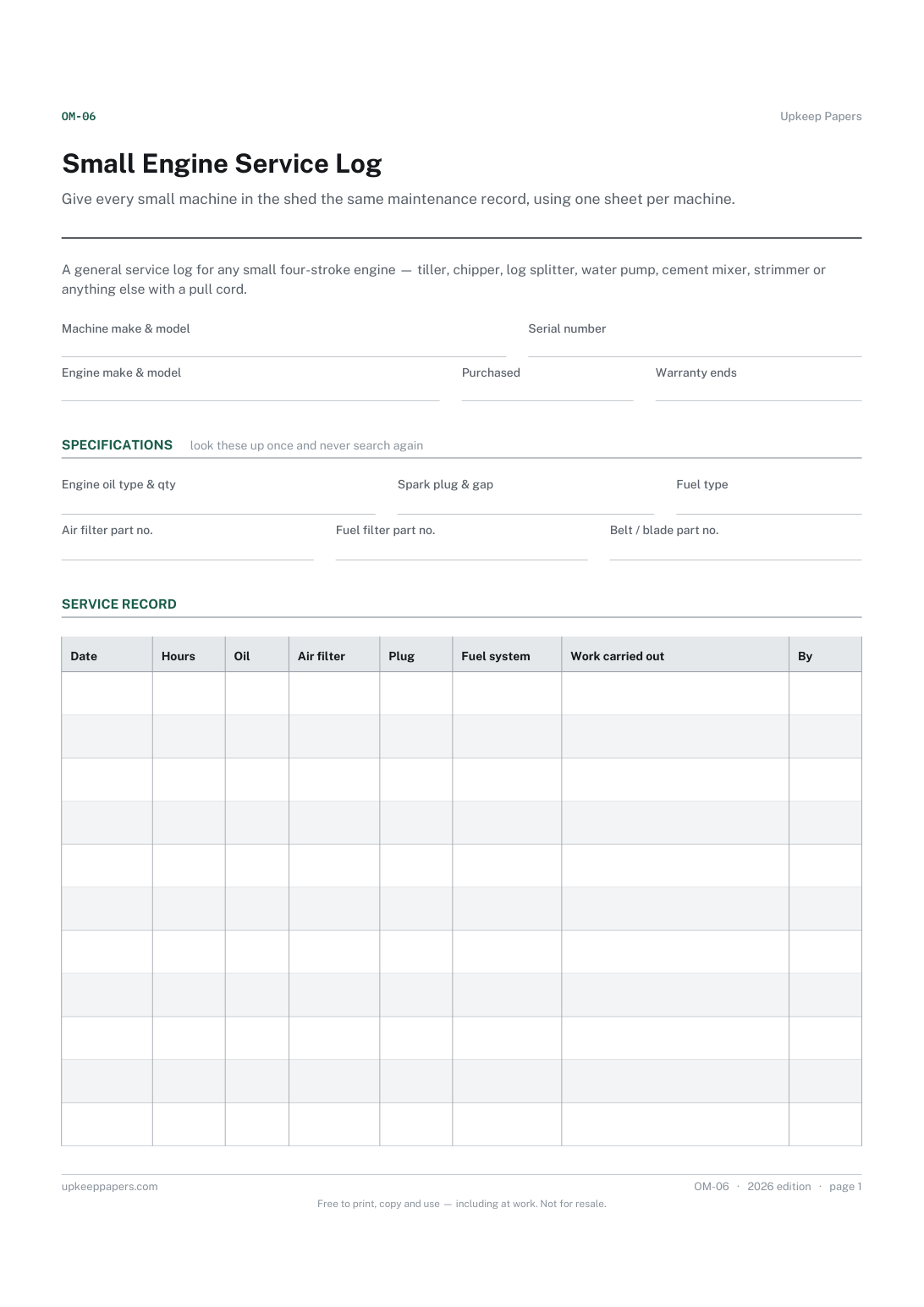
Small Engine Service Log
Give every small machine in the shed the same maintenance record, using one sheet per machine.
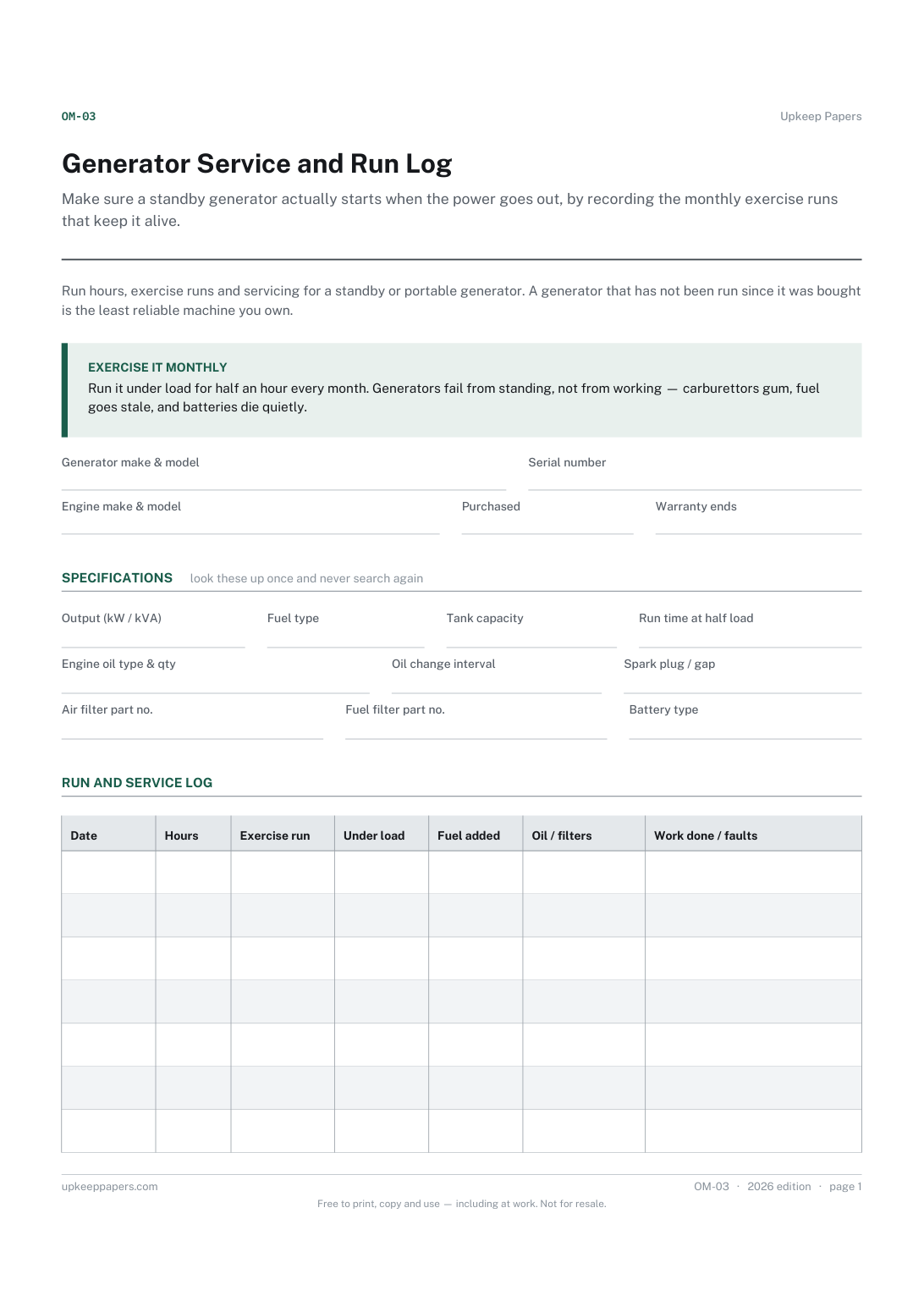
Generator Service and Run Log
Make sure a standby generator actually starts when the power goes out, by recording the monthly exercise runs that keep it alive.
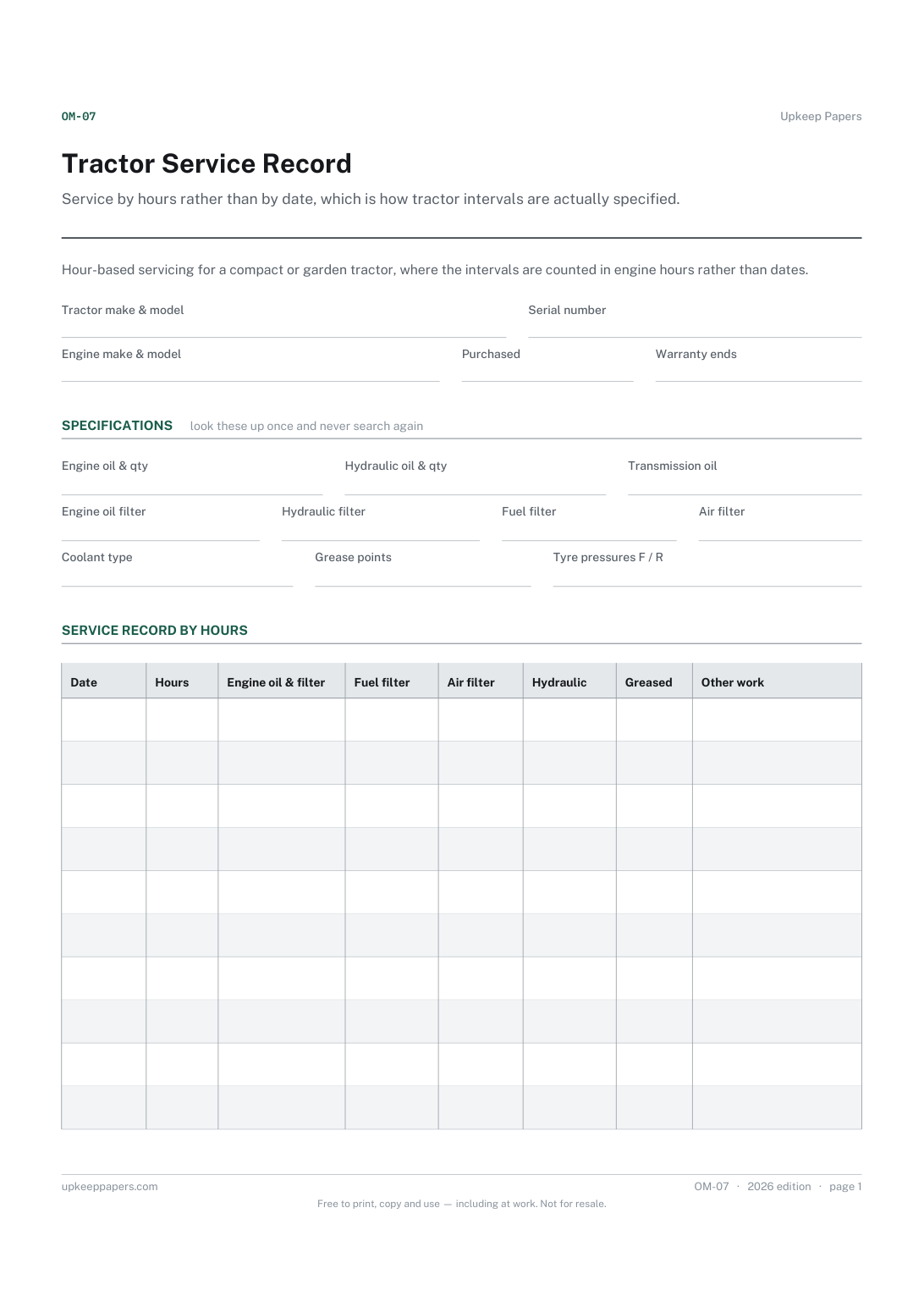
Tractor Service Record
Service by hours rather than by date, which is how tractor intervals are actually specified.
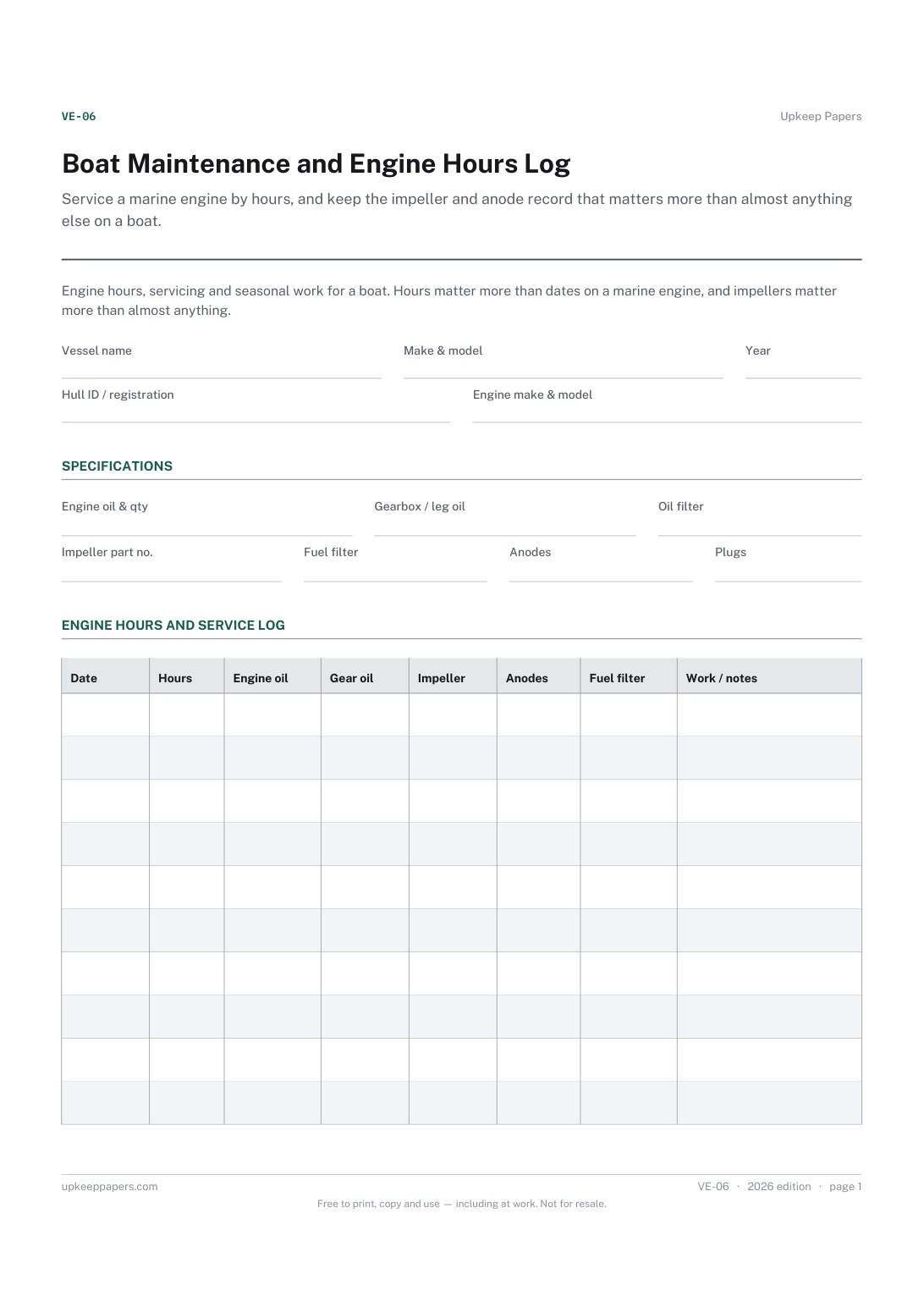
Boat Maintenance and Engine Hours Log
Service a marine engine by hours, and keep the impeller and anode record that matters more than almost anything else on a boat.
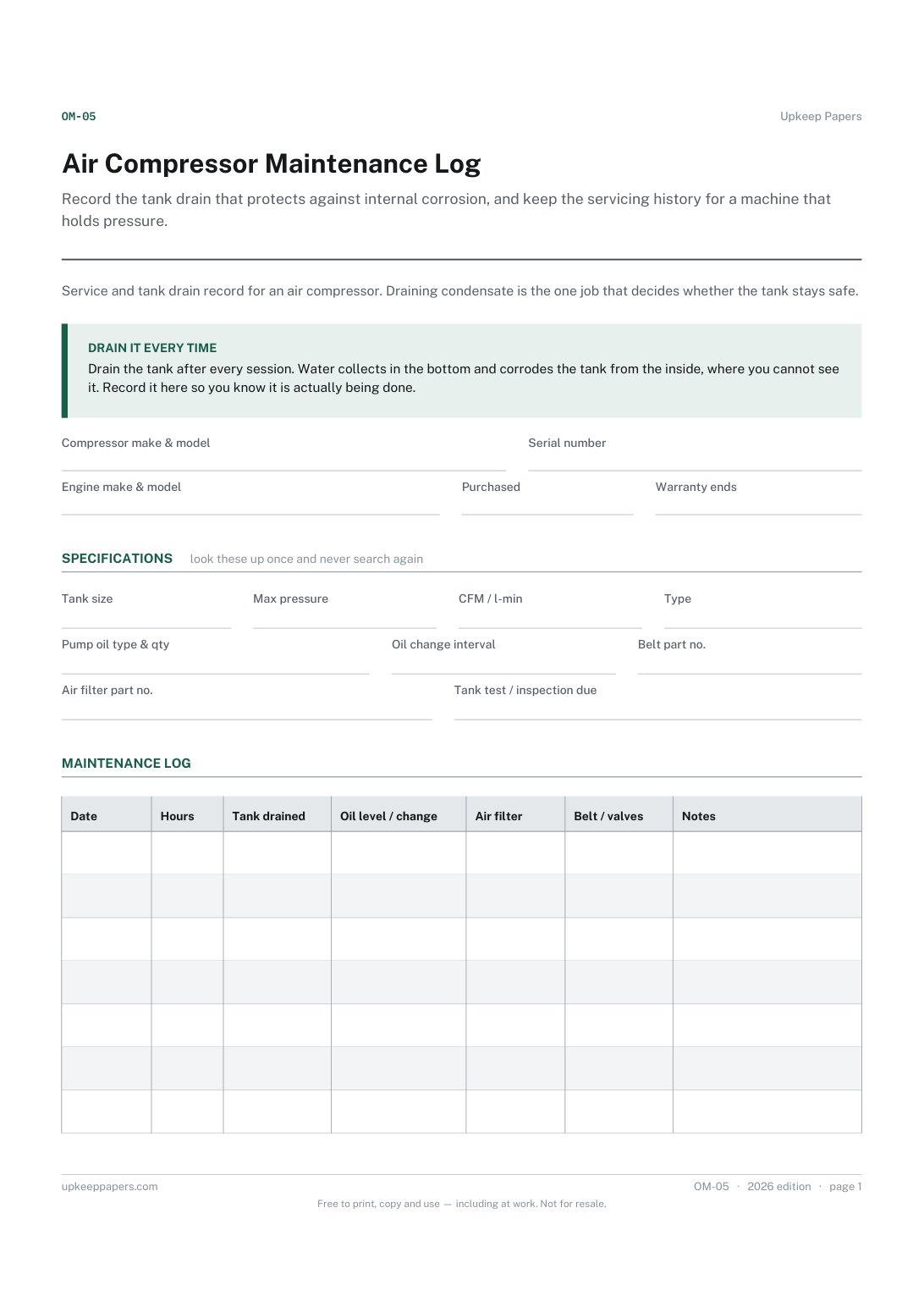
Air Compressor Maintenance Log
Record the tank drain that protects against internal corrosion, and keep the servicing history for a machine that holds pressure.
More guides
Why Small Engines Will Not Start in Spring
Stale fuel is why most mowers, strimmers and generators fail after storage. What happens inside the carburettor, and the two storage methods that prevent it.
How to Build a Home Maintenance Binder That Survives
A ring binder beats an app for house records, but most binders die within a year. The sections that work, what to file, and how to keep it alive.
Car Service History: What to Keep and Why
What a service history actually consists of, how stamped books and digital records differ, what a private buyer looks for, and how to handle gaps honestly.