
How we work
How to Rebuild a Service History You Have Lost
The folder is gone and the car is going up for sale. Here is how to reconstruct a service history that a buyer can actually trust.
Most of the sheets on this site assume the record already exists and just needs somewhere proper to live. This week’s vehicle sheet starts from the opposite problem: the record doesn’t exist any more, or you never had all of it, and the car is going up for sale anyway.
That is a genuinely common situation, and it is a worse one than it sounds. A car with no service history is not just a car with a gap in its paperwork. To a buyer it reads as a car where nobody can say what has and hasn’t been done to it, which is a different and much bigger question than “was the oil changed on time.” The folder going missing does more damage than the missed services themselves usually would.
The instinct to avoid
The tempting shortcut is to write down what probably happened. You know roughly when you’d have had it serviced, you can guess at a rough mileage, and filling in a plausible-looking table feels better than handing over a blank one. Don’t do that. A rebuilt history is only worth anything if every line on it can survive being asked “how do you know that,” and a guess dressed up as a record is worse than an honest gap — it’s a lie waiting to be caught, and once a buyer catches one line that doesn’t check out, they stop trusting every other line as well, including the ones you could actually prove.
The Rebuilt Service History Sheet is built around that constraint on purpose. It has a confidence column — certain, approximate, or unclear — next to every entry, and a notes column for saying plainly when a stretch of years has nothing behind it. The gaps are meant to be visible, not smoothed over.
Where the evidence actually is
Before you write anything down, it’s worth spending an hour looking in places that don’t feel like “the service folder” but often hold exactly the same information.
The garage itself. Independent garages and dealers keep their own job records for years, often far longer than customers keep the paper copy they were handed. A phone call asking for a duplicate invoice works more often than people expect, especially if you can give them approximate dates.
Bank and card statements. A payment to a named garage, on a date, for an amount that looks like a service rather than a fill-up, is real evidence — not the invoice itself, but proof that something happened there and then, which is often enough to anchor everything else nearby.
Your national test or inspection history, where your country has one. Most of these don’t record what maintenance was done, but they usually record the mileage at each test, which gives you a dated mileage trail even when the service detail is missing. That trail alone rules out or confirms a lot of guesses.
Previous keepers. If you’re not the first owner, whoever had it before you may still have paperwork they didn’t think to pass on. It’s a slightly awkward phone call and frequently worth making.
Warranty registrations and manufacturer apps. Increasingly these hold their own service records independently of any paper trail, sometimes going back further than the current owner realises.
None of these individually rebuilds the whole history. Together, worked through in order, they usually rebuild more of it than starting from memory ever would.
Say what you don’t know
Once you’ve gathered what you can, the honest version of the sheet will have gaps in it, and that’s fine. A gap that’s labelled as a gap — “no evidence, 2019 to 2021” — reads as somebody who did the work of checking and found nothing, which is a completely different impression from a history that just stops with no explanation. Buyers who read a lot of these adverts can tell the difference between the two immediately.
It’s worth being upfront in the advert or the handover conversation, too: this is a reconstruction, built after the fact from whatever evidence still existed, not the original paperwork. Some buyers and some trade guides will value that differently from an unbroken dealer history, and pretending otherwise doesn’t help anyone. What it does do is turn “we don’t really know” into “here is exactly what we know, and here is how we know it,” which is the only thing a rebuilt record can honestly offer — and it’s worth considerably more than nothing.
Not just for selling
The same approach works if you’ve simply inherited a car with no history and want to start keeping one properly from here, or if you’re buying something with a thin folder and want to record what you can verify before you form an opinion on the rest. Once the sheet is filled in as far as the evidence goes, it hands off cleanly to the ordinary Vehicle Service Record for everything that happens from that point on — the rebuilding only needs to happen once.
The same principle applies well beyond cars. A Home Service History Register for a house you’ve just bought has exactly the same problem in miniature: a boiler nobody has the paperwork for, a roof repair the previous owner mentioned once in passing. The method is the same one — work through where the evidence might actually be, write down only what you can show, and let the gaps stay visible rather than trying to paper over them.
From the library
Sheets mentioned here
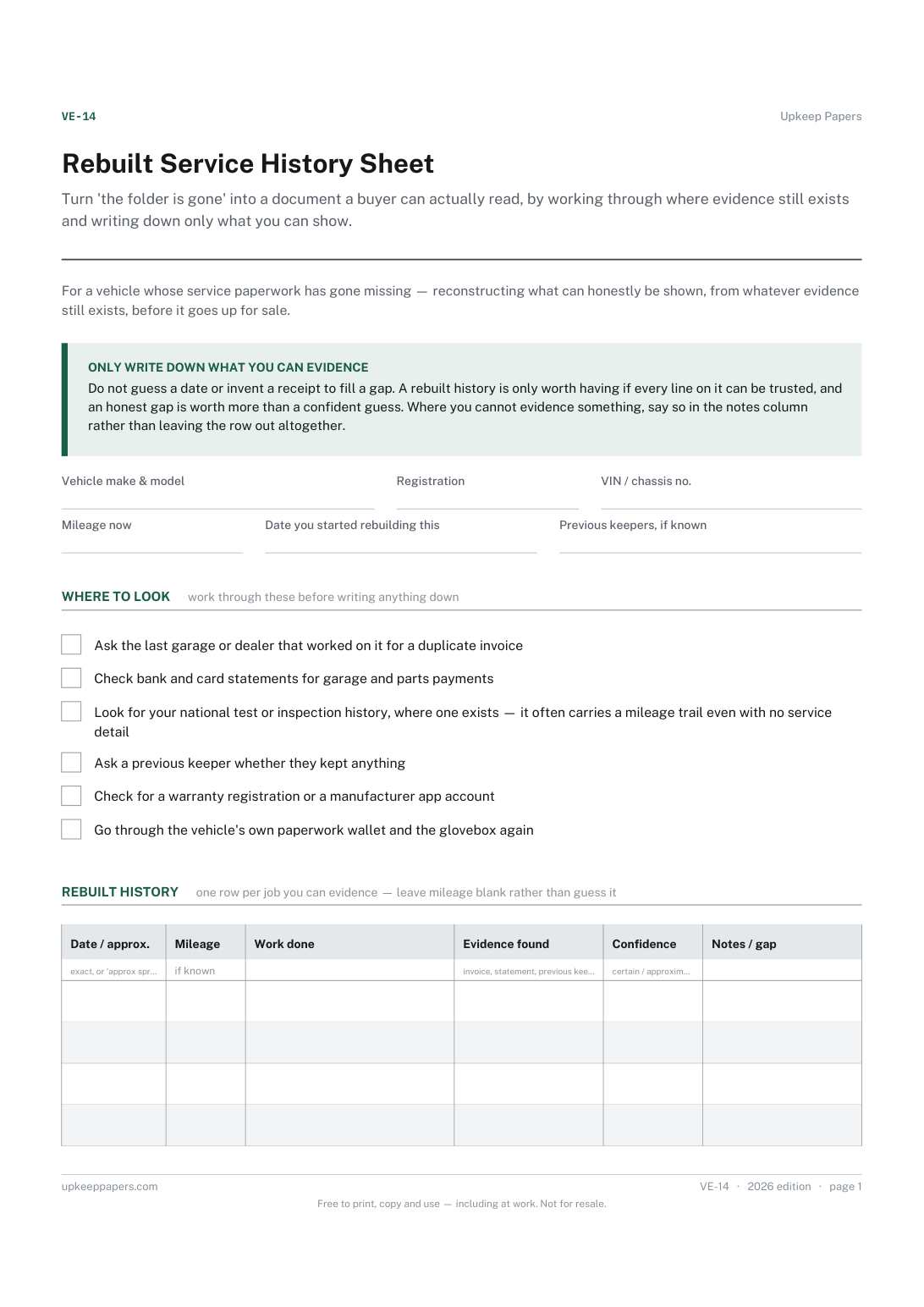
Rebuilt Service History Sheet
Turn 'the folder is gone' into a document a buyer can actually read, by working through where evidence still exists and writing down only what you can show.
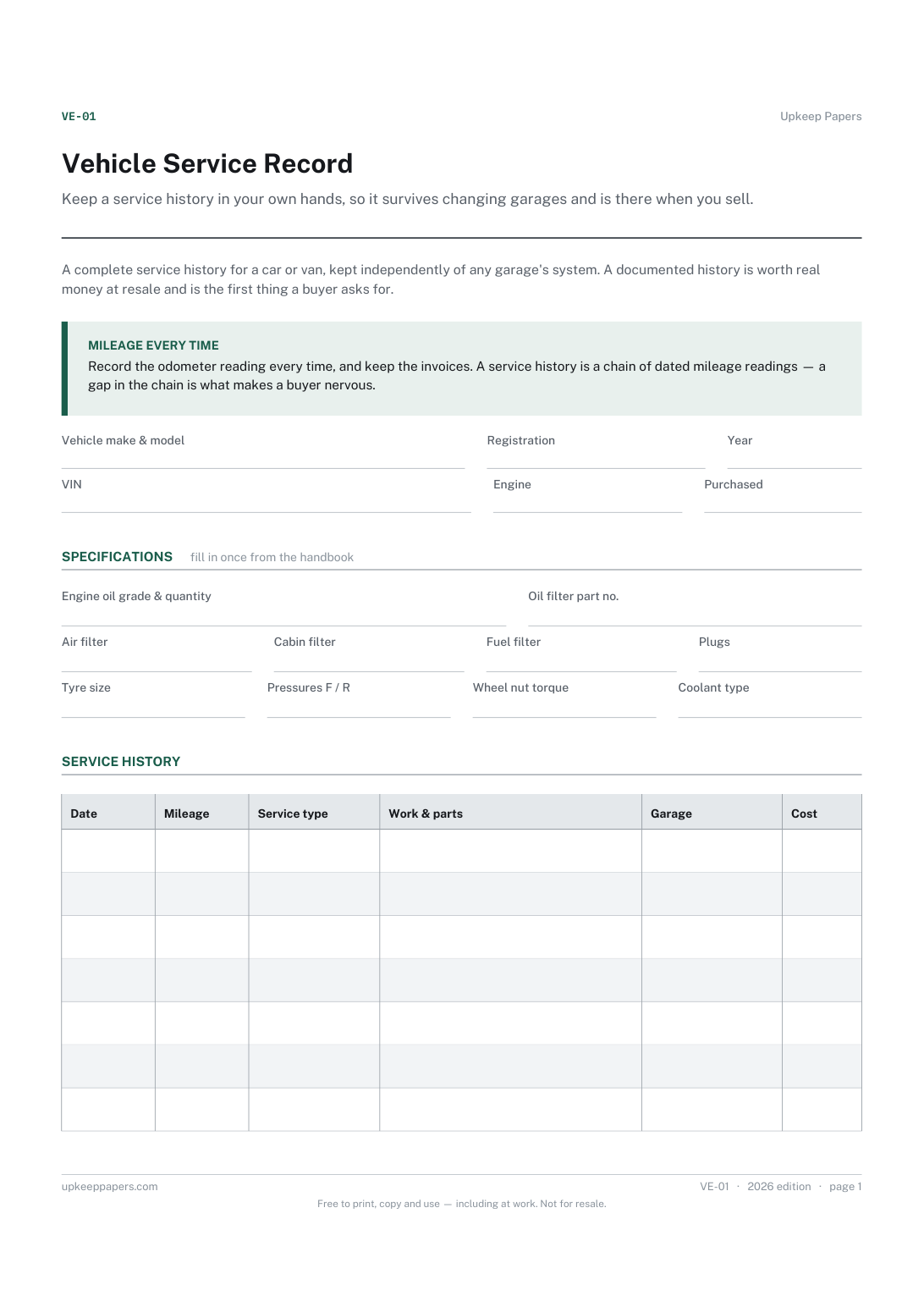
Vehicle Service Record
Keep a service history in your own hands, so it survives changing garages and is there when you sell.
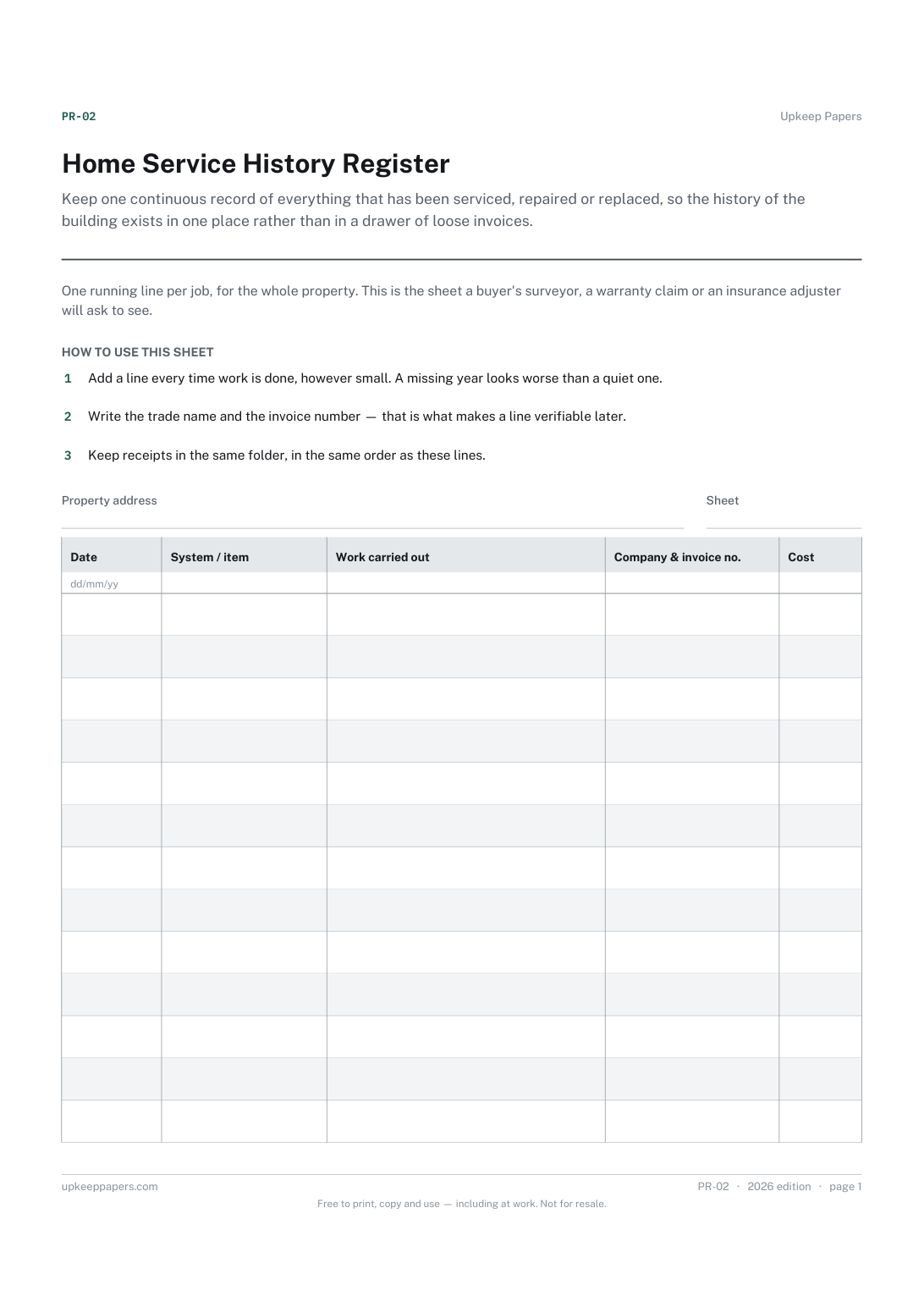
Home Service History Register
Keep one continuous record of everything that has been serviced, repaired or replaced, so the history of the building exists in one place rather than in a drawer of loose invoices.
More posts
A Gap in the Data Is Not Always a Gap on the Site
Two of this week's five measured keyword gaps already had a page. Here is the test that caught it, and the three that survived.
When the Roadmap Runs Out, Measure Instead of Guessing
The 200-sheet roadmap this site started with is finished. Here is what we built instead of guessing, and why four of five sheets came from one measured gap.
When a New Sheet Earns Its Own Page
Five sheets this week could easily have been three. Here is the test we use to tell a genuinely different record from the same one wearing a new title.
