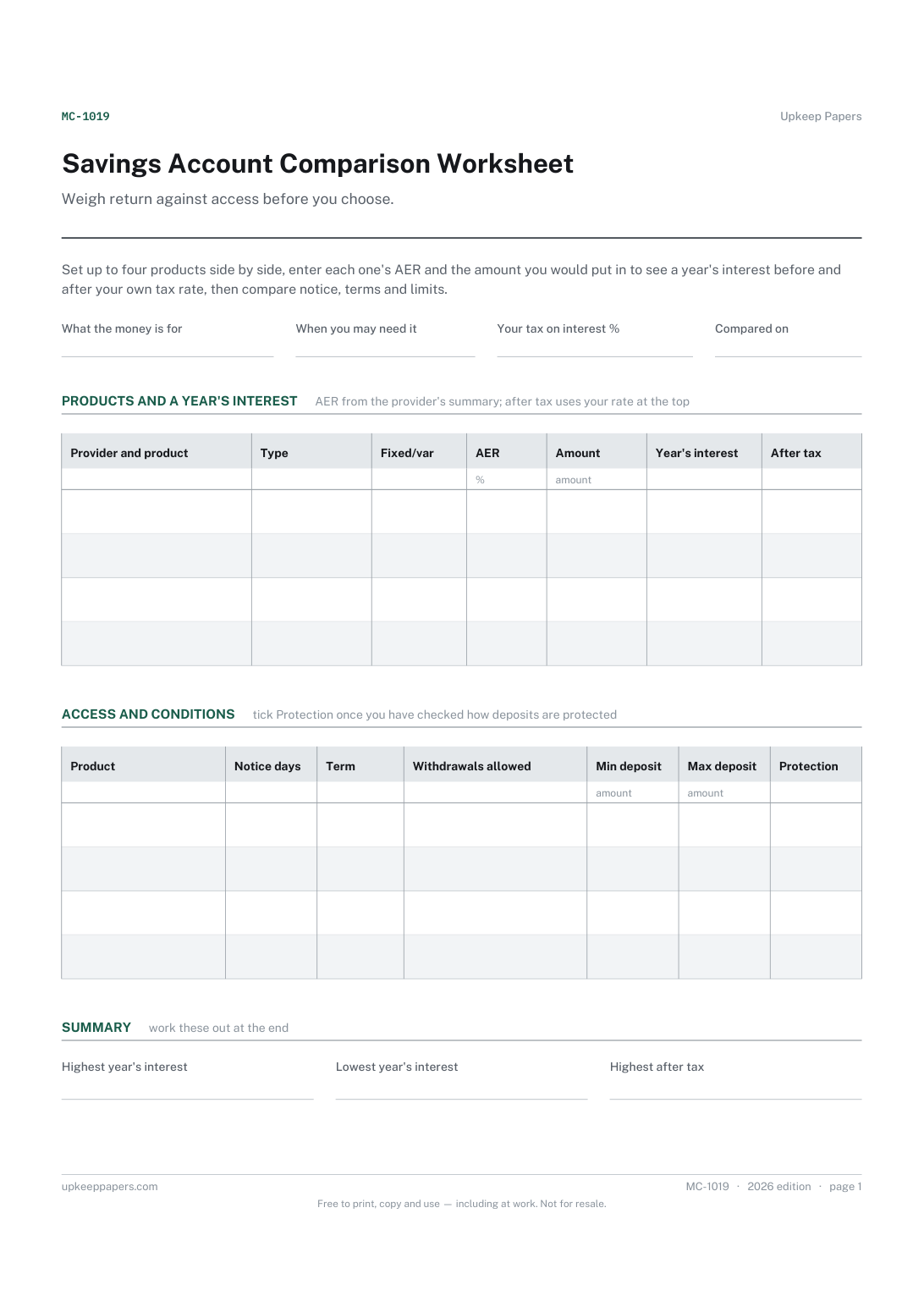
Savings Account Comparison Worksheet
Each product's type, whether its rate is fixed or variable, and its AER.
MC-1019 Form PDF Excel Online
Everything here is free. Making it takes time and money. Everything here is free.
 Buy us a coffee
Finance, budgeting and money · FB-1020 · Register
Free fixed-term savings register: each fixed-term account and bond with its maturity date, days left, estimated interest and your decision. Excel, PDF, browser.
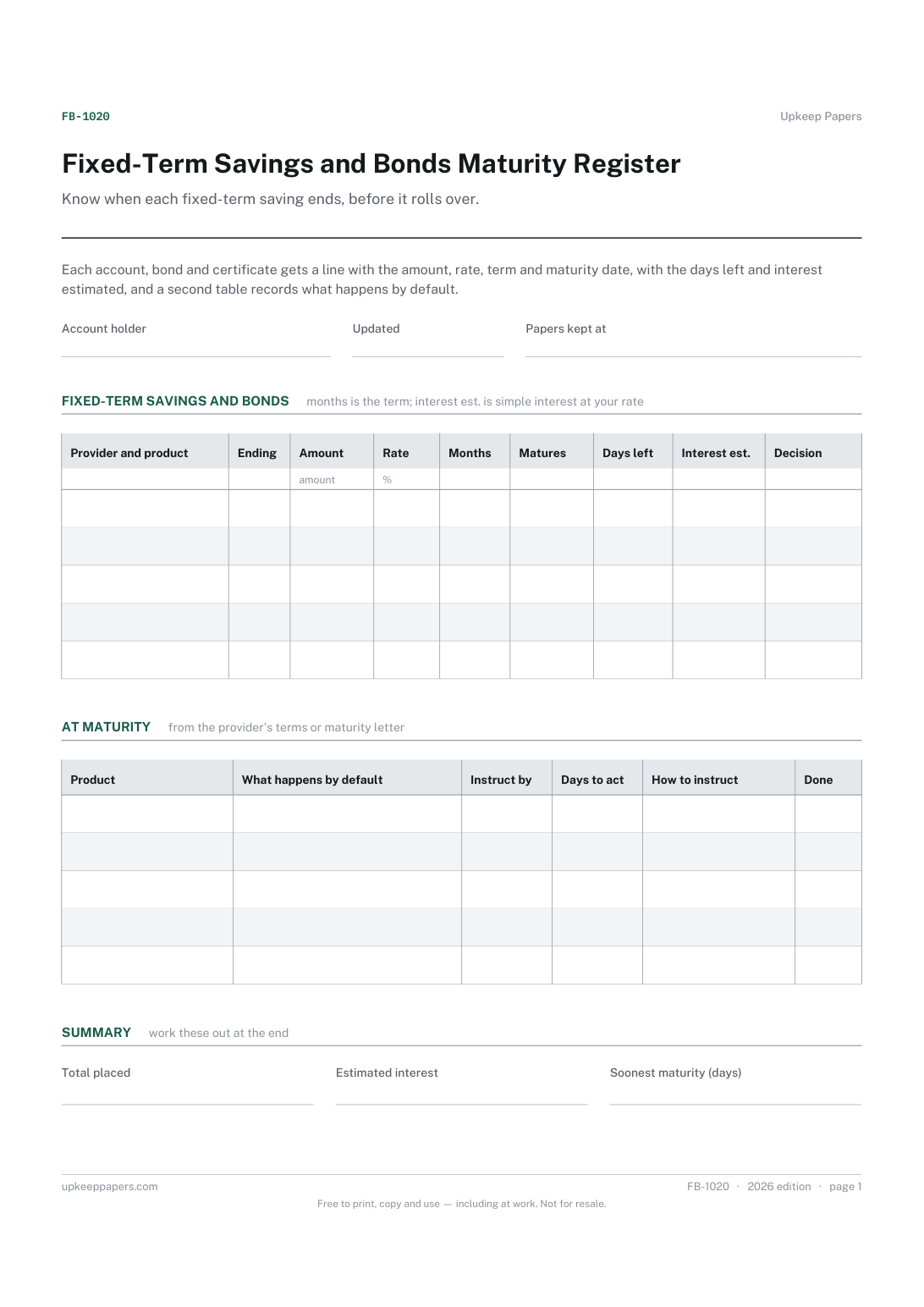
One page. The A4 and US Letter files are laid out identically, so neither is shrunk to fit.
Print it and write on it
Fillable PDF type and save
Spreadsheet formulas included
The fillable versions have real form fields — open them in any PDF reader, type into them and save. Printing help.
The same sheet, on screen. Totals and figures are worked out as you type, rows can be added or removed, and you can print it or download the completed version as a PDF. Everything stays in your browser — your entries are kept in this browser's own storage on this device, nothing is uploaded, and there is no account.
Know when each fixed-term saving ends, before it rolls over. Each account, bond and certificate gets a line with the amount, rate, term and maturity date, with the days left and interest estimated, and a second table records what happens by default.
Savers with money spread across fixed-term accounts, bonds and savings certificates with different end dates, and anyone keeping a record a partner or executor could follow.
The printable is laid out inside a box that fits both A4 and US Letter, so the two files are identical and neither one is scaled. The fillable PDF has real form fields. The workbook uses plain formulas only — SUM, IF, COUNTIF and the like — so it opens in Excel, LibreOffice and Google Sheets without anything breaking, and every calculated cell is grey so you can see which figures it worked out.
Download the A4 or US Letter file to match the paper in your printer, open it in a PDF reader and print at 100% — not "fit to page", which shrinks the writing space. Both files leave a 14 mm margin, which clears the unprintable edge on home printers. To print the online version with your entries in it, use the Print this sheet button, which prints only the sheet and none of the page around it. More on printing.
As simple interest: the amount times your rate times the term in years. Products that compound, pay interest monthly or pay a fixed return will differ, so use the provider's own figure where it gives one.
It depends on the product and the provider: some roll into a new term, some move to an easy-access account and some pay out. Write what your own terms say in the default column, because that is what happens if you do nothing.
Savings with no maturity date do not need this register; keep them in your general savings records. Bonds and certificates that run for a fixed term fit, with the term in months and the date they mature.
No. The last few digits are enough to tell products apart. Keep certificates and letters somewhere safe, and write where they are at the top of the sheet.
Each product's type, whether its rate is fixed or variable, and its AER.
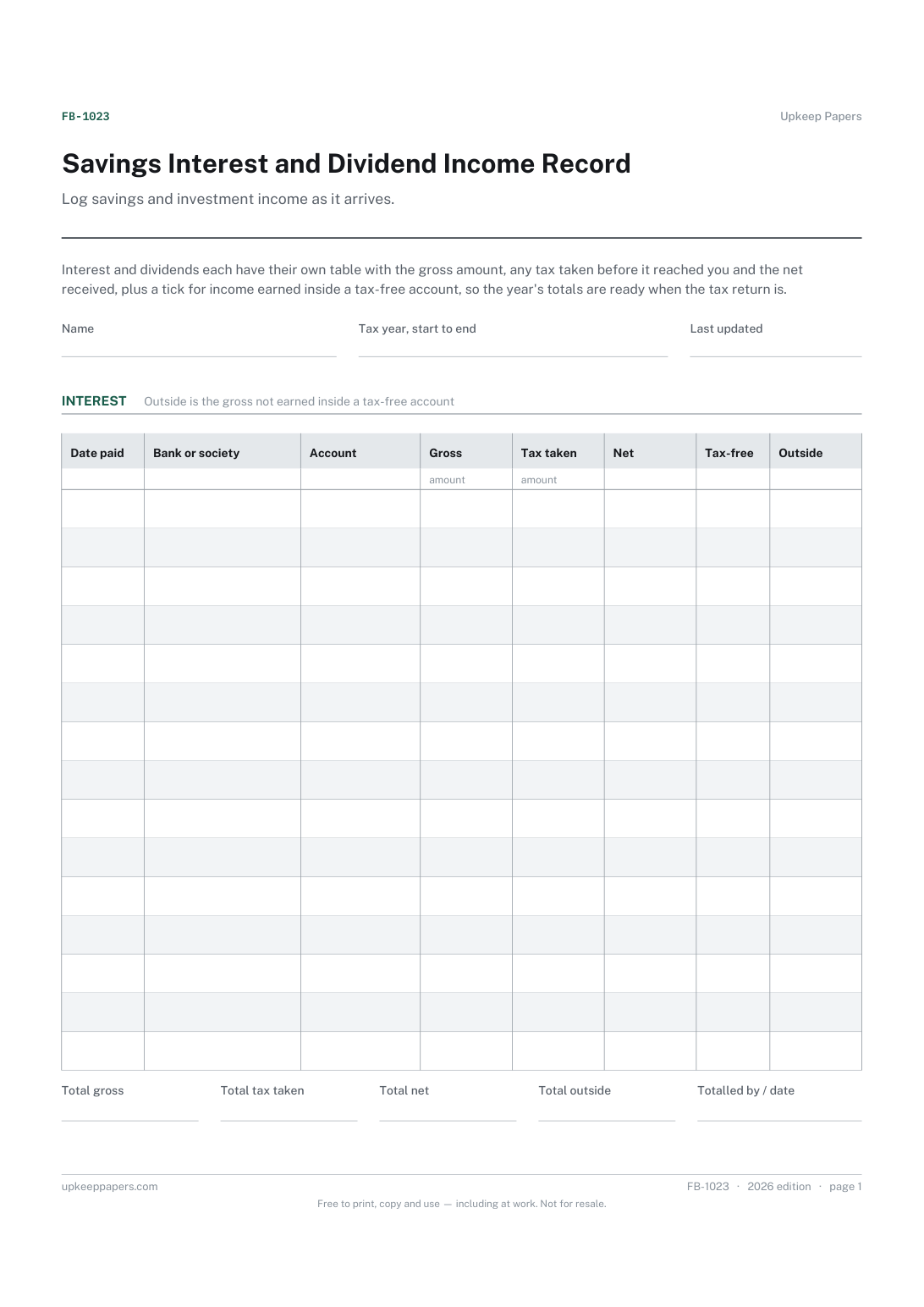
Each interest payment by bank, account and date.
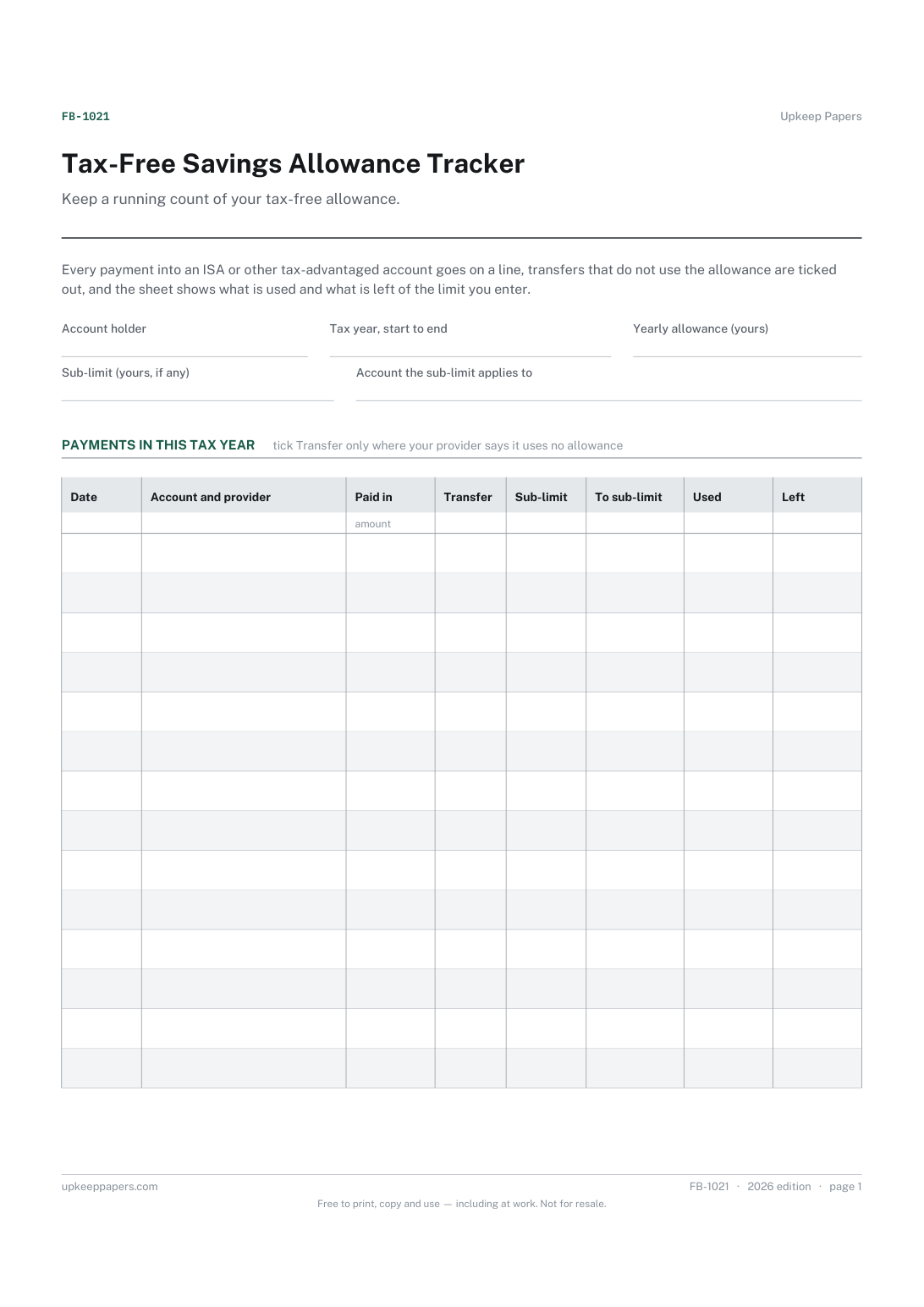
Every payment into a tax-free account, with its date and provider.
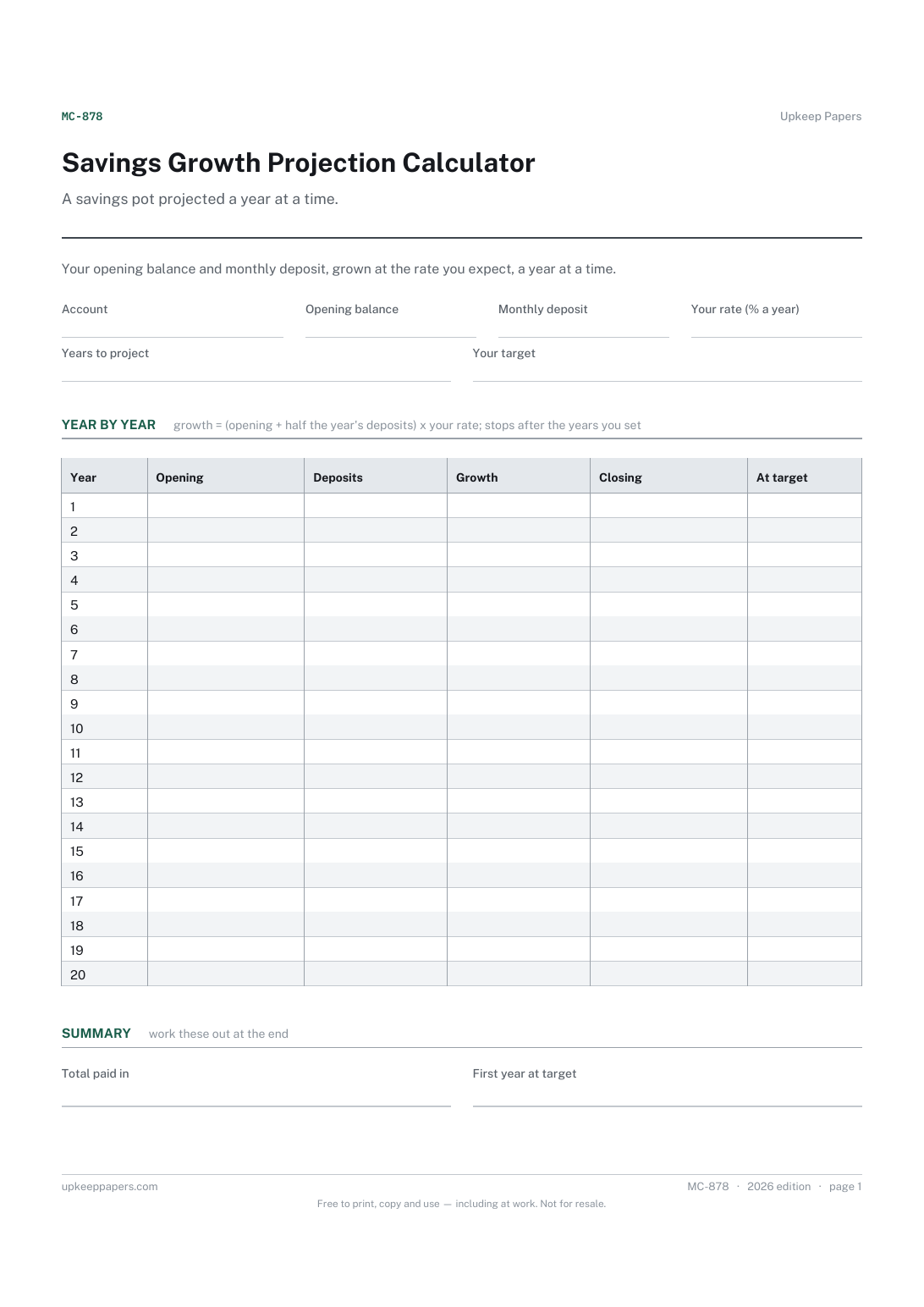
The balance at the start and end of each year.
Printable sheets, workbooks and tools on the same subject.
Insurance, licences, tests, memberships, passports and everything else that quietly expires — counted down from today and sorted by what lapses first.
Everything you own on one side, everything you owe on the other, and the difference tracked month by month so the direction of travel is visible.

Every sheet, binder, game and puzzle on Upkeep Papers is free to download, with no email and no account. Making them is not free: each one takes days of research, design and checking, and the site costs money to run. If something here saved you time, you can buy us a coffee. It is entirely optional: nothing is locked, and nothing changes if you don’t.
Buy us a coffee Opens PayPal in a new tab. Any amount, and nothing changes if you would rather not.