
Family history and genealogy · FH-399 · Checklist
Surname Research Checklist
Free surname research checklist — the kinds of record to consider for one surname, grouped as prompts to tick off, with a table of spelling variants.
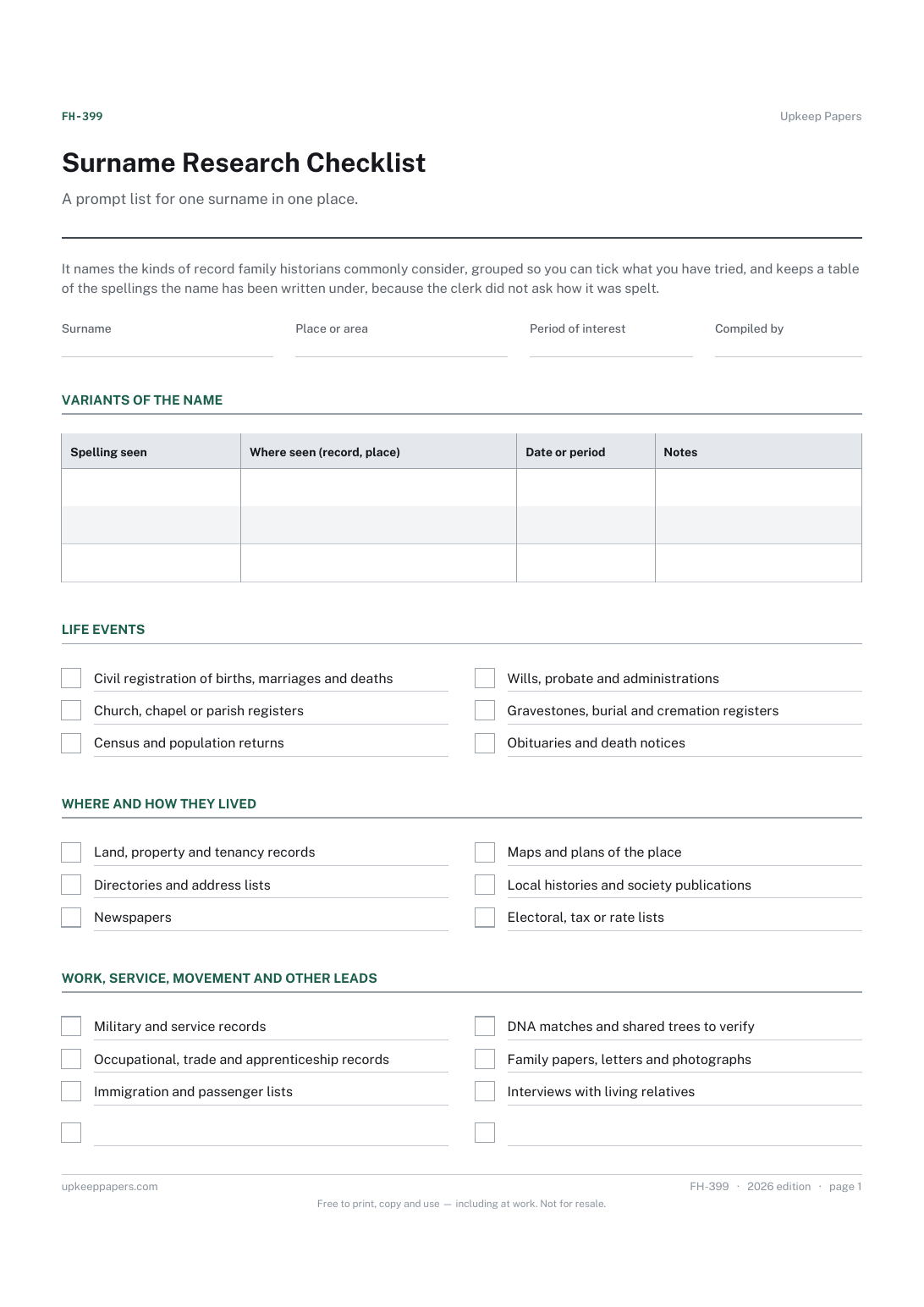
One page. The A4 and US Letter files are laid out identically, so neither is shrunk to fit.
Print it and write on it
Fillable PDF type and save
Or no download needed
Fill it in onlineThe fillable versions have real form fields — open them in any PDF reader, type into them and save. Printing help.
Fill it in online
The same sheet, on screen. Tick, type, add or remove rows, then print it or download the completed version as a PDF. Everything stays in your browser — your entries are kept in this browser's own storage on this device, nothing is uploaded, and there is no account.
Who this is for
A prompt list for one surname in one place. It names the kinds of record family historians commonly consider, grouped so you can tick what you have tried, and keeps a table of the spellings the name has been written under, because the clerk did not ask how it was spelt.
Anyone starting on a new surname or a new place and wanting to be sure they have thought of every type of source before deciding a person cannot be found.
What this helps you track
- The kinds of record that might bear on the name, so none is forgotten
- Which of them you have already considered, ticked as you go
- The variant spellings the name has appeared under and where you saw each
- Your own additions for the place and period, on the blank lines
- A single page to keep at the front of the folder for that surname
How to use it
- Write the surname, the place and the period you are working in at the top. Use a fresh sheet for each combination; the records that exist differ between them.
- Read through the groups. Each item is a kind of record that may or may not exist for your place and period, and may or may not be open to you; finding that out is part of the work.
- Tick an item when you have looked into it, whether or not it produced anything, and put what you actually searched on the research log.
- Add your own items on the blank lines — the records particular to your area, a local society's index, a family paper you know exists.
- Every time the name turns up spelt differently, add the spelling to the variants table with where you saw it. Search under every variant.
- Keep the sheet at the front of the surname folder, and on screen save it in your own browser.
Formats
- Printable PDF (A4 and US Letter)
- Fillable PDF with form fields
- Fill in online, saved in your browser
The printable is laid out inside a box that fits both A4 and US Letter, so the two files are identical and neither one is scaled. The fillable PDF has real form fields. The online version keeps what you enter in your own browser and builds the completed PDF on your device.
How to print
Download the A4 or US Letter file to match the paper in your printer, open it in a PDF reader and print at 100% — not "fit to page", which shrinks the writing space. Both files leave a 14 mm margin, which clears the unprintable edge on home printers. To print the online version with your entries in it, use the Print this sheet button, which prints only the sheet and none of the page around it. More on printing.
Questions
Does the sheet tell me which records exist for my country?
No. It lists kinds of record as prompts, not claims. What survives for a place and period, where it is held and whether you can see it are things to find out from the archive or office concerned.
What is a spelling variant?
Any form the name has been written in — by a clerk, a priest, an enumerator or a transcriber. Names were spelt as they were heard, so a person may appear under several forms in the same decade. Write each one down and search for all of them.
Where does DNA fit in?
It is one prompt among many. A DNA match is a lead to be followed like any other and recorded on the DNA match log; this sheet only reminds you that the option exists.
Can I use it for a place rather than a surname?
Yes. Put the place at the top and treat the surname field as the family of interest there, or leave it blank; the record types are the same.
Related resources
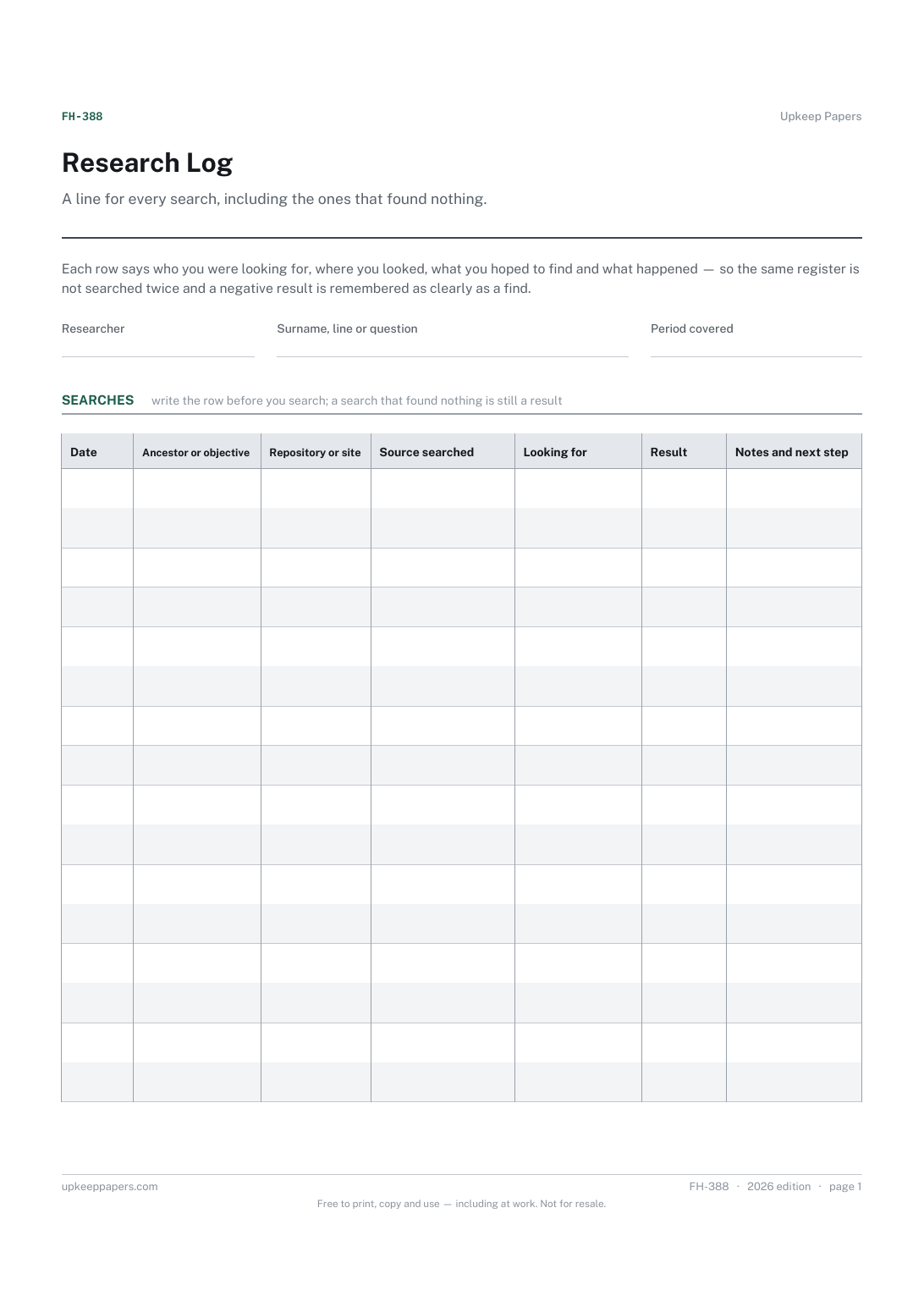
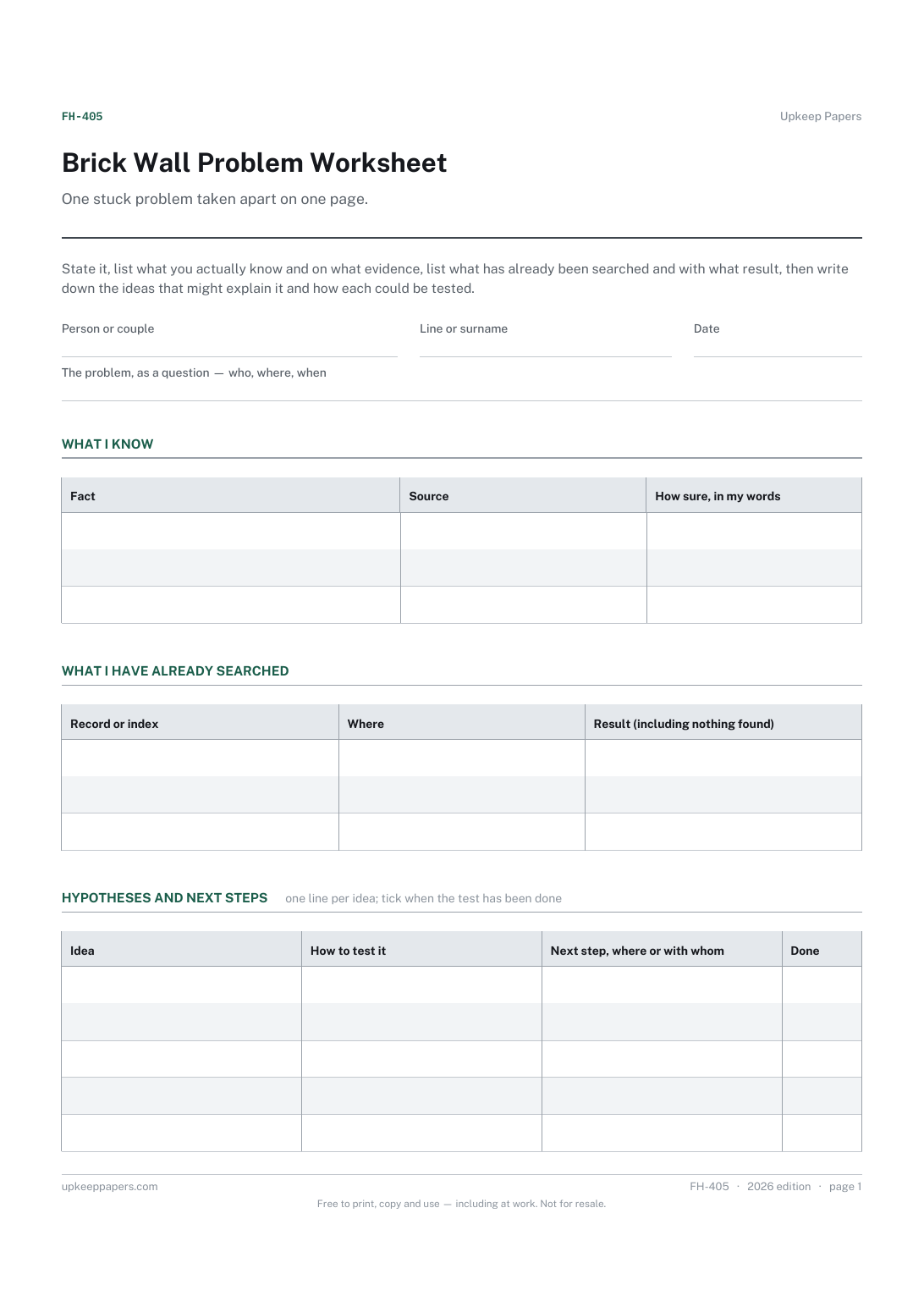
Brick Wall Problem Worksheet
The problem in a sentence or two, so it stops shifting every time you return to it.
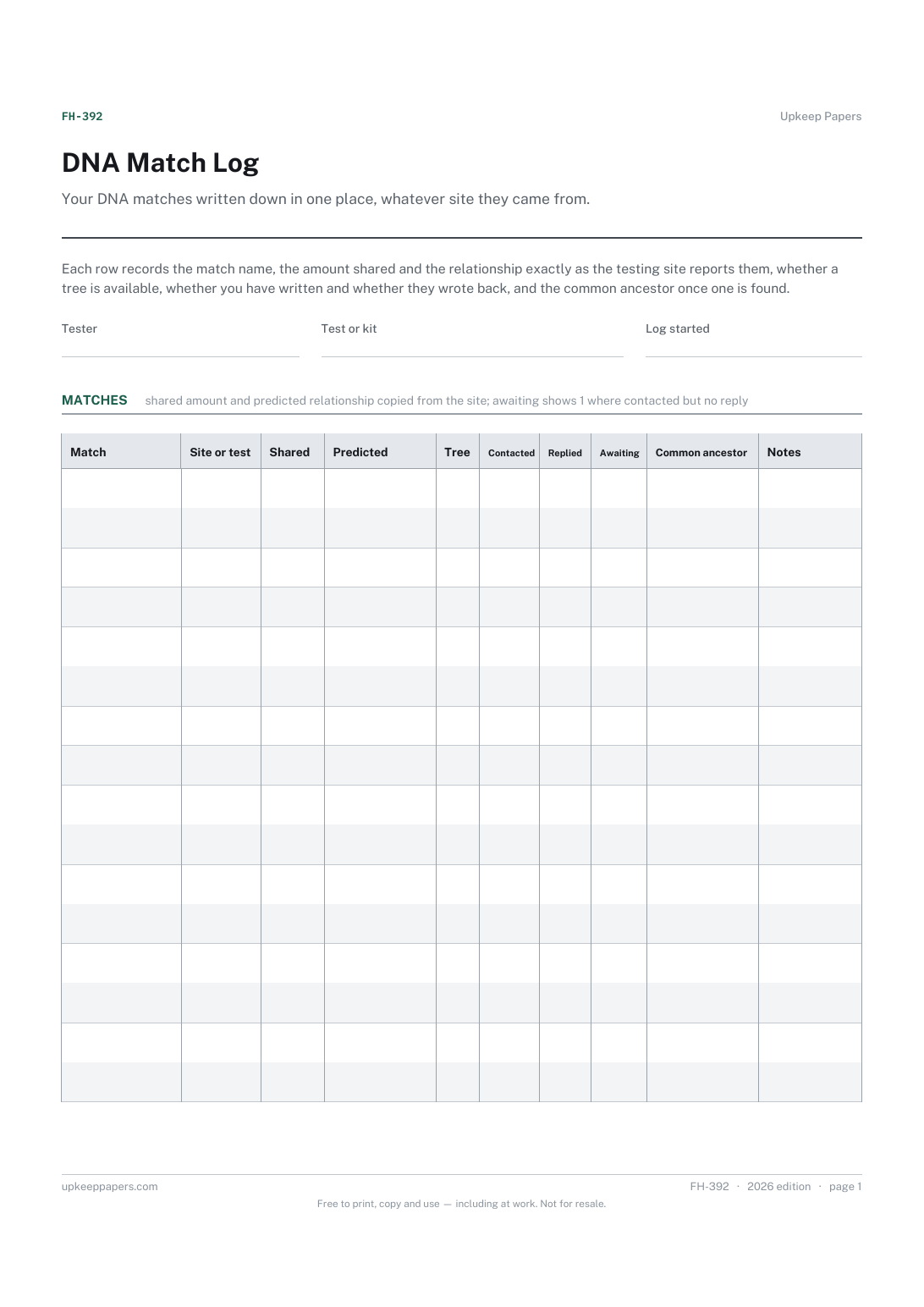
DNA Match Log
Each match by name or username, and which site or test it is on.
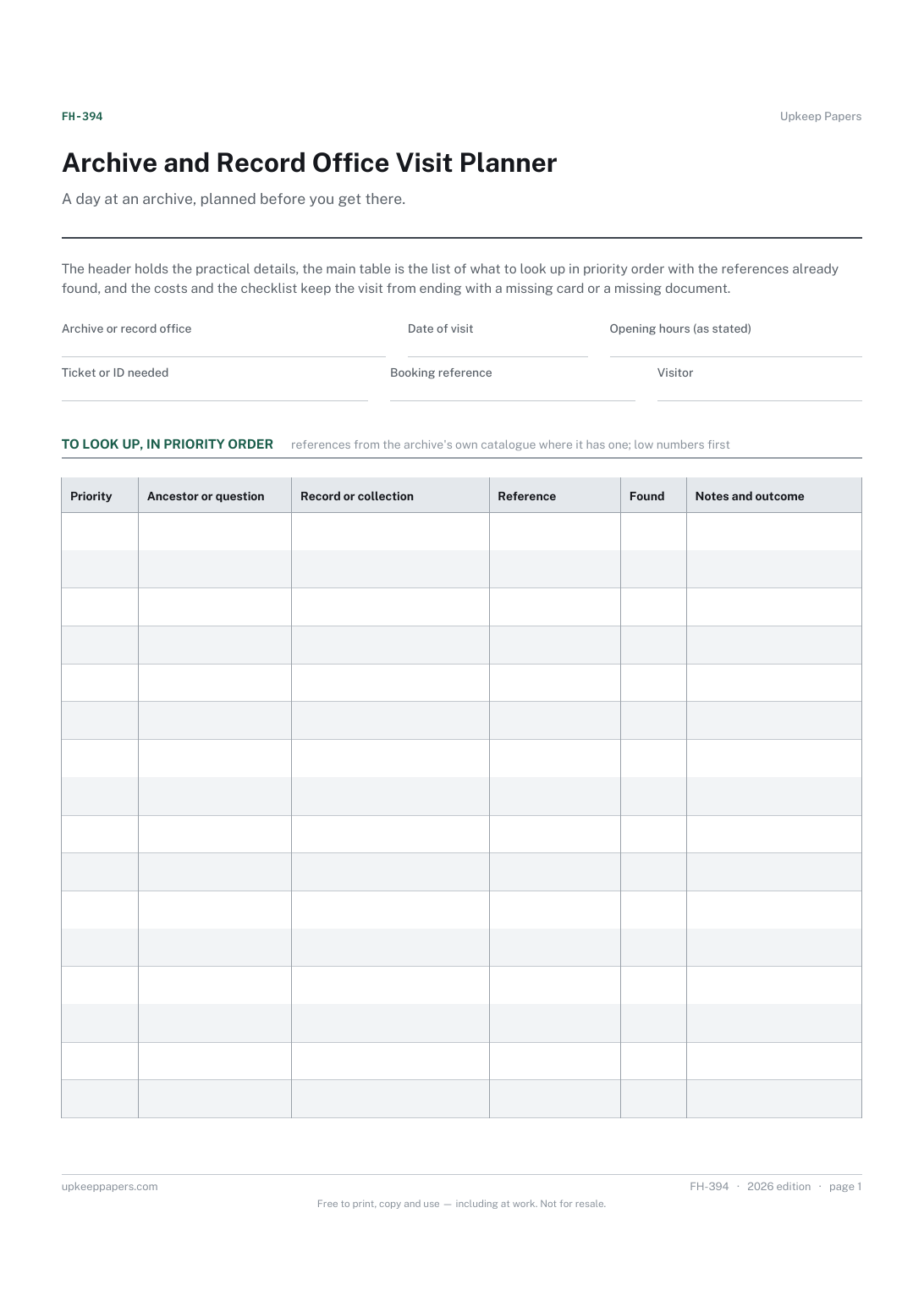
Archive and Record Office Visit Planner
The archive, the date, its opening hours and what you need to get in.
