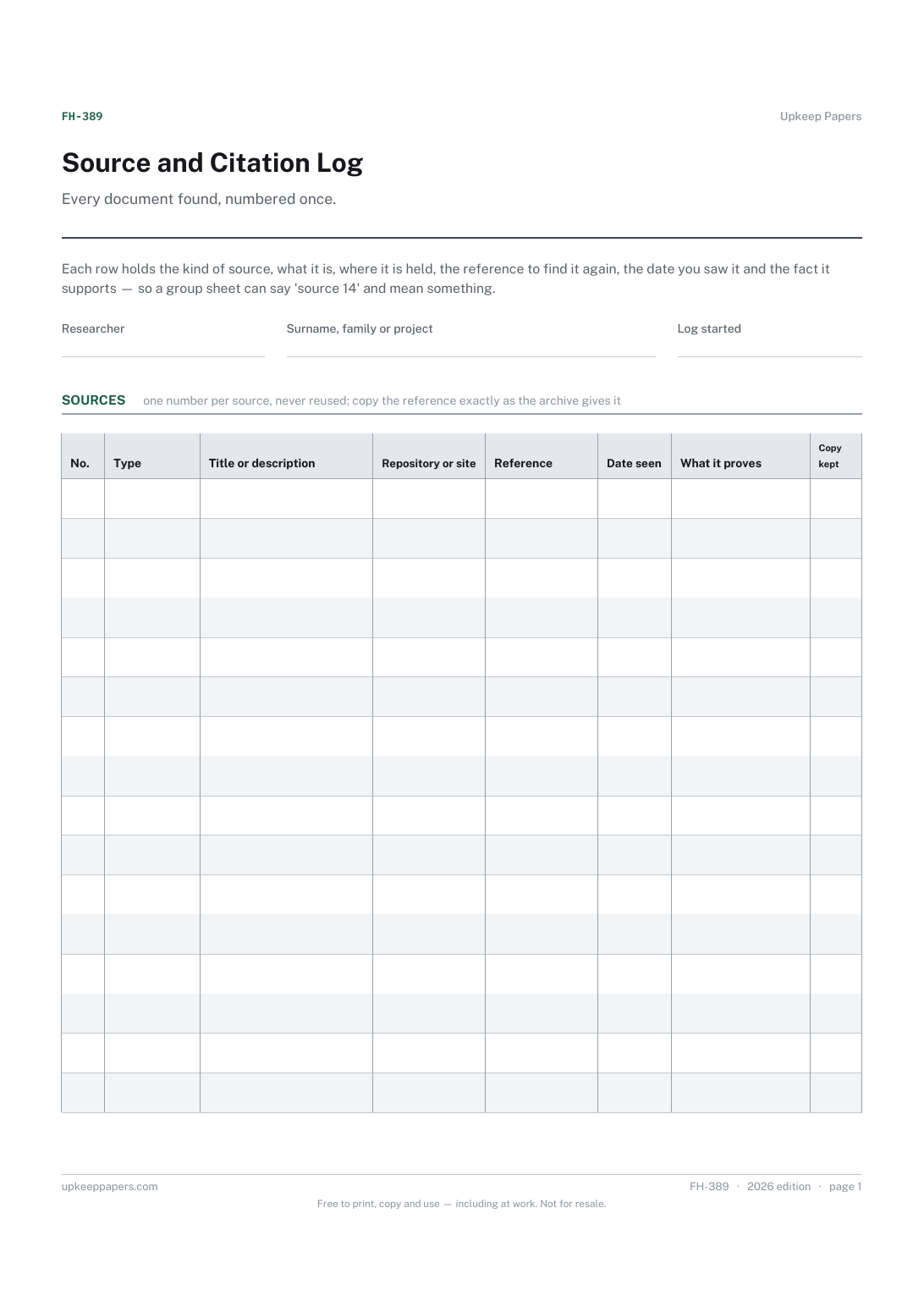
Source and Citation Log
A number for every source, to quote on group sheets and profiles.
FH-389 Log PDF Online
Everything here is free. Making it takes time and money. Everything here is free.
 Buy us a coffee
Family history and genealogy · FH-395 · Record
Free printable cemetery and grave record — the burial ground at the top, then each stone with names, dates as inscribed, plot, inscription and condition. PDF.
2 pages. The A4 and US Letter files are laid out identically, so neither is shrunk to fit.
Print it and write on it
Fillable PDF type and save
Or no download needed
Fill it in onlineThe fillable versions have real form fields — open them in any PDF reader, type into them and save. Printing help.
The same sheet, on screen. Tick, type, add or remove rows, then print it or download the completed version as a PDF. Everything stays in your browser — your entries are kept in this browser's own storage on this device, nothing is uploaded, and there is no account.
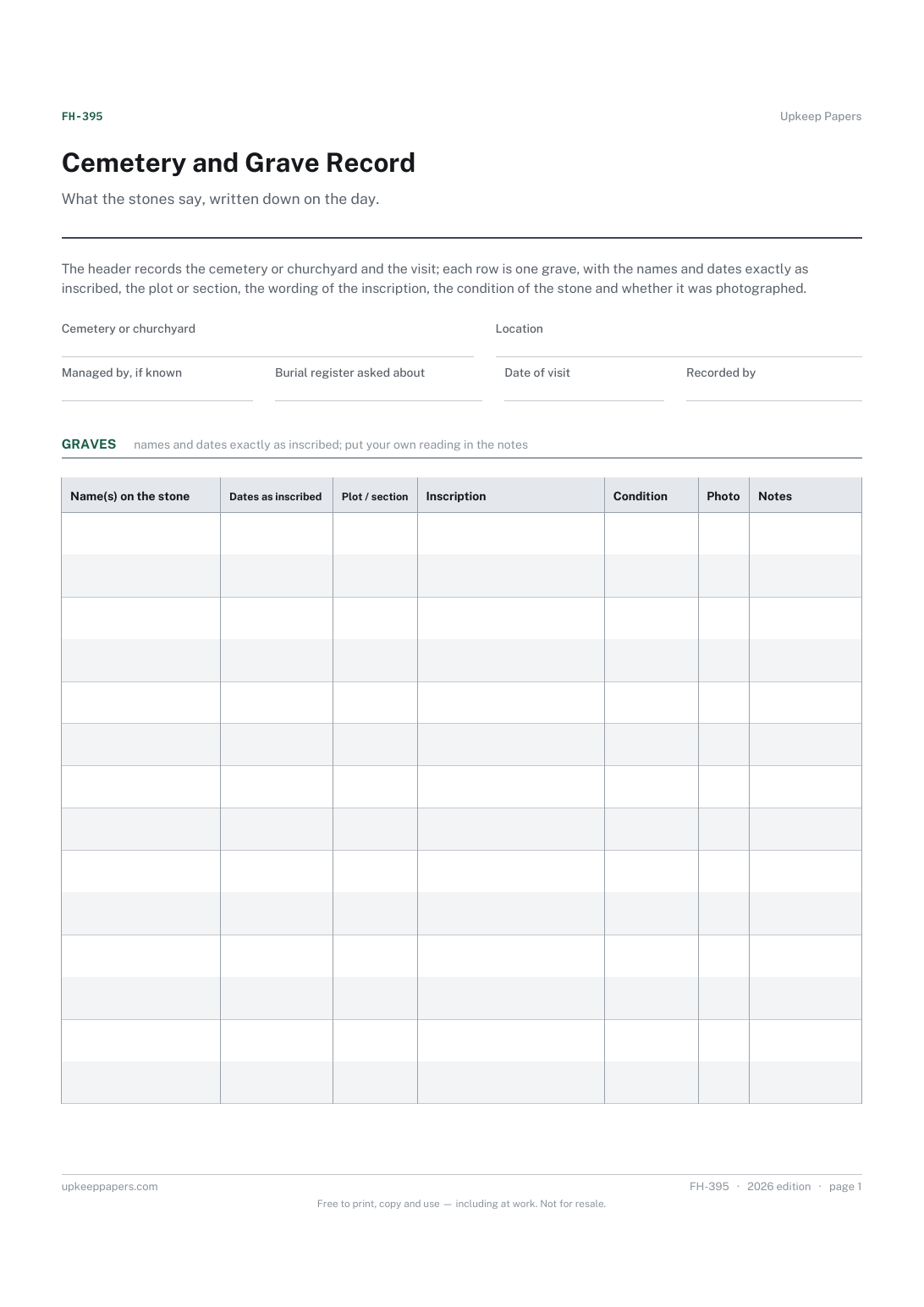
What the stones say, written down on the day. The header records the cemetery or churchyard and the visit; each row is one grave, with the names and dates exactly as inscribed, the plot or section, the wording of the inscription, the condition of the stone and whether it was photographed.
Family historians visiting the burial grounds of their ancestors, and anyone recording a churchyard or cemetery section before weather and time take the inscriptions.
The printable is laid out inside a box that fits both A4 and US Letter, so the two files are identical and neither one is scaled. The fillable PDF has real form fields. The online version keeps what you enter in your own browser and builds the completed PDF on your device.
Download the A4 or US Letter file to match the paper in your printer, open it in a PDF reader and print at 100% — not "fit to page", which shrinks the writing space. Both files leave a 14 mm margin, which clears the unprintable edge on home printers. To print the online version with your entries in it, use the Print this sheet button, which prints only the sheet and none of the page around it. More on printing.
Because the stone may disagree, and the disagreement is information. A date on a stone was chosen by the family, sometimes years later, and the record here is what the stone says, not what is true.
Copy what can be read, mark the gaps and say so in the condition column. A photograph in raking light often recovers more later, which is one reason the photographed tick matters.
Neighbouring stones are worth a row: the same surname a few plots away is often a relative, and shared plots are common. Record what is near and decide later.
Often, and it is held by whoever manages the ground — a church, a council, a company. What it contains and who may see it differs from place to place; the header has a line to note what you asked and what you were told.
A number for every source, to quote on group sheets and profiles.
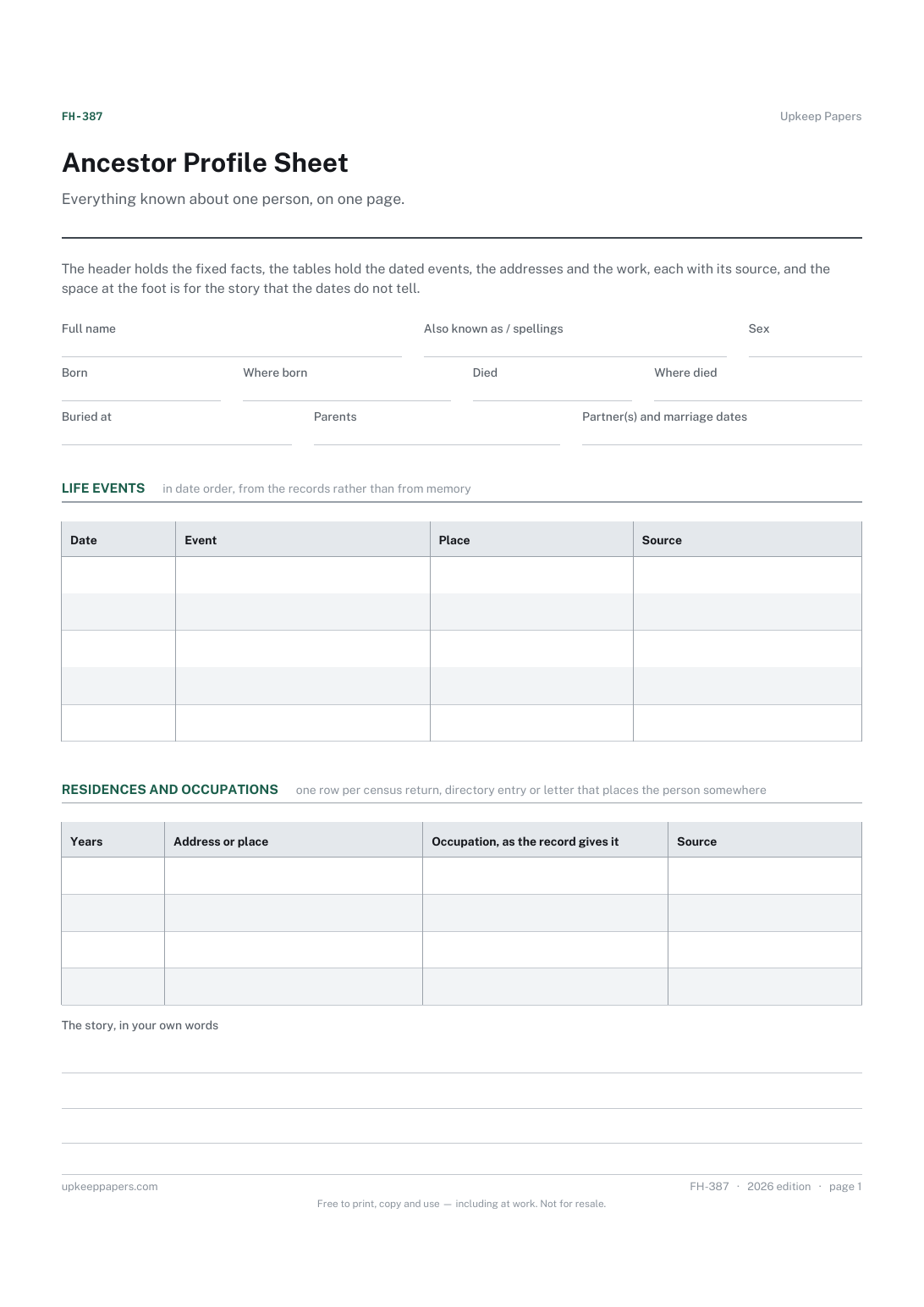
Names, including the spellings and nicknames the records use.
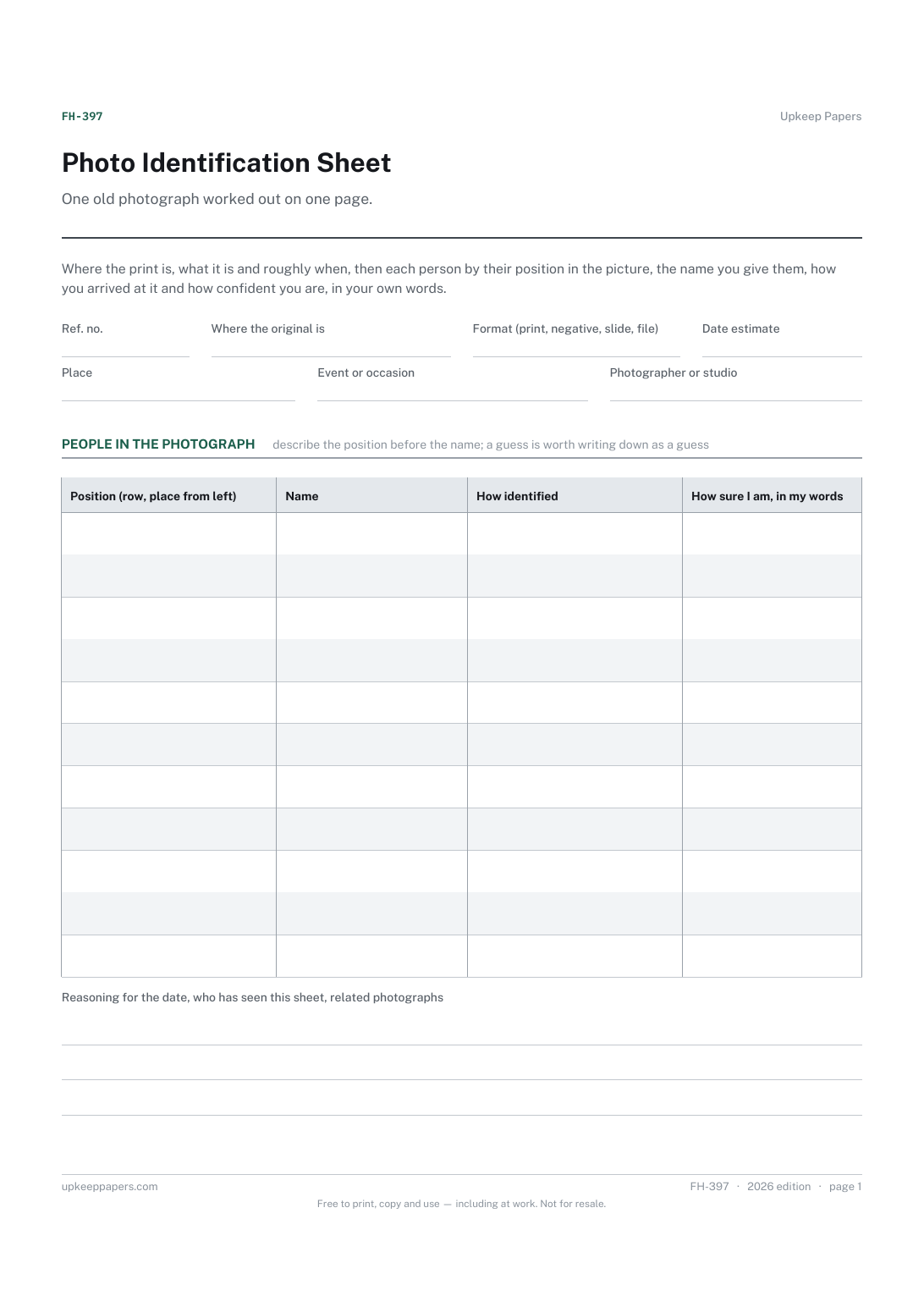
A reference number and the physical location of the print, negative or file.
Printable sheets, workbooks and tools on the same subject.
Turn a note into a record, by giving it a title, a date, ruled space and somewhere to sign.
Keep observations and conclusions in separate columns, which is what makes a record useful when somebody else reads it back.

Every sheet, binder, game and puzzle on Upkeep Papers is free to download, with no email and no account. Making them is not free: each one takes days of research, design and checking, and the site costs money to run. If something here saved you time, you can buy us a coffee. It is entirely optional: nothing is locked, and nothing changes if you don’t.
Buy us a coffee Opens PayPal in a new tab. Any amount, and nothing changes if you would rather not.