Guide · Rental property
Landlord Maintenance Records: What to Keep
Why response time is the figure that decides most tenancy disputes, how to keep evidence that holds up, and why every requirement here has to be checked locally.
Published
In a disagreement between a landlord and a tenant about a repair, the question is rarely whether the repair was carried out. It is when the landlord knew, and how long the gap was. That gap is what everything turns on, and it is the number almost nobody can produce afterwards, because nobody wrote down the day the tenant first mentioned it.
Before anything else: this page states no rules
What a landlord must do, what certificates a property must hold, how often checks must happen, how much notice must be given, how deposits must be handled, and how long records must be kept all differ enormously — between countries, between regions within countries, and between types of letting and building. They also change.
Nothing here is a statement of what applies to you, and nothing here is legal advice. Get your actual obligations from a source with authority where your property is: the local authority or housing regulator, a landlord association in your jurisdiction, or a solicitor. If you let in more than one place, assume the rules differ in each until you have checked.
What generalises is the discipline of recording. That is what this page is about.
The four timestamps
For every maintenance issue in a let property, four moments matter, and each should have a date against it.
Reported. When the tenant first raised it, in whatever form. Not when you read the message.
Acknowledged. When you responded, and what you told them.
Attended. When somebody actually turned up.
Resolved. When the work was completed and the tenant confirmed it, or it was closed with an explanation.
Most landlords, if pressed, can produce the last one. The interesting one is the first, and the second changes the character of a dispute entirely. A landlord who can show a report on the 3rd answered on the 3rd, attended on the 6th and resolved on the 11th is in a different position from one who can only say the boiler was fixed at some point in November.
A Rental Property Maintenance Log with a column for each of those dates is not more work than a simpler log. It is the same work, arranged so the answer is written down before anybody asks.
Keep the reporting channel single
The most common cause of an unprovable history is that reports arrive by four different routes: a text message, a phone call, a remark in passing at an inspection, and something through an agent.
Pick a channel and tell tenants at the start of the tenancy that it is the one to use. When a report arrives some other way, transfer it into the log the same day, note how it came in, and reply through the proper channel so there is a written acknowledgement with a date on it. A screenshot of a text message, saved and filed, is a perfectly good record. A recollection of a conversation on the stairs is not.
Fixing something quickly because you happened to be there is good landlording; not writing it down means six months later there is no evidence you did.
Photographs that are worth something
- Take a context shot, then a close-up. A close-up of damage with no surroundings could be any room in any property.
- Shoot from the same position each time. A consistent angle at check-in, at each inspection and at check-out turns a set of photographs into a sequence showing change over time.
- Do not edit, and do not strip the metadata. An image that has obviously been through an editor invites the argument you least want.
- Photograph the ordinary as well as the damaged, and photograph meter readings at the start and end of every tenancy with the serial number visible. What proves condition later is the shot of the things that were fine.
Inspections
Routine inspections produce two things: a record of condition, and a record that you looked. The second is easy to overlook. “Inspection carried out, no issues identified, photographs taken” with a date on it is a useful entry, and a run of them establishes a pattern.
Note what you observe rather than what you conclude — “dark staining to the ceiling above the shower, approximately 30cm across” rather than “tenant damage from overflowing bath”. The distinction between fair wear and tear and damage is contested territory, frequently regulated, and decided differently in different jurisdictions. Your record’s job is to capture the facts, not reach the verdict. A Rental Property Inspection Record filled in that way survives scrutiny; an argumentative one does not.
How much notice you must give before an inspection, and how often you may carry them out, are governed by local law and by the tenancy agreement. Check both.
Contractors and independent evidence
A contractor’s own paperwork carries more weight than anything you write, because it comes from somebody with no interest in the dispute. Keep the invoice, the job sheet, and any written report. Where a contractor diagnoses something relevant — a blocked condensate rather than a failed boiler — get it in writing while they are on site, because they will not remember in eight months. Record who attended and when on a Contractor and Tradesperson Log: the same heating engineer attending for five years is somebody who can describe a property’s history.
Safety-related records
Alarms, extinguishers and any equipment subject to periodic checking deserve their own log, because they are the records most likely to be asked for specifically and under pressure.
Which are required, how often, by whom, and with what documentation differs by jurisdiction and property type. This is one of the areas where rules vary most and change most often, so check yours periodically. What is worth doing regardless is a dated log with one row per device: a Smoke and CO Alarm Test Log showing every device tested on every date is easy to keep and awkward to reconstruct.
Retention
How long to keep records is another question with no general answer. Retention periods can be set by tax rules, housing legislation, deposit scheme requirements and the period during which a claim could still be brought against you — each potentially a different length for the same file.
Two points that do not depend on the jurisdiction. Keep the whole tenancy file well beyond settlement of the deposit, because that is when disputes surface. And find out the actual periods that apply rather than picking a number, because both errors are expensive: destroying something you needed, or holding personal data longer than you are permitted to.
That second half matters. Tenancy files contain personal data about identifiable people, and how it may be stored, who may see it and when it must be deleted are regulated in many countries — rules separate from housing law, and checked separately.
Short lets
A holiday let has the same logic compressed into days. The changeover is the inspection, and a Holiday Let Changeover Checklist signed and dated by whoever did the turnaround is the equivalent record — but because it happens every week, it has to be quick or it will not happen at all.
The habit that actually works
None of this survives as a good intention. It survives as a filing moment attached to an existing event: when a tenant reports something, the log entry is part of reading the message; when a contractor leaves, the invoice is filed before you drive away.
Records assembled after a dispute begins look exactly like records assembled after a dispute begins. Records kept as you go look like a property being managed properly, because that is what they are.
From the library
Sheets mentioned here
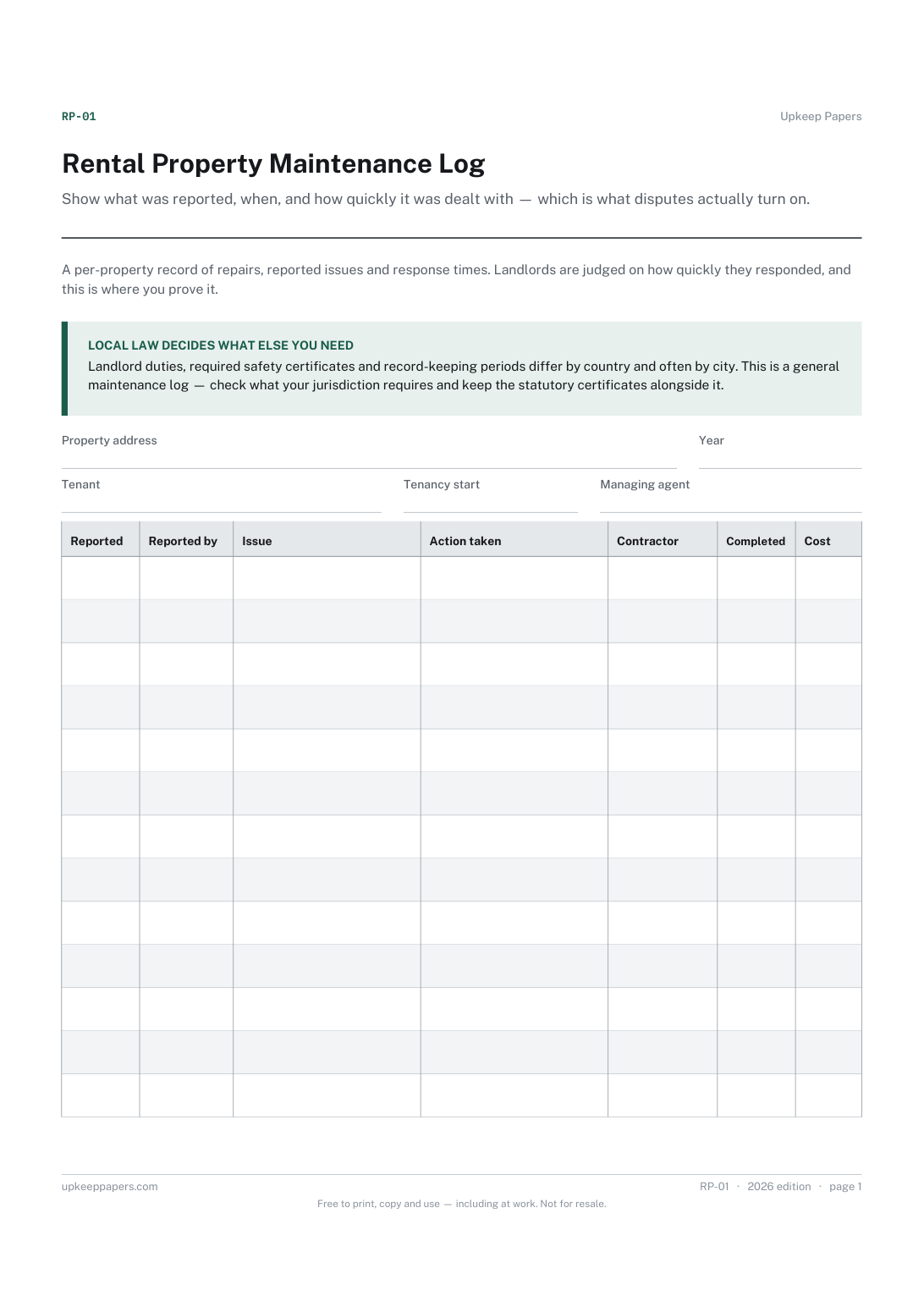
Rental Property Maintenance Log
Show what was reported, when, and how quickly it was dealt with — which is what disputes actually turn on.
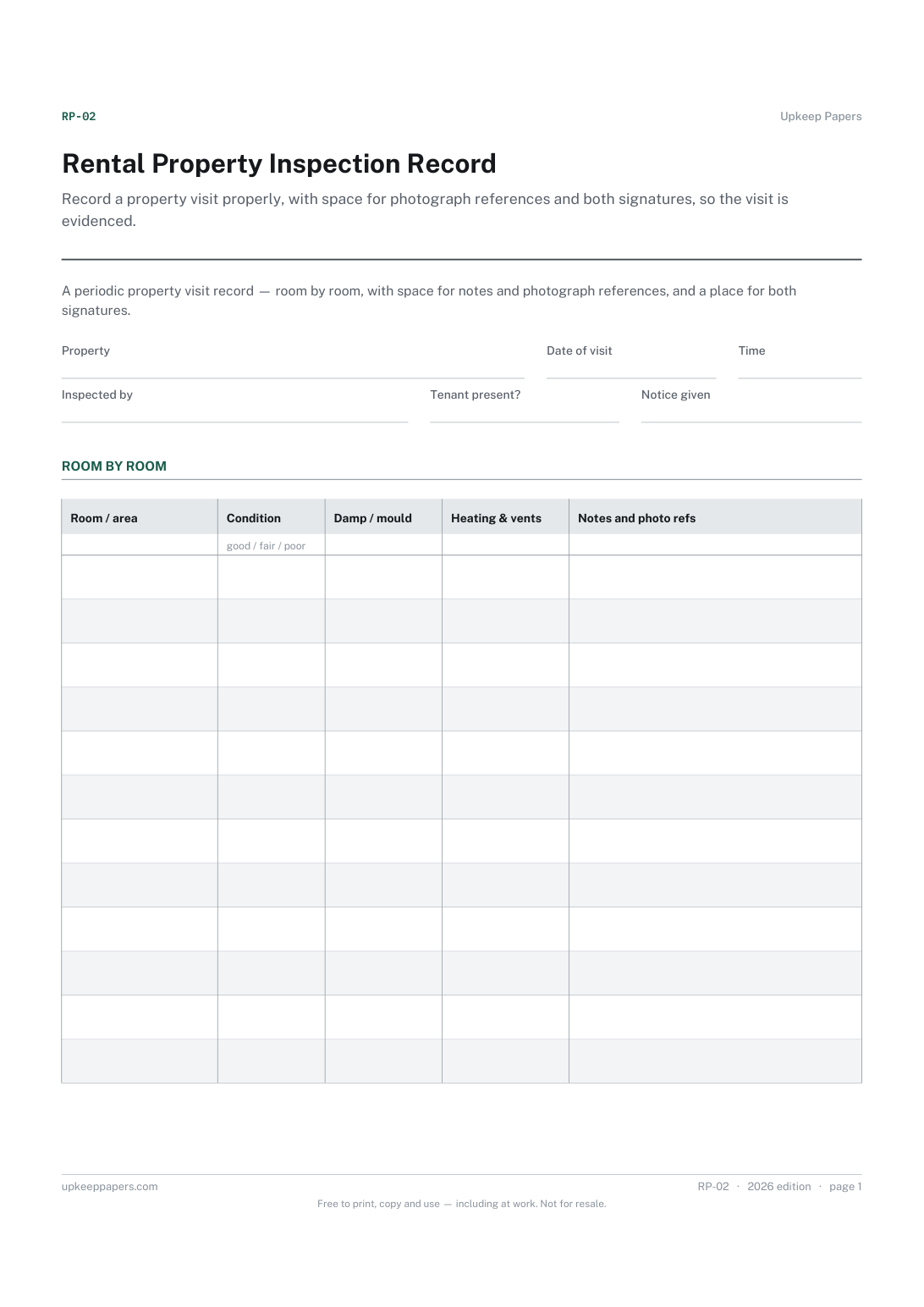
Rental Property Inspection Record
Record a property visit properly, with space for photograph references and both signatures, so the visit is evidenced.
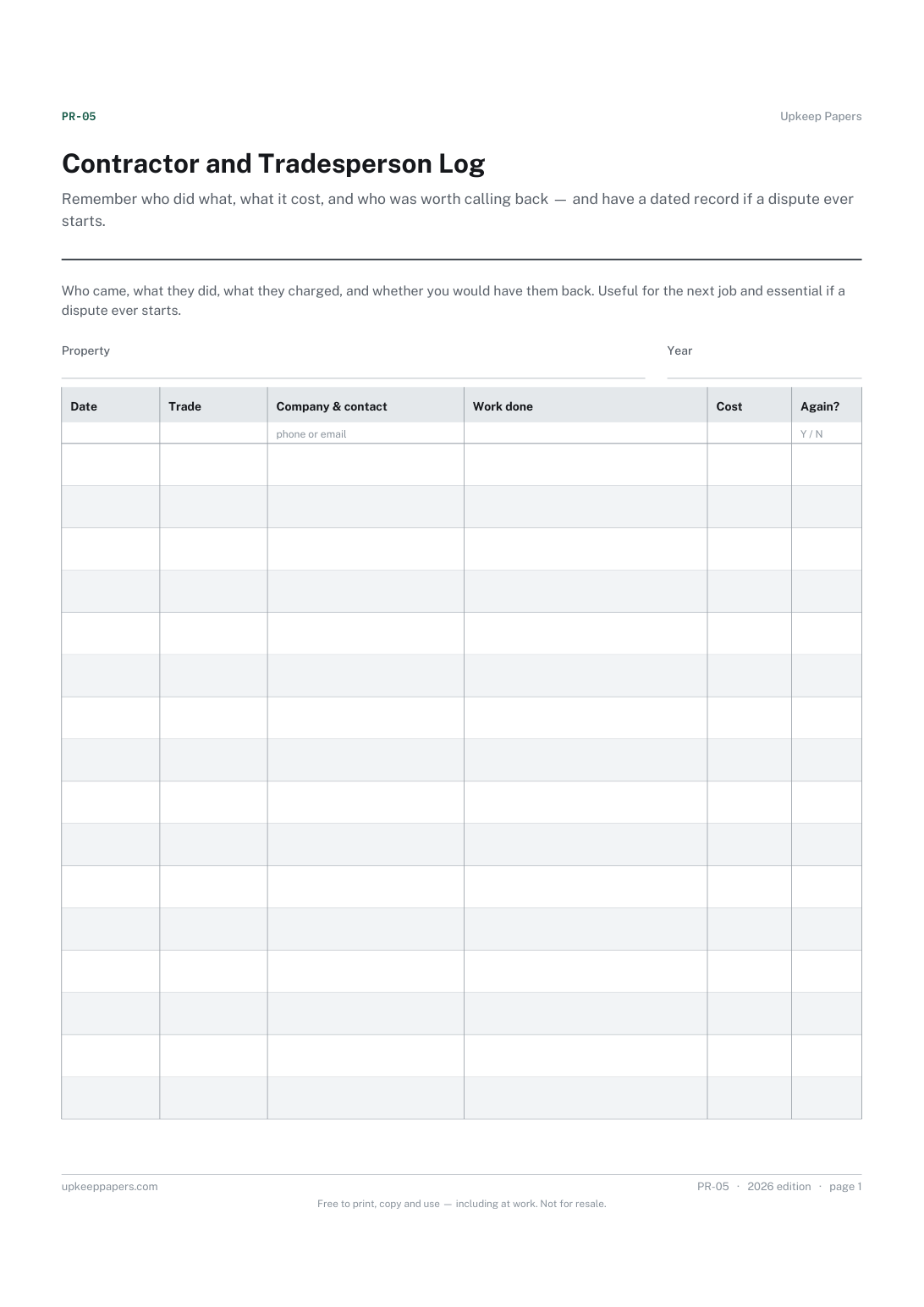
Contractor and Tradesperson Log
Remember who did what, what it cost, and who was worth calling back — and have a dated record if a dispute ever starts.
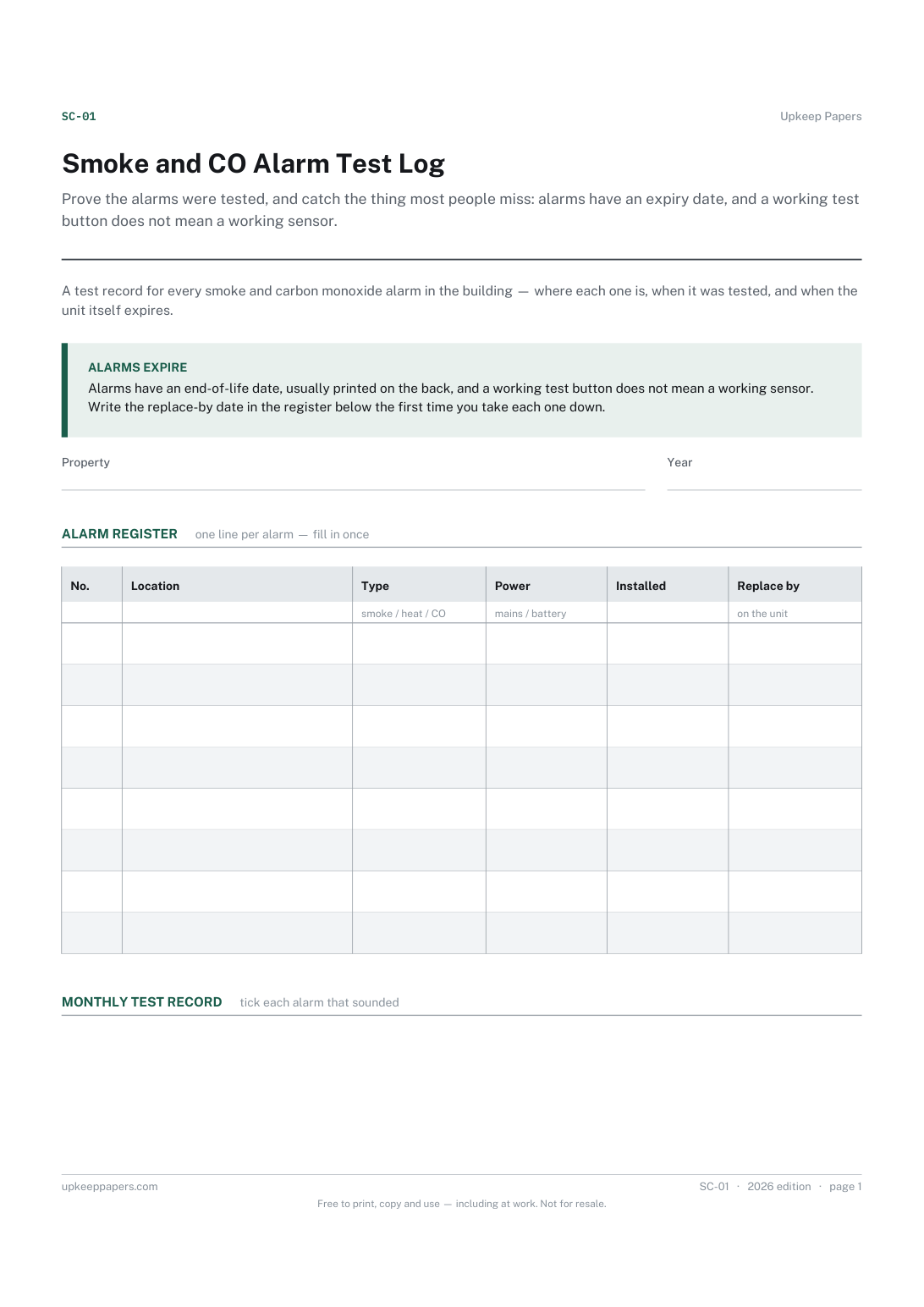
Smoke and CO Alarm Test Log
Prove the alarms were tested, and catch the thing most people miss: alarms have an expiry date, and a working test button does not mean a working sensor.
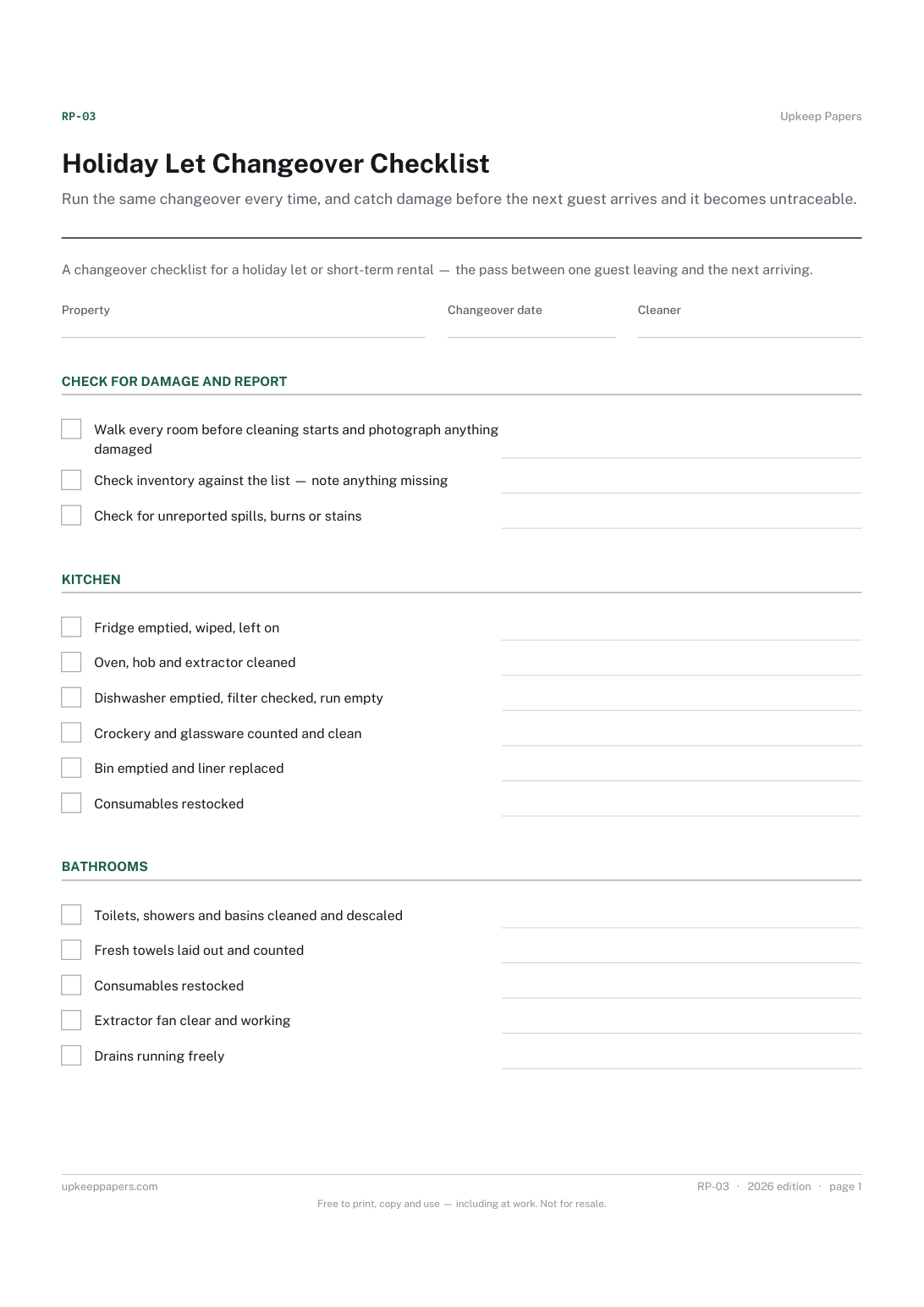
Holiday Let Changeover Checklist
Run the same changeover every time, and catch damage before the next guest arrives and it becomes untraceable.
More guides
How to Build a Home Maintenance Binder That Survives
A ring binder beats an app for house records, but most binders die within a year. The sections that work, what to file, and how to keep it alive.
Car Service History: What to Keep and Why
What a service history actually consists of, how stamped books and digital records differ, what a private buyer looks for, and how to handle gaps honestly.
Free Printable Blank Forms, Log Sheets and Record Sheets
Blank forms, log sheets, record sheets and checklists as free PDFs, every one laid out to print correctly on both A4 and US Letter.