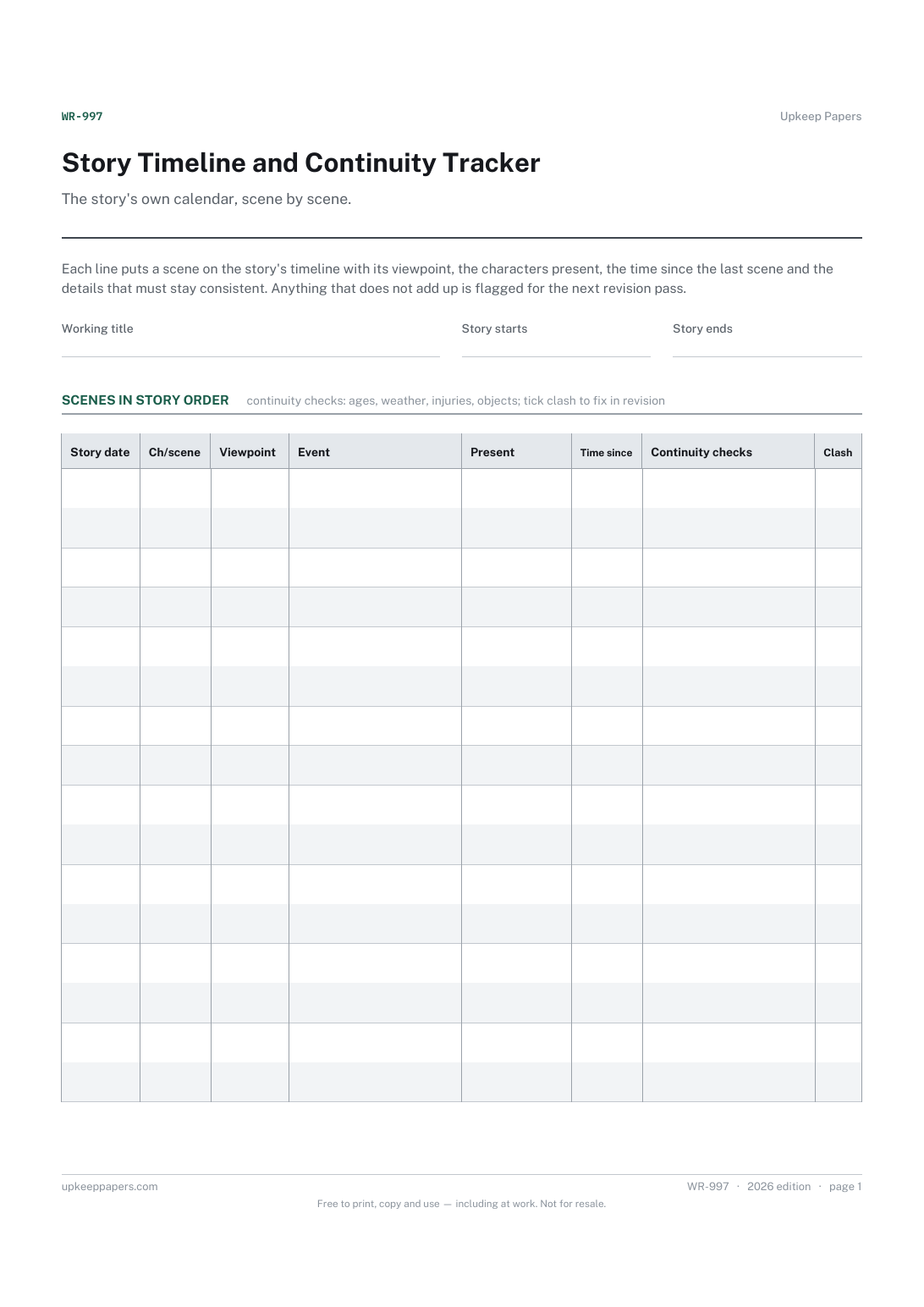
Story Timeline and Continuity Tracker
The order events happen in the story, not just on the page.
WR-997 Tracker PDF Online
Everything here is free. Making it takes time and money. Everything here is free.
 Buy us a coffee
Writing and Publishing · WR-983 · Log
Writing research log — every fact looked up for a book, its source, where it is used and whether it is verified, plus open questions. PDF and browser.
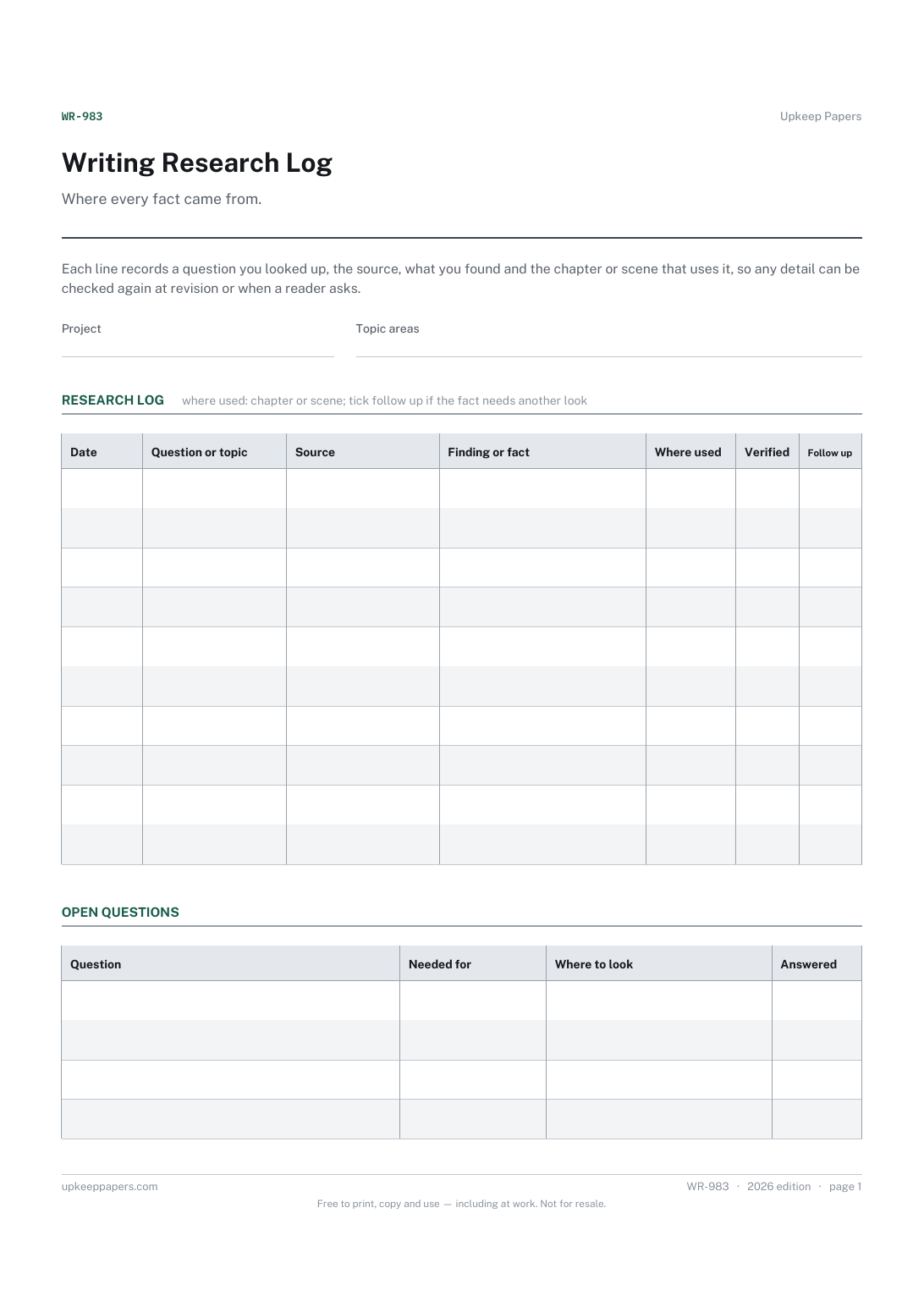
2 pages. The A4 and US Letter files are laid out identically, so neither is shrunk to fit.
Print it and write on it
Fillable PDF type and save
Or no download needed
Fill it in onlineThe fillable versions have real form fields — open them in any PDF reader, type into them and save. Printing help.
The same sheet, on screen. Tick, type, add or remove rows, then print it or download the completed version as a PDF. Everything stays in your browser — your entries are kept in this browser's own storage on this device, nothing is uploaded, and there is no account.
Where every fact came from. Each line records a question you looked up, the source, what you found and the chapter or scene that uses it, so any detail can be checked again at revision or when a reader asks.
Historical, crime and literary novelists, non-fiction authors, and anyone whose book leans on facts about places, periods, professions or procedures they had to look up.
The printable is laid out inside a box that fits both A4 and US Letter, so the two files are identical and neither one is scaled. The fillable PDF has real form fields. The online version keeps what you enter in your own browser and builds the completed PDF on your device.
Download the A4 or US Letter file to match the paper in your printer, open it in a PDF reader and print at 100% — not "fit to page", which shrinks the writing space. Both files leave a 14 mm margin, which clears the unprintable edge on home printers. To print the online version with your entries in it, use the Print this sheet button, which prints only the sheet and none of the page around it. More on printing.
Enough to find it again in a year: author, title and page for a book, the full address and date seen for a web page, the name and date for a conversation. A vague source is almost as bad as none.
Whatever standard you set for your book. Many writers tick it when a second, independent source agrees. The sheet does not set a rule; it gives you a column to record your own.
So a gap in your knowledge does not stop the draft. Note the question, keep writing and come back to the list in a research session. Answered questions move into the log.
Yes. The log suits any book built on research. Sources for family records are often worth recording in more detail, with reference numbers, so another researcher can find them.
The order events happen in the story, not just on the page.
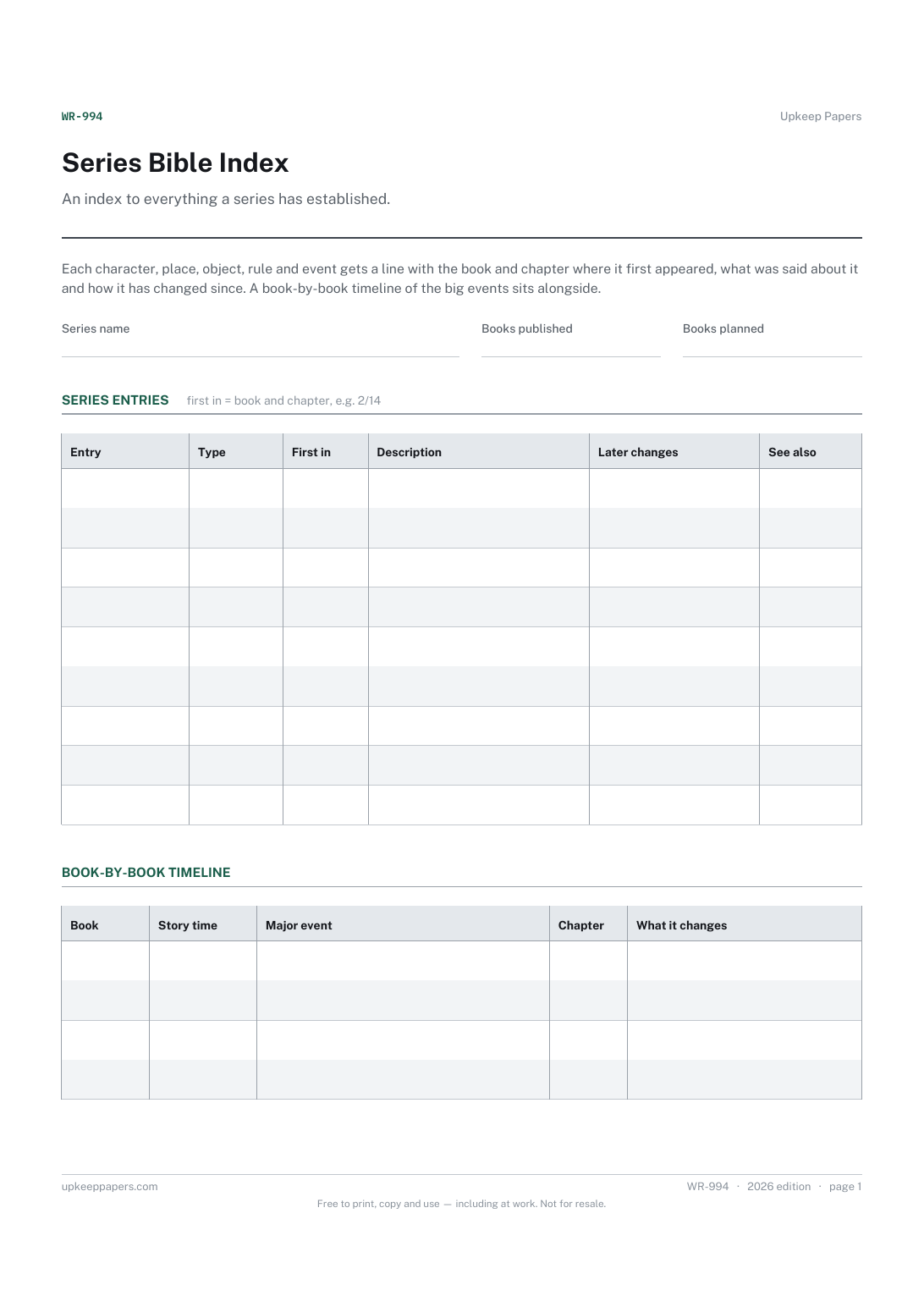
Where each character, place, object and rule was first established.
Printable sheets, workbooks and tools on the same subject.
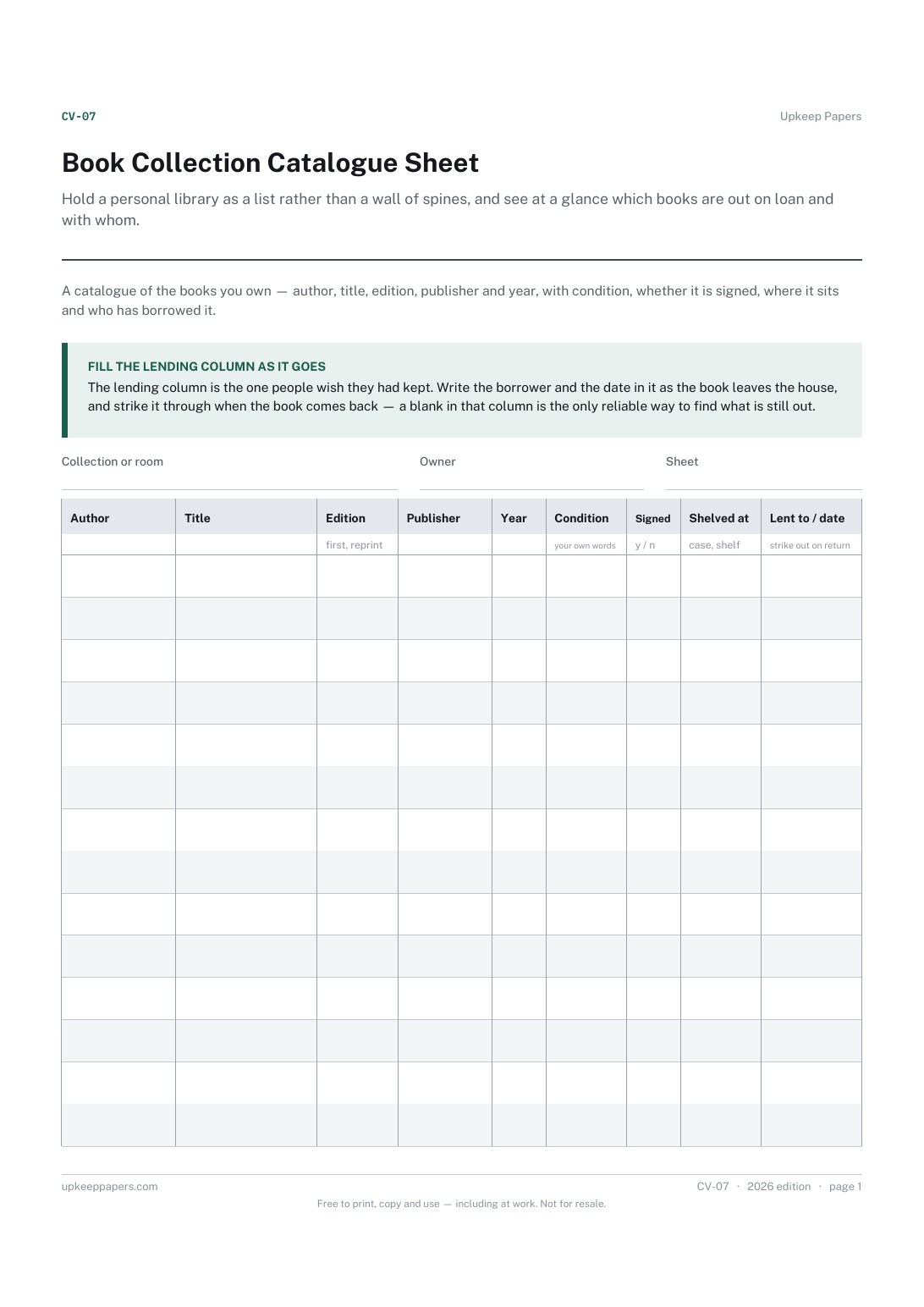
Hold a personal library as a list rather than a wall of spines, and see at a glance which books are out on loan and with whom.

Every sheet, binder, game and puzzle on Upkeep Papers is free to download, with no email and no account. Making them is not free: each one takes days of research, design and checking, and the site costs money to run. If something here saved you time, you can buy us a coffee. It is entirely optional: nothing is locked, and nothing changes if you don’t.
Buy us a coffee Opens PayPal in a new tab. Any amount, and nothing changes if you would rather not.