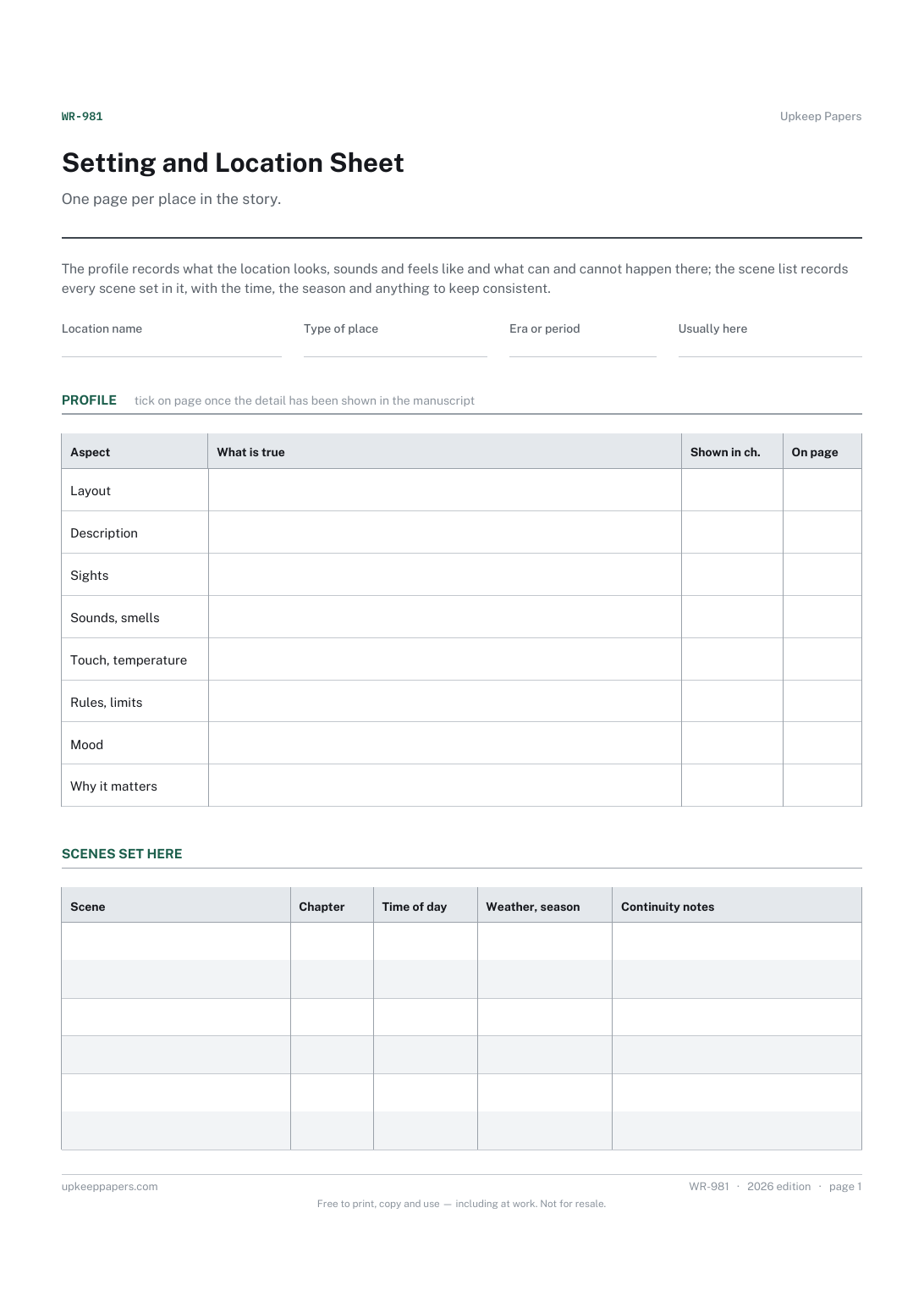
Setting and Location Sheet
The layout and description of a place, in one reference.
WR-981 Form PDF Online
Everything here is free. Making it takes time and money. Everything here is free.
 Buy us a coffee
Writing and Publishing · WR-980 · Form
Character profile sheet for writers — appearance, voice, background, wants, fears and arc, plus a list of facts stated in the text. PDF and browser.
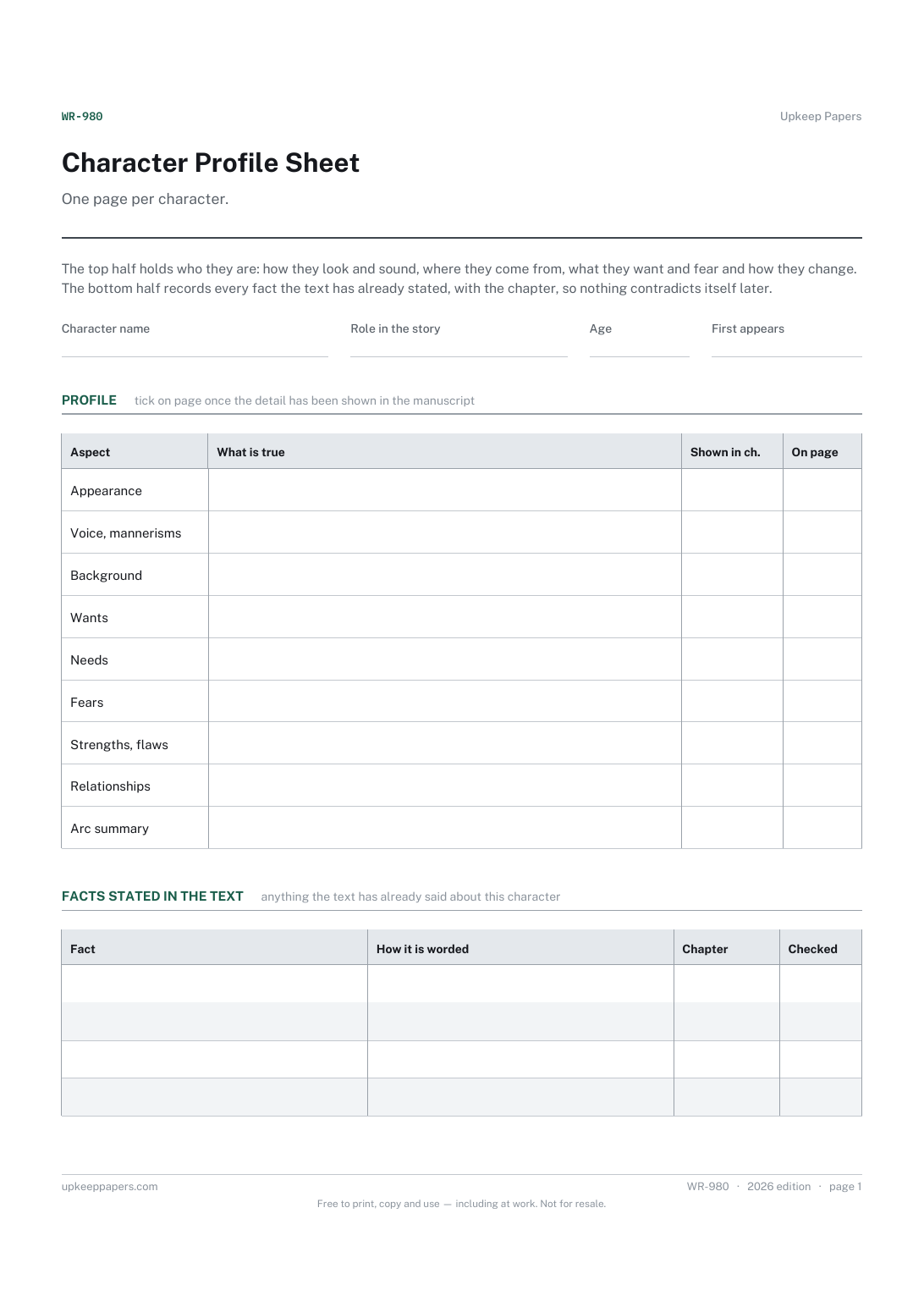
One page. The A4 and US Letter files are laid out identically, so neither is shrunk to fit.
Print it and write on it
Fillable PDF type and save
Or no download needed
Fill it in onlineThe fillable versions have real form fields — open them in any PDF reader, type into them and save. Printing help.
The same sheet, on screen. Tick, type, add or remove rows, then print it or download the completed version as a PDF. Everything stays in your browser — your entries are kept in this browser's own storage on this device, nothing is uploaded, and there is no account.
One page per character. The top half holds who they are: how they look and sound, where they come from, what they want and fear and how they change. The bottom half records every fact the text has already stated, with the chapter, so nothing contradicts itself later.
Novelists and short story writers with more than a handful of characters, writers of series who need a character to stay the same across books, and anyone revising a draft written over a long time.
The printable is laid out inside a box that fits both A4 and US Letter, so the two files are identical and neither one is scaled. The fillable PDF has real form fields. The online version keeps what you enter in your own browser and builds the completed PDF on your device.
Download the A4 or US Letter file to match the paper in your printer, open it in a PDF reader and print at 100% — not "fit to page", which shrinks the writing space. Both files leave a 14 mm margin, which clears the unprintable edge on home printers. To print the online version with your entries in it, use the Print this sheet button, which prints only the sheet and none of the page around it. More on printing.
No. Some characters need a full profile and a walk-on needs only a name and a few facts. Fill what helps you write them and leave the rest; the facts table is the part worth keeping up for everyone.
A common way of thinking about character: what they are consciously chasing, and what would actually change them. They are separate lines so you can see where the two pull against each other. Use them only if the idea helps.
Because continuity errors usually come from details written months apart. A list of what the text has already said, and where, is quicker to check than rereading the whole manuscript.
Yes. Use the facts table to record what you have stated and where, alongside the research log for where each fact came from.
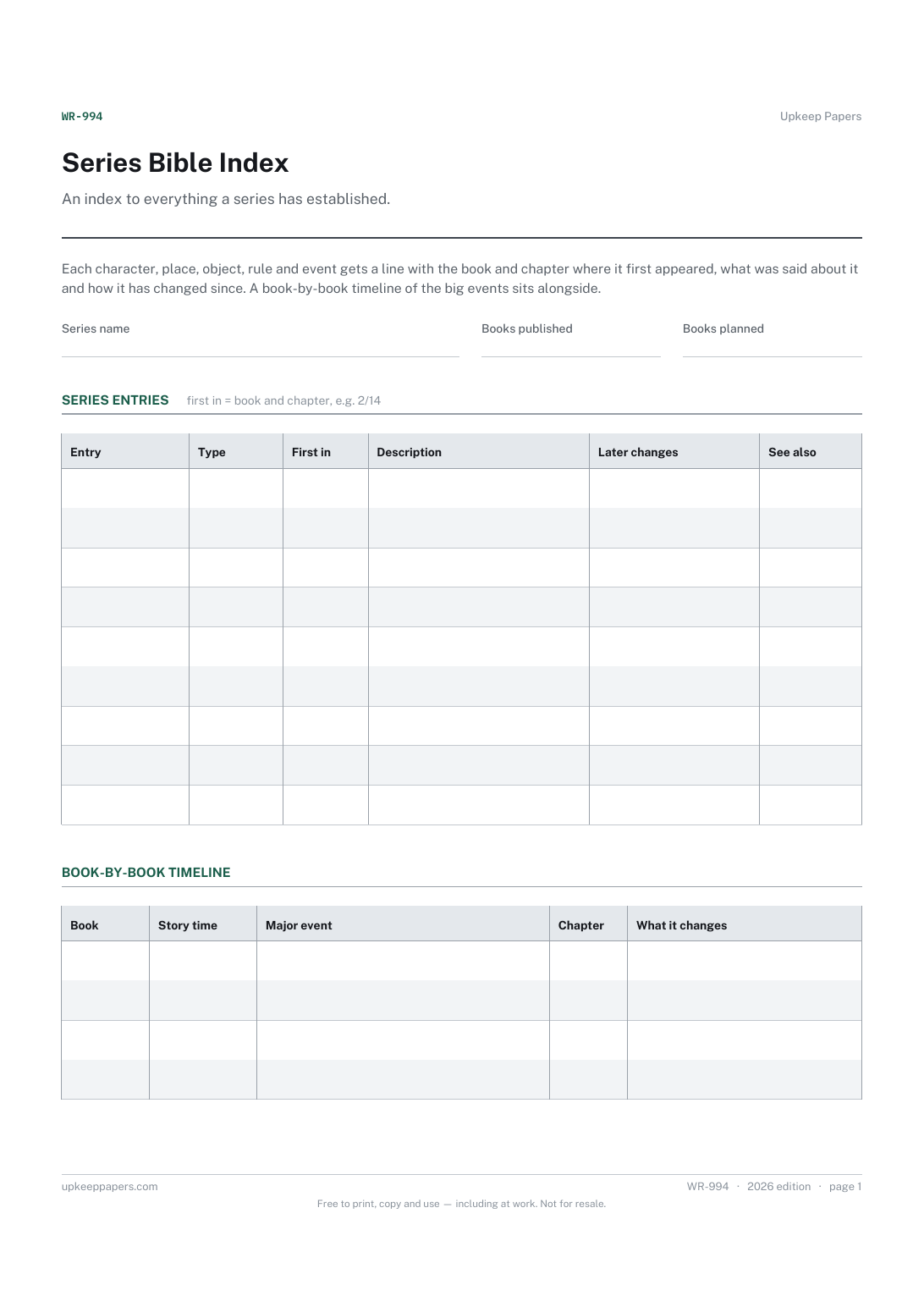
The layout and description of a place, in one reference.
Where each character, place, object and rule was first established.
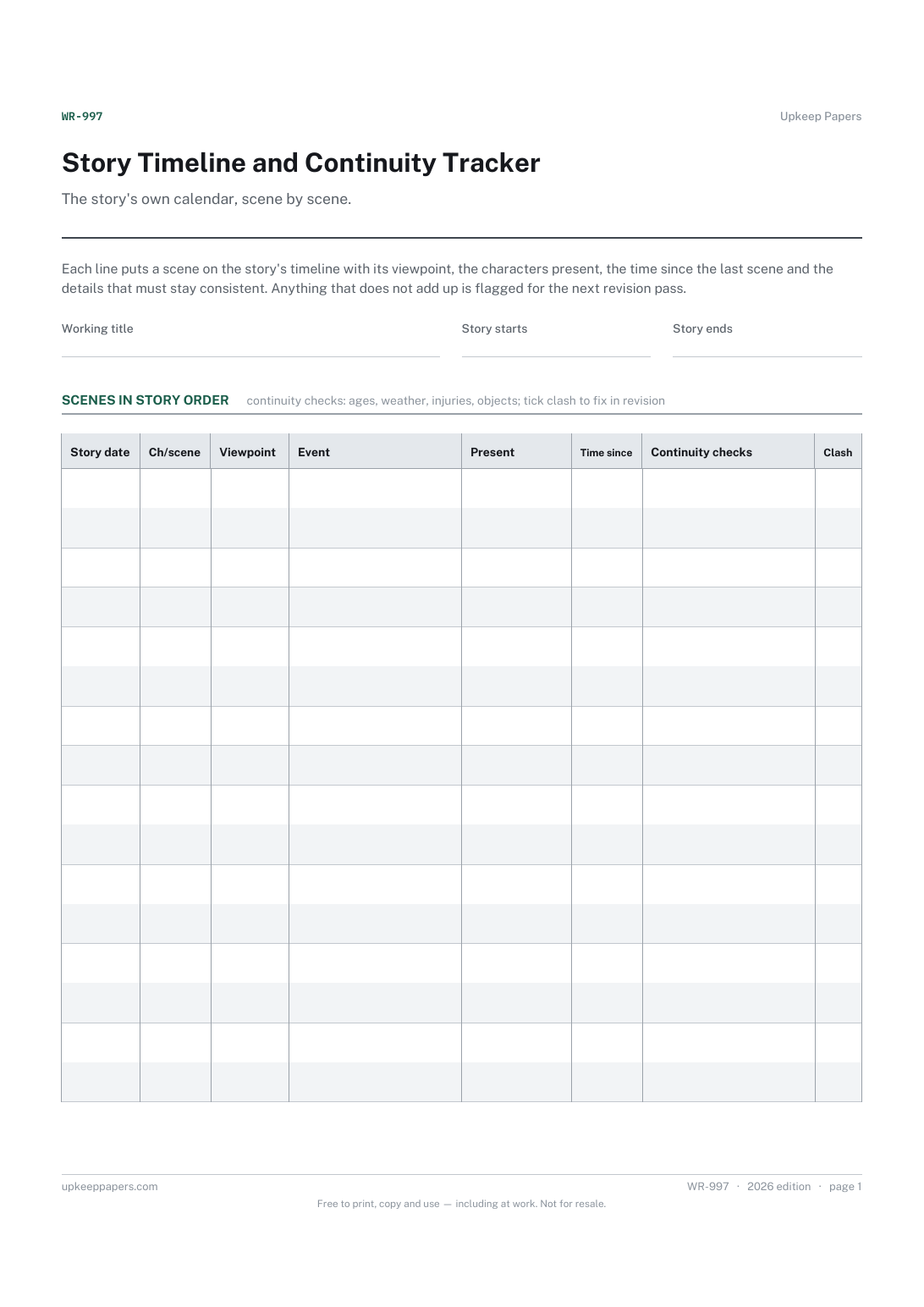
The order events happen in the story, not just on the page.
Printable sheets, workbooks and tools on the same subject.
Print ruled paper when the pad has run out, in a form that suits a folder as well as a desk.

Every sheet, binder, game and puzzle on Upkeep Papers is free to download, with no email and no account. Making them is not free: each one takes days of research, design and checking, and the site costs money to run. If something here saved you time, you can buy us a coffee. It is entirely optional: nothing is locked, and nothing changes if you don’t.
Buy us a coffee Opens PayPal in a new tab. Any amount, and nothing changes if you would rather not.