Mortgage Overpayment Calculator
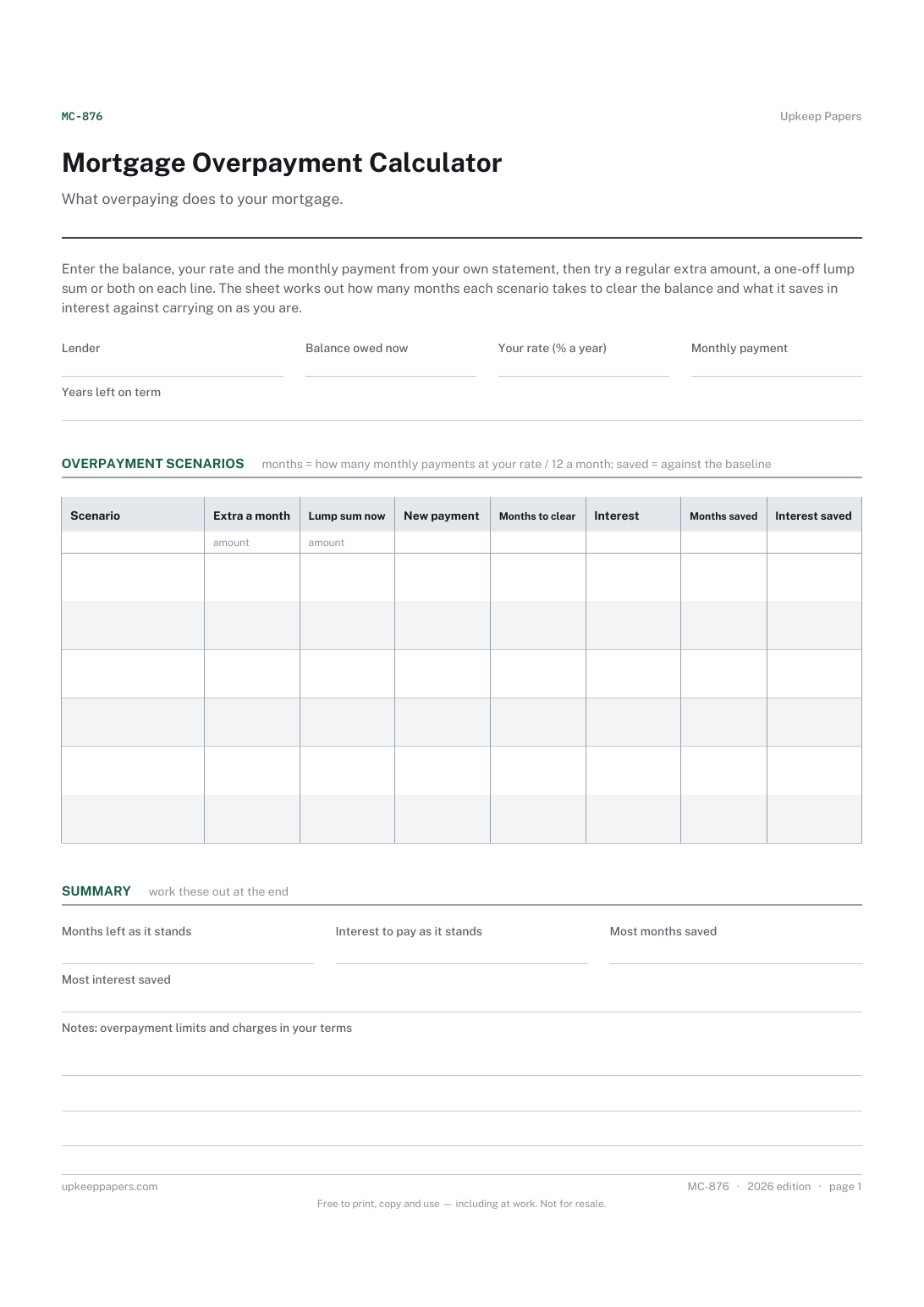
How many months the mortgage has left if nothing changes.
MC-876 Form PDF Excel Online
Everything here is free. Making it takes time and money. Everything here is free.
 Buy us a coffee
Money Calculators and Worksheets · MC-879 · Form
Rent vs buy worksheet: the monthly and one-off costs of renting and of buying a similar home, totalled over your chosen period. PDF, Excel and browser.
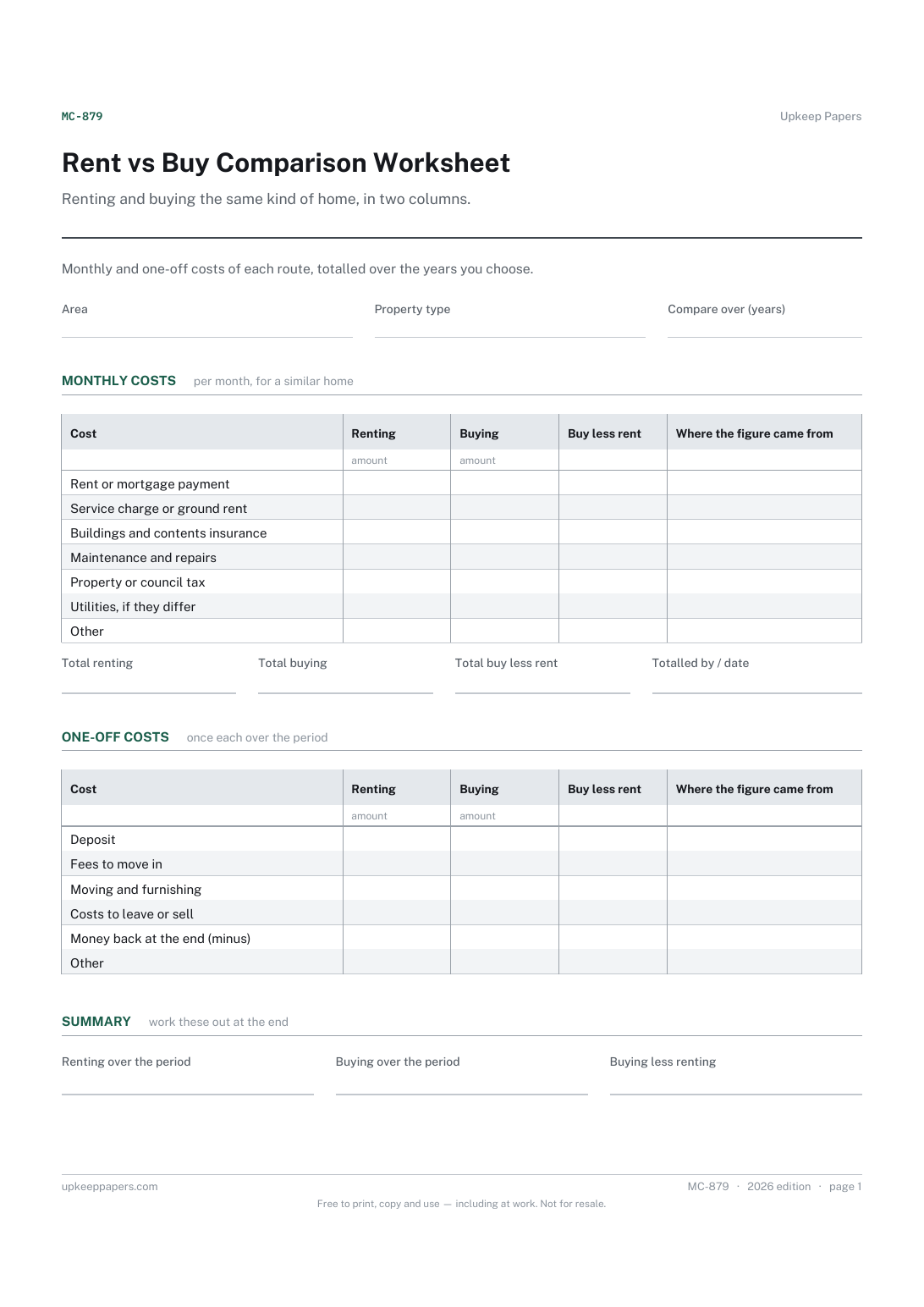
One page. The A4 and US Letter files are laid out identically, so neither is shrunk to fit.
Print it and write on it
Fillable PDF type and save
Spreadsheet formulas included
The fillable versions have real form fields — open them in any PDF reader, type into them and save. Printing help.
The same sheet, on screen. Totals and figures are worked out as you type, rows can be added or removed, and you can print it or download the completed version as a PDF. Everything stays in your browser — your entries are kept in this browser's own storage on this device, nothing is uploaded, and there is no account.
Renting and buying the same kind of home, in two columns. The monthly costs go in one table and the one-off costs of getting in and getting out go in another, and the sheet totals each side over the number of years you choose. The difference is what one route costs against the other on your own figures.
Households deciding whether to keep renting or buy, first-time buyers testing the numbers on a particular area, and anyone comparing a move to rent against buying where they are.
The printable is laid out inside a box that fits both A4 and US Letter, so the two files are identical and neither one is scaled. The fillable PDF has real form fields. The workbook uses plain formulas only — SUM, IF, COUNTIF and the like — so it opens in Excel, LibreOffice and Google Sheets without anything breaking, and every calculated cell is grey so you can see which figures it worked out.
Download the A4 or US Letter file to match the paper in your printer, open it in a PDF reader and print at 100% — not "fit to page", which shrinks the writing space. Both files leave a 14 mm margin, which clears the unprintable edge on home printers. To print the online version with your entries in it, use the Print this sheet button, which prints only the sheet and none of the page around it. More on printing.
Because it reduces what the route costs you overall. For buying, it is roughly what you would keep after selling and repaying the mortgage; for renting, the deposit returned. Entering it as a minus lets the totals net it off.
From you: rents from local listings, a mortgage payment from a quote, insurance from real quotes and your own allowance for repairs. The sheet supplies no prices or values, and the answer is only as good as the figures entered.
No. What you expect a home to be worth at the end is your own estimate, entered in the money back row. Try a cautious figure and a hopeful one on two sheets to see how much the answer depends on it.
No. It is arithmetic on your own figures. Things it cannot weigh, such as security of tenure or flexibility to move, need weighing alongside the totals.
How many months the mortgage has left if nothing changes.
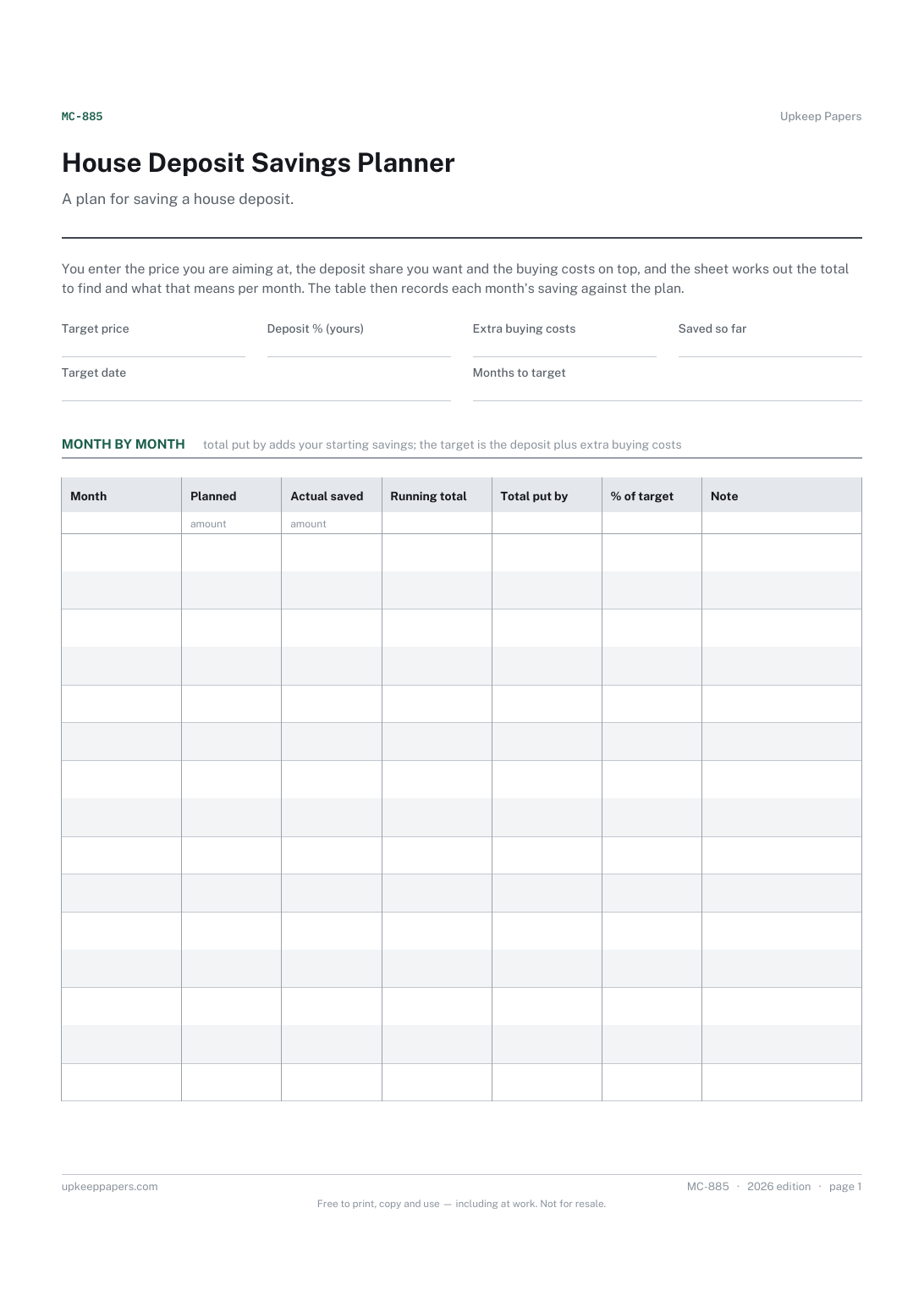
The deposit a target price needs at the share you have chosen.
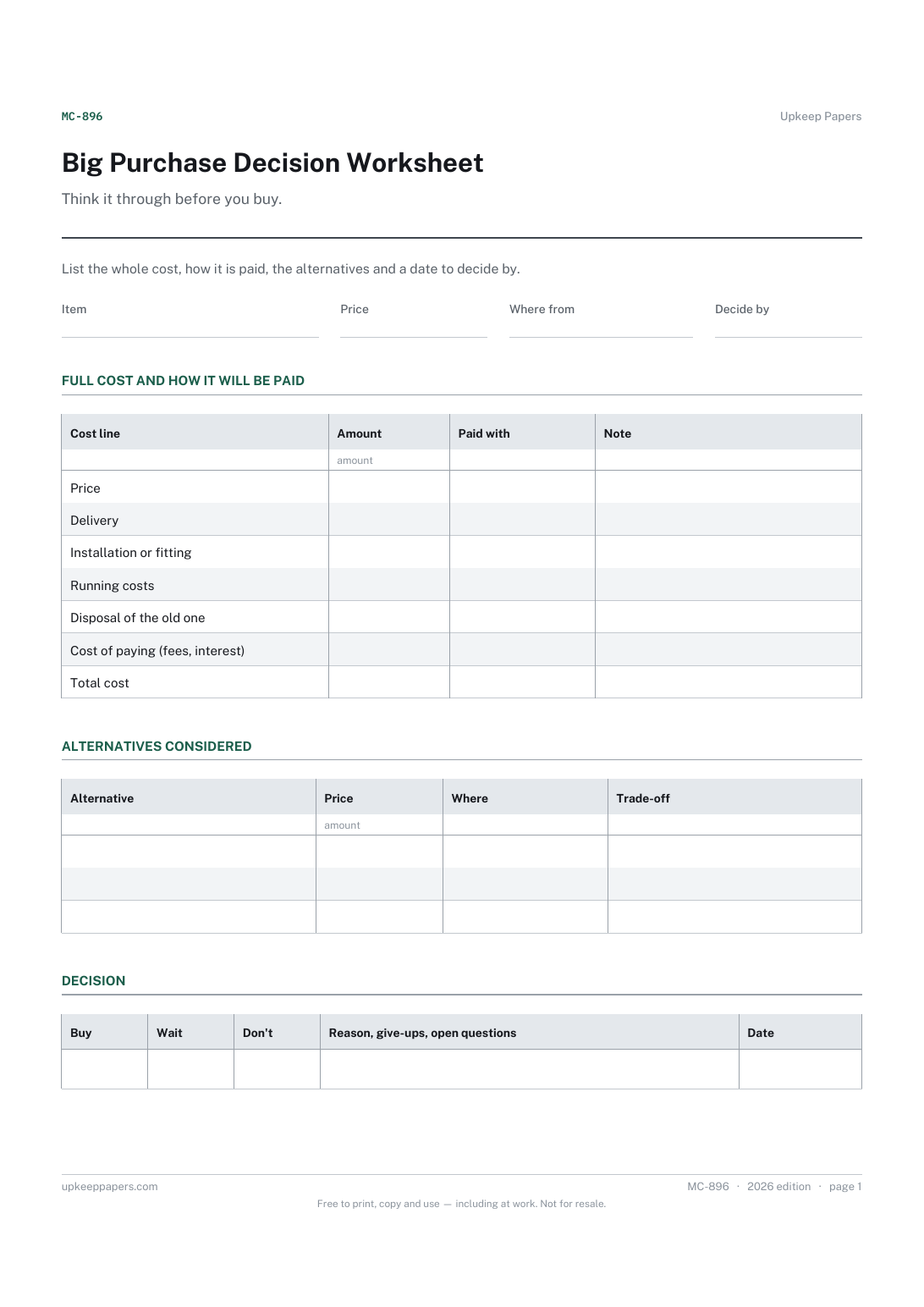
The full cost: price, delivery, fitting, running costs and disposal.
Printable sheets, workbooks and tools on the same subject.
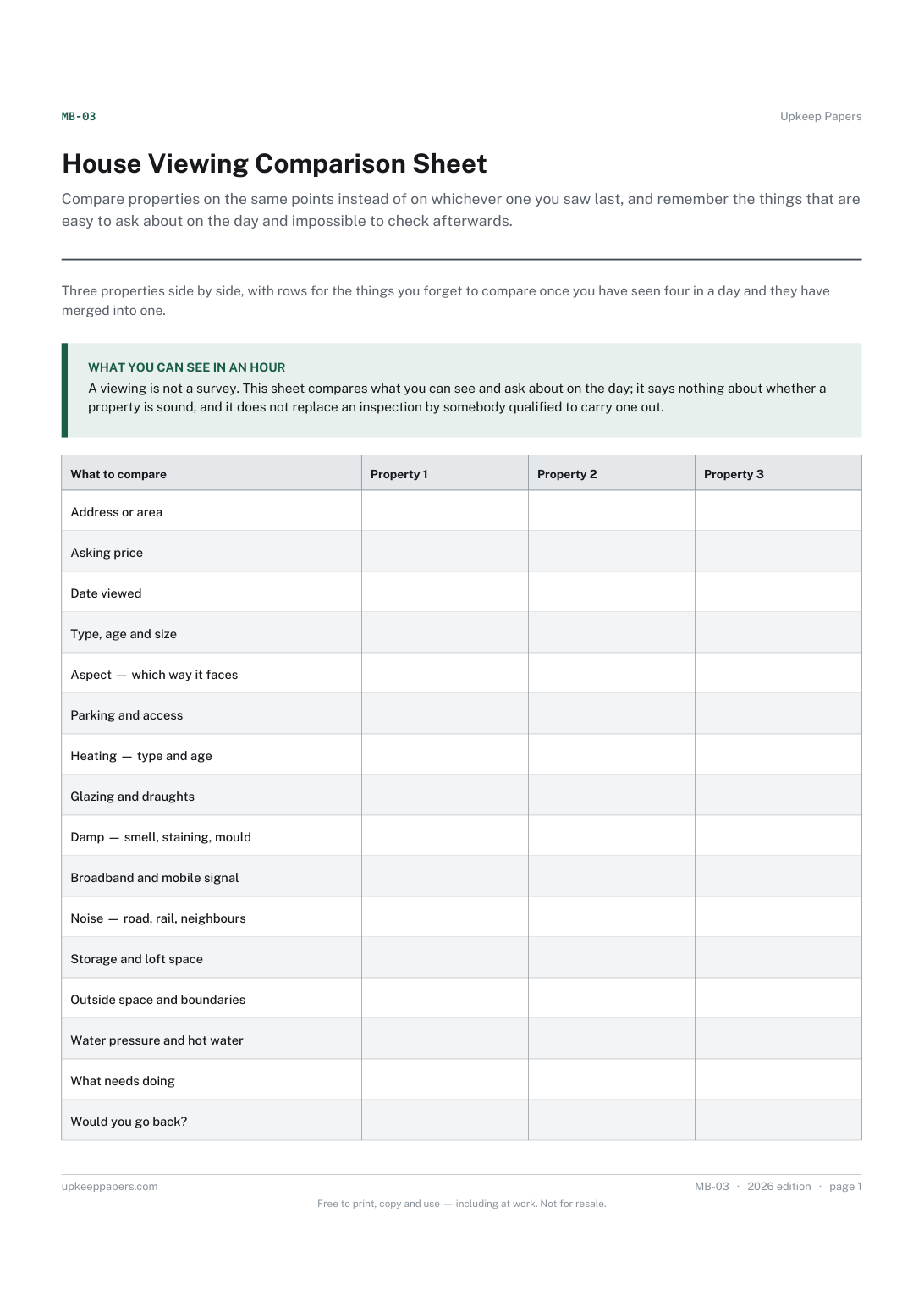
Compare properties on the same points instead of on whichever one you saw last, and remember the things that are easy to ask about on the day and impossible to check afterwards.
A monthly budget that adds up planned against actual, keeps income, outgoings and saving apart, and rolls twelve months into a year view.

Every sheet, binder, game and puzzle on Upkeep Papers is free to download, with no email and no account. Making them is not free: each one takes days of research, design and checking, and the site costs money to run. If something here saved you time, you can buy us a coffee. It is entirely optional: nothing is locked, and nothing changes if you don’t.
Buy us a coffee Opens PayPal in a new tab. Any amount, and nothing changes if you would rather not.