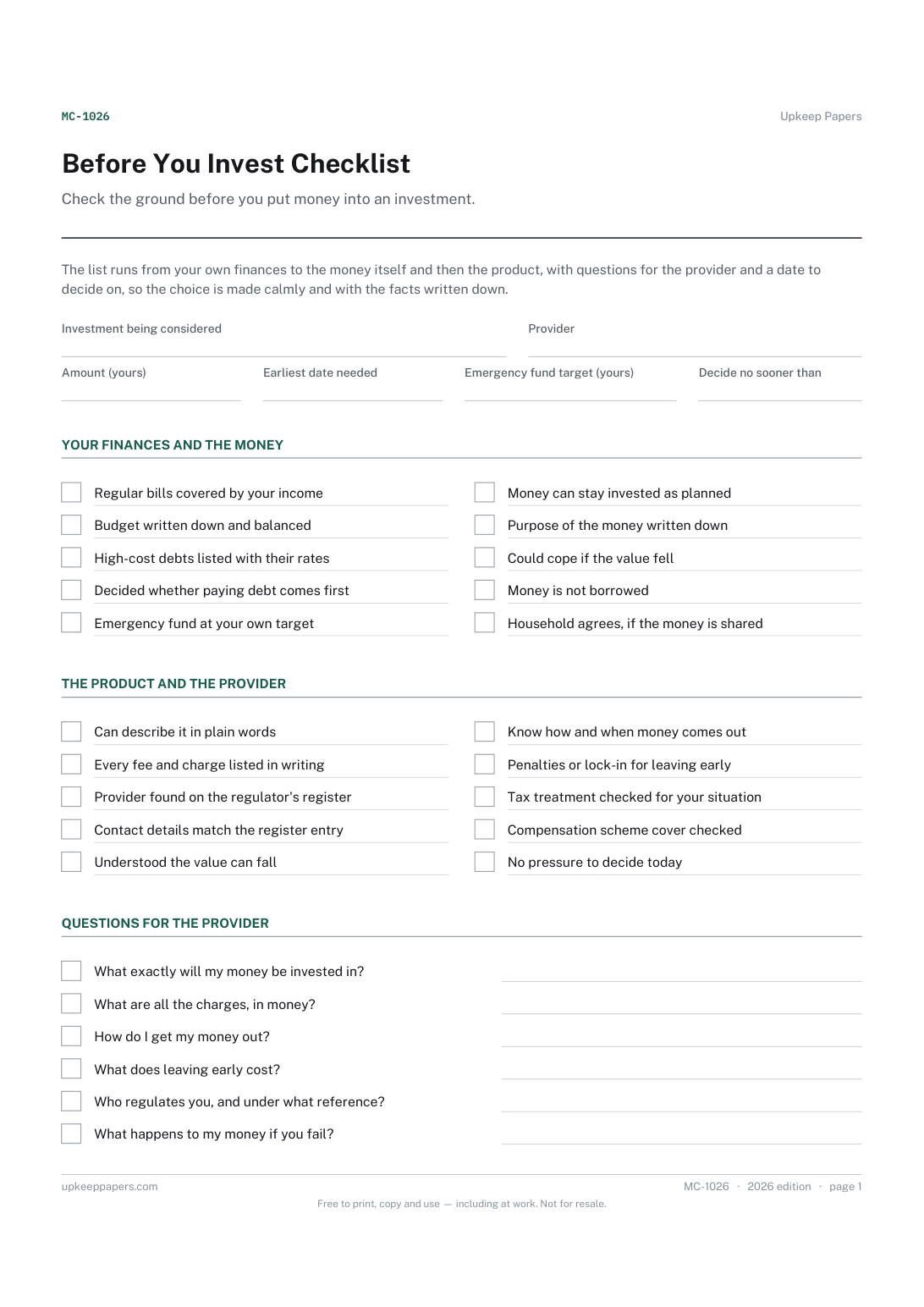
Before You Invest Checklist
Whether your budget, debts and emergency fund are where you want them.
MC-1026 Checklist PDF Online
Everything here is free. Making it takes time and money. Everything here is free.
 Buy us a coffee
Money Calculators and Worksheets · MC-1024 · Form
Investment fees comparison: every charge of up to four funds, plans or platforms applied to your own amount, for year one and over time. Excel, PDF, browser.
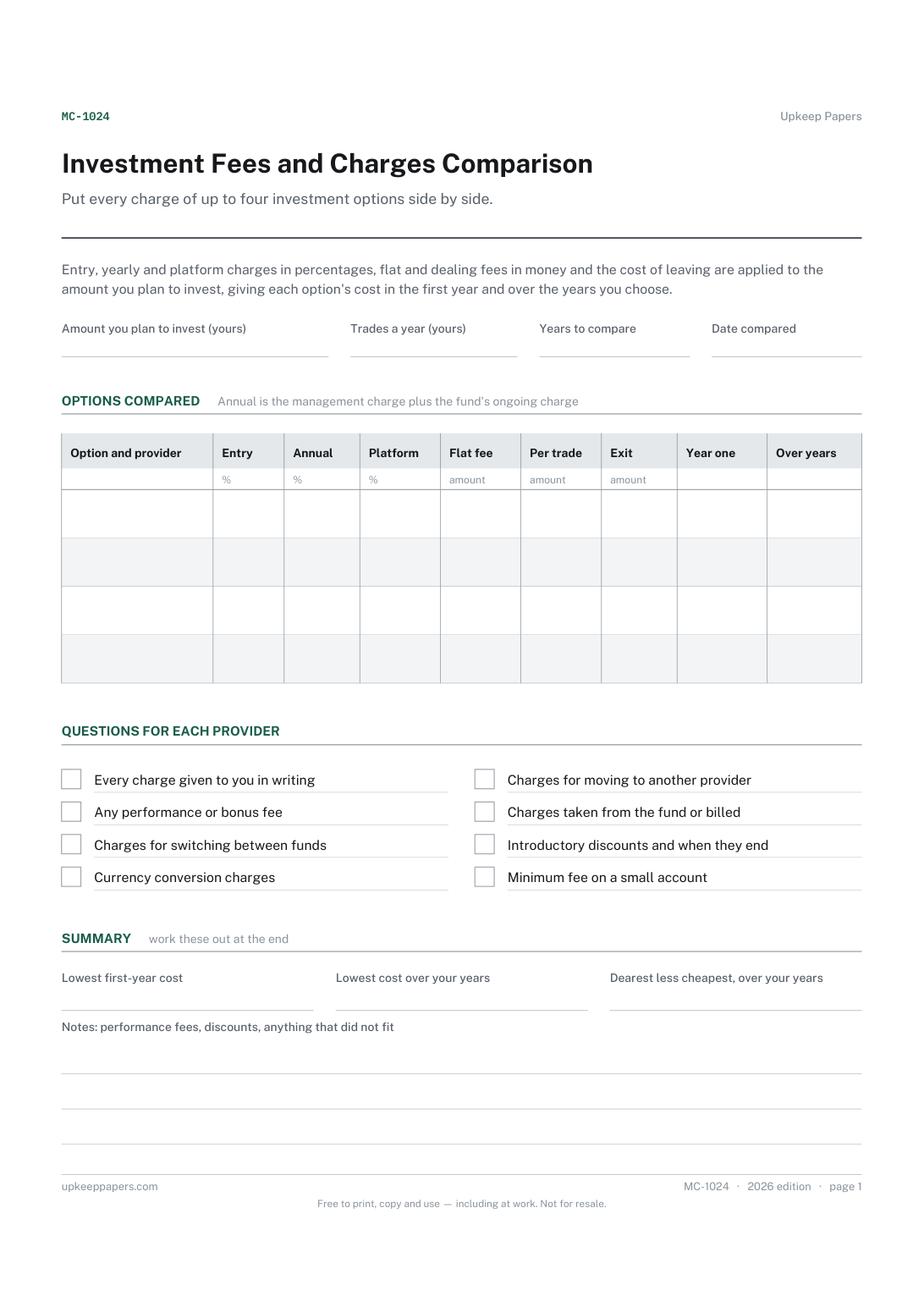
One page. The A4 and US Letter files are laid out identically, so neither is shrunk to fit.
Print it and write on it
Fillable PDF type and save
Spreadsheet formulas included
The fillable versions have real form fields — open them in any PDF reader, type into them and save. Printing help.
The same sheet, on screen. Totals and figures are worked out as you type, rows can be added or removed, and you can print it or download the completed version as a PDF. Everything stays in your browser — your entries are kept in this browser's own storage on this device, nothing is uploaded, and there is no account.
Put every charge of up to four investment options side by side. Entry, yearly and platform charges in percentages, flat and dealing fees in money and the cost of leaving are applied to the amount you plan to invest, giving each option's cost in the first year and over the years you choose.
Anyone choosing between investment funds, pension plans, platforms or other investment products, or checking whether one they already hold costs more than an alternative.
The printable is laid out inside a box that fits both A4 and US Letter, so the two files are identical and neither one is scaled. The fillable PDF has real form fields. The workbook uses plain formulas only — SUM, IF, COUNTIF and the like — so it opens in Excel, LibreOffice and Google Sheets without anything breaking, and every calculated cell is grey so you can see which figures it worked out.
Download the A4 or US Letter file to match the paper in your printer, open it in a PDF reader and print at 100% — not "fit to page", which shrinks the writing space. Both files leave a 14 mm margin, which clears the unprintable edge on home printers. To print the online version with your entries in it, use the Print this sheet button, which prints only the sheet and none of the page around it. More on printing.
Percentage charges rise and fall with the value, and future growth is not known, so the sheet applies them to the amount you enter. That keeps the comparison like for like; the real cost will differ once values change.
Entry is any initial or allocation charge, Annual the management charge plus the fund's ongoing charge, Platform any percentage account fee. Flat fee is a yearly fee in money, Per trade the dealing fee and Exit the cost of leaving.
The yearly cost of running a fund, taken from inside the fund rather than billed to you. It is shown in the fund's key information document, and because you never see it deducted it is easy to leave out of a comparison.
Not on its own. Cost is one part of the choice alongside what the investment holds, its risk and how and when you can get your money out. The sheet compares charges only and is not advice on which option to choose.
Whether your budget, debts and emergency fund are where you want them.
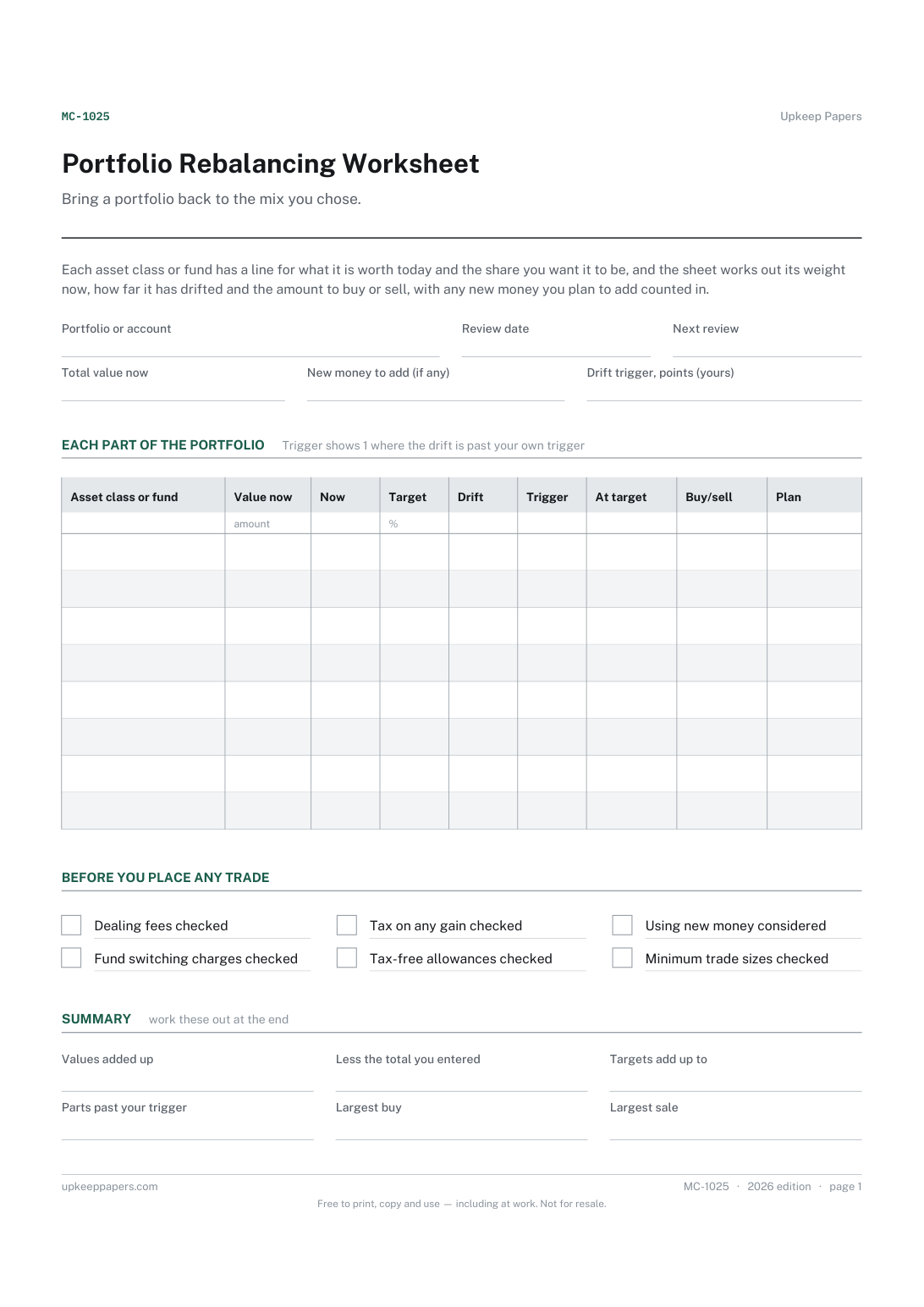
The value and current weight of each part of the portfolio.
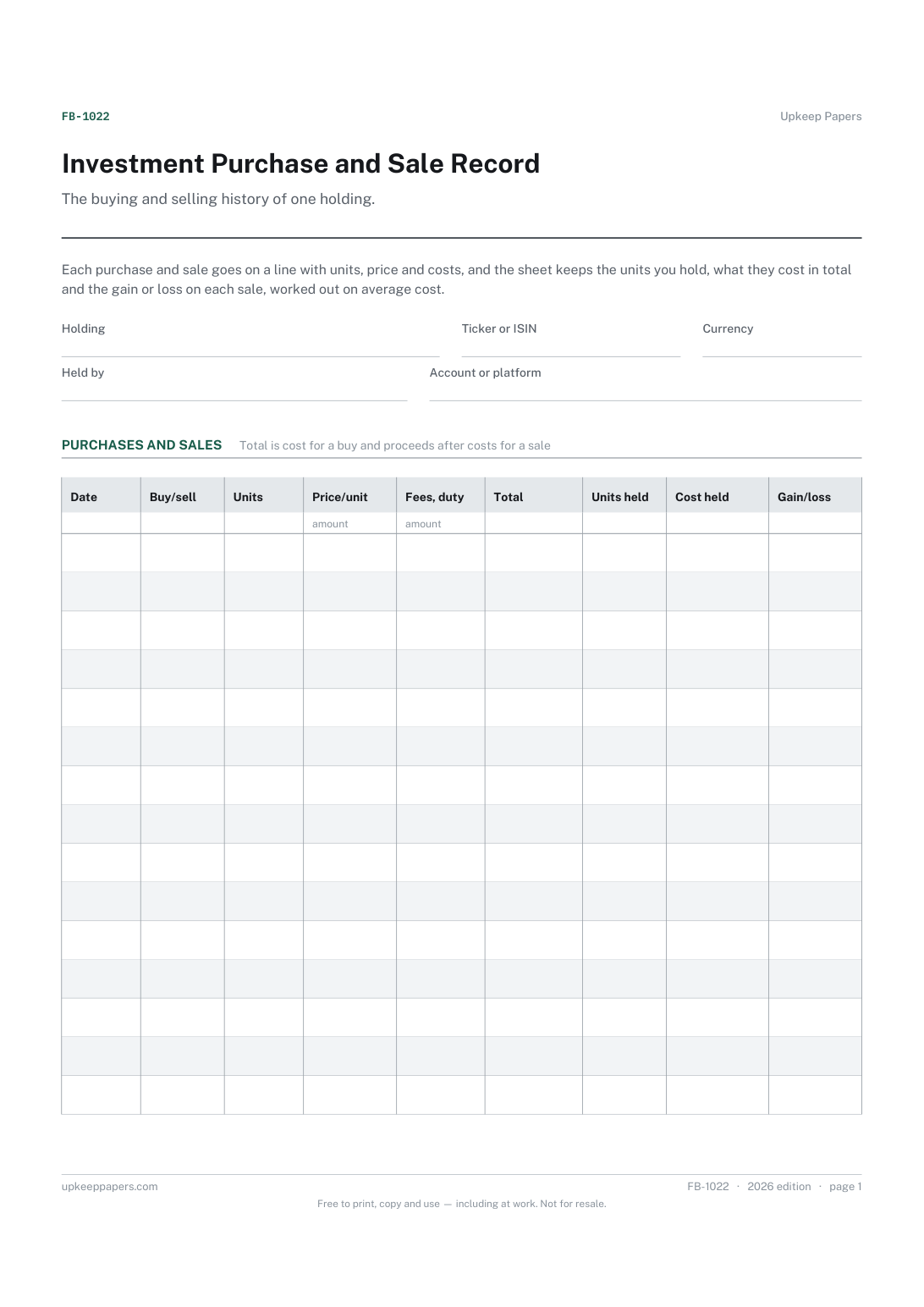
Every purchase and sale of one holding, with the date and price.
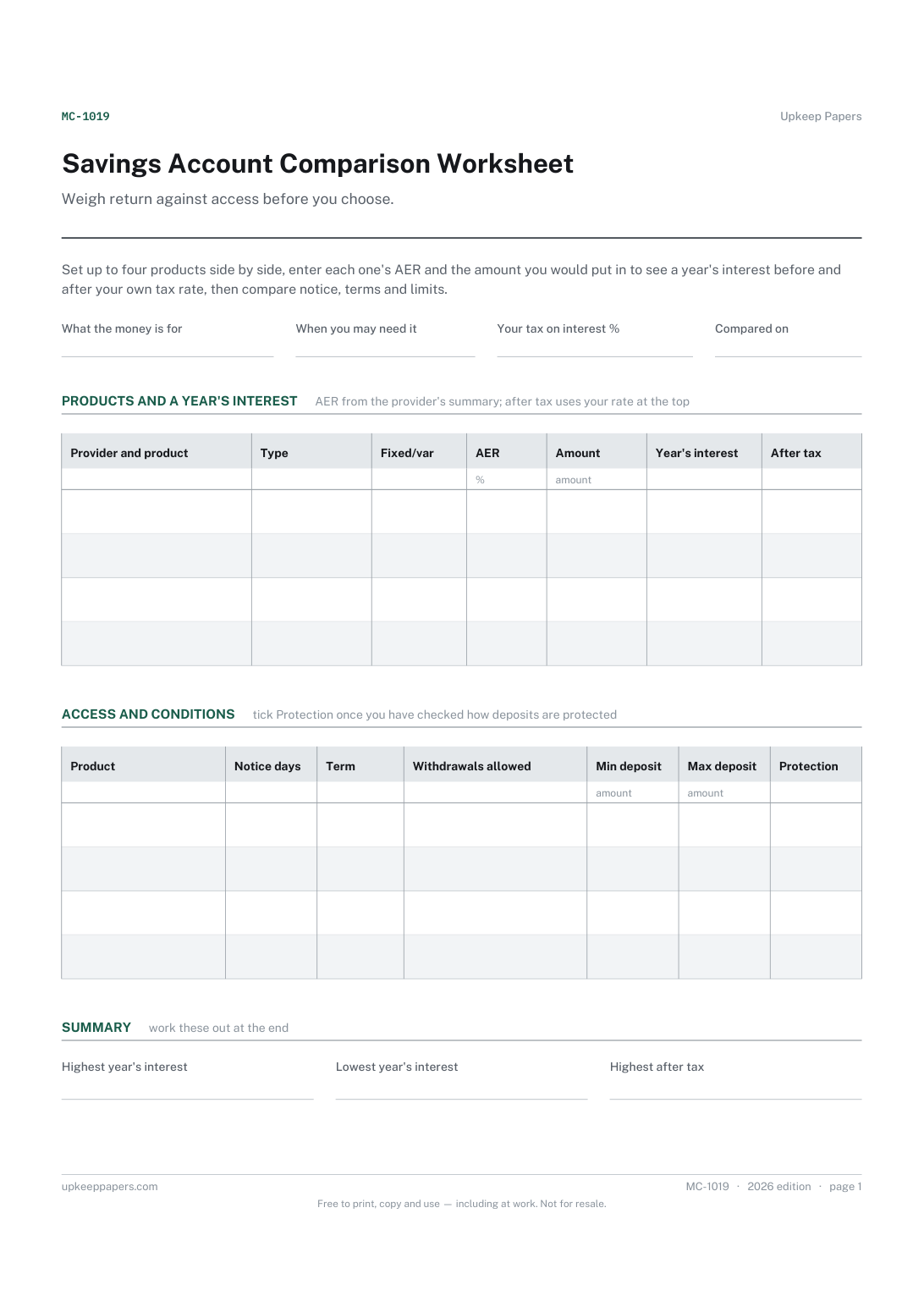
Each product's type, whether its rate is fixed or variable, and its AER.
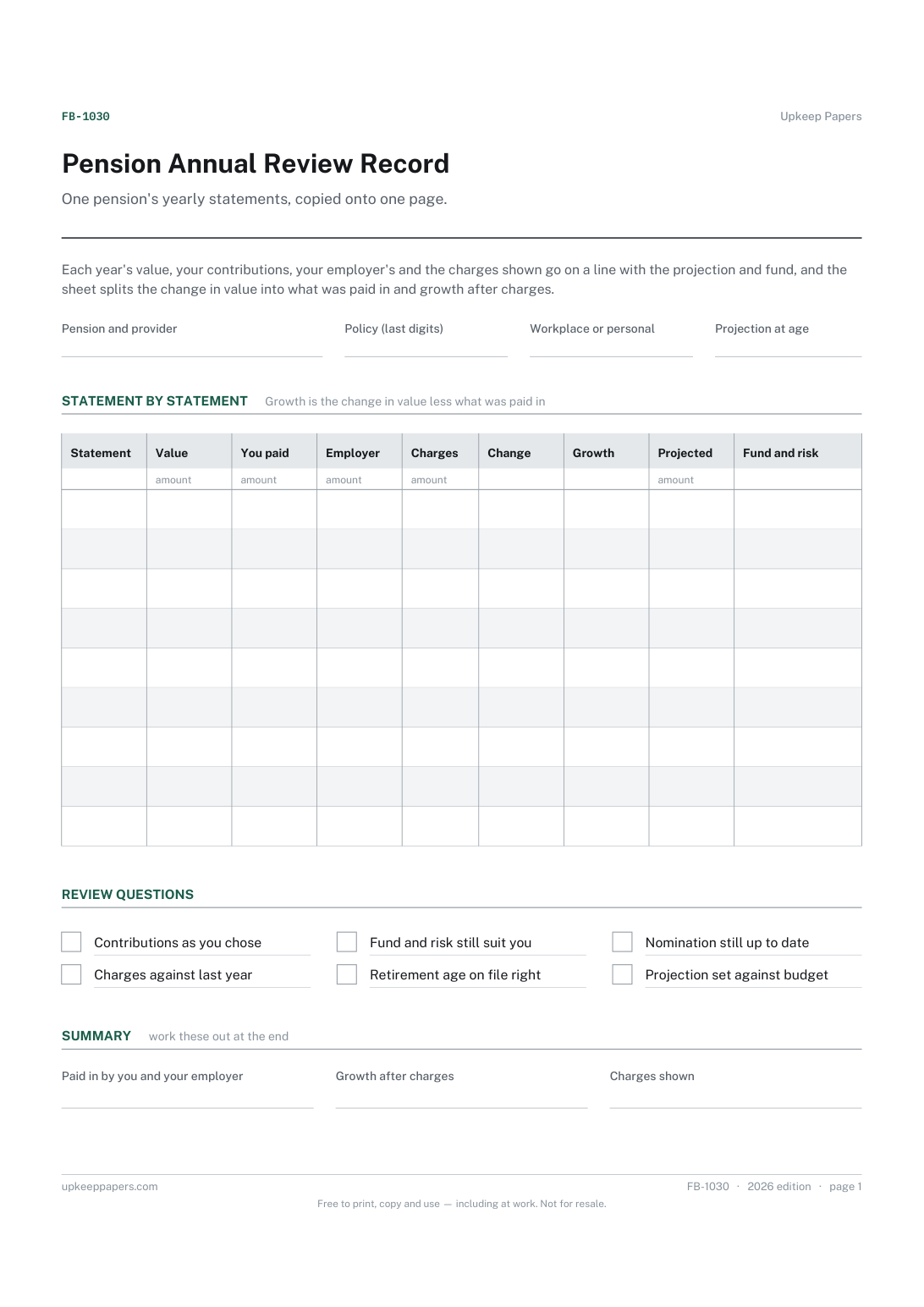
The value on each yearly statement, year after year.

Every sheet, binder, game and puzzle on Upkeep Papers is free to download, with no email and no account. Making them is not free: each one takes days of research, design and checking, and the site costs money to run. If something here saved you time, you can buy us a coffee. It is entirely optional: nothing is locked, and nothing changes if you don’t.
Buy us a coffee Opens PayPal in a new tab. Any amount, and nothing changes if you would rather not.