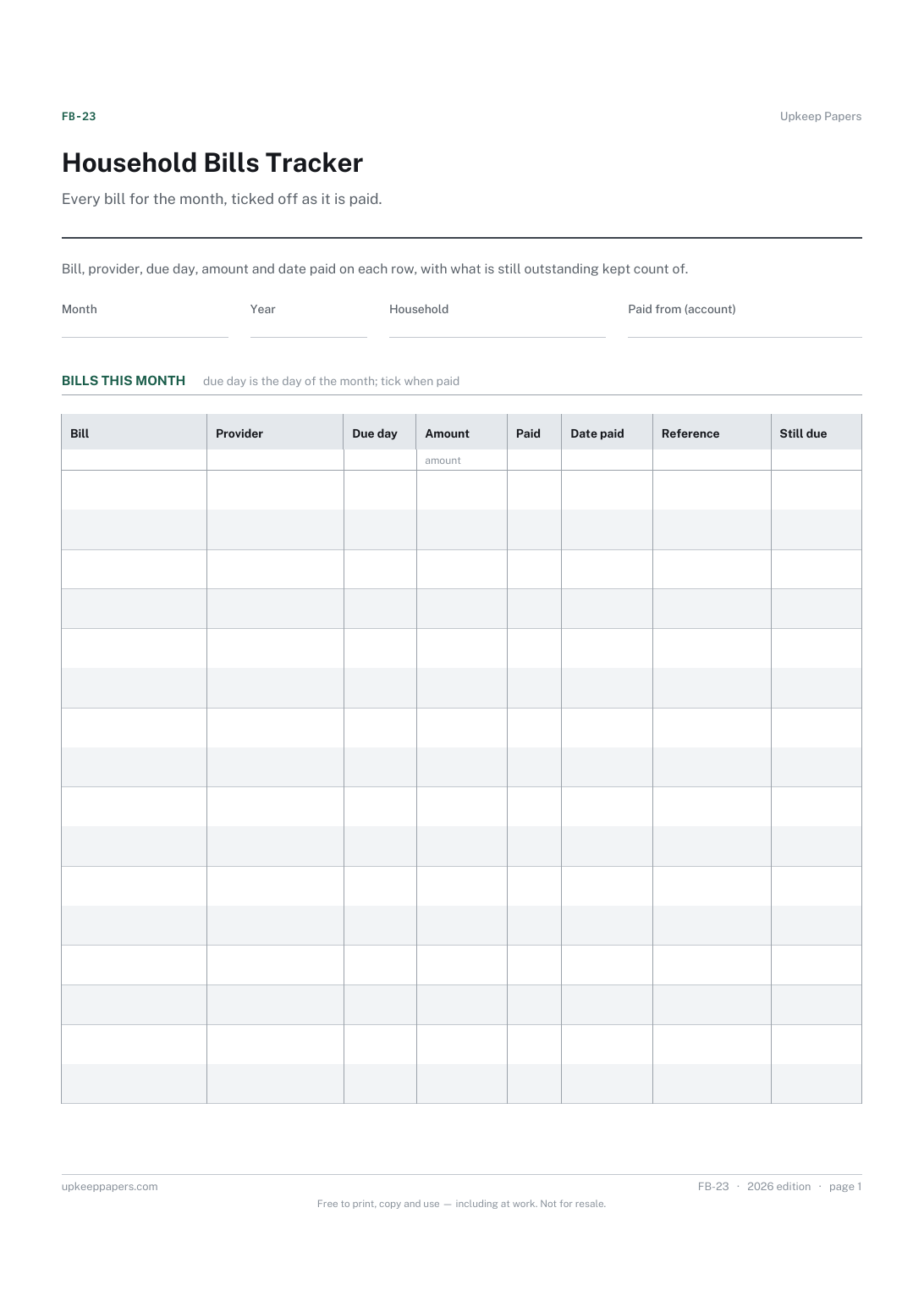
Household Bills Tracker
Which bills are due this month and on what day.
FB-23 Tracker PDF Excel Online
Everything here is free. Making it takes time and money. Everything here is free.
 Buy us a coffee
Logs and record sheets · LR-162 · Log
Free water usage log — meter readings with usage since the last read and cost at your own rate, plus supply problems. PDF, Excel and browser versions.
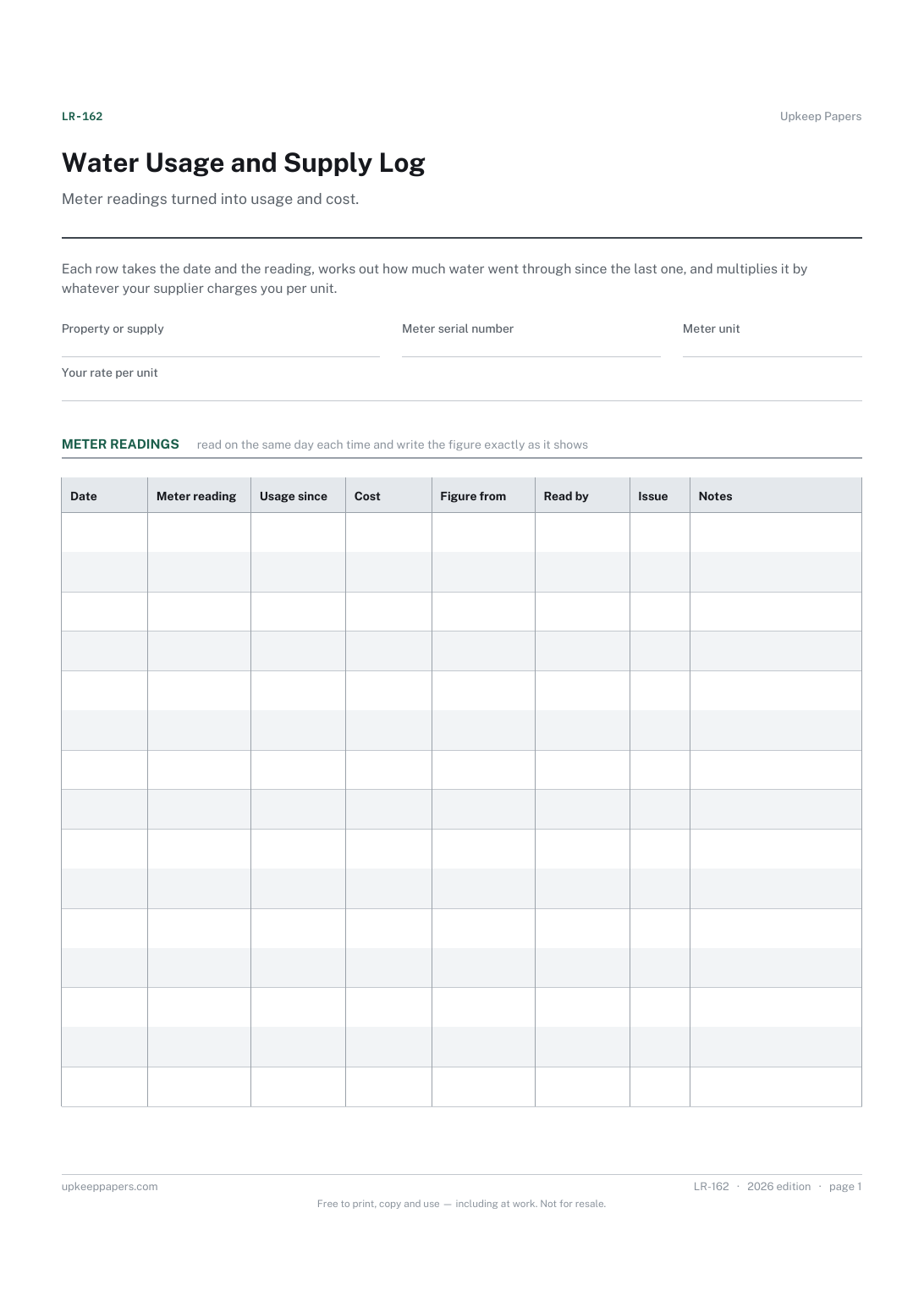
2 pages. The A4 and US Letter files are laid out identically, so neither is shrunk to fit.
Print it and write on it
Fillable PDF type and save
Spreadsheet formulas included
The fillable versions have real form fields — open them in any PDF reader, type into them and save. Printing help.
The same sheet, on screen. Totals and figures are worked out as you type, rows can be added or removed, and you can print it or download the completed version as a PDF. Everything stays in your browser — your entries are kept in this browser's own storage on this device, nothing is uploaded, and there is no account.
Meter readings turned into usage and cost. Each row takes the date and the reading, works out how much water went through since the last one, and multiplies it by whatever your supplier charges you per unit.
Households watching a bill, smallholdings and stables on a metered or borehole supply, landlords reading a meter between tenancies, and small premises checking their own consumption against what they are billed for.
The printable is laid out inside a box that fits both A4 and US Letter, so the two files are identical and neither one is scaled. The fillable PDF has real form fields. The workbook uses plain formulas only — SUM, IF, COUNTIF and the like — so it opens in Excel, LibreOffice and Google Sheets without anything breaking, and every calculated cell is grey so you can see which figures it worked out.
Download the A4 or US Letter file to match the paper in your printer, open it in a PDF reader and print at 100% — not "fit to page", which shrinks the writing space. Both files leave a 14 mm margin, which clears the unprintable edge on home printers. To print the online version with your entries in it, use the Print this sheet button, which prints only the sheet and none of the page around it. More on printing.
The one on your own bill, in the same unit your meter counts in. Rates differ by supplier, region and tariff and change over time, so none is supplied here. If your bill has a standing charge as well, add it in the notes rather than the rate.
Convert once, write the conversion in the notes area, and keep the log in a single unit. Mixing units halfway down a column is what makes these logs unusable later.
Yes. Anything with a counter works the same way: a reading, the gap since the last reading, and a cost if there is one. Leave the rate blank if the water costs nothing but the pumping.
The meter reading log covers several utilities side by side. This one is water only and goes further: usage between reads, cost at your rate, and a column for supply problems.
Which bills are due this month and on what day.
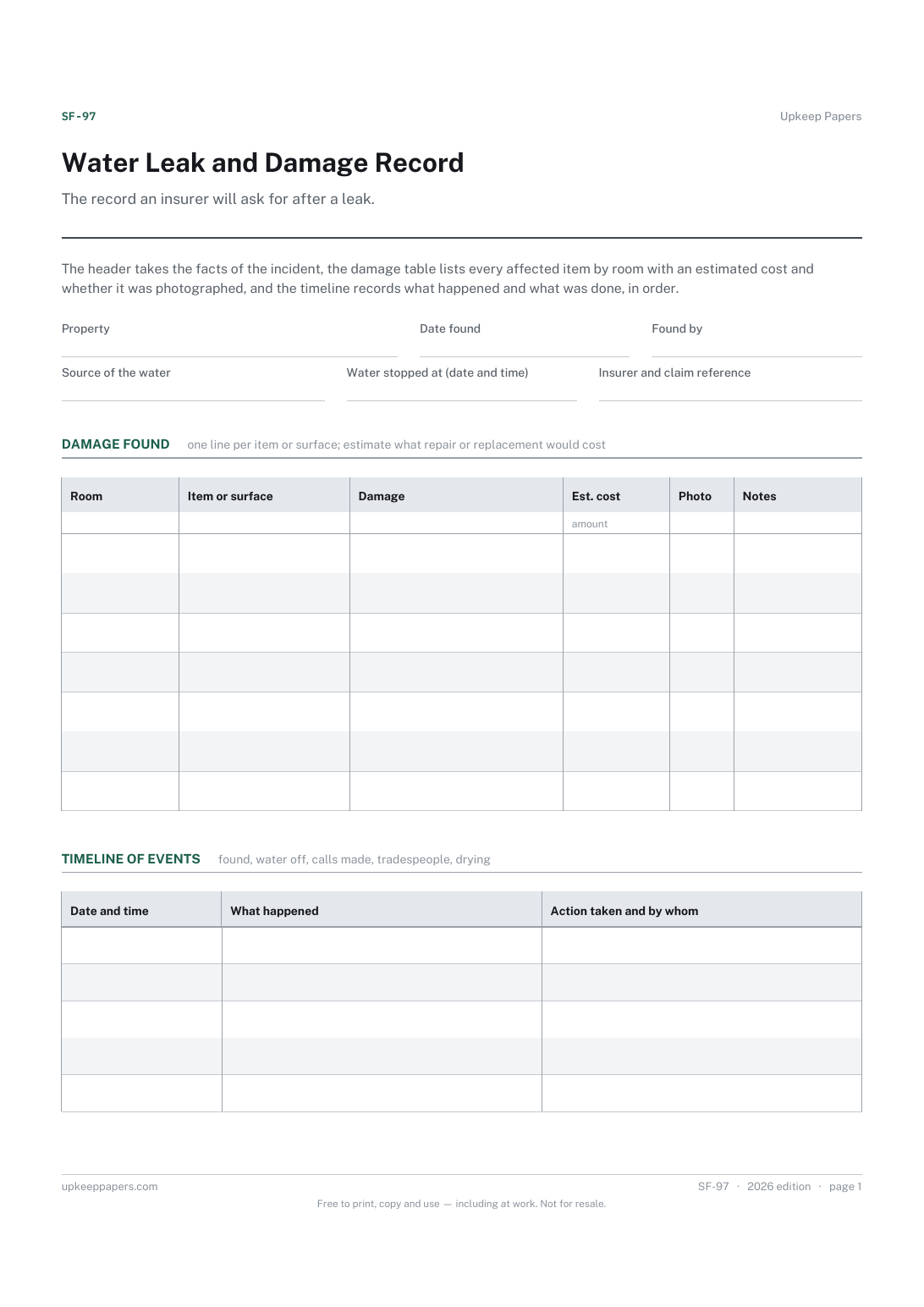
Every damaged item, room by room, with an estimate against each.
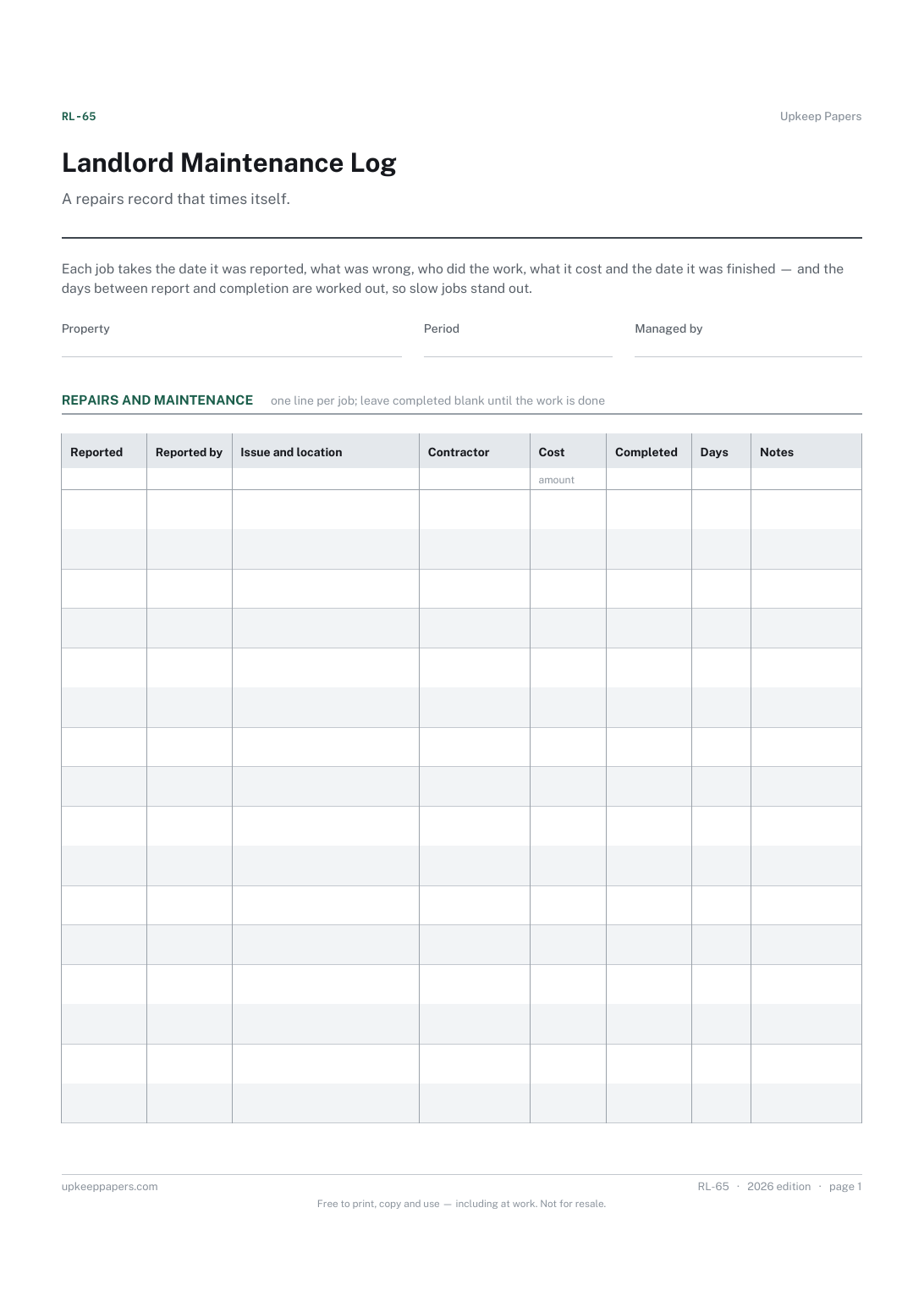
Every repair reported, dated, with who reported it.
Printable sheets, workbooks and tools on the same subject.
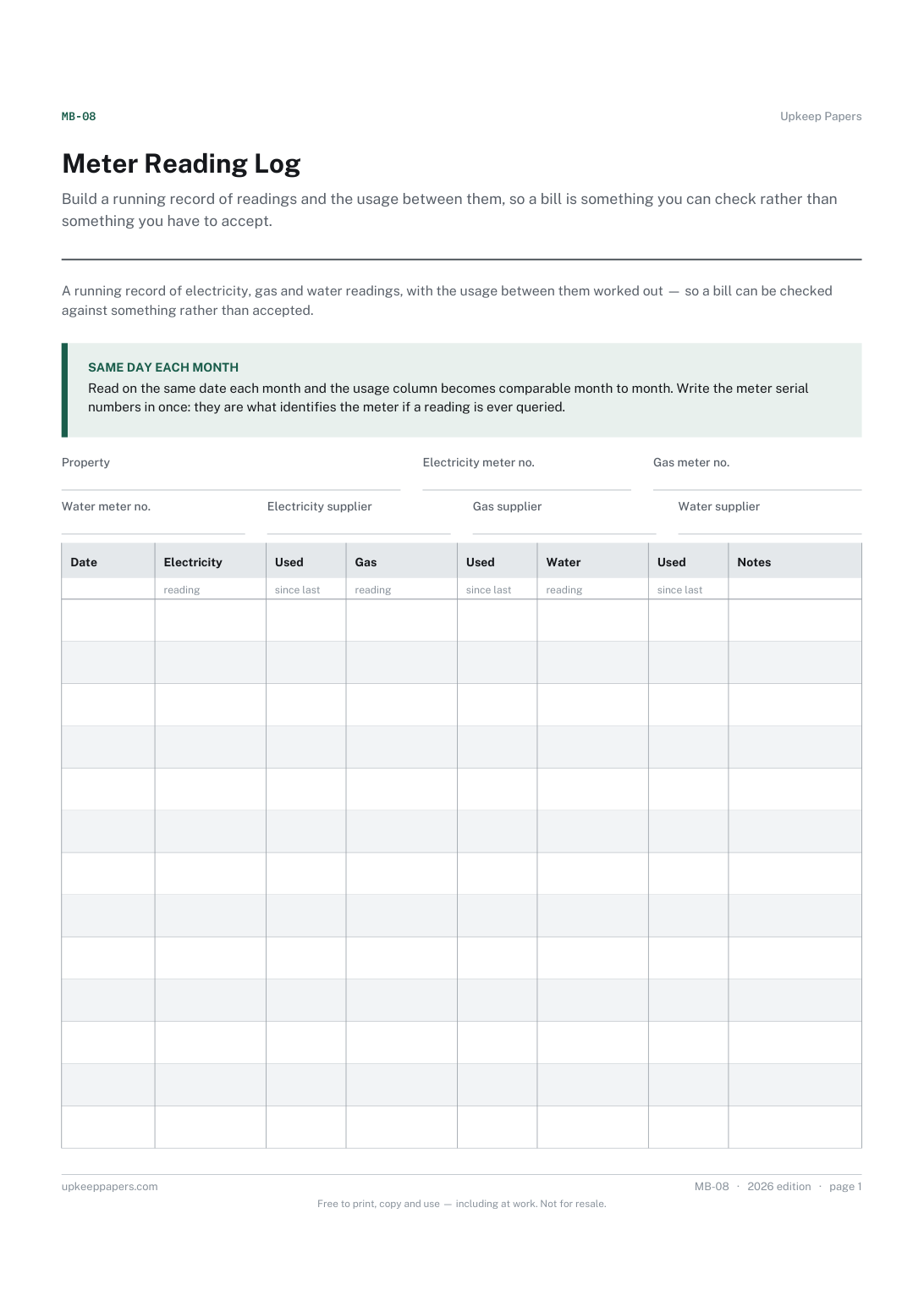
Build a running record of readings and the usage between them, so a bill is something you can check rather than something you have to accept.
Record the water round, which is the one daily job where a missed fault becomes an emergency within hours.
Meter readings turned into usage and cost per period, so a bill can be checked against what the meter actually did rather than taken on trust.

Every sheet, binder, game and puzzle on Upkeep Papers is free to download, with no email and no account. Making them is not free: each one takes days of research, design and checking, and the site costs money to run. If something here saved you time, you can buy us a coffee. It is entirely optional: nothing is locked, and nothing changes if you don’t.
Buy us a coffee Opens PayPal in a new tab. Any amount, and nothing changes if you would rather not.