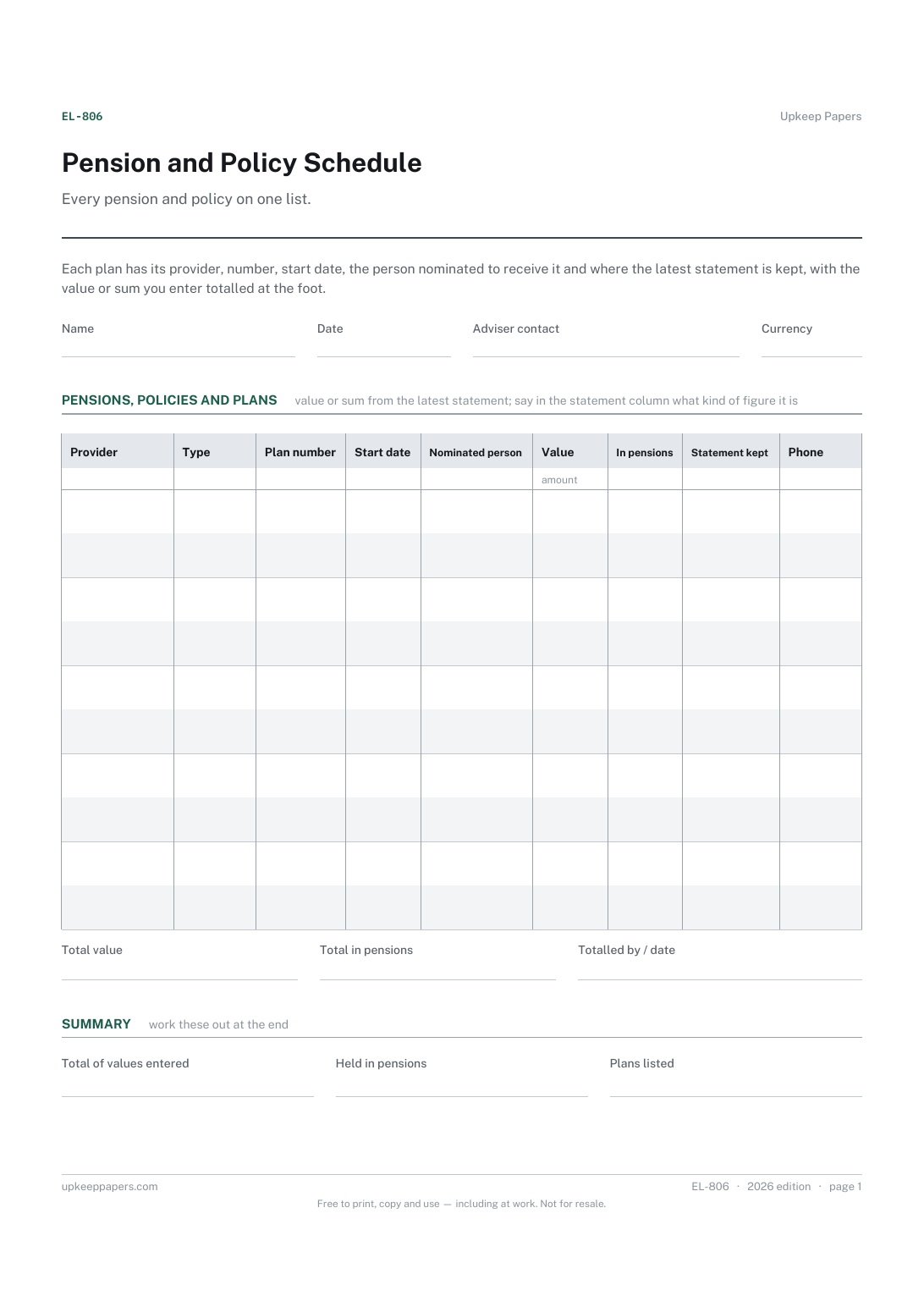
Pension and Policy Schedule
Every pension, life policy, endowment and similar plan in one place.
EL-806 Schedule PDF Excel Online
Everything here is free. Making it takes time and money. Everything here is free.
 Buy us a coffee
Estate and Legacy Planning · EL-805 · Record
Free assets and liabilities schedule: everything owned and owed, sole or joint, totalled to a net figure from your own values. Excel, PDF and browser.
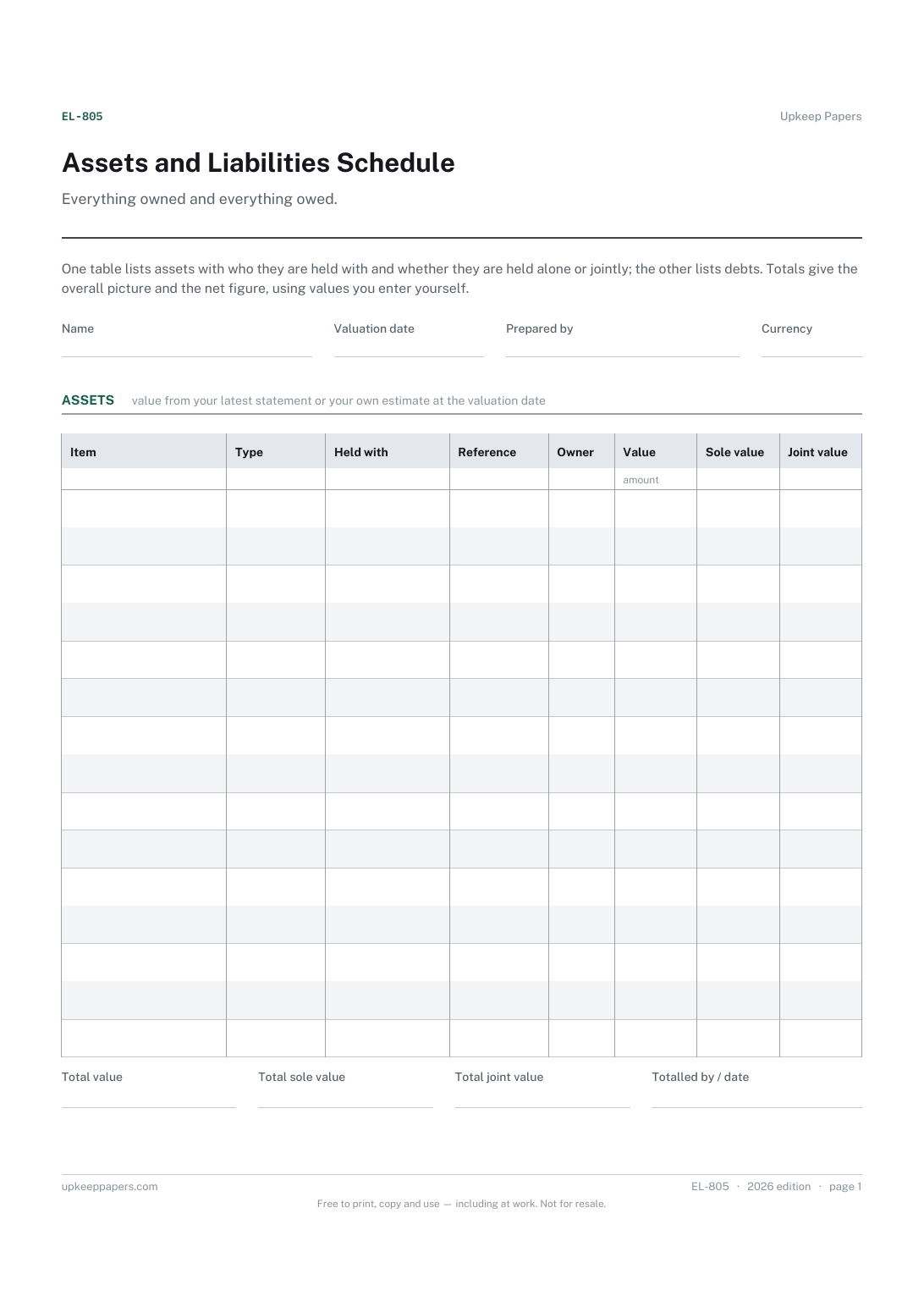
2 pages. The A4 and US Letter files are laid out identically, so neither is shrunk to fit.
Print it and write on it
Fillable PDF type and save
Spreadsheet formulas included
The fillable versions have real form fields — open them in any PDF reader, type into them and save. Printing help.
The same sheet, on screen. Totals and figures are worked out as you type, rows can be added or removed, and you can print it or download the completed version as a PDF. Everything stays in your browser — your entries are kept in this browser's own storage on this device, nothing is uploaded, and there is no account.
Everything owned and everything owed. One table lists assets with who they are held with and whether they are held alone or jointly; the other lists debts. Totals give the overall picture and the net figure, using values you enter yourself.
People putting their affairs in order who want one clear picture of their finances, and executors building the list of an estate from statements and letters.
The printable is laid out inside a box that fits both A4 and US Letter, so the two files are identical and neither one is scaled. The fillable PDF has real form fields. The workbook uses plain formulas only — SUM, IF, COUNTIF and the like — so it opens in Excel, LibreOffice and Google Sheets without anything breaking, and every calculated cell is grey so you can see which figures it worked out.
Download the A4 or US Letter file to match the paper in your printer, open it in a PDF reader and print at 100% — not "fit to page", which shrinks the writing space. Both files leave a 14 mm margin, which clears the unprintable edge on home printers. To print the online version with your entries in it, use the Print this sheet button, which prints only the sheet and none of the page around it. More on printing.
From you: the latest statement, a valuation you have obtained or your own estimate. The sheet supplies nothing. Using the same valuation date for every line makes the totals mean something.
Because jointly held assets may be treated differently from those in one name when an estate is dealt with. The rules differ by country and by type of ownership, so check the rules where you are; the sheet simply keeps the two apart.
Put the home's value in assets and the mortgage balance in liabilities. The net figure then reflects both. The property and valuables schedule goes into more detail on property if you need it.
A net worth tracker follows the figure over months. This schedule is a snapshot at one date, with the references and ownership an executor needs, and is meant to sit in the affairs folder.
Every pension, life policy, endowment and similar plan in one place.
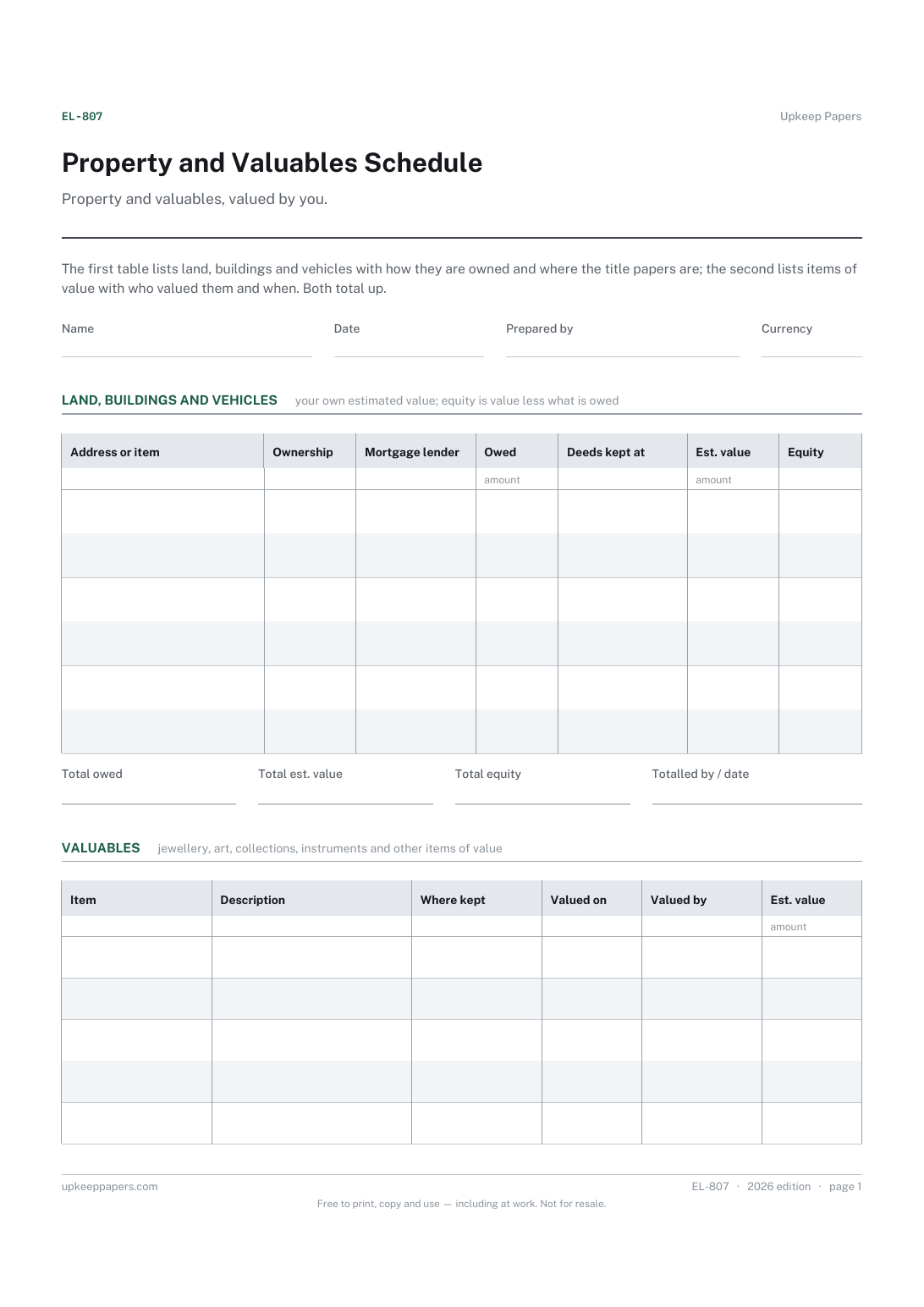
Each property or vehicle, how it is owned and where its papers are kept.
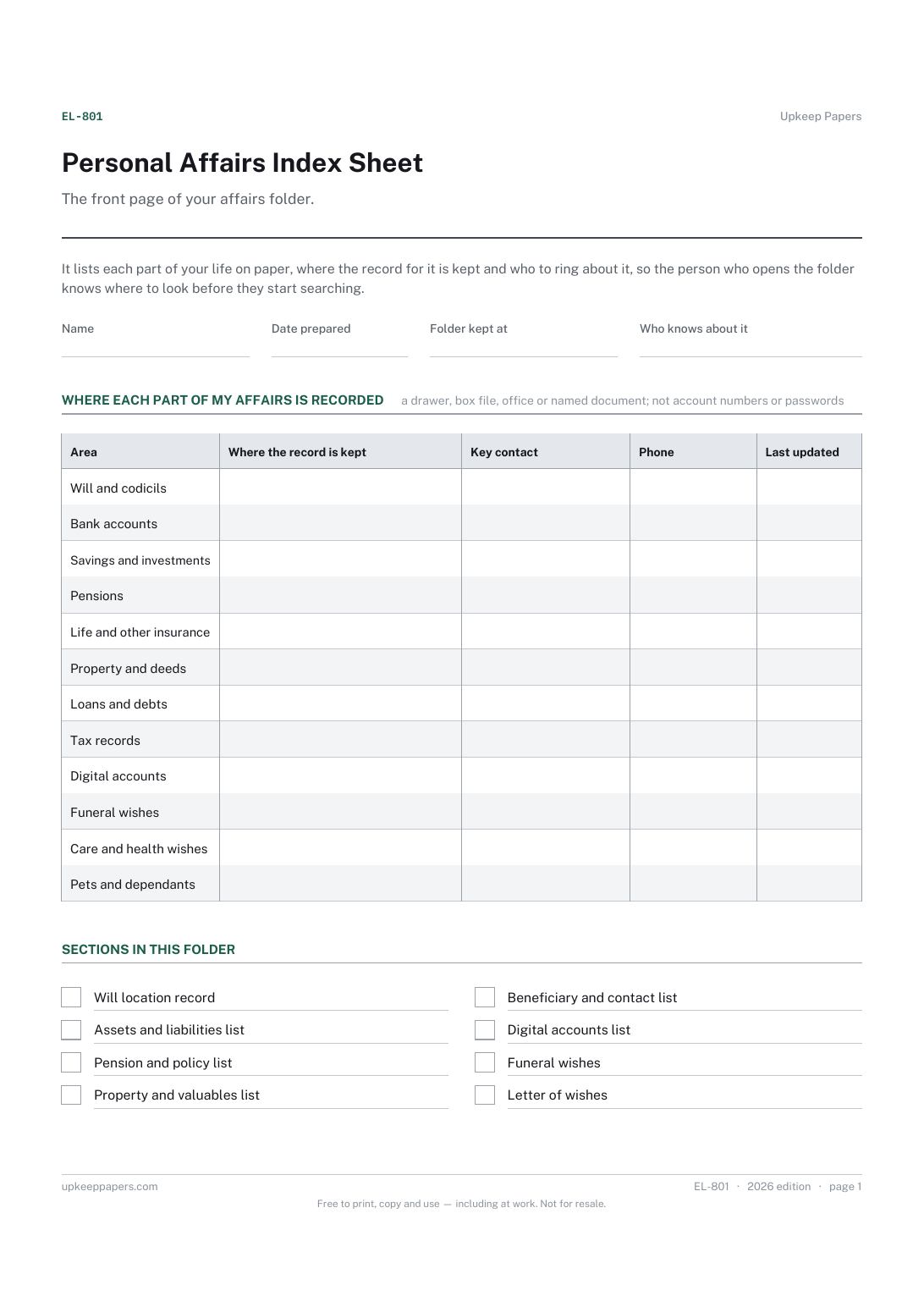
Where the folder itself is kept and who knows it exists.
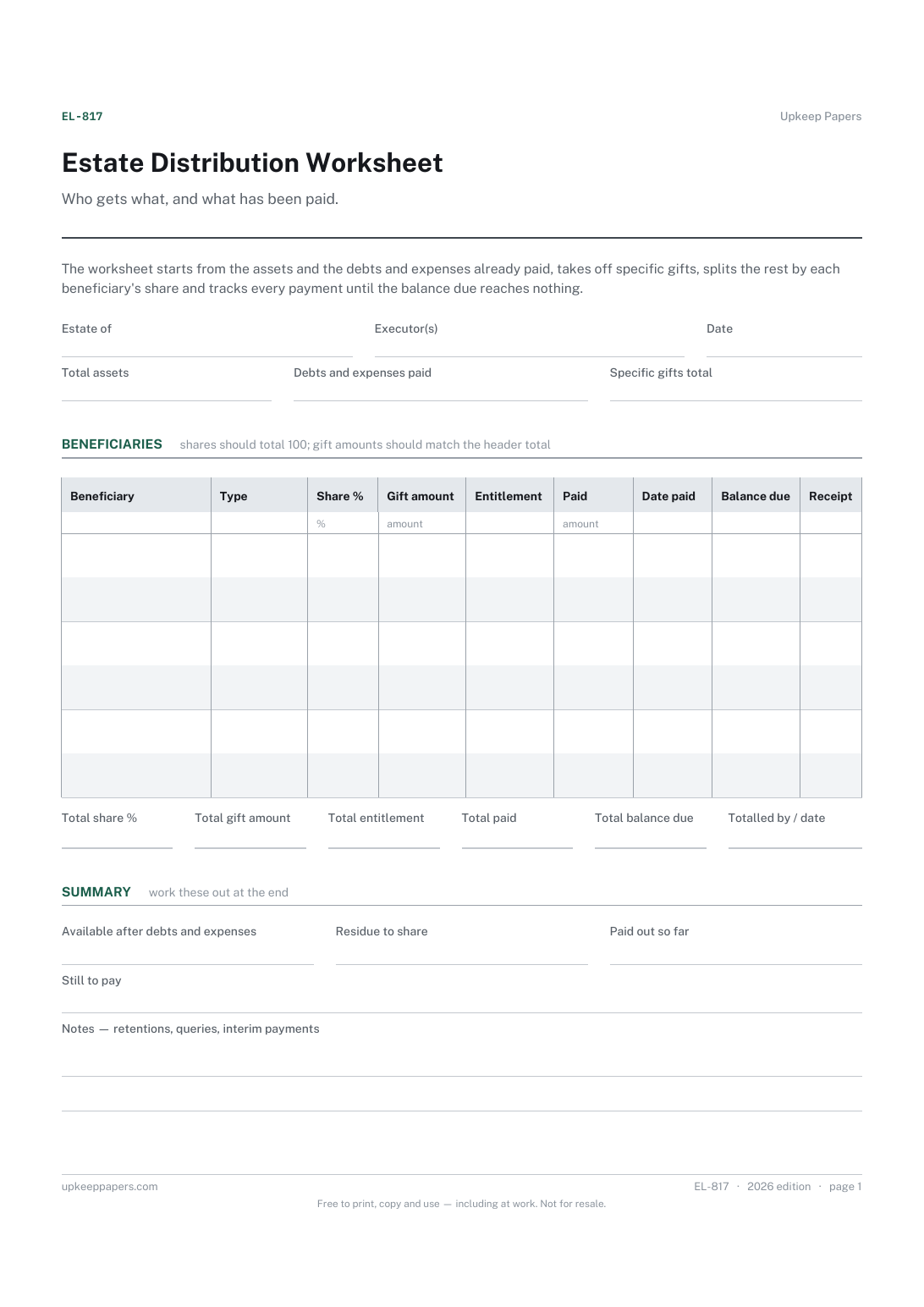
The total assets, debts and expenses, and what is left to distribute.
Printable sheets, workbooks and tools on the same subject.
Everything you own on one side, everything you owe on the other, and the difference tracked month by month so the direction of travel is visible.

Every sheet, binder, game and puzzle on Upkeep Papers is free to download, with no email and no account. Making them is not free: each one takes days of research, design and checking, and the site costs money to run. If something here saved you time, you can buy us a coffee. It is entirely optional: nothing is locked, and nothing changes if you don’t.
Buy us a coffee Opens PayPal in a new tab. Any amount, and nothing changes if you would rather not.