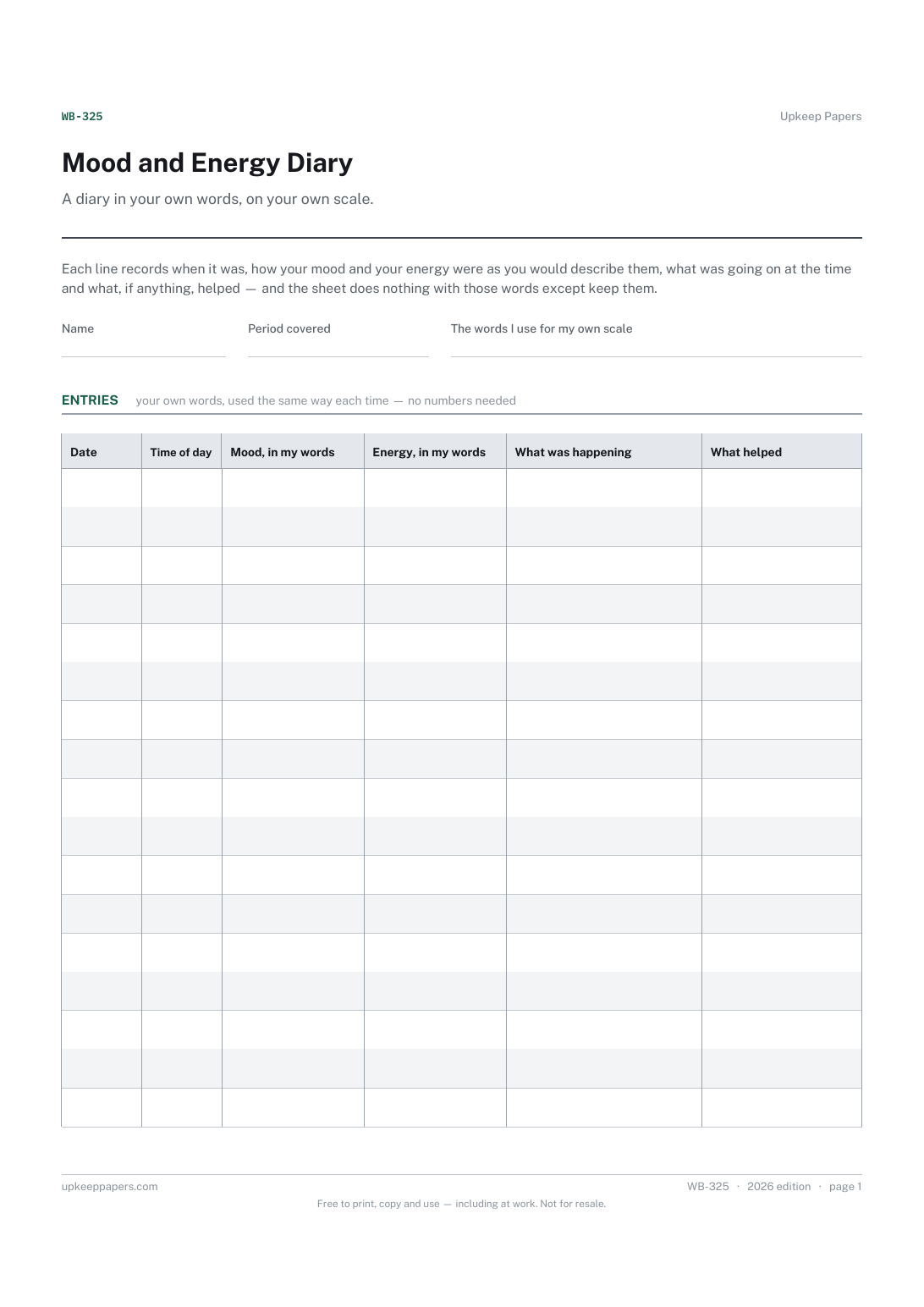
Mood and Energy Diary
Mood and energy at different times of the day, described the way you describe them.
WB-325 Log PDF Online
Everything here is free. Making it takes time and money. Everything here is free.
 Buy us a coffee
Wellbeing and habits · WB-326 · Log
Free printable sleep diary — to bed, lights out, woke, up, your own estimate of hours asleep, times woke and how you felt, averaged. PDF, Excel and browser.
2 pages. The A4 and US Letter files are laid out identically, so neither is shrunk to fit.
Print it and write on it
Fillable PDF type and save
Spreadsheet formulas included
The fillable versions have real form fields — open them in any PDF reader, type into them and save. Printing help.
The same sheet, on screen. Totals and figures are worked out as you type, rows can be added or removed, and you can print it or download the completed version as a PDF. Everything stays in your browser — your entries are kept in this browser's own storage on this device, nothing is uploaded, and there is no account.
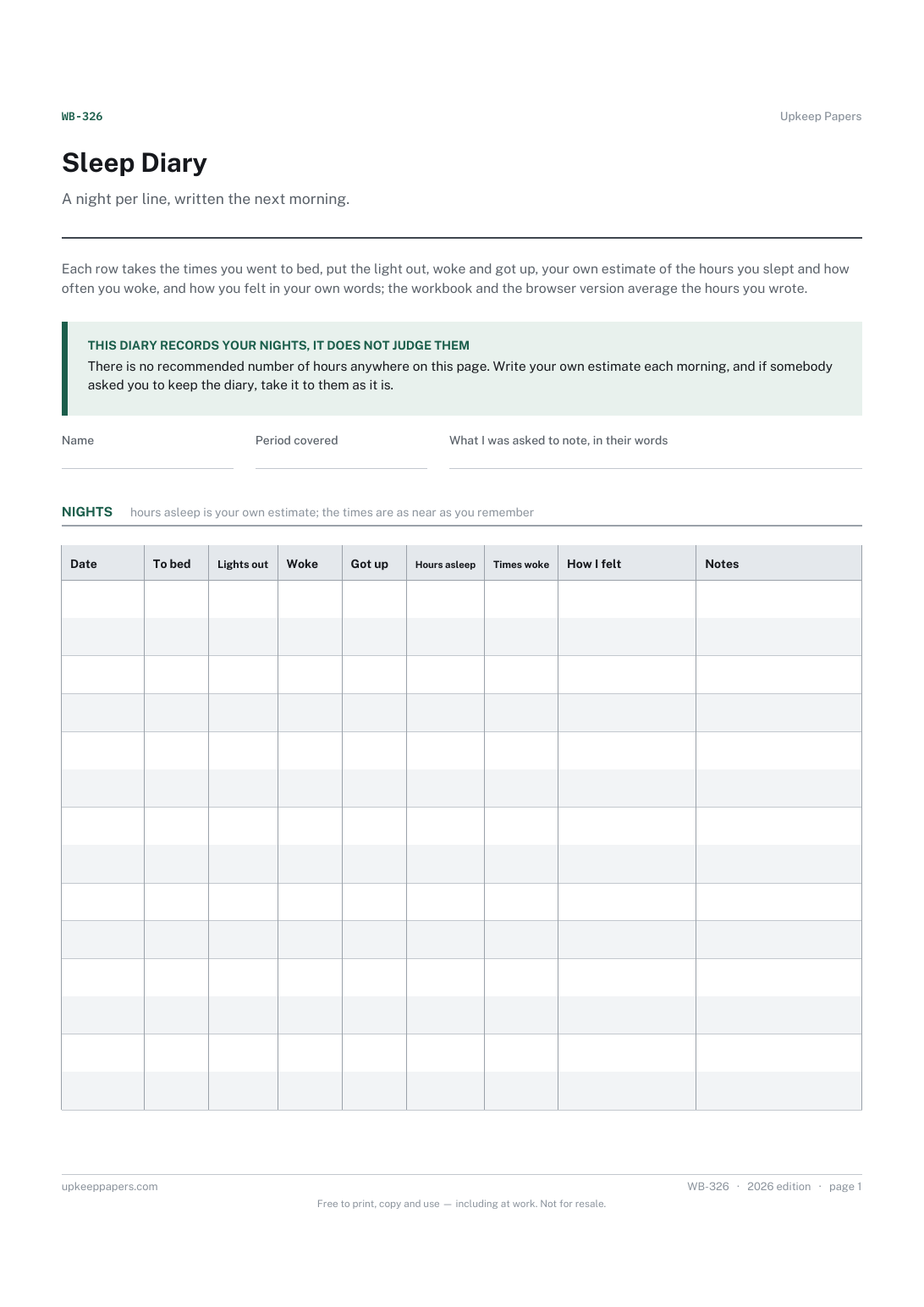
A night per line, written the next morning. Each row takes the times you went to bed, put the light out, woke and got up, your own estimate of the hours you slept and how often you woke, and how you felt in your own words; the workbook and the browser version average the hours you wrote.
Anyone who has been asked to keep a sleep diary before an appointment, people whose nights have gone wrong and who want to see the shape of it, shift workers, new parents and anyone curious whether a bad week was as bad as it felt.
The printable is laid out inside a box that fits both A4 and US Letter, so the two files are identical and neither one is scaled. The fillable PDF has real form fields. The workbook uses plain formulas only — SUM, IF, COUNTIF and the like — so it opens in Excel, LibreOffice and Google Sheets without anything breaking, and every calculated cell is grey so you can see which figures it worked out.
Download the A4 or US Letter file to match the paper in your printer, open it in a PDF reader and print at 100% — not "fit to page", which shrinks the writing space. Both files leave a 14 mm margin, which clears the unprintable edge on home printers. To print the online version with your entries in it, use the Print this sheet button, which prints only the sheet and none of the page around it. More on printing.
This sheet does not say, and carries no recommended figure anywhere. The only numbers on it are the ones you write, and what they mean for you is a question for whoever you see about your sleep, not for a template.
No. The hours column is your own estimate, and the times are as near as you can remember. A diary of honest guesses is what most people are asked to keep; if you have a device, you can copy its figure in and say so in the notes.
It is the average of the hours you wrote, over the rows on the sheet. It is a description of your own entries and nothing more — the sheet does not compare it with anything.
Yes, and it is worth saying so in the notes, because what a partner saw and what you remember are both useful and not always the same.
Mood and energy at different times of the day, described the way you describe them.
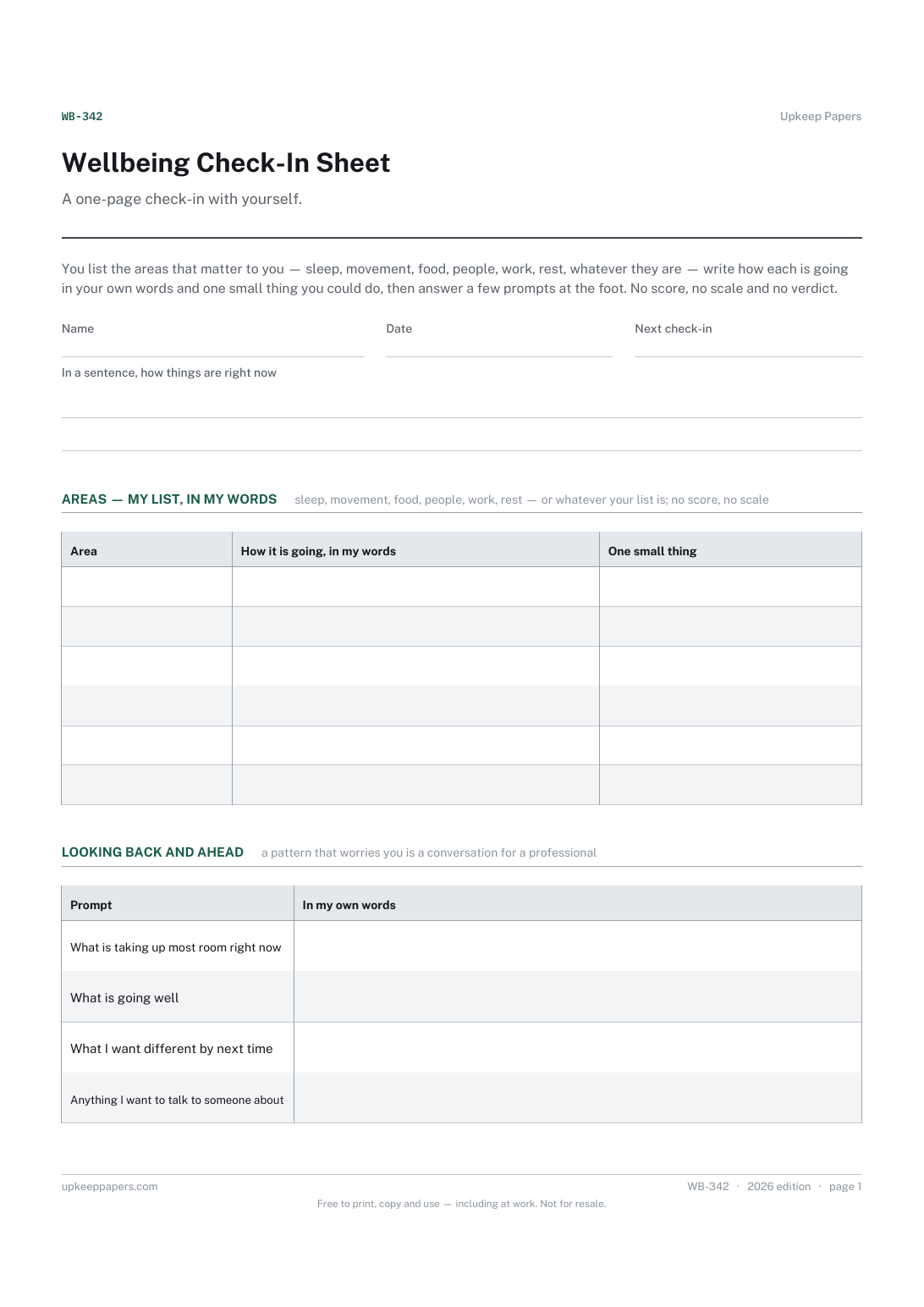
The areas of your life you decide to look at, in your own list.
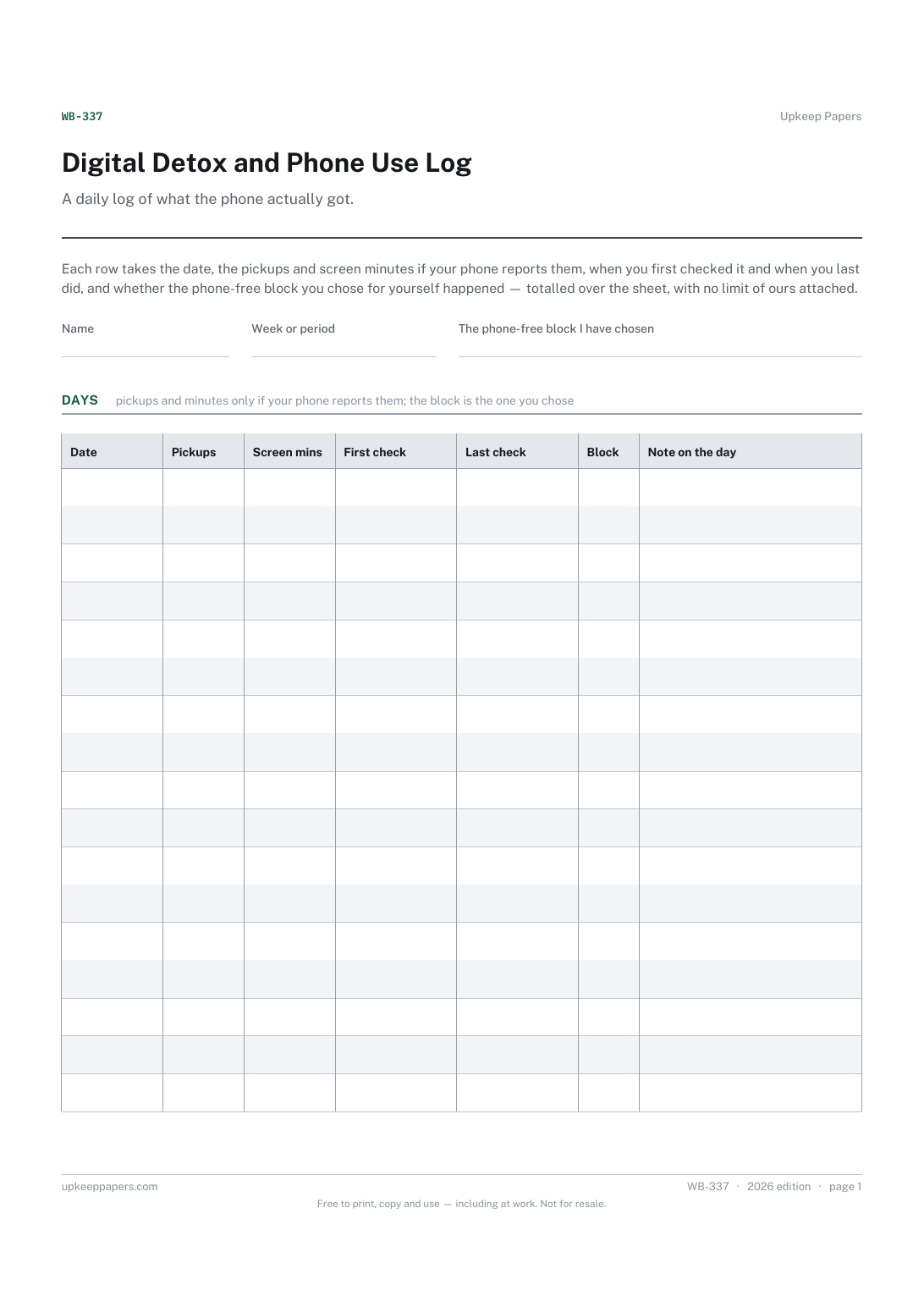
Pickups and screen minutes each day, copied from what the phone reports.
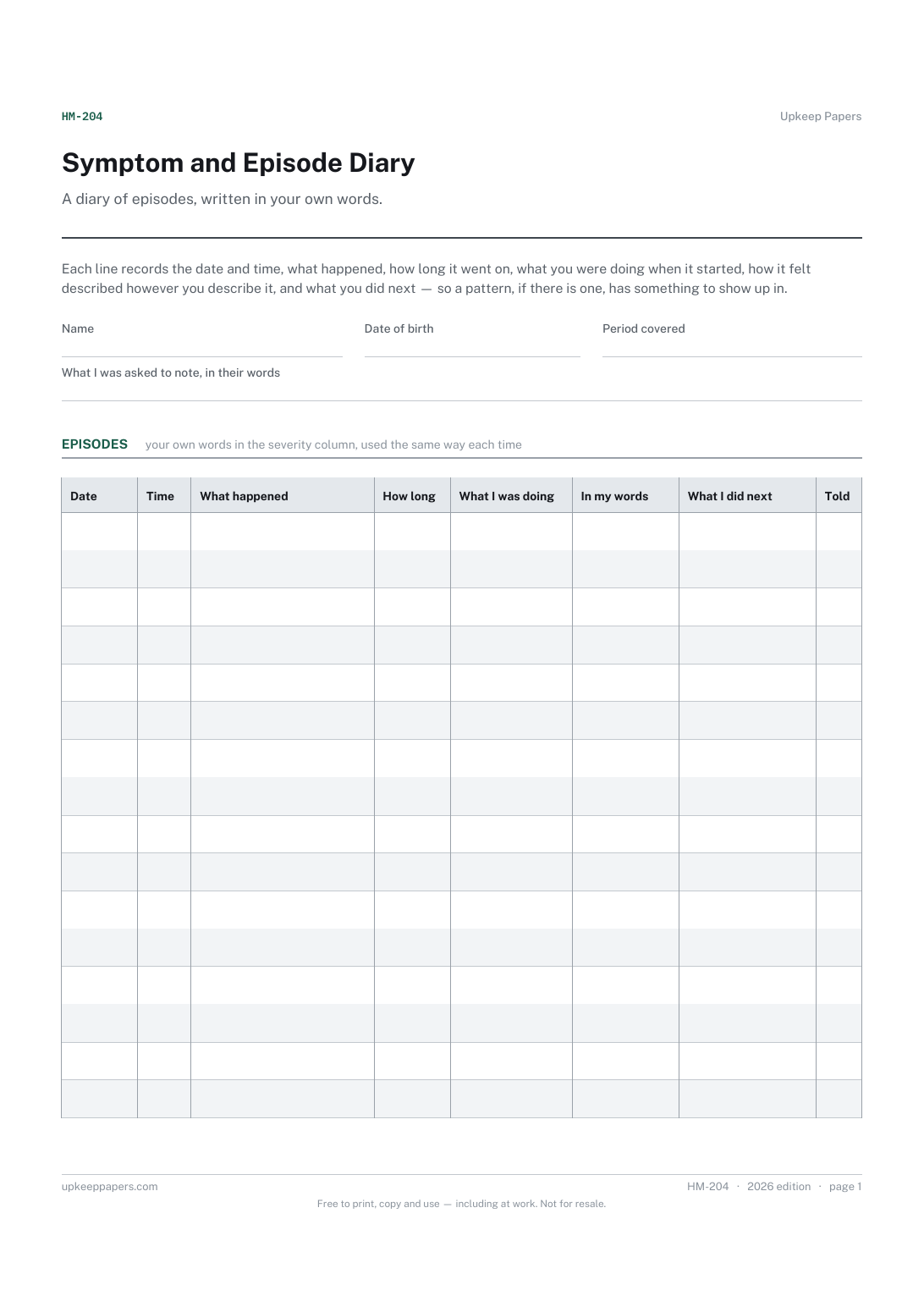
What happened and when, written close to the time rather than remembered later.
Printable sheets, workbooks and tools on the same subject.
Keep observations and conclusions in separate columns, which is what makes a record useful when somebody else reads it back.

Every sheet, binder, game and puzzle on Upkeep Papers is free to download, with no email and no account. Making them is not free: each one takes days of research, design and checking, and the site costs money to run. If something here saved you time, you can buy us a coffee. It is entirely optional: nothing is locked, and nothing changes if you don’t.
Buy us a coffee Opens PayPal in a new tab. Any amount, and nothing changes if you would rather not.