Care Equipment and Aids Record
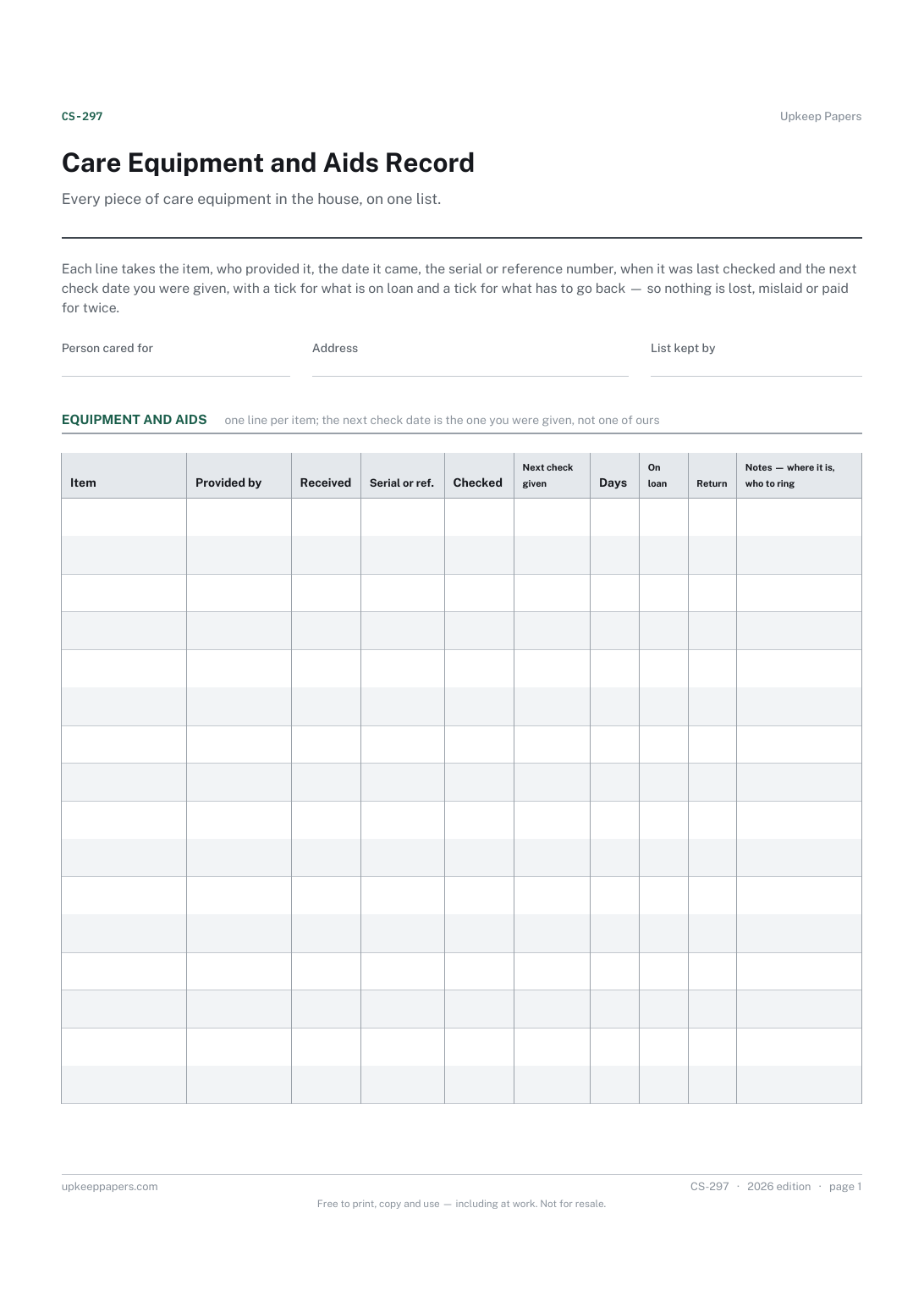
What equipment is in the house and where each item came from.
CS-297 Record PDF Excel Online
Everything here is free. Making it takes time and money. Everything here is free.
 Buy us a coffee
Care and support records · CS-285 · Record
Free printable mobility and transfer record — how the person moves, what they use, how many people help and what the assessment said. PDF and browser versions.
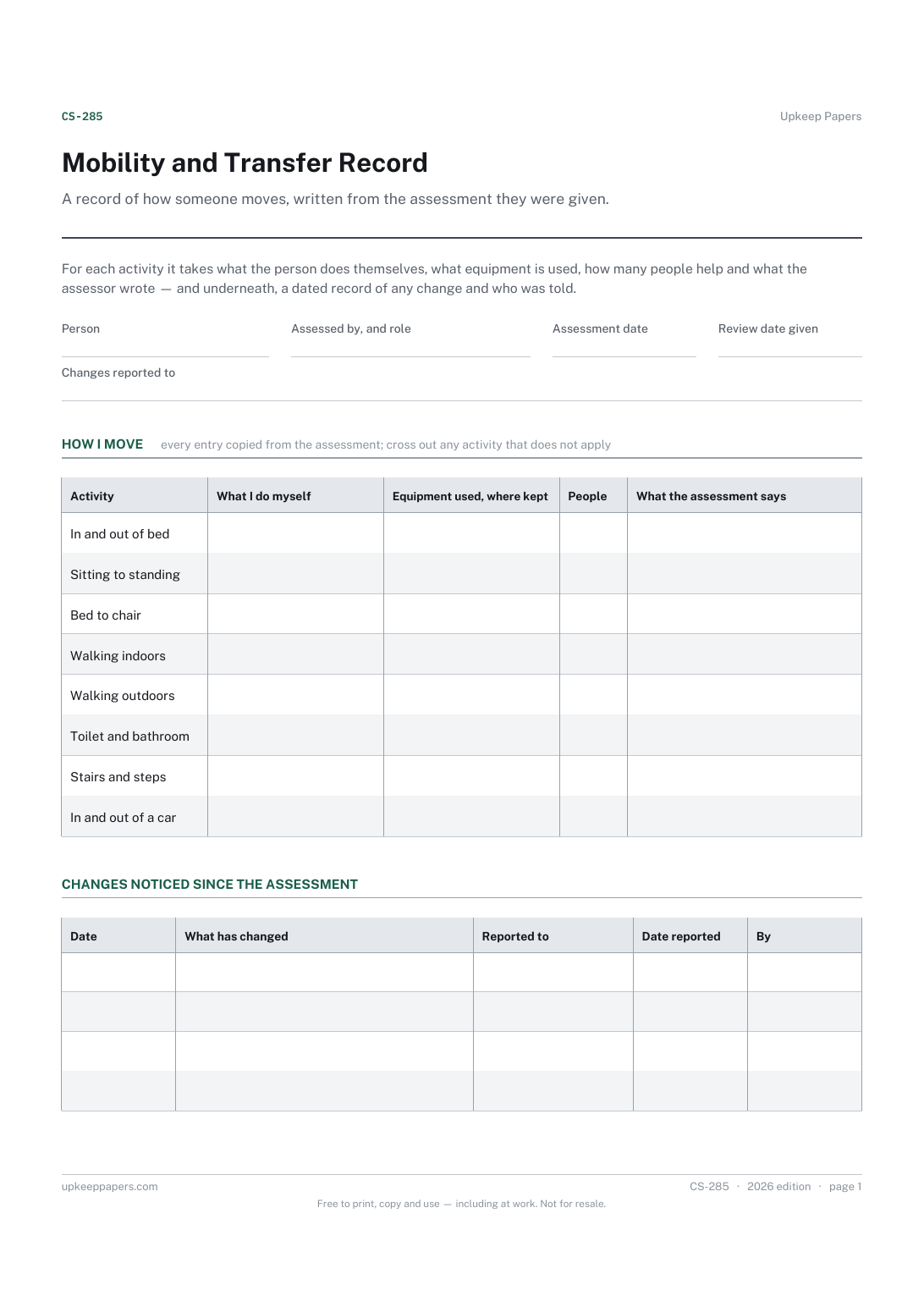
One page. The A4 and US Letter files are laid out identically, so neither is shrunk to fit.
Print it and write on it
Fillable PDF type and save
Or no download needed
Fill it in onlineThe fillable versions have real form fields — open them in any PDF reader, type into them and save. Printing help.
The same sheet, on screen. Tick, type, add or remove rows, then print it or download the completed version as a PDF. Everything stays in your browser — your entries are kept in this browser's own storage on this device, nothing is uploaded, and there is no account.
A record of how someone moves, written from the assessment they were given. For each activity it takes what the person does themselves, what equipment is used, how many people help and what the assessor wrote — and underneath, a dated record of any change and who was told.
Carers and families following an assessment made by a physiotherapist, occupational therapist or moving and handling assessor, agencies keeping a copy in the home, and anyone who needs a new carer to know on day one how the person gets from bed to chair.
The printable is laid out inside a box that fits both A4 and US Letter, so the two files are identical and neither one is scaled. The fillable PDF has real form fields. The online version keeps what you enter in your own browser and builds the completed PDF on your device.
Download the A4 or US Letter file to match the paper in your printer, open it in a PDF reader and print at 100% — not "fit to page", which shrinks the writing space. Both files leave a 14 mm margin, which clears the unprintable edge on home printers. To print the online version with your entries in it, use the Print this sheet button, which prints only the sheet and none of the page around it. More on printing.
No. It contains no technique, no method and no limit of any kind. Everything in it is copied from the assessment the person was given, and the person who made that assessment is the one to ask about how a move is done.
The record is built to hold what an assessment says. Without one, write what the person tells you about how they move and say so plainly at the top, and ask whoever arranged the care about an assessment.
Anything different from what the assessment describes: a move that has become harder or easier, equipment that has changed, a near miss. Write it down with the date and who you told; the sheet does not decide what it means.
Because a new carer arriving alone needs to know at once whether that is how the move is meant to be done. The figure is the one in the assessment, not one of ours.
What equipment is in the house and where each item came from.
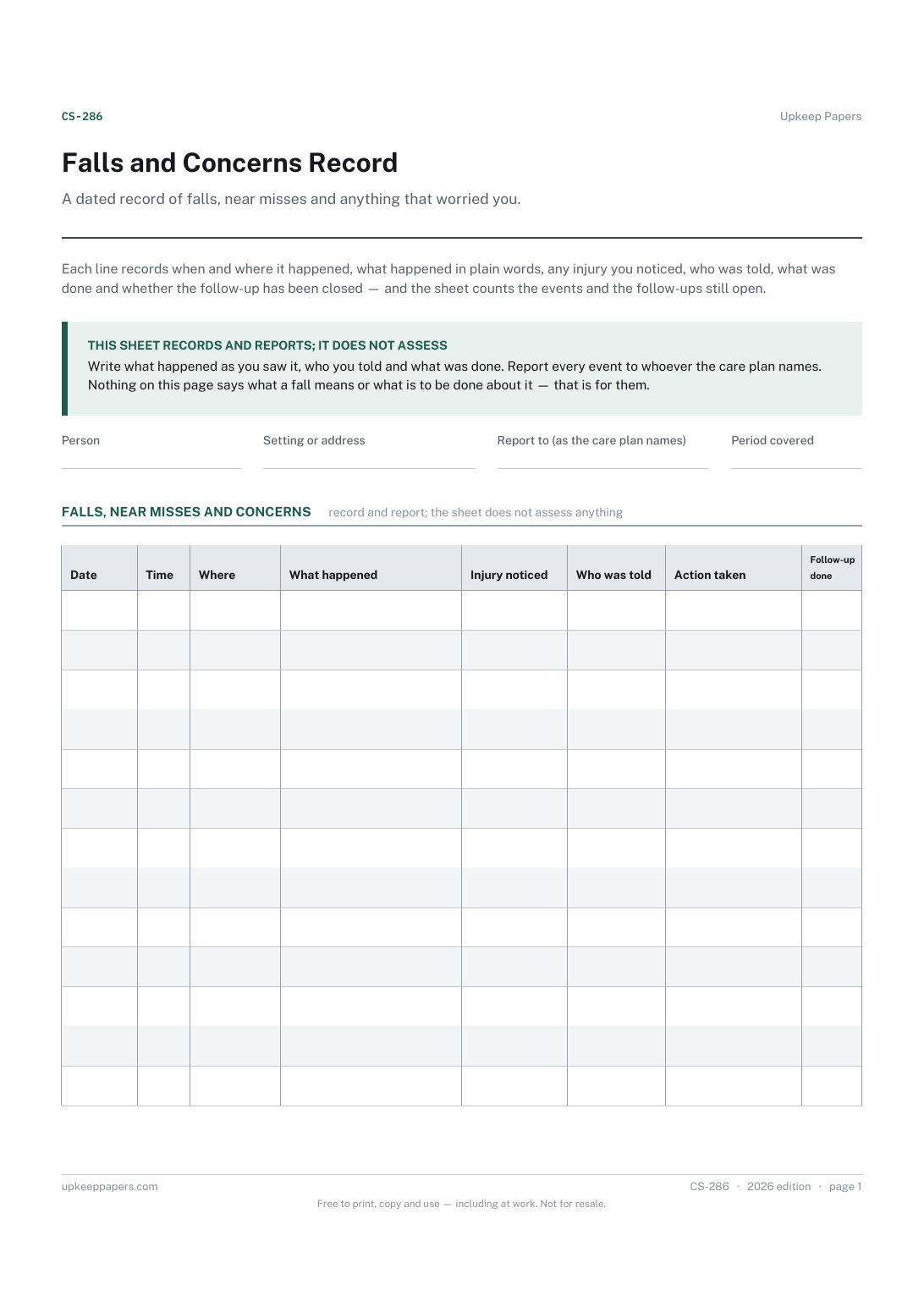
Every fall, near miss or concern with the date, time and place.
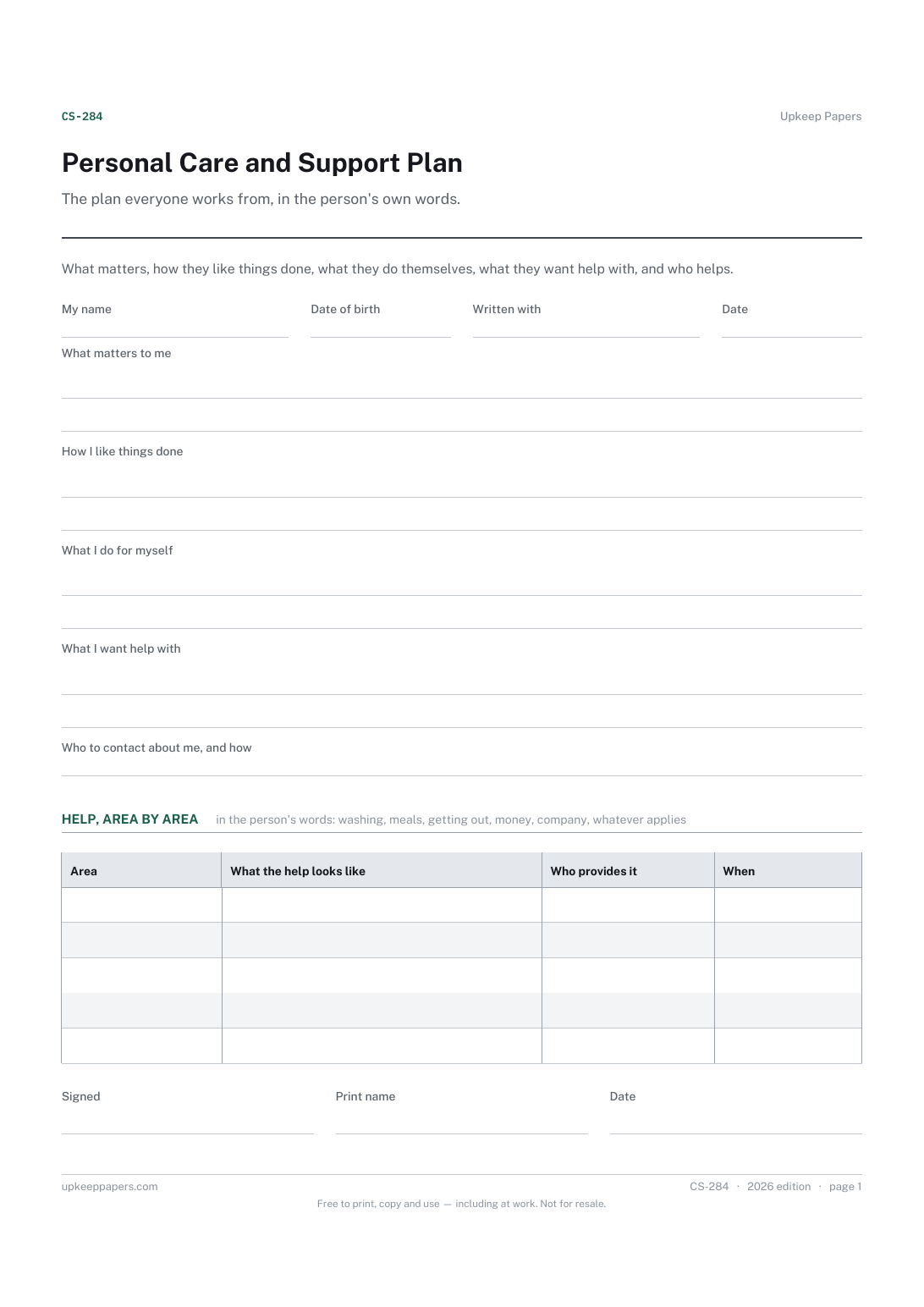
What matters to the person, in their own words.
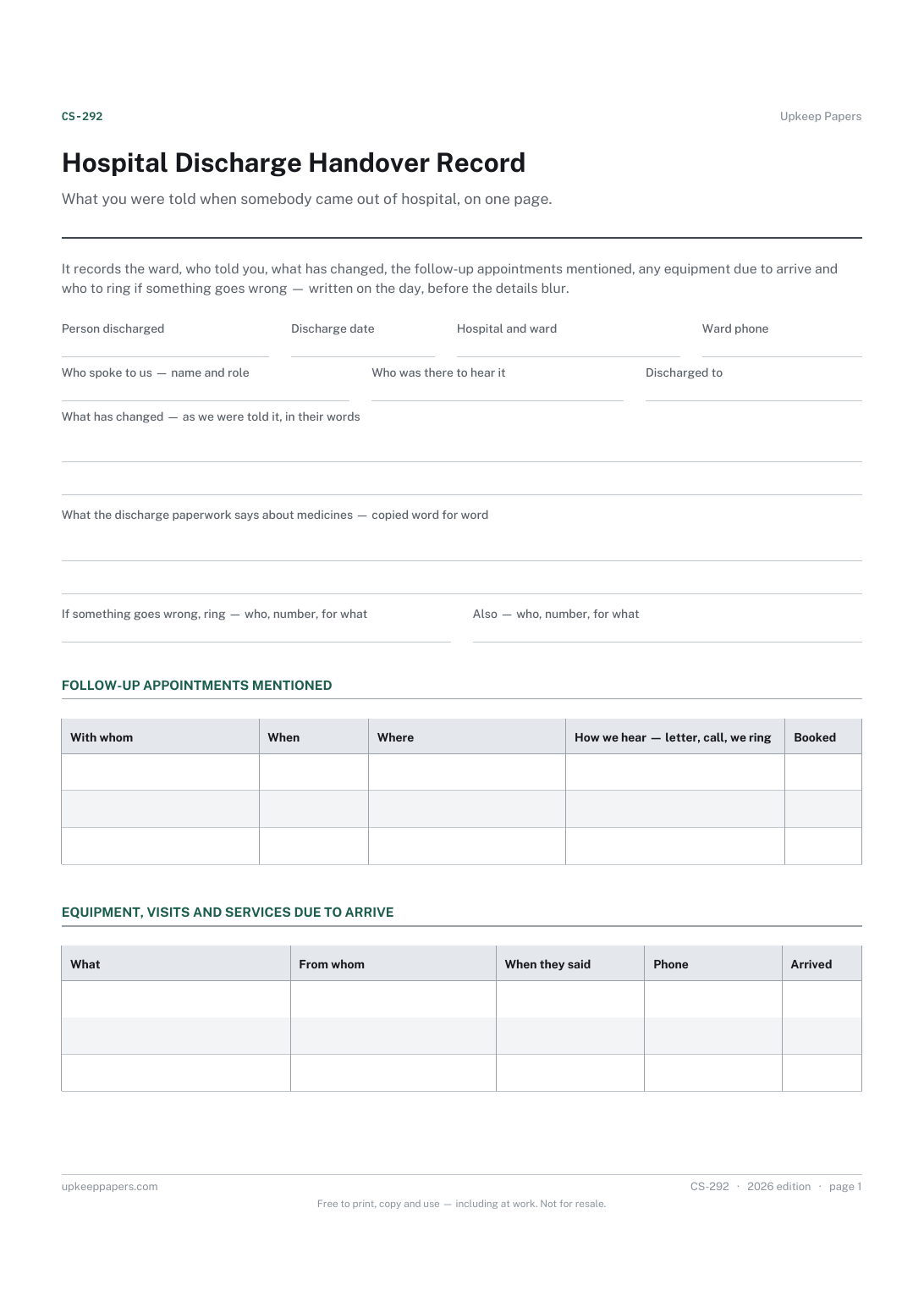
Which ward, which hospital and who to ring back with a question.

Every sheet, binder, game and puzzle on Upkeep Papers is free to download, with no email and no account. Making them is not free: each one takes days of research, design and checking, and the site costs money to run. If something here saved you time, you can buy us a coffee. It is entirely optional: nothing is locked, and nothing changes if you don’t.
Buy us a coffee Opens PayPal in a new tab. Any amount, and nothing changes if you would rather not.